Board of Trustees, Change Programme, Financial issues, Governance

Openness, [REDACTED] & [REDACTED]

Peter Harvey posts….

We look to do the right thing in an honest, fair and responsible way through appreciating others’ opinions, viewpoints, thoughts and ideas so that we build strong and trusting relationships. 

We keep people informed through clear, open and honest communication.

These two statements are taken from the BPS’s 2024 Strategy document [see https://cms.bps.org.uk/sites/default/files/2024-01/BPS%20Strategy%202024_0.pdf]. Along with a whole collection of vacuous feel-good, virtue-signalling, management-speak phrases the commitment to openness appears on the very first page of the document. It must be important then.

But, in a phrase much used by my old head of department, the late Bill Trethowan (yes, for those of you with long memories, that Trethowan) when testing for thought disorder “Fine words butter no parsnips”. How do these fine words translate into behaviour?

If we take the latest minutes of the Board of Trustees (BoT) [note: access to these on the BPS website is restricted to members, so I have included screenshots of the relevant sections]. These were published around the middle of March 2024 and refer to the meeting held in November 2023. Two things to note here – the long gap between meetings of the BoT as well as the delay in publishing them. We have pointed out previously that the BPS is undergoing serious financial problems and we are aware that a number of staff have been/are being made redundant (we can say no more than that because the BPS has been completely silent on this critically important matter). It comes as something of a surprise that at a time of such serious financial pressures there were not more meetings. And, by the way, don’t bother trying to find anything in The Psychologist. As ever, it shows absolutely no interest in keeping the membership informed about anything to do with the management of the BPS – not enough opportunity for virtue signalling I would guess.

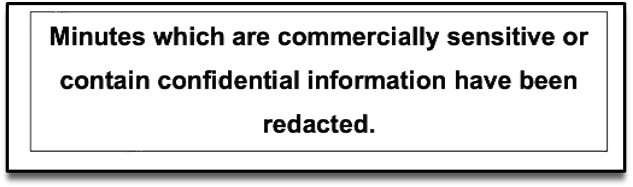
You might imagine, as a member of an organisation that you pay for, you might be able to see just how your money is being spent. Please add your own hollow laugh at this point. At the top of the BoT minutes the following appears:

I can fully appreciate the need for redacting information that relates to individuals – so far, so understandable. But the phrase “…commercially sensitive…”  is a bit more problematic. Correct me if I’m wrong but the BPS is a membership organisation and a charity – it is not a business. I accept that the organisation should be run in a business-like manner, ensure that income is at least equal to expenditure.  So far, so GCSE Business Studies. If the BPS were a company in the commercial sector where activist shareholders or predatory asset strippers prowl in the shadows, keeping your accounts under wraps is understandable. Could this be true of the BPS? Is the Royal College of Psychiatrists about to make a hostile take-ever bid? Perhaps Stonewall want a new identity and is looking to the BPS (on second thoughts, some recent pronouncements from a BPS Officer suggests that has already happened)? Is the BPS in such robust good health financially that a sanctioned oligarch sees the opportunity to launder their ill-gotten gains through  a ‘respectable’ UK organisation? (To borrow from Private Eye – That’s enough, Ed). 

I think not, m’lud. In truth, the BPS is a completely unattractive proposition for any potential buyer (perhaps we should run a competition – devise a sales prospectus as if for floating a company) – unless Del Trotter might be interested, of course.

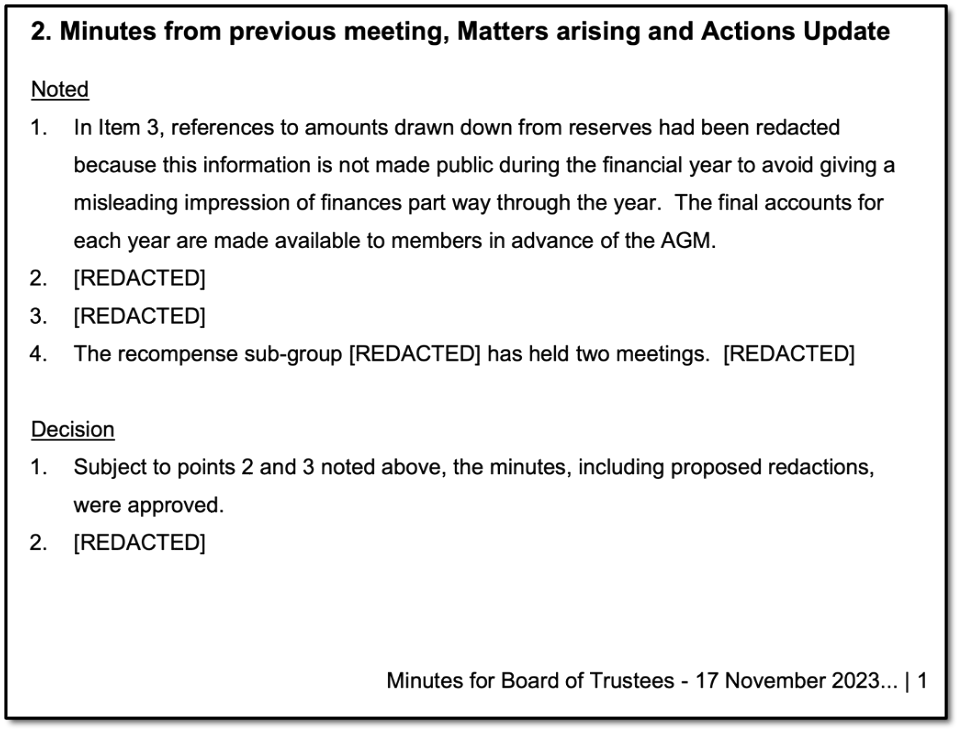
Back to reality. The statement above is played out in practice….

What an interesting phrase “..giving a misleading impression…”. I leave it up to you, the reader, to make what you will of it. In all, there are 16 redactions.

Perhaps the BoT needs to be reminded of some important things:

  1. The money is not theirs, nor the Senior Management Team’s. It is extracted from the members to pay for services.
  2. Members have a right to know how that money is spent.
  3. Trustees – acting on behalf of the fee-paying membership – have a duty under the law to ensure that “…your charity’s money is safe, properly used and accounted for. Every trustee has to do this…” [https://www.gov.uk/guidance/managing-charity-finances].

How can members, either indirectly through the Trustees or directly as an individual member, find out if their money is being spent wisely, if all the relevant information is withheld? This is made all the more difficult by reference to the following statement (again from the November BoT minutes: (under 8. AOB, noted 3)…

I refer you back to the statements at the start of this post. Can anyone explain to me how the extracts above square with these?

Now I am sure that the BPS will argue that it follows due process by publishing fully audited accounts for the membership at the AGM. Of course they do, for otherwise the Charity Commission would be sniffing around (again!). But for those hardy souls who choose to plough through all 48 pages of the last consolidated financial statements there are two things to note: (1) that they are anything but recent (they only cover the year up to 31 December 2022); and (2) they have all the detail and clarity of a political party’s election promises. For example, try to find out how much was spent on legal fees and external consultancies (if you find it, please let me know). Up-to-date information about finances is (or should be) available to the BoT and the SMT (although if our experience with the much vaunted £6 million Change Programme is anything to go by I wouldn’t guarantee that). Surely it is possible to able to provide meaningful information to the membership without compromising any properly confidential detail? 

Secrecy is a pernicious poison, sowing mistrust, suspicion and disbelief. The recent furore about the manipulation of photographs (as well as the wider debate about ‘fake news’ and AI-influenced material) should give us all cause for concern. Why deny members access to information to which they have a right? To remind the BoT – it is the members’ money you are accountable for. You have a duty to be open and honest – let our parsnips be well and truly buttered by your commitment to truth and transparency.

Governance

How not to run a “learned” society? Some further observations

As with the previous post regarding the failure to consult the Division of Occupational Psychology about changes which would affect the qualifications of that group of practitioners, the British Psychological Society have repeated that consultation failure  with a counselling training route. Here we reprint in full, with her permission, two posts that the Chair of the BPS Division of Counselling Psychology, Dr Sue Whitcombe, published on her LinkedIn page.

First post, 10 March 2024:

I am receiving an increasing number of emails from members, colleagues and stakeholders who have heard that the independent route to qualification, offered by the BPS, is closing.  I have also heard of many candidates, prospective candidates and members who have contacted the BPS about their studies or their concerns, and received no response.

The Division of Counselling Psychology has not been informed, formally, of the closure of the Qualification in Counselling Psychology.  There has been no discussion with the Division around any such decision. In fact, during our last contact with the BPS Qualifications Team on 15th August 2023, we were informed of the high level of interest in QCoP and a commitment to the relaunch of the new Qualification in Quarter 2 2024.

In mid February, we were informed by colleagues that BPS CEO Sarb Bajwa had announced the immediate closure of the Qualification in Counselling Psychology, and two other qualifications, during a Qualifications Committee meeting earlier that month.

On 22nd February, I wrote to Sarb Bajwa, the Chair of the Board of Trustees, Chair of the Education and Training Board and Chair of Senate.  There has been a wall of silence – no response at all – other than from the Chair of Senate who responded immediately with a commitment to take concerns to the Board meeting on 1st March.

I conveyed the lack of respect and consideration for members, volunteers, stakeholders & contracted staff in the failure to consult and communicate with the Division and its 4000 members.  I voiced concerns about the apparent failure to consider the far-reaching implications for our profession.   

This modus operandi is contradictory to the values the BPS espouses – values such as involving and encouraging members and valuing their contributions; being open and keeping people informed through clear, open and honest communication; working in a psychologically informed way. https://www.bps.org.uk/our-values

Given the absence of any discussion or communication, and the failure to operate in accordance with the Society values, I requested that the process by which decisions were taken be made transparent, as is to be expected of a membership organisation.  I requested:

  • Disclosure of all documentation and communication which was shared with the Board of Trustees regarding the Qualification in Counselling Psychology 
  • Immediate transparent sharing of unredacted minutes, documentation & records relating to the review of the Qualification in Counselling Psychology, and the decisions made
  • Immediate correspondence with all members, candidates, applicants and those who have expressed an interest in the Qualification in Counselling Psychology informing them of the decisions which have been taken and the implications for their studies.

As a member undertaking activities on behalf of the BPS I am required to act in accordance with its values, act in the best interest of the Society as a whole and not engage in conduct that might bring the Society or the reputation of the profession into disrepute.  I have, to the best of my ability attempted to represent the Division of Counselling Psychology diligently, following due process and communicating through appropriate channels.  I am sharing this information today as I believe I have a duty to keep my members, and stakeholders, informed in the continued absence of any communication from the CEO or the Chair of the Board of Trustees.

The Division of Counselling Psychology is committed to engaging with our members, gathering and representing your views.  We have heard your concerns and are actively seeking clarification.  We are fully supportive of the QCoP as a valued, flexible, accessible route to qualification and we will take whatever action is necessary to amplify the voices of our members and challenge any decision which we feel is detrimental to the sustainability and standing of our profession.

Update, published 13 March 2024:

On behalf of the Division of Counselling Psychology Committee, I would like to thank all our members, colleagues, stakeholders and friends – from within the Division, sister Psychology domains and elsewhere – for your overwhelming support around my post on Sunday https://www.linkedin.com/pulse/bps-qualification-counselling-psychology-qcop-dr-sue-whitcombe-9nvve/?trackingId=0Mf6LBOE4M5Qm3gaYDvzDg%3D%3D

While not surprised by the strength of feeling, we are quite humbled by, and grateful for, the universal solidarity and support we have received. 

I am aware that my post may have inadvertently provoked anxiety for some candidates who are already enrolled on the Qualification in Counselling Psychology.  I apologise unreservedly for this.  I have been informed by colleagues – not directly by the BPS – that QCoP administration staff wish to reassure all candidates and supervisors that the announced closure of QCoP will not affect those currently enrolled on the programme.

On Monday, the day after my post, the BPS CEO emailed me suggesting a conversation to clear up matters more quickly.   I am still consulting with colleagues about this.  I am mindful of the CEO’s previous failure to respond to emails – from myself and others – and a need for clarity and transparency.

I have had discussions with other Division Chairs to consider how we might, collectively, share our members’ voices about current concerns and decisions. 

This morning, I received an announcement from the BPS President in an email from the BPS Head of Member Networks and Events.  I have included this in its entirety below:

You may have seen online coverage recently relating to BPS-delivered qualifications. Please find below a message from President, Nicky Hayes:  

The BPS is totally committed to seeing the highest professional standards in the field of Psychology, culminating in its Chartered status. As a result of concerns raised by members representing three professional domains (occupational, counselling and educational psychology (Scotland), the Board is keen to undertake further consultation with members over BPS support for these, and other, qualifications. The BPS wants to ensure that a future structure is both a hallmark of quality, and sustainable.

Nicky Hayes

President

While the suggestion of belated consultation is welcome, we felt the need to communicate our disappointment to the President.  I emailed her today.   

We did not feel that the announcement reflected our concerns.  It did not capture the absence of any consultation on the closure of QCoP with members or their representatives on the Division committee.  Enrolment on the Qualification has been paused for nearly a year, during which time the Qualification has been reviewed. The only discussions with the Division during this time were positive in nature, acknowledging the substantial interest in the Qualification and committing to relaunch in the first half of 2024.  It did not acknowledge the failure of staff, management and trustees to respond to normal lines of communication from ourselves and our members, including current and prospective QCoP candidates, and colleagues supporting the Qualification.  The announcement suggests that any concerns relate to the Qualifications themselves, rather than the concerns we have raised about transparency, poor management and an apparent disregard for members and their representatives. 

As it is not clear in the announcement, I have asked for confirmation that our members, including current and prospective QCoP candidates, have been informed of the status of their studies, applications and enrolment.  Further, I asked for confirmation that the apparent decision to close the Qualification in Counselling Psychology has been rescinded pending comprehensive consultation.

Please be assured that we will continue to adhere to our values, keeping you informed as we represent your views.  I will endeavour to respond to all messages on Social Media and via email, but please do bear with me – it may take some time!

Warm wishes and thanks.

Governance

How not to run a “learned” Society?

Below is a copy of a letter sent to Sarb Bajwa this week which we are reproducing with the permission of Felicity Hill-Miers, who coordinated the response. It has 99 signatories. We understand that the Division of Occupational Psychology is also preparing a response expressing their serious reservations. They are not alone – the Division of Counselling Psychology is expressing similar concerns (we are approaching them for more information).

A combined response from Occupational Psychologists working in the private sector, and as self-employed independent practitioners, on the closure of the Qualification in Occupational Psychology (Stage 2). 

Dear Sarb Bajwa,

Many Occupational Psychologists working in private sector organisations, alongside self-employed independent practitioners, were deeply concerned to hear that you had informed the Stage 2 QOP Qualification Team of your intention to cease delivery of the qualification. 

We were surprised and alarmed that prior to your announcement, there had been no consultation with the Stage 2 QOP Qualification Team and the DOP Committee, nor had the information been shared with the BPS Senate and wider BPS employees such as your member network leads. We would really appreciate understanding the rationale behind the decision and would appreciate some further information. 

 A large number of individuals, representing a significant number of organisations who employ Occupational Psychologists, as well as those who operate independently, are incredibly concerned that the decision was made without any consultation of the relevant in-house BPS areas, let alone with the wider DOP members. As a society who represents the psychology professions, it is strongly felt that critical decisions need to be made in consultation with your members, and that missing out on this key stage has shown an extreme lack of consideration for your member’s needs. We should be seen as your stakeholders and customers, who have a vital an important voice in regard to the BPS and our professions. 

There are obviously some grave concerns about the decision-making that has underpinned this announcement, and the way that the move has been handled so far without consultation or rationale provided. Due to this, a number of us have come together to jointly voice our concerns and ask a variety of pertinent questions. 

There is a clear desire to have a rationale shared behind the decision-making, whether financial and other. Financially, as BPS members, there is a large concern around how you, as the CEO, and the Trustees, have allowed the BPS to get into such an untenable position that you feel you have to close three qualifications, with potentially more joining the list in the future. 

There is concern about what the future looks like for those of us in Occupational Psychology roles or working across wider sectors utilising our skills. There is also concern about those in their early careers and what this now means for them. There is significant value placed on us as a professional group, with our unique areas of expertise, and this move feels completely devaluing of that. It is felt that our credibility comes from having our chartered status and the associated qualification. Years have been spent ensuring clients regard chartered status as a marker of excellence and reassurance of expertise, and many organisations are firm advocates of the need to provide that professional “kitemark”. It should be noted that for many of us, our clients require our consultants to hold chartered status in order to work with them. Taking this away suggests our status is less worthy and we are less capable psychologists than those who work in other settings, such as clinical.

In a time of such constant and fast-moving change in organisations, particularly technological and with the influx of artificial intelligence and unregulated start-ups and technology companies, Occupational Psychologists are needed more than ever to provide support. It therefore becomes even more essential to understand human behaviour at work, and it feels we are in a time of continued growth and respect of our industry, where the real value of our work is being recognised in the workplace. On top of this, we also provide support to people and organisations that perform safety/mission critical roles (i.e. there are people out there undertaking dangerous tasks, that we help make safer). 

We wonder therefore what consideration has been given to the impact of this decision on the reputation and integrity of the profession, and how people and organisations will now view us and our worth? This decision feels incredibly damaging to the reputation that many of us, and colleagues before us have worked tirelessly to promote, and risks damaging the future of many aspiring Occupational Psychologists who have dedicated themselves to the pursuit of this profession, not for their own benefit, but to hopefully benefit the lives of many in the working world.

Many of us speak fondly about our personal career journeys, and the support and encouragement we’ve had along the way from others. Many of us now spend considerable amounts of time supervising, mentoring and guiding others on their journey into the field. This is a profession where people are proud of the work they do, and where our field is widely recognised for the services we provide. This decision has endangered that greatly. 

The QOP Stage 2 remains a central part of the UK Occupational Psychology profession and the move to cancel the qualification appears poorly conceived and has been badly handled to date. There are many questions about what the future qualification route may be, if any, and what preparation has taken place to look into this. There is concern about the impact on Stage 1 accreditation providers and if there is any expectation that a different provision of Stage 2 would be sought externally, that no market readiness activity has taken place prior to closing QOP. The potential resultant talent shortage with the removal of QOP is of significant concern.

Whilst the qualification is challenging, it is also seen as a rewarding process which enhances the skills of those who undertake it. The Stage 2 QOP Qualification Team have worked hard, and closely with the wider profession, to ensure that the 2019 route reflects the requirements of our roles. It is reflective – encouraging critical thinking, it instils the consultancy cycle and skills needed for those entering the profession, as well as having a strong focus on using an ethical and evidence-based approach. Without this pillar of best practice, how do we ensure that those who want to enter the profession have the right knowledge, skills and attributes needed? Without an entry route, how is our profession sustainable? How will service users (clients) have confidence that they’re obtaining appropriate advice/support? How will they know if a provider is competent? 

Outside of concerns on those already chartered, there are significant concerns about those currently studying on MSc programmes and QOP already. The impact on them is significant, financially, emotionally and on their future career. They are just starting to enter a field which feels in grave danger of no longer existing. Many people set their whole career path based around attaining chartership, sometimes moving jobs to cover the breadth of areas, sometimes taking pay cuts to join organisations where chartership is supported. The lack of consideration of this group is appalling. 

This decision acts as part of a major change programme, which is currently being handled incredibly poorly. It should be noted that many Occupational Psychologists specialise in this area, and you are urged to reflect on your approach here and manage this change better. There are some within this group who would actively offer their support to ensure positive outcomes.  

A huge amount of trust has been broken with this move, and it is felt that the BPS actions are in breach of your own Ethics and Conduct: respect, competence, responsibility and integrity. For an organisation that supposedly supports psychologists, promotes work/wellbeing issues and supports social mobility the lack of communication has been seen as disgraceful. We expect you to be a membership organisation who supports and values us as individuals and as a profession.

It is felt by some that through active and open dialogue, through listening, engaging and consulting with the members of your organisation, this may be remedied. So as a group, we are asking for transparency and explanation about how the decision has been reached. We urge you to consider that future decisions of this nature are communicated differently, and that we as members are engaged with in advance. Many are in disbelief that with the awareness that the decision has been shared with your members, that the BPS themselves have failed to offer any kind of communication at all.

We request that you reconsider any plans to withdraw the QOP.  We would ask that you consider our concerns, and also respond to a number of questions:

  1. Why was there no consultation with the Stage 2 QOP Qualification Team, the DOP Committee, BPS Senate or DOP members, prior to your announcement to the Qualification Team?
  2. What is the specific rationale and drivers that underpin the decision-making? What attempts have been made to remedy the situation prior to making this decision? What issues, risks and impacts were taken into consideration, and how have these been mitigated?
  3. Where do you see the future of the Occupational Psychology profession, with the main entry route removed? How do we continue to grow and evolve what is seen to be a thriving profession with the removal of QOP? Are you considering alternative methods, or are you saying that the profession is no longer required? If alternative methods, what research has taken place to look at market readiness? What do you feel the implications of this decision are on the profession and its members?
  4. What specific consideration has been given to the withdrawal of QOP as the recognised route through for Occupational Psychologists to gain statutory registration with the Health & Care Professions Council (HCPC)? What impact do you think this will have on use of the protected title moving forwards?
  5. What do you think the impact of removing the main entry route will be on how people and organisation’s value Occupational Psychologists? Do you see the profession being devalued following this move?
  6. What is your messaging to those of us who are already registered Occupational Psychologists, who have continued to support the BPS and the profession, when it has felt that for years there has been something very wrong behind the scenes for many years? What does the BPS plan to do to support us and the potential impact on us from organisations finding out we are potentially a legacy profession? 
  7. What is your messaging to those already undertaking their QOP, wondering whether there is now any point and whether they are wasting their time and money – particularly for those who are self-funding? How do you intend to support those currently registered moving forwards? How do you intend to support the supervisors of those registered?
  8. What is your messaging going to be to those who are enrolled on accredited MSc Organisational/Occupational/Business Psychology postgraduate degrees who are already undertaking that further, expensive study to make their way into the field?
  9. On the BPS website, it says “We are the British Psychological Society. For more than 120 years, we have championed psychology, psychologists and the wider psychological professions, supporting our members through every stage of their careers.” Has this focus now changed? What role do the BPS feel they now will play as our professional body?
  10. How do you intend to build back trust with your members?

This combined response covers the collective feelings of a large number of organisations and Occupational Psychologists. However, we ask that you also view the individual responses from so many who feel so strongly about this decision, shared as an appendix.

Gender, Governance, Identity Politics

Going undercover at the BPS…

Below is the full text of James Esses’s blog post which we are publishing with his permission. The link to the full post is here which will allow you to view the videos and see comments.

In our view this shows the full extent of the misgovernance, lack of proper oversight and organisational capture within the BPS. This is no way for a learned society to act. Surely its job is to be the place where open, honest, evidence-based discussions are encouraged and supported – it’s not part of its job to be an “ally”. Ultimately, the BPS is failing the public, particularly in relation to child safeguarding. The BPS is increasingly dysfunctional as is shown in our recently published book.

Lunatics Running The Asylum: Going Undercover at the British Psychological Society

The British Psychological Society (BPS) was founded in 1901 and currently acts as the representative body for well over 60,000 psychologists.

I first became concerned with ideological capture in the BPS when I saw that they were actively promoting Mermaids to vulnerable patients (this is the same Mermaids under investigation by the Charity Commission for safeguarding issues, including sending breast binders to children behind parents’ backs).

So, when the opportunity presented itself last week to go undercover to an internal BPS webinar, I took it. The purpose of the webinar was to “shine a light on the history of the LGBT+ community’s experience of receiving healthcare”.However, this was far from a mere talking shop. The BPS stated that the webinar “aspires to equip psychologists with actionable insights and recommendations to implement systemic change”.

It is clear from this blurb that the BPS sought to impress recommendations upon their members.

Before attending the webinar, I looked up the speakers. They included:

·       Dr Adam Jowett – Chair of the BPS EDI Board, who has led research for the government on their proposed ban on ‘conversion therapy’

·       Penny Catterick – A ‘trans’ member of the BPS Human Rights Advisory Group

·       Dr Heather Armstrong – Academic at the University of Southampton

·       Dr Katherine Hubbard – Academic at the University of Surrey

·       Dr Rob Agnew – Clinical psychologist and Chair of the BPS Section of Gender, Sexuality and Relationship Diversity

Clearly, the BPS were bringing out the big guns.

The webinar began with panellists’ thoughts on the current state of play regarding ‘trans healthcare’ in society. The audience were told that “LGBTQ people face huge medicalisation”. This statement was ironic, given that the BPS support puberty blockers, hormones and surgery for those with gender dysphoria – the very definition of ‘huge medicalisation’.

The usual dollop of scaremongering was quickly added. We were informed that we are living in a “precarious and serious time”. Dr Katherine Hubbard, on the theme of patients feeling anxiety and distress, said: “Of course you feel anxious and distressed…look at the world you’re living in and the way your being is being pathologised”.

This is a worrying sentiment from a senior psychologist who appears to impose her own narrative and worldview on vulnerable patients. Rather than seeking to explore potential causation and co-morbidities of gender dysphoria, she simply views anxiety and distress as evidence as to why someone should transition.

However, the most concerning statement of the session came from Dr Rob Agnew (remember, he is a Chair within the BPS).

Agnew began with what can only be described as a rant, claiming that we have allowed “socially sanctioned discrimination” from people who can “hide behind other protected characteristics”.

It is clear who Agnew is referring to here – those of us who hold ‘gender critical’ beliefs, which, as we know, are protected under the Equality Act 2010. How would gender critical members of the BPS feel listening to this?

However, the worst was yet to come. 

Agnew went on to refer to a recent statement from the United Kingdom Council of Psychotherapy (UKCP) as being “transphobic”. This statement was off the back of litigation I had pursued against UKCP and it recognised explicitly that psychotherapists are both professionally and legally entitled to hold ‘gender critical’ beliefs.   

Agnew stated that we should clamp down on therapists with gender critical beliefs “in the way we wouldn’t expect a female client to accept therapy from an incel or a misogynist”.

To compare clinicians who believe in biological reality with incels or misogynists is beyond disgraceful. Shockingly, not a single panellist challenged Agnew on this statement. Remember, these panellists are purporting to speak on behalf of the entire BPS. 

I wrote an anonymous question into the Q&A box, challenging what Agnew had just said. Unsurprisingly, my question was ignored.

Up next was a dose of identity politics from Penny Catterick, the ‘transwoman’ who told viewers that he has “55 years of track experience”,whatever that means.

Reflecting on recent attempts to introduce self-ID in Scotland, Catterick claimed that Scottish women are suffering from “minority stress”, on the basis that they are “living in nested minoritisation in the UK”.Truthfully, I don’t even know what this means…I think Catterick was trying to suggest that because Scottish people are not the majority nationality within the United Kingdom, that this is innately stressful for them…

Catterick, a man identifying as a woman, went on to say that we are “living in a patriarchy”.That he could not see the irony in this statement is truly worrying.

At this point, Dr Rob Agnew chimed in again with more random ranting. He chastised paramedics who “assume a person is a man because they have a beard…putting them in a situation in which they have to out themselves”.

He went on to question: “how relevant is it if they were assigned male or female at birth?”

In the world of emergency healthcare being provided by paramedics, extremely relevant.

But Agnew, blinded by his devotion to gender ideology, cannot even see this. He then said that “social background” is more important that “biological background” and expressed hope that one day we will live in a world in which clinicians can “engage with non cis het people” without needing to know their “personal history”.

This is complete and utter madness being spouted by the association of psychologists – a profession operating within a framework of medicine and science. Or at least they used to.  

I was particularly concerned to hear a recommendation from the panel that “WPATH psychologists should be recognised by NHS”and that “recognition and promotion of WPATH practices by BPS practitioners could likely benefit psychological treatments in the UK.”

This is the same WPATH recently under intense spotlight, following the publication of the ‘WPATH Files’, demonstrating that their clinicians are clearly aware of the serious damage that can be caused by puberty blockers, cross-sex hormones and surgery, in the name of ‘gender affirmation’. This is the same WPATH which recommends breast and penis removal for children as young as 9 years old and has even advised that ‘eunuchs’ are recognised as a distinct gender identity.  

Towards the end of the webinar, the panel engaged in a highly unprofessional and deeply disgusting attack on the ongoing Cass Review – the independent, government-commissioned review into gender services for children.

Dr Rob Agnew said that we should not have a “cisgender person deciding what trans youth services are going to look like” and instead “should have someone we can have faith in”.

To attempt to raise doubt, suspicion and paranoia over the work of Dr Hilary Cass, solely on the basis that she is “cisgender”, is utterly abhorrent and incredibly dangerous.

He went on to claim that there are “risks of explorative therapy” and that explorative therapy is “tied very strongly to conversion therapy”.To allege that therapists who seek to explore issues with clients (a bedrock of psychotherapy) is a form of ‘conversion therapy’ is simply beyond words.

The webinar finished with ‘transwoman’, Penny Catterick, saying that people have always told him “what a courageous person” he is for ‘transitioning’. He then, dramatically, paraphrased Franklin D. Roosevelt, telling his fellow trans people that they have entered the “Theatre of Critics” and reminded them that they are on a “hero’s journey”,even if “people in the cheap seats do chuck stuff at you”.

The webinar finished with a statement that “trans affirmative healthcare is the right side of history.”

I closed my laptop, feeling like I had just come from a Stonewall rally, rather than a professional, psychological webinar.

The lunatics are well and truly running the asylum. This should be of great concern to us all.

"The Psychologist", Board of Trustees, Governance

Has anything really changed?

One of the functions of BPSWatch is, without wishing to be too grandiose, to hold those in senior positions at the BPS to account and to give them an opportunity to provide us, and hence the wider membership, with information about what is actually going on in the organisation. It should be the case that we are unnecessary, that the BPS was actually keeping its recent promises about openness and transparency. This is not happening, so we plod on in a so far vain attempt to ensure that the organisation that we all have contributed to over the years really does become one of which the discipline of psychology can be proud.

Below are copies of recent correspondence between David Pilgrim and David Crundwell, the Chair of the Board of Trustees (BoT). These are presented unedited and open for you, the reader, to allow you to draw your own conclusions. A brief opinion follows.

David Pilgrim’s email:

Dear Mr Crundwell,

A few weeks ago I invited you to be a discussant at the book launch on December 8th of my edited collection British Psychology in Crisis: A Case Study in Organizational Dysfunction. You declined, arguing that you only wished to look forwards and not backwards. You said that the book contained “accusations” and I argued that these were empirical claims for you to admit to or refute with evidence. Your refutation about the critique in the book is still awaited and may be impossible to fashion because you know very well that broadly our claims about misgovernance are completely valid. Now the BPS staff are vindicating our warnings in this regard.

In the past couple of weeks two important events have highlighted your lack of wisdom in refusing to learn from history. Sadly you appear to have reinforced a pre-existing cultural norm of toxic positivity. The two events exposing your error are a. the need to make a fifth of the workforce redundant and b. the incipient vote of no confidence in the SMT from the BPS staff. Their concerns confirm what we in BPSWatch  have been warning you about for the past three years. The BPS is heading towards a state of both financial and moral bankruptcy. 

On the financial front you are making hardworking staff redundant, while at the same time pouring more and more membership fees into defending the inexcusable (i.e. the contrived expulsion of Dr Nigel MacLennan). His imminent Employment Tribunal will, in its evidence taking, expose far more damning detail than we have been able to publish in the book, on our blog and on our X account about corruption and cover up. You are now drawing down reserves which are not unending. The Society has been in financial deficit year on year recently. Finance directors have mysteriously disappeared in haste.  Members are leaving in a state of disgust and exasperation. 

On the moral front, transparency remains absent and the wool is pulled over the eyes of members and the public as a matter of course, seemingly with no regret or shame from either the SMT or the BoT. The obvious channel to keep members informed should be The Psychologist. Instead it offers an assured biddable silence.

So, an open discussion about the deepening crisis will continue to rely on journalists and us in BPSWatch reporting events

The Charity Commission will soon become aware of the failure of the BPS leadership to mend its ways over broken governance. Do you think that a U-turn might now be wise for you and others on the BoT about this ongoing silence? Why not just admit that the truth about the crisis and those culpable for its emergence need to be named and explained properly to members and the public?

We look forward to you answer to these important questions. 

Dr David Pilgrim on behalf of BPSWatch

David Crundwell’s reply:

Thank you for your note, and apologies for any delay in replying – Christmas and all that. It is worth me clarifying a couple of points.

I, and three other new trustees from outside, volunteers all, joined the BPS a year ago now in response to the change in board, and goverance, structure agreed by members in 2022. 

You are of course correct, and it is a matter of public record, that the organisation has operated in deficit for a number of years now, clearly that is not something that can continue. Hence, drawing down on reserves is not new as you suggest – reserves have always funded those deficits, also a matter of public record. The board of 2023 was set the challenge, by the board in 2022, of returning the organisation to a balanced budget and this is a priority. This can only be done responsibly alongside creating a sustainable, scalable, operating model.

A balanced budget will give the BPS opportunities to build on key areas such as research; and new ways to support those interested in all aspects of psychology enjoy a lifetime’s journey within the BPS.

The board is the ultimate decision maker on strategy and so too the finance envelope; it then operates in partnership with the executive team to deliver on those goals. It is not, and should never be, the other way round. Substantial progress has already been made in 2023 through improved focus and taking tough decisions. Tough decisions which are not taken lightly. Our progress to date will be clear with the publication of the audited accounts later this year.

As you are aware the employment tribunal judgment last summer is being appealed by the plaintiff. I do not feel it appropriate to comment while the case is still underway. Though I have read the initial judgement, as I am sure you have, with interest.

Equally, while the organisation is in consultation with a number of staff, it again would not be appropriate to comment on that legal process. Suffice to say in line with my observations earlier we are doing our best to shape the organisation for the future.

Our actions in 2023 reflect an organisation learning from the past, and using good data, good governance, and best practice – rather than emotion – to move forward with focus and purpose.

Turning to The Psychologist magazine, this exists to serve as a forum for communication, discussion, and debate on a range of psychological topics. This is its clear mandate as is explained on the BPS website https://www.bps.org.uk/about-psychologist The Editor of The Psychologist is independent of the Board of Trustees and the Senior Leadership Team regarding the publication’s content. As they should be. He is free to publish within the law and his remit – whatever he wishes. 

He works closely with the Psychologist and Digest Editorial Advisory Committee on content and consults with them regularly on editorial direction as well as individual editorial decisions. The Psychologist is not there to report on the organisation itself, that is outside its remit. Communicating with members about the organisation takes place through a variety of channels – messages direct from the President, through discursive forums such as The Senate, member groups, and a wide range of other communications channels including the website, “X” and the like.

On the issue of corruption, you imply you have detailed information. I am of course aware of the fraud case, and the details of that investigation. Are you referring to any other issue or incident which I may not be aware of? I would be grateful if you could provide details. It is important that any new allegations can be investigated and substantiated, otherwise there is potential for the defamation of innocent individuals. The board would take any defamatory statements seriously, as we have done in the past, as a responsible organisation.

As I said when we first corresponded, I was happy to meet with you all in person, alongside the CEO, The President, and the President-Elect. The opportunity was to discuss your concerns and take a rounded view with all key stakeholders present; an offer that was declined.

Finally, I have referenced twice in our past correspondence my dislike of online bullying and trolling. Online bullying is an insidious byproduct of social media and cannot be acceptable at any level. It is one of the most corrosive aspects of modern society. Constructive dialogue quickly becomes futile in such an atmosphere. Something I am sure you would as a group, and individually, be prepared to agree with me on?

2024 is an important year for the organisation. Our work continues both on the finances and to build a sustainable, scalable, operating model. We will be doing this by focussing on what matters, while highlighting more of the world class work, and mature debate – based on quality research – that members can be proud of.

Bests,

David 

Commentary by Peter Harvey, Blog Administrator.

On the plus side, David did at least get a reply (a significant and welcome change from previous administrations). And, yes, it was a detailed response to most of the points that he raised. But (you couldn’t have imagined that there wouldn’t be a ‘but’ sooner or later) let’s look at some of the content in more detail (and in no particular order).

The reply is a good example of corporate-speak – the verbal style of a comms team rather than a person. It is essentially complacent in its tone – “Yes, there are problems (unspecified) but we have it all under control”. 

There is a serious mismatch between the seriousness of the financial problems and the sparse and skimpy information that has been given to the membership. Indeed, bland statements available in the highly redacted BoT Minutes suggest that the overall financial situation is positive [see my previous post here]. There is no sense of an impending crisis – and proposing over 30 redundancies is as serious a crisis as it gets.

There is not a trace of empathy for those staff whose heads will roll. As I have said before [see here], I doubt whether the redundancies will be at the very well-paid top of the hierarchy. It will be at the level of member services, the very people on whom those in senior positions rely on to do the everyday key tasks on which the membership (and the future of the Society) depend.

Mr Crundwell states that The Psychologist is not there to report on the organisation itself. Sorry to contradict, but I quote from The Psychologist Policies and Protocols document, published in March 2021, Section 3.2 which states that The Psychologist is expected to fulfil the following roles 

  • as a source of information about the views of the Society; 
  • as a place to publish Society news and business, and to reflect the Society’s member-voted policy themes and current priorities; 

Mr Crundwell argues that there is a multiplicity of other sources of information. This view compares unfavourably with my experience of another organisation of which I am a member – the Royal Photographic Society (RPS). In their Journal there is always a full narrative report of their Board of Trustees meeting; there are regular updates on RPS activities; the President writes a regular column. And there is still room for the main content. I guess that the RPS see their journal as an important archive which records the formal activities of the Society.  The problem with Mr Crundwell’s sources is that they are uncoordinated and transient – and, of course, more easily edited or ‘lost’.  In my view, a key function of the Society’s house journal is to act as a Journal of Record (similar to a Newspaper of Record) so that there is always an accessible and permanent record of the Society’s activities. It would not take that much space. It would also be a lot more accessible and member-friendly than the increasingly impenetrable post-£6 million Change Programme website. It’s almost as if the BPS doesn’t want its history recorded.

As so to the sly references in Mr Crundwell’s response to “bullying”. It’s Interesting to note how often that word has occurred in our collective correspondence with the BPS. It’s almost as if there is a little bit of code in the word-processor that recognises our names and automatically boilerplates a phrase about bullying and/or harassment. For me bullying has to include intent to harm (both ACAS and the Anti-Bullying Alliance include this concept in their guidance). ACAS also invokes the abuse of power as a factor. I think we can put that to one side – unless I am seriously misreading the situation, the power of a large, wealthy organisation which could, at any time, revoke our membership trumps that of a small group of malcontents. So, to intent, m’lud. We have always made it clear that our intent in all of our activities is to prevent damage to a discipline of which we are proud. In our view the BPS has, in recent years, failed singularly and particularly to represent psychology in all its many and varied forms in a responsible and professional manner. When we (and many others) have tried to engage senior members of the Society (whether elected or paid) we have been fobbed off, blocked or simply ignored. Because the amount of important and relevant information about the workings of the Society is so hidden from public view, we will often have to repeat requests. This is not “harassment” or “bullying”. It is a reaction to an unresponsive, defensive and secretive organisation. As a further observation, at no stage has the BPS felt the need to correct any of our statements or assertions when given the opportunity either publicly or privately. To reinforce this we are more than willing to publish any statement from the BPS without editorial interference.

He also refers to “trolling” which, according to the UK Crown Prosecution Service is

“…a form of baiting online which involves sending abusive and hurtful comments across all social media platforms.”

We would like to see the evidence to which this implied accusation relates. In our public statements, whether here or elsewhere, we focus on the behaviour of the organisation and the behaviour of office-holders in their role  – we clearly do not target individuals personally with abusive communications. We raise legitimate questions about the Society which is accountable to its membership for its actions. I would challenge Mr Crundwell to show us and the wider membership concrete examples of any malicious or abusive communications from any one of our contributors. As with many public statements, accusations are made without supporting evidence and hence are slurs and smears which cannot be refuted.

Mr Crundwell is right in stating that we refused a meeting with him and key stakeholders. Our reason for that is simple. We have argued long and hard that the Board of Trustees is not fully independent of the BPS – and paid staff are clearly not. What we asked for – and continue to request – is a meeting at which we can speak freely to one of the only independent trustees who has no vested interest (legitimate or not) in protecting their position within the Society. 

Enough of my ramblings. As Mr Crundwell notes, 2024 is an important year for the Society. It will be spending even more of members’ money on legal fees; will probably waste members’ money on consultancies and outsourcing; be evermore in thrall to whatever “social justice” bandwagon it feels the need to jump on; and generally fail to be the organisation of which members can be proud.

"The Psychologist", Board of Trustees, Governance

Evil secrets and good intentions in the BPS

David Pilgrim posts….

In his eloquent appreciation of George Orwell, Christopher Hitchens addressed an unresolved set of questions about ethics and power (Hitchens, 2002).  One which stands out for our purposes on this blog was the need to discover the kind and extent of evil that typically operates secretly at the centre of any particular regime of power. Interpreting Orwell’s legacy, Hitchens offered a nuanced analysis. 

On the one hand, generally power is self-perpetuating and self-serving. Those who attain positions of power do so for many reasons, but once achieved it then tends to takes on a momentum of its own. People in power do things simply because they can. They enjoy the ride for its own sake and often do not want it want it to end. That is why, as Enoch Powell once noted fairly, ‘All political lives…end in failure…’ (though his focus might have been about himself).  In the case of the BPS, the old oligarchy (circa 1960-2000) became a self-regarding bunch of mutual back-scratchers (Allan, 2017) or self-confessed ‘BPS junkies’ (Miller and Cornford, 2006). Unchecked due to an absence of governance (i.e.no independent Board of Trustees), they enjoyed their time while it lasted. 

On the other hand, people initially may seek power with genuinely good intentions about the world and their fellows. The cliché from politicians is that they ‘want to make a difference’, which can be a zero sum game given that they are pulling in different directions ideologically and in practice. These contradictions have been evident in the workings at the centre of the dysfunctional and corrupt BPS. There have been deceitful and power-hungry operators but there have also been those who have tried to serve the interests of membership democracy and public accountability, rather than their own CVs and egos. There have been, and there remain, endemic conflicts of interest in the BPS and plenty of remaining spaces for personal opportunism. However, some people have really tried in good faith to alter the incorrigible organization for the better. In my view they are hoping to make a silk purse out of a sow’s ear, but their intentions are good. More on this later.

Fight Club at the top

By the turn of this century, with a governance vacuum still evident, the new class of managers entered the fray, so the BPS junkies and mutual back-scratchers had their wings clipped, but some joined the ranks of the New Public Management regime. Although that professional class of managers had been growing since the Second World War, it expanded in particular in size and power after the turn of this century in both the public and charity sectors (Ehrenreich and Ehrenreich, 1979; cf. Gruening, 2001). 

Over the past twenty years the Society not only failed to comply with the spirit and letter of the assumption of it being a properly governed charity open to public scrutiny and control. It also became a boxing ring without a referee. The power blocs of the old oligarchs and the new managers began to scrap it out in an organizational setting with no publicly agreed oversight, scrutiny or knowledge. Moreover, to paraphrase the secret pact of rock bands (‘what happens on tour stays on tour’), what has happened in the ‘Board of Trustees’ has broadly stayed in the ‘Board of Trustees’. Those slugging their way to dominance at the top of the BPS seemed to agree on one thing only: let us keep the dirty secret of this fist fight to ourselves. Very few people not privy to business of the ‘Board of Trustees’ or the Senior Management Team know the answers to many democratically warranted questions about the point scoring in this ‘fight club’ scenario. 

The secretive ‘Board of Trustees’

When we in BPSWatch lumbered, in our journey of discovery, from one evident misdeed or scandal to another, we could not put everything we found in our book just published (Pilgrim, 2023). We relied on leaks and leaps of interpretation. We had to, for the very reason that those at the centre never admitted bad news or apprised the membership or public of their business. The shamefully biddable role of The Psychologist is now beyond question. However, it is a symptom not a cause of the core problem: there is a cultural norm of secrecy at the centre of the BPS and it may signal its final decline and fall (Harvey, 2023). 

The editor of The Psychologist, like all the other senior employees of the BPS, knows that for personal survival it is better to keep shtum. As an employee he obeys or he resigns and alternative employment may not be available for him.  He has opted to stick it out and stay loyal. One consequence has been that members and public have been hoodwinked by radio silence. He has ensured that the public has had to look to local and national journalists (joined and encouraged by BPSWatch) to have any idea at all about the crisis at the centre. The Comms Team, and especially its Director, have been central to keeping the lid on the truth. Silence and censorship have been the name of the game from this part of the management team. This has made a mockery of the idea that the BPS is a learned organization, which respects academic freedom or truth seeking.

There has been an ingrained norm of not sharing information with either the membership or the public. Moreover, the SMT did their best to resist accountability to those on the ‘Board of Trustees ‘, who were internal appointees from the membership, who were usually the same recycled names over many years. Recent minor reforms of some fresh independent Trustees does not alter that fact that they are a very recent innovation and that even today most of the Board are faux Trustees, because they are BPS members from the sub-systems. A mantra of the SMT has been that operational details are nothing to do with the Trustees (authentic or faux), which of course is the inverse of how a well governed charity should function. Trustees should have access to any information about the organization – this is about proper scrutiny. The SMT do not want to be scrutinized and given the corruption and dysfunction evident this is an understandable evasive strategy.

Nigel MacLennan pushed for more accountability about this unsatisfactory state of affairs about a lack of independent oversight. As a result, his card was marked and his days were numbered. The legitimation crisis in the BPS was coming to head at this point (2020). At one point before his suspension in the wake of the fraud, the CEO went to the Board asking for advice about how to bat away an increasing flow of complaints by members. The fact that he made the request at all demonstrates his contempt for ordinary members (i.e. not his doubters on the ‘Board of Trustees’) as an irrelevance. Complaints might have been a source of quality improvement and they certainly came from a democratic constituency warranting staff accountability. The CEO had other ideas (bearing mind the major distraction for him of the fraud and its threat to his future). 

Repeatedly not answering letters, often multi-signed and sent to him from ordinary members not the oligarchs, with important and legitimate concerns, makes sense in that context. He had other fish to fry at the time. When Rachel Scudamore (‘Head of QA and Standards’ (sic)) used the collective noun, ‘we’ in an apology to a complainant three years after Sarb Bajwa had personally ignored it, she revealed another norm of evasion. As Hannah Arendt noted, the use of a collective apology for past egregious misdeeds is a convenient tactic to avoid pinpointing the named culprits involved. Bajwa not only ignored the complaint he got an underling to offer a bullshit reply after the event.  He was the culprit and she obediently offered the ‘we’ approach to apologies.

To be fair, the old oligarchs also had a poor track record about a genuine concern for ordinary members, but that failing seems to have intensified with the new managers. For the latter, when things went wrong (say the fraud or the arson) it was important that neither the membership nor the general public became aware of the facts. Silence became normative.  When the ‘Board of Trustees’ came to consider the suspension of the CEO, note after several months of the discovery of the fraud, neither the membership nor the general public were kept informed. The Charity Commission claim that the latter is a hallmark of good practice in any charity and it is a shame the oversight body has done little or nothing to challenge substantially the secretive norm in the ‘Board of Trustees’. The norm was for minutes to be heavily redacted (old habits die hard and this one has certainly continued). When the Finance Director did a moonlight flit, within a month of his suspension, he decamped to a similar role in the National Lottery Community Fund. This fact was not disclosed to the outside world, let alone the whys and wherefores of his move (presumably he received a glowing reference from someone inside the cabal). 

Ditto with the fraud. The jailed perpetrator had a previous criminal record of many similar offences. To this day nobody in the BPS has offered the public an explanation of who appointed her or how her offending, involving hundreds of signed off fraudulent expenses, occurred. As for the CEO who signed off those claims, he returned to his role after a year. Was he genuinely exonerated (i.e. was he actually innocent of any wrongdoing) or was his return to work based on a failure of the investigatory process? For now we do not know (because no one has explained what happened), though the legal fight back by the expelled President Elect, Nigel MacLennan, may soon force the facts of the matter into the public domain. Maybe most secrets eventually have to blink into the light of day. My hunch is that such a day will soon arrive: the manipulations of the SMT, driven by priorities set by the ‘Comms Team’, will be laid bare. Moreover those on the ‘Board of Trustees’ at the time should by now be very anxious about their legacy liability. 

The disparagement of MacLennan before he even had the time to appeal the decision to expel him was put on a YouTube video. Subsequently after protests, the BPS withdrew the scurrilous video, but the substantive script from it read out by the Acting Chair of  the ‘Board of Trustees’, to her shame, remains on record (McGuinness,  2021). Thus when the cabal took the risk of a public disclosure, they were not very skilled at it because they did it so rarely; and did it show in this case. They probably will rue the day when they ‘chanced their arm’, at this callow attempt at public grandstanding. The Comms Team spin merchants offered the ‘Board of Trustees’ very poor advice at that moment.

Why did those on the ‘Board of Trustees’ not suspend or sack the CEO the moment the fraud came to light? Why did his suspension take several months to be agreed? When he was suspended was this a unanimous decision or by majority vote only? An ordinary member would not know the answer to these important questions because the relevant Board minutes were either redacted or absent. Those sparring in the Board may have resented their enemy but they did fight together to maintain the traditional regime of secrecy and mendacity that has been at the centre of the BPS for decades. It clearly suited both of their interests. Sudden openness would risk the cat being out of the bag and amongst the pigeons about the dirty secrets of the ‘Board of Trustees’. 

MacLennan was the main risk to this traditional complicit norm of secrecy. But he was not the only one: the cabal lost control of another President (David Murphy) who for many years has been ‘one of their own”. He could bear the shenanigans no more, as his letter makes clear. The covered up fraud, the bloated staff costs and the fight club scenario prompted him to leave the scene, disaffected. The NCVO report and the withdrawal of its consultants, for fear of harm from the toxic culture in the BPS, vindicated the summary of Murphy about the dire culture he described being present in Leicester. Murphy was right and we can be grateful, on this occasion at least, for the democratic role of Twitter.

The will to power and the will to comply and obey 

A point raised by Hitchens, in his appreciation of the work of Orwell, was that the latter focused on the distinction between power elites on the one hand and those who obey them on the other. Those in power will abuse it if they are allowed, as the recent Covid Inquiry is revealing in gory detail. They will cover their backs and tracks by the use of information control (redacted minutes, the biddable silence of others, etc.). In particular, they will become adept at producing bullshit (Spicer, 2020). 

The ‘Comms Team’, with its censorship sub-department, is basically now running the BPS and all, including employees, are paying the price. Morale is low. Many are leaving or may be made redundant (possibly, over thirty at the most recent count). The NCVO report confirmed a toxic staff culture. Korn Ferry warned of membership depletion. The Society has lost money year on year. The ‘Change Programme’, all six million pounds-worth, has disappeared from view (bearing in mind it began with no clear performance indicators in the first place). In the meantime, the Teflon cabal have ploughed hundreds of thousands of pounds from membership fees into persecuting Nigel MacLennan with the legal costs accrued. The slow-mo car crash of a financial meltdown is still not over; we await the findings at some point in the future from a forensic accountant.

How do we make sense of this organizational disaster? Apart from the unresolved conundrum for human science, that for toxic leadership to exist there must be a supporting cast of toxic followship (Buchanan, 2023), we can also consider systemic inertia. Cultural patterns that connect through time can be stubborn and enduring (Dalton 2014). If this point is in doubt, look at how the new independent chair of the ‘Board of Trustees’, David Crundwell, has ‘gone native’.   

He was given a chance to cultivate a new regime of transparency. He could have insisted on an immediate look back exercise to answer the questions raised above about the scandal of the fraud and the appointment of the fraudster or MacLennan’s kangaroo court expulsion. He has done none of this. I invited him into a discussant role at the launch of the book but he refused the offer. He describes our claims on this blog and in the book as ‘accusations’. But if they are false then those leading the BPS should have no difficulty in disproving them. 

So where is their rebuttal for the world to consider from anyone on the ‘Board of Trustees’ or from the Senior Management Team? That response has been absent because our critique and its revelations are basically sound and Crundwell knows that very well. Blind optimism is a lazy substitute for a proper historical reckoning.  He has made it clear that he prefers to only drive forwards in a car with no rearview mirror. A failed MOT may well be on the cards but those inside will be happy shiny people. The psychotic norm of Pollyanna optimism continues unabated (cf. Carpenter and Bajwa, 2022).

When we turn to the toxic followship problem, a few subgroups can be discerned with differing or overlapping motives. A largely hoodwinked membership offer only a passive bystander role. There are some individuals who complain, get nowhere and simply leave (saving money on fees paid to a dysfunctional and unaccountable organization). There are those who exit in large groups with a common interest, tired of an incorrigibly dysfunctional organizational culture. Examples here have been the emergence of the Association of Business Psychologists and the Association of Clinical Psychologists. 

For those who stay as loyalists, they may have a sort of Stockholm Syndrome. They genuinely believe that the BPS is basically a sound organization and merely that the ‘wrong people’ have been in charge. They promote themselves or others as new virtuous leaders. However, virtue in its original antiquarian sense was not about being civil, benign, pragmatically amenable and nice to others, it was about courage, strength, candour and fortitude. The latter personal characteristics in the context of the dysfunction of the BPS have been punished, whereas being personable and biddable have been very highly rewarded. 

Being ‘nice’ in that context is a formula for conservative complicity, a quiet life and a CV tick. Instead of that passive collusion, what was required in 2020 was a clear and defiant challenge to the regime of power that had become ingrained in the BPS for over fifty years (Fromm, 2010). Those attempting this challenge from within (especially, but not only, MacLennan) were punished. Those on the outside of the centre of power (such as those of us in BPSWatch) were simply ignored. We were subjected to only tentative versions of sabre rattling about our conduct in relation to legal threats and possible disciplinary action against us. By and large, we have been dealt with by contemptuous non-engagement, which has been a clear and consistent policy from the cabal.

Other examples of this blanking strategy have been multi-signed letters of criticism, which were sent to the CEO but received no reply, even when prompts were sent to him. A ‘problem what problem?’ approach to life from the SMT (with some Presidential collusion at times) is like not opening the envelope of the final red warning before your electricity is cut off.

We have seen a strategic range, from optimistic amenability to robust candour and critique, in the many Presidential styles and efforts of new Board members over the years. Some have been complicit in their own oppression. For example, Nicky Hayes has simply accepted that her role as President will now be reduced to the ceremonial (personal communication). Presidents will no longer chair the Board but instead will now act only in an ‘ambassadorial’ capacity. This means an end to the prospect of turbulent Presidents, such as MacLennan or even the bean-spilling Murphy. ‘Ambassadors’ make poor candid critics for obvious reasons; the clue is in the title. This neutering of the Presidential role was agreed after the quasi consultation about changing the wording of the Royal Charter and Statutes, that process itself almost designed to ensure lack of engagement from the membership at large. So the most senior and potentially influential elected officer (i.e. the individual who is there to represent the whole membership) is reduced to a cipher.

As far as the mysterious old and reformed versions of the Board of Trustees are concerned we have more of the same. As we have noted often, The Psychologist rarely reports anything about the BPS but when it does it is always chirpy good news. In the most recent edition a glowing account is presented of two new appointees to the Board: one is the chair of the Practice Board and the second of the Education and Training Board (Rhodes, 2023).  Welcome though new blood is we must ask just how new it actually is. As with most appointments to office within the BPS, the selection process is opaque and secretive (even the results of the voting for President Elect are not published anywhere).

Appointing Trustees to the Board by default of their office-holding is a complete contradiction of the concept of independence – a key defining feature of the role.  Almost inevitably people who end up in these roles are long-standing members of the BPS and there will be a strong element of self-selection. They are insiders, drawn from the BPS sub-systems.  They and the other sub-system appointees, should be accountable to trustees they should not be trustees.  A process of unaccountability has been so ingrained since 1966 that those inside the BPS simply accept it as legitimate custom and practice, rather than an offence to charity law compliance. Cultural reproduction is ensured and public scrutiny is blocked out. 

We see then that the absence of an independent Board of Trustees has afforded this conservative tendency of sustaining the status quo and resisting disruption or challenge. The more it changes the more it stays the same, as those entering the reformed Board of Trustees are now showing in embodied form. The shock to the system of MacLennan’s challenge, when he first demanded proper governance and then moved to being a whistleblower was intolerable for the cabal and, with hindsight, his disparagement and expulsion were inevitable. 

The mess in the BPS continues and its future remains precarious. Meanwhile, to confirm the continuing insights of George Orwell about doublethink, those at the top of the organization include the key salaried roles of ‘Director of Knowledge and Insight’ and ‘Head of QA and Standards’. These preposterous grand titles are hilarious, given the bankrupt wreckage in Leicester. Eric Blair may well be spinning his grave. You really could not make this stuff up but, like Arendt, we are still interested in culprits not the bullshit offered by the ‘Comms Team’ and those obeying its daily party line.

References

Allan, C. (2017) Always cheerful and positive. The Psychologist, October.

Buchanan, G. (2023) The lure of the toxic leader. In D. Pilgrim (ed) British Psychology in Crisis: A Case Study in Organisational Dysfunction Oxford: Phoenix Books.

Carpenter, K. and Bajwa, S. (2022) From the President and Chief Executive. The Psychologist January 4-5.

Dalton, C. (2014) Beyond description to pattern: the contribution of Batesonian epistemology to critical realist research. Journal of Critical Realism 13, 2, 163-182.

Ehrenreich, B. and Ehrenreich, J. (1979) The Professional Managerial Class. In P. Walker (ed) Between Labor and Capital, South End Press, Boston.

Fromm, E. (2010) On Disobedience: Why Freedom Means Saying ‘No’ To Power London: Harper

Gruening, G, (2001) Origin and theoretical basis of new public management, International Public Management Journal4, 1, 1-25,

Harvey, P. (2023) Resisting the silence of the cabal:  resorting to social and alternative media. In Pilgrim, D. (ed) British Psychology in Crisis: A Case Study in Organisational Dysfunction Oxford: Phoenix Books.

Hitchens, C. (2002). Why Orwell Matters. New York: Basic Books

McGuinness, C. (2021) The Society is at a Crossroads The Psychologist June 34, 4-5. 

Miller, R. and Cornford, T.  (2006) Double top – Ray Miller in discussion with Tim Cornford: The Society’s new President in discussion with the Chief Executive. How do their roles work together, and where do they see the Society going? The Psychologist April, 19, 20-21.

Pilgrim, D. (2023a) (ed) British Psychology in Crisis: A Case Study in Organisational Dysfunction Oxford: Phoenix Books.

Rhodes, E. (2023) Meet the new Board Chairs The Psychologist November 4-5.

Spicer, A. (2020) Playing the bullshit game: how empty and misleading communication takes over organizations Organization Theory 1, 1-26

Board of Trustees, Change Programme, Governance

The Spirit of Christmas Present?

Peter Harvey posts….

I was truly shocked by the news, reported in Third Sector, that the BPS is considering making some 32 people redundant.

From any perspective that clearly demonstrates a hugely dysfunctional organisation. This is a minute from the Board of Trustees (BoT) meeting of 15 September 2023

Finance – the August 2023 management accounts showed that the positive trend from July was continuing. The current operating deficit is REDACTED better than
budget. The overall bottom line is significantly better than a year ago, although this improvement was largely driven by improvement in the value of investments. Membership network subscription income is now REDACTED ahead of budget

Now I’m no accountant but that doesn’t strike me as an overly downbeat assessment of finances, yet just over two months later these draconian measures are proposed. There are hints, though (from the same minutes)

Trustees discussed the proposed drawdown from reserves. Trustees were asked to approve a drawdown of up to REDACTED. It was hoped that a smaller amount, REDACTED, would be needed. The drawdown is for general expenditure rather than specific items and relates to the need to balance cash flow through the end of the year. Most membership income is received in January and February. 

The overall financial objective is to achieve break-even by the end of 2024. Further work will be needed on cost reduction, to keep the plan on track. The proposed drawdown would leave reserves close to the prudential level approved by Trustees of 9 months’ income

Delving back to the BoT meeting before that, we read

A number of financial indicators are positive. The apparent increase in direct income as at April 2023 is linked to a systems/anniversary issue causing a gap in recorded income in early 2022. Accurate figures are now available. It is too early in the year to predict the full year outcome for 2023 but early indications are satisfactory.

and

Trustees noted progress on plans to increase income and reduce costs. 

Again, no acknowledgement (except that bland phrase “…reduce costs…”) that there is any problem.

From the minutes of the BoT for 21 April we read

Trustees discussed whether the organisation is making sufficient progress in improving the financial position. It was noted that headcount and discretionary spending are areas that organisations often look at when seeking to cut costs in the short term. There are currently 8 vacancies, albeit not a blanket freeze on recruitment. The SMT review staffing on an ongoing basis, balancing the financial demands on the organisation with the need to continue to provide core member services, and ‘extreme’ cuts may be more harmful in the long term. 

So, within the space of two months the BPS has to “reduce costs” by pushing thirty two people out despite this phrase in the extract above 

and ‘extreme’ cuts may be more harmful in the long term.

It raises serious questions about the financial management and reporting systems in the BPS – yet again. How much have the Trustees been told? After all they are legally responsible for the financial health of the Society. Why is there a sudden need for such major cost savings? It must seem a bitter paradox that the BPS has blown £6 million on the Change Programme (to what effect?, the interested reader may well ask). Why are members being deprived of critically important information (note the redactions) about the future viability of the Society which they pay for? These are not ‘commercially sensitive” data nor does it relate to named individuals. It is yet another example of the wilful and deliberate withholding of key information from the membership. Let’s have some honesty, please.

Will it be any of those 18 staff members, with their grandiose (and largely meaningless) job titles whose combined salaries are around £1.5 million? After all, it is these people who must take the overall responsibility for the operational management of the Society. Call me an old cynic but my guess is that they will stay and, as in all organisations, it’s the “poor bloody infantry“ that bears the brunt.

It is just those people on whom the BPS is absolutely dependent. Without them the Society simply would not work. Remove the odd highly paid Director of [fill in your own ostentatious new management-speak title here] and I doubt would we would notice the difference. Note that during the 12 month suspension of the CEO the BPS still functioned (presumably he was still paid during his gardening leave). But lose those hard working and committed people who do the donkey work and where are you. Without a paddle and hopefully not up a creek managed by Southern Water.

Back in the day (OK nearly 25 years ago now) I held three posts in turn (Chief Examiner, Chair of the Board of Examiners, Chair of the DCP – and no, I am not a BPS junkie) which had a degree of responsibility. They also made serious demands on my time – and, no, I am not asking for your sympathy here as I gave that time willingly and freely. But the point of this is not to self-aggrandize but to emphasize that I simply could not have done these jobs without the helpful, willing and kind people in the middle ranks of the BPS bureaucracy. Not only were they well-versed in the reality of how the organisation worked in general and their subsystems in particular, they often gave much more than their position and salary indicated. They were tolerant of my naivety, subtle in their advice and always, but always, had the best interest of the membership at the centre of what they did. Sometimes, I think that their close identification with their particular sub-grouping with the BPS meant that they attracted management censure for having (to use a politically and culturally inappropriate phrase in these post-colonial times) “gone native”. 

So, if this is where the axe will fall, then who is going to guide and support those volunteer office-holders which the BPS so desperately needs? Who will provide the continuity, the hidden knowledge that the manuals don’t include? Who will provide the services that members pay their (soon-to-be-increased) subscriptions for? Who will do the actual day-to-day work?

But this is a selfish perspective. I write this at the start of December – three weeks or so before Christmas. Thirty two people – and let’s not distance them by calling them members of staff – these are real people with real families, real mortgages and energy bills to pay, real mouths to feed – will be facing the festive season with dread and foreboding. Their New Year will be uncertain, unpredictable, filled with fear as to whether they will be able to find another job or they will be subject to the cruel vagaries of the benefit system. Uncertainty about your job is bad at any time but there is cruel irony about the timing of this news.

Perhaps the BPS, rather than spending its time and scarce resources chasing whatever current cause triggers its need to virtue signal, might spare a thought for those people on whom it depends. But perhaps it simply doesn’t care.

Uncategorized

An invitation

Peter Harvey, Blog Administrator, posts…

The blog has been quiet of late, partly due to legal restrictions on discussing Nigel MacLennan’s expulsion. One of the reasons for this is that, until recently, little has changed with the BPS and frankly, it gets disheartening to keep on saying the same thing and getting no reaction. Our heads can take only so much banging the brick wall.

However, things are on the move. We have our book launch next week (sorry, no more tickets available – the event has been fully booked) but copies are available for those of you yet to get a copy – and we have a couple of new posts due this weekend. 

But I am sure that we are not the only ones in despair about the state of the BPS – certainly, informal feedback from the blog and the Twitter (X) feed suggest that lots of you agree with us. Heartening though that is it would be good to get some contributions from a wider group than the same old malcontents.

So, if you have something to say that you think might be of interest then please get in touch. We have a light editorial touch (unlike some publications I could mention) and we are firm in our commitment to confidentiality and respecting anyone’s right to choose anonymity.

It would certainly make for a more varied read if we had some new voices.

Contact us at at bpswatch@btinternet.com if you would like to discuss a possible contribution.

"The Psychologist", Academic freedom and censorship, Gender, Identity Politics

Puberty blockers and Conversion Therapy – BPS in the dock

Pat Harvey posts….

Today’s (22 October 2023) Observer editorial appears in timely fashion as the NHS England consultation on puberty blockers reaches its deadline and there has been government confusion regarding a ban on “conversion therapy” (see here) for people experiencing gender incongruence.

As the British Psychological Society puts together, behind its opaque glass door, its response to the puberty blockers consultation, this succinct yet astonishingly comprehensive Observer editorial must signal to the Society that its ideological/social justice approach to the psychological phenomenon of gender incongruence and its pharmacological and surgical medicalisation must now be radically revisited.

Until now, there has not even been a pretence of balance on the subject. Like many other professional bodies, the BPS has been totally trans-ideology captured. It has colluded with those social movements rushing to affirm to unhappy children, often dealing with their adolescence alongside other trauma and difficulties, that it is their “gender identity” that is the problem which can be fixed with affirmation, medications and surgery. The BPS’s track record on this is deplorable. This is demonstrated by:

  • The BPS’s confirmation that affirmation is the default approach to gender incongruence in its 2019 Guidelines, led by a trans activist, which are still extant.  This has actively discouraged and undermined the confidence of psychologist practitioners to engage with children early and in local service settings. As the Observer notes  “An independent review for the NHS highlighted many mental health professionals are already reluctant to treat children with gender distress because of pressure to adopt the affirmative approach”. This has had serious consequences for many children and families. There is little sign that any review of those guidelines will be addressing services to children, a cowardly avoidant strategy by the BPS.
  • The BPS house publication The Psychologist, by its own admission, commissioning and facilitating a highly contentious article by a trans activist ideologue and resisting or refusing to print a number of critical responses by members and removing comments below the article. The BPS has actively censored publication of other material which questioned the trans activist ideological stance (Singer, J., Pilgrim, D., Hakeem, A. et al. Constraints on Free Academic and Professional Debate in the UK About Sex and Gender. Arch Sex Behav 52, 2269–2279 (2023). https://doi.org/10.1007/s10508-023-02687-3).
  • The BPS offering a less than positive response to Cass, focussing on referral overwhelm rather than service model failures.
  • The BPS repeatedly resisting demands that it should recognise the huge pitfalls of an unsophisticated “virtue signalling” campaign to ban the ill-defined and therefore legislatively hazardous soi-disant Conversion Therapy. The Observer article notes that” “…a government-commissioned study found no evidence that trans conversion therapy happens in the UK beyond a methodologically flawed self-report survey...”. A key leader of that “methodologically flawed” research has been increasingly influential in the BPS, originally within the Sexualities Section and now Chair of its recent Equality Diversity and Inclusion Board.

The appearance of the Observer article now shows, in a carefully crafted, justifiable and easily understood argument, how crucial it is in terms of professional responsibility to remove the trans ideological social justice perspective from matters of clinical services for distressed children. It states: “The chilling effects of criminalising exploratory conversations between a therapist and a young person that could be perceived as denying their identity will only make the holistic therapy recognised as critical by the Cass review even harder to access. Campaigners will have no qualms about misrepresenting unclear law to tell clinicians, therapists and parents they may be committing a criminal offence and subject to “conversion therapy protection orders” unless they immediately affirm a child as trans.” Increased pressure to seek and to prescribe puberty blockers would be a likely result, alongside continuing reluctance of practitioners to work in this service context.

The British Psychological Society must now be made accountable for the serious shortcomings of its positioning on gender.

"The Psychologist", Board of Trustees, Change Programme, Expulsion of President-Elect, Financial issues, Governance

Junkies, Fraud and Spin Doctors: The BPS Kakistocracy

David Pilgrim posts…..

Editing a book on the crisis in the BPS was in one sense easy. It was like shooting fish in a barrel. The Society is so dysfunctional and corrupt that the facts just spoke for themselves. I did hit some problems though. I had to lose some important contributions for reasons of sub judice. This was not because the claims to be made were untrue and without an extensive evidential basis. It was because the victim of a gross injustice, President-Elect Nigel MacLennan, was pursuing his legal right to redress, which I could not jeopardize by going public too soon with every damning fact known to me and other writers in the book.  

In continuing their own desperate defence of past actions, the BPS leaders will take even more money from a currently uninformed membership. The latter deserve a detailed list of the costs involved in the campaign to persecute MacLennan. We are probably talking not tens of thousands of pounds, as was the case in relation to the fraud perpetrated by the PA of the CEO (see below) but hundreds of thousands, with the bill still mounting. Whose interests exactly have been served in this expensive campaign of disparagement of an individual, who was acting in good faith to improve governance in the BPS? When the dust settles on his case the costs to members entailed should be made known, given that to date the leaders have been coy about their accounting practices. 

In my view, looking at the arc of this story and the evidence we have, it was because MacLennan was an incipient whistleblower that the cabal went out to get him, a process that had started early on in his tenure. The SMT and the Board of Trustees spotted a troublemaker in their midst, who might spill the beans on what was wrong in the Society and whose moral and legal culpability might be exposed.  He was probably seen initially as an agitator for governance reform (his candidate statement for President forewarned them). When he moved from agitator to whistleblower (with Charity Commission interest becoming more evident) then his days looked numbered and his expulsion could soon be contrived. Whistleblowers blow the cover on dubious practice and there was much of this waiting to come out.

The problem of opaqueness and the cant in the BPS about its claimed ‘transparency’ have recurred in our critique of the BPS culture. Although the facts do indeed speak for themselves, secrecy and spin, ensured by the censorship role of the Comms Team and the silence of The Psychologist, meant that they were by no means all that easy to either come by or broadcast (Harvey, 2023). 

When writing my history of the BPS across chapters in the book, I cautioned that the full details behind our criticisms were still patchy and shrouded from view. We may have got it wrong in whole or part: who knows for certain? The long standing organizational malaise in the BPS could all have been a set of innocent human errors, made by people of good will. On the other hand, the Machiavellianism could be much worse than even we have described. Indeed it is because leaders in the BPS have covered their tracks with such assiduous effort that we may never know, for certain, what has really happened in the Kafkaesque Leicester HQ. 

We await a rebuttal of the arguments in our book from BPS officialdom but no effort has been made to date to offer a celebratory history of the Society, maybe for very good reason. Where would that celebration start exactly? How about the twice President and dodgy eugenicist Cyril Burt during the Second World War? How about the failure to set up an independent Board of Trustees in 1966 and missing a second bite of the cherry in 1988? How about the crash down of British empiricism and positivism in the wake of the postmodern turn in the discipline during the 1980s and 90s? How about the departing CEOs and other senior officials in the wake of financial crises, after the turn of this century? How about the New Public Management model and its consequences for a bloated economy in the Society? How exactly would this sow’s ear picture be turned into a proud silk purse for posterity? Spin in the present understandably does not welcome historical candour. 

The spin is what has been said but the main strategy to keep members in the dark has been silence, ‘Keeping schtum’ has served self-interest at the top well.  Call it what you wish (‘cover up’ ‘mystification’ ‘spin’, ‘bullshit’) the outcome is the same: the BPS is not and has never been transparent. Its ordinary members and the general public have been shielded from anything other than good news stories. 

The surviving and still extensive contributions in the book were certainly damning enough. They demonstrated that the BPS has never had a fit-for-purpose Board of Trustees since it was recognized as a charity in British law. That lack of independent oversight has ensured organizational dysfunction, a lack of membership democracy, a lack of transparency, recurrent policy capture, the abandonment of freedom of expression and academic probity at the altar of modish identity politics, as well as of course financial mismanagement and then the corruption, with a prison sentence eventually attached. Thus, the lack of proper governance has triggered more than financial concerns alone. 

I expand this point now more by looking at junkies, fraud and Pollyanna spin doctors as symptomatic aspects of the BPS organizational malaise. Together they have constituted a ‘kakistocracy’. The ugly but apposite term comes from the old Greek ‘kakistos’ meaning ‘worst’ and ‘kratos’ meaning ‘rule’.  

BPS junkies

When then President Ray Miller quipped that he was a ‘BPS junkie’ we will never know why; the claim was fair comment but his motive for making it could reflect guilt, pride, either or both.  The context was important though. He was in conversation with an early representative of the New Public Management approach, the CEO Tim Cornford, flexing its muscles at the turn of this century (Miller and Cornford, 2006). These two leaders of the organization ‘in conversation’ reflected a tentative hand over of power between the old regime of oligarchs and the new managers. Many of them, as was to become apparent, were not psychologists but some were. Together they shifted the organizational emphasis from academic values to those of a managed bureaucracy; a wider feature in the UK in the 1990s. (Third sector organizations, like those in the public sector, became both more marketized and more bureaucratized.) 

With a shift from the traditional power of oligarchs with their recycled names to the controlling role of new management class with their invented new Orwellian titles, a struggle for who was top dog ensued. The controversial ‘Change Programme’ and the spiraling costs at the centre of the organization were symptoms of an insidious shift to unaccountable managerial power and financial profligacy. Fifteen years after Miller’s confession, President David Murphy made much of this popping financial bubble in his resignation letter, placed for all to see on social media. Seemingly, in his eyes, not only the crooked PA had been on a self-indulgent spending spree (see below).

Miller may have confessed his guilty secret but he was by no means the only recycled name at the top. Some, such as Ann Colley, upstaged him by being both the BPS President and CEO. Some took on the sinecure of ‘Honorary General Secretary’. Grand in its title, what it was, when the payment for it stopped, and for what reason, are like many things in the BPS lost in the haze of time.  Hypnotized by personal cunning plans or seduced by old fashioned vanity, so much still remains unknown about these recycled names. Maybe they did it just because they could and it would always look good on their CV. ‘Junkies’ may be a metaphor for personal addiction to bureaucratic status and power in this context. However, the governance vacuum created by a lack of an independent Board of Trustees opened the door very widely to such personal craving and it then rewarded addicts. The latter could readily rationalize their overly-long involvement as service, but who were they serving? 

One lesson we have learned in our campaigning is that some senior colleagues with long term involvement in the Society we have spoken to manifest degrees of ‘Stockholm Syndrome’. They counter our criticisms by arguing that if only this person rather than that took over as the Chair of this or that sub-system, or could join the faux Board of Trustees, then the BPS dysfunction would soon be rectified. Another aspect of this quick ‘fixit’ mentality is the idea that a quiet private word with individuals at the top will ensure that a particular grievance or inefficiency will soon be resolved. We should stop our negativism and look on the bright side, curry favour with those in power now or prospectively, and it will all be OK. This theme of a new world coming in a BPS with bushy tailed innovators recurs over and over again (see below). 

One ex-President we contacted was shocked by our sleuthing saying that she thought that she had, like Hercules, successfully ‘cleaned out the stables’ during her tenure. She accepted what we said but really believed that she had fixed the problem. Such defences of the old regime by senior colleague are, to put it politely, highly irrational. How precisely would individuals in their efficiency and integrity singlehandedly solve a structural problem? This naïve assumption could be a function of psychological reductionism and vain individualism but we know that other organizations can be oligarchical and lacking in insight. The shock here though is that psychologists are expected to at least reflect on their problems; they are allegedly experts on that reflection about individuals and groups. In practice this reflexivity has been notably absent in the culture of Leicester. 

Fraud

Even today I meet BPS members who are unaware of the major fraud in the BPS. This is because it was not reported in The Psychologist or announced by the SMT or Board of Trustees. It was reported though in the Leicester Mercury (as was an arson attack at BPS HQ). So if a member wants to understand their professional organization they would do well to take this local newspaper rather than rely on BPS statements and publications. 

The gist of the unedifying main story is that a woman who had numerous previous offences of the same type had used the BPS credit card for over £70K of spending (on amongst other things a cruise and Jimmy Choo shoes).  After the fraud was eventually discovered and reported the offender was tried and sent to prison for 28 months. In court she reported that it was like being a ‘kid in a candy shop’.

A naïve outsider faced with this picture may well assume that those responsible for appointing her would be disciplined or sacked. They might also assume that as she was the PA of the CEO, the latter would have signed off fraudulent claims. They might also assume that oversight of financial probity would be the responsibility of the Finance Director.  They might also assume that as well as the end-point offender being held to account in a court of law, that the legal liability or ethical culpability of other key players would be under scrutiny. These are all fair assumptions. So this is what happened in practice.

News of the fraud was buried in a line or two of the annual accounts as a minor irrelevance. No report of the organizational background to story was supplied to the membership. The CEO and Finance Director were suspended and placed under investigation. The former stayed suspended for a year and then returned and is still now in post. The latter went off to be employed by the National Lottery Community Fund within a month of his suspension (presumably with a reference dutifully given by someone in the BPS). He remains employed there. To date no one in a leadership role has offered a transparent (that word again) account to the world of what went so badly wrong about financial probity. Thus the only disciplinary consequence on public record has been the imprisonment of the PA. None of this drama has been reported or discussed in The Psychologist or any other BPS outlet. Silence has been the main cover-up tactic. 

Here are the loose end questions that members and the general public may be interested in. Did the ‘Board of Trustees’ discuss the termination of employment of the CEO and FD? Were they unanimous in their decision to suspend them both? Did they examine the evidence related to the CEO’s sign offs of multiple fraudulent claims and the due diligence of his FD in overseeing those sign offs and confirming their legitimacy? Did they put in place plans to investigate who was responsible for the appointment of a convicted fraudster? Did the BoT suspend the two senior employees at once or did several months elapse between the fact of the fraud being known and their eventual suspension? If so why? Did the CEO return to post after a year because he was totally and unambiguously exonerated of any negligence or wrongdoing? Instead might his retained role be explained by another reason? Why have the members been given no answers to these questions? Does that silence reflect a norm of mystification in the BPS, which it turn reflects a failure of governance over decades?

And there is more. If the FD and CEO have had their salaried posts and reputations left unscathed by the fraud, what of the parallel drama at the time of the expulsion of Nigel MacLennan?  Did he commit a criminal offence or was any form of illegality committed instead against him in relation to employment law, personal disparagement and his human rights? Soon we will find out the answers to these questions but not before the BPS leadership will pour even more into the legal costs sustaining their attack on MacLennan. Where will that money come from? (That question is rhetorical not open.)

Where is the evidence that he actually did anything wrong? Why did the video about his expulsion appear as an act of deliberate public humiliation on YouTube, fronted by the Acting Chair of the BoT, before MacLennan even had the time to appeal the decision (McGuinness, 2021)? Were those appointed to investigate the charge against him truly independent of vested interests in the BPS leadership? Do they today stand by their decision and approve of the YouTube posting?  Any fair minded outsider would surely smell a rat about this scenario, unless all of the questions I posed above were answered in a convincing manner (rather than being spin or bullshit). This cues the next and final section.

Pollyanna spin doctors 

The unreal culture of the BPS is fascinating. On the one hand its ‘officers’ send po-faced letters marked ‘private and confidential’ about minor bureaucratic details pertaining to an investigated complaint, which has typically run into the sands, as if they are gravely concerned about standards.  On the other hand, they are quite happy to publicly trash people like Nigel MacLennan with impunity, as I have just noted. What ethical ‘standard’ was being applied precisely in his case? On the one had they say that complaints against individuals are not investigated by the BPS but on the other hand they deploy self-declared BPS junkies to pursue such an investigation, when it suits the interests of those in power. On the one hand they boast that ‘transparency’ is a key value of the organization and on the other hand they fail to report any event that might get in the way of the narrative that everything in Leicester is just fine and, if it is not, then improvements are just around the corner.

Whistling in the dark and pretending everything is fine and under control have attended the demise of the BPS in recent decades. Silence in The Psychologist and the weasel words of the anonymous apparatchiks of the Comms Team have always been on hand to maintain this madness with its underlying method or aim, but there are other key players. One group are those manifesting variants of ‘Stockholm Syndrome’, noted above. However, at the top of the pyramid are the SMT and the Chair of the Board of Trustees. The latter used to come with the job of being the President. That is no longer the case as the role has now become merely ‘ambassadorial’. 

This tweak might have passed the average member by but it is important. Now we have a new and independent chair and three independent colleagues. At last there has been some sign after years of Charities Commission pressure of a shift for the first time towards an independent Board. For now the majority are still old school appointees from the sub-systems, there by Masonic-style nod and a wink trickery. They still have conflicts of interest but this new picture is at least a start. A fully independent BoT would be a necessary but not sufficient condition for confronting the gross mismanagement and misdemeanors of the past, but note that it is a necessary condition.

Under this shift towards independent scrutiny, the old habit of Pollyanna spin from the SMT and Presidents is potentially now open to challenge. Maybe the stop button on the BPS bullshit generator might at long last be pressed by these newcomers. Sadly that is not what appears to be happening. The neophytes seem to have ‘gone native’. I have been in correspondence with David Crundwell, the new chair and he has been polite and he has replied at length. (This is an improvement on being totally ignored or threatened with disciplinary action, which was the stance of the SMT in recent years since BPSWatch emerged.) 

I sent Mr Crundwell a copy of our book, at his request. He was concerned to anticipate what he called ‘accusations’ and I preferred to call ‘empirical facts’. I asked him to report any factual inaccuracies about the claims being made in the book but he declined on the grounds that it was all before his time. This is a bit odd, given that any of us can offer a view about anything that has happened in the past and drawn to our attention now in evidential detail (that is how the jury system works). I also asked him to join a panel at a launch of the book but he declined the invitation. Nobody from the SMT or BoT have yet complained about the facts recorded in the book, which is relevant for the historical record. Their silence is telling and a full debate with them would be intriguing for any listener.

On the positive side, Mr. Crundwell has agreed that the high rate of redactions still common in BPS Board meetings is incompatible with a spirit of transparency. He truly appreciates that claiming transparency and being transparent are not the same thing, which was an insight clearly lost on the old regime. And a certain degree of caginess is understandable, given that he has had to work with a dysfunctional leadership which was not of his choosing. However, sadly that caution has now tipped over into Pollyanna spin and so is compounding, not challenging, old bad habits.

Reasons to be cheerful with no rear view mirror

Ian Dury’s long shopping list of ‘reasons to be cheerful’ was tempered at the end by the wise caution of ‘perhaps next year or maybe even never’. Pollyanna managers are less sophisticated about the complex relationship between past, present and future. Patterns connect through time and old habits die hard.  Stock-taking about the legacy of the past for naïve optimists is threatening to them because it gets in the way of their current rhetoric of shiny future prospects. It is dangerous for them because they are wrongheaded and so they will be prone to mismanage and be exposed for their folly. It is dangerous for others because it is misleading about unrecognized risks for the general good. 

‘Reasons to be cheerful’ rhetoric means not having to deal with the grim reality of what has been inherited but living instead in a comforting imaginary world. Who can object to good intentions even if they may risk paving the way to hell? They sound plausible and are an example of the power of positive thinking but they are actually profoundly illogical at times.  In Peter Barham’s poignant account of psychotic patients going ‘over the top’ in the First World War, oblivious to the dangers they were facing, being out of touch with reality meant making their vulnerable lives more, not less, risky (Barham, 2004).

A theme in my correspondence related to Mr. Crundwell’s preference not to look in the rear view mirror (his chosen metaphor not mine). In response I noted that a car minus a mirror will fail its MOT. My metaphor seemed to cut no ice. He wanted instead to look only optimistically to the road ahead. He even invited me to get in the car and enjoy the ride with other BPS members about ‘exciting prospects’ envisioned but not elaborated in any detail. 

What Mr. Crundwell does not seem to understand is that in the rear view he is choosing to ignore, there are not only shocking past events but also impending and foreboding consequences.  The reality of the past and the present and the future are bound up together in all open human systems. Any manager ignoring that truism is, to say the least, unwise. I did point this out to Mr. Crundwell (boringly and repeatedly) but my view was ignored. ‘Line drawing’ is just magical thinking. Forget complexity and focus on comforting future fantasies. The contempt this shows for the importance of history is jaw dropping.

Of course we have heard this ‘drawing a line’ sort of argument recently from Crundwell’s new colleagues. It came from the CEO and the then new President installed as a safe pair of hands to replace the expelled MacLennan, following the nifty imposed rule change that only allowed Senate members to be candidates. Carpenter and Bajwa (2021) then were singing the same refrain as Crundwell is now. I have no idea whether they coached him in a ‘party line’ or he came to the same unwise stance with no help from them (our correspondence was polite but not a mutual confessional).

The ‘drawing a line under the past’ management cliché undermines three linked imperatives for a healthy organization. The first is justice. Justice requires truth. Without truth there can be no redress for, and reconciliation about, historical wrongdoing. Hiding the detailed facts of the fraud or MacLennan’s kangaroo court expulsion helps few, other than those with the self-interested need to cover up the evidence of their past culpability. 

Second, when those in power go into hiding, then trust is broken in them. If the BPS leaders do not report adverse events to members, why should the latter have any trust in them? When that trust breaks down some members stay and fight (as we have done), some become passive cynical onlookers and some resign in contempt for their professional and disciplinary body. New psychologists will be wary of joining a discredited organization. A measure of this in applied psychology has been the formation of others splinter groups (the AEP, ABP and ACP), where greater trust is invested. Another has been that now most psychologists registered with the HCPC are not BPS members.

Third, future improvements only come about as a result of organizational learning. That is why I have attacked the BPS for being an ‘organization without a memory’ (Pilgrim, 2023a; cf. Donaldson, 2002). A necessary outcome of that contrived amnesia is its need to produce organizational bullshit (Pilgrim, 2023b; Spicer, 2020).  For example, those working in the NHS understand from painful experience the importance of critical incident reporting and constant reflection about lessons learned. When that duty (and it is a duty) of learning is evaded about the past, then we tend to have unnecessary deaths in the future. The consequences for critical incidents in the BPS may be less dramatic but they still implicate risks to the public, as we know in relation to policy capture.

Conclusion

The BPS is a kakistocracy. Those addicted to status, those using it as a cash cow and those expert at spin and bullshit to defend the indefensible, have aggregated in its culture in the past decades. They have been joined by a self-interested expansive management class. None of these have had any inclination to come clean about all of the matters that we in BPSWatch have insisted on unpicking in the past couple of years. 

The next phase of decline, and maybe fall, awaits with leaders driving with no rear mirror. Tailgating the jaunty BPS car is a juggernaut of legal reckoning and the prospect of a scattering loss of those psychologists who have simply had enough of an implausible charity and professional body that has lost academic credibility. Any members left behind will continue to fund the antics of the kakistocrats. They would do well to ask for a detailed receipt.

References

Barham, P. (2004) Forgotten Lunatics of the Great War New Haven: Yale University Press.

Carpenter, K. and Bajwa, S. (2021) From the President and the CEO The Psychologist November.

Conway, A. (2023) BPS Policy Capture (2): selective ‘memory science’ and the betrayal of victims of abuse. In D.Pilgrim (ed) British Psychology in Crisis: A Case Study in Organizational Dysfunction Oxford: Phoenix Books.

Donaldson L. (2002) An organisation with a memory. Clinical Medicine Sep-Oct;2(5):452-7

Harvey, P. (2023) Resisting the silence of the cabal:  resorting to social and alternative media. In D.Pilgrim (ed) British Psychology in Crisis: A Case Study in Organizational Dysfunction Oxford: Phoenix Books.

McGuinness, C. (2021) The Society is at a Crossroads The Psychologist June 34, 4-5. 

Miller, R. and Cornford, T.  (2006) Double top – Ray Miller in discussion with Tim Cornford: The Society’s new President in discussion with the Chief Executive. How do their roles work together, and where do they see the Society going? The Psychologist April, 19, 20-21.

Pilgrim, D. (2023a) An organization without a memory? In D.Pilgrim (ed) British Psychology in Crisis: A Case Study in Organizational Dysfunction Oxford: Phoenix Books.

Pilgrim, D. (2023b) BPS Bullshit In D.Pilgrim (ed) British Psychology in Crisis: A Case Study in Organizational Dysfunction Oxford: Phoenix Books.

Spicer, A. (2020) Playing the bullshit game: how empty and misleading communication takes over organizations Organization Theory 1, 1-26