
Pat Harvey posts…..
The Chair of the Board of Trustees, David Crundwell, has resigned – according to the BPS , “for personal reasons”. He does, however, remain chair of the Imperial Health Charity, which supports hospitals through grants, volunteering and fundraising. On his bio on Imperial Health website the reference to his position at the BPS was quickly expunged.
The report of his resignation, “after just over a year in the role” was also carried in the Third Sector publication , which has also, along with The Times and The Telegraph, carried a number of articles covering untoward events relating to the many governance crises at the Society in the last few years. Professor David Pilgrim published and edited a book , published in July 2023 (British Psychology in Crisis: A Case Study in Organisational Dysfunction), on the extent of the dysfunction of the BPS which was developed from the picture that emerged after co-founding this blog in 2020. Seven articles in the three publications referred to above, and published in a three year period, are linked in the endnotes to Chapter 3 “Resisting the silence of the cabal: resorting to social and alternative media” written by this writer. In the context of the BPS’s refusal to communicate meaningfully with its members, strenuous efforts had to be made to get to what was really going on in this 65,000 member, Royal Chartered charitable organisation representing British psychology.
Crundwell was the first independent chair, appointed after the Charity Commission had been engaged with the BPS over serious complaints and concerns about how its governance and administration was functioning. The BPS had lost, over recent years and before the end of their terms of office, many of its member-elected representatives in the Presidential team of three. Some had even, nearly a decade ago, been “escorted from the premises” with threats of legal action. This culminated in 2021 when, within a couple of months, all three Presidential team members were gone. The President resigned “for personal reasons”. The Vice President, a long-serving holder of other BPS offices, resigned in a damning letter citing concerns about governance, financial management and lack of openness and transparency. The President Elect, voted into office in an explicitly reforming mandate, was expelled on the grounds of “bullying” staff he had never met and was publicly vilified to the world on a YouTube video before he had even had his appeal [see here, here and here]. This case has cost the BPS many thousands of pounds in legal advice which they did not follow, and they face further court proceedings which will no doubt cost substantial sums when the expelled President Elect mounts his Employment Tribunal appeal hearing in July 2024.
Many, many internal problems and wrangles have followed the appointment of Sarb Bajwa as CEO at the BPS in April 2018. He arrived from a job in a professional body relating to the gas industry. Rumour from several sources has it that on his arrival at the BPS he may have said that he thought 90% of the existing staff were incompetent. He acquired an executive assistant, appointed by outsourcing her recruitment, a person with 17 previous crimes to her name, including several thefts from former employers including defrauding the University of Leicester out of £30,000 in 2014. She had already served two terms in prison. At the BPS, using CEO Bajwa’s organisational credit card, she then began falsifying expenses claims to make her reckless spending on them appear legitimate. During a 17-month crime spree, which involved more than 900 fraudulent transactions. Jimmy Choo shoes were falsely described as accommodation, while £355 worth of lighting equipment delivered to her home was passed off as funding a board dinner. Two Rotary watches were marked as a retirement gift, £595 spent at Peter Hahn fashion store was falsified as a conference and Eurostar tickets for herself and her partner were listed simply as travel. The criminal activity began in August 2018 and continued until it was discovered in January 2020 [see here and here].
It is believed that the frauds could only be perpetrated as the result of failures to follow basic financial procedures over 18 months – failures by the CEO and the Director of Finance to inspect card statements and follow basic authorization processes. It is understood that there had been other problems of fraud around credit card use at that time and this had resulted in the Finance Director supposedly tightening up on procedures. Astonishingly the misuse of credit cards issued to the CEO and his fraudster assistant actually increased after this, most of the money being fraudulently obtained after the tighter processes were not followed. The BPS response was turgid. Eventually the CEO and the FD were suspended.
Disciplinary action? Responsibility taken? Seemingly not. The Finance Director fled with alacrity to another job in the charity sector, the National Lottery Community Fund, whilst still suspended. Was a reference not required for this appointment, and how was it obtained? One of us has variously and unsuccessfully asked the governors of the National Lottery and the Charity Commission, assisted by a bemused MP – who could also get no answer. Meanwhile the turnover of Finance Directors and acting Finance Directors at the BPS breaks records, at least 4 in 3 years.
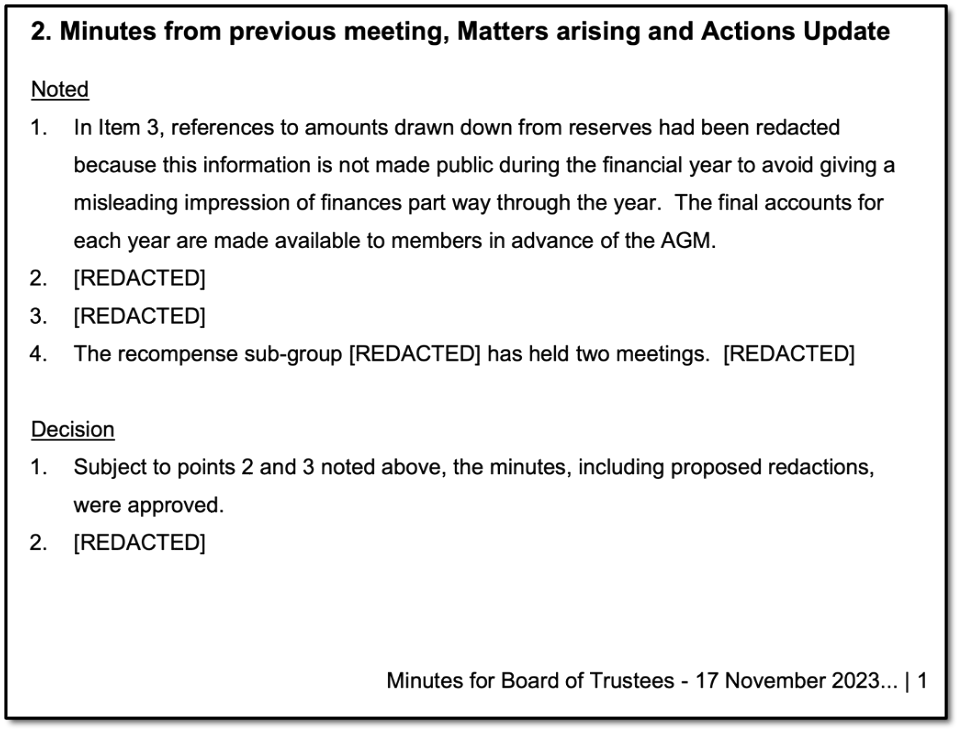
The Society has run a deficit since the CEO’s appointment, drawing down on reserves. It has lashed out £6m on a Change Programme and appointed Diane Ashby as its Change Programme Director, from Southern Water where she was Head of Change Delivery. It is thought there were some ‘unusual” procurement issues of this programme from the start… whither the glowing pronouncements of Social Kinetic and its happy smiley client, the BPS? The verdict on the outcomes of that £6million spend as they trickle into scrutiny is pretty dire particularly in relation to Customer Relations Management (CRM). The latest available minutes of the Board of Trustees (November 2023) states
There is a backlog in processing membership applications. The Society takes an application fee when an individual begins their application, and a subscription fee when the application is completed. The website says that applications take 6-8 weeks to process – we are not currently meeting those timescales. As of 14 November, the backlog has been reduced and applications are taking just over 9 weeks. More work is required to re-design processes. An external provider will help to reduce pressure on the team in the main renewal period during December and January at an additional cost of [REDACTED]. Trustees felt that delays represent a degree of reputational as well as financial risk.
In fact, the BPS have been using that external provider for some significant period of time, at a cost of around £84000 per annum. More work is required to re-design processes? What has the Director of Change Programme been doing/overseeing for the last five years? I personally (as well as others in other contexts) have asked for an accessible breakdown report and evaluation of the Change Programme. Has it met its targets and been value for money? What is there yet to do? I was fobbed off, and others have been told there is no apparent appetite amongst members for such a report. So what is the Change Programme Director up to these days? And how much is she paid for whatever it is?
There was, however almost a year, November 2020-October 2021, when she did have additional duties as that was the period when the CEO was suspended pending investigation of the fraud. During that period of his suspension, the Charity Commission became involved: “Exclusive: British Psychological Society faces Charity Commission probe: Claims of poor governance and silencing of academic dissent amid concern over argument for prescription rights”. The Commission required various matters to be addressed about which members were never fully informed, but this did not progress to a statutory inquiry.
So, was the CEO held in any way responsible for his oversight failures in relation to the fraud? He returned apparently unscathed after his year’s gardening leave. Third Sector helpfully reported this and gave some context. It is worth reproducing its report here:
British Psychological Society chief executive cleared in fraud inquiry
28 October 2021
An internal inquiry found that Sarb Bajwa was in no way party to committing fraud, following the arrest of a former staff member. The chief executive of the British Psychological Society has returned to his position after a fraud-related internal inquiry cleared him of any involvement. The charity reported an allegation of fraud involving a former staff member to police following an internal investigation last year.
Sarb Bajwa, chief executive of the BPS, was asked to step aside while the inquiry took place.
He returned to work yesterday. The BPS is the charity that acts as the representative body for psychology and psychologists in the UK. It is responsible for the promotion of excellence and ethical practice in the science, education and application of the discipline.
In February this year, Leicestershire Police confirmed to Third Sector that an allegation had been made in relation to the fraudulent use of a credit card, and a woman had been arrested on suspicion of fraud by abuse of position. A BPS spokesperson said: “Following the arrest of a former member of staff on suspicion of fraud, the trustees requested that Sarb step aside whilst an inquiry into our working practices and processes took place.
“We would like to make it clear that the inquiry found that Sarb was in no way a party to committing fraud. “We believe there are lessons about our working practices and processes, which, as the inquiry found, needed to be tightened and improved. Changes to our working practices and processes were recommended and these have been fully implemented.
“We all regret that this process has taken a long time, and that the chief executive has been away from the office for longer than was desirable.”
The charity’s trustees said that Bajwa was returning to the BPS with their full support.
Bajwa added: “While I’ve been away from the office for much longer than I would have wanted, I’m returning to a society which, despite the many challenges, has done extraordinary work. I’m looking forward to continuing our programme of transformational change, serving members and the profession.”
Findings from a report into the culture at the BPS, published by Third Sector at the end of last week, found an “endemic” lack of trust between staff and members and an “us” and “them” mindset. The BPS expelled its president-elect in May amid allegations of “persistent bullying”, which he said were “baseless and without merit”. But the report, shared with members two months after the president-elect’s dismissal, concluded there was an “endemic” lack of trust and respect between staff and members and said members had a “lack of access to timely and accurate financial information”. Third Sector also revealed in June that the National Council for Voluntary Organisations pulled out of a consultancy contract with the BPS because it felt the charity’s culture would be detrimental to the wellbeing of its consultants. The previous president of the BPS stood down in April this year due to family commitments.
In addition to members who were able to access this publication wondering why the Society was in the mess depicted, they could legitimately ask how the CEO got away without serious censure. He may not have known what was going on, but that was the heart of the problem that led to the fraud. Was his behaviour, or lack of it, over such a period, not misconduct at least, and possible gross misconduct? There is a suggestion that the BPS was given that advice. Is there justification for the suggestion that the BPS had not followed proper procedure around the suspension and hence was open to legal challenge?
Many, inside HQ and without, have since his return called the CEO “the invisible man”. Many dubious policy decisions, responses to psychologically relevant hot topics in the public domain have happened since October 2021. Or have been ignored. The BPS operates in the field of public policy less with sound evidence -based psychological material and more as a Social Justice Campaigning organisation. This is clearly and increasingly outwith its mission.
The above drift, over which the CEO has presided, has been accompanied by gross financial recklessness and lack of acumen. Staffing numbers became bloated and unsustainable, leading to a recent desperation to cut numbers via redundancies and random wastages. In this context the use of the term restructuring is, frankly, dishonest. Service to the most important source of income, membership, will deteriorate from its already pretty poor quality.
Final demands to get the budget on track were presumably being made by a Chair who has now abruptly resigned. It is my view, and that of others, that the CEO panicked and made a possibly terminal mistake. in the November board of Trustees minutes it was stated:
The CEO recommended that qualifications activities be phased out strategically. The business model does not cover its costs and demand is low. Existing candidates will be supported to complete their qualifications, where possible. Trustees discussed a number of issues including implications in relation to HCPC, limited numbers of candidates on some qualifications, the existence of alternative providers, and the extent to which certain qualifications do or do not cover their costs.
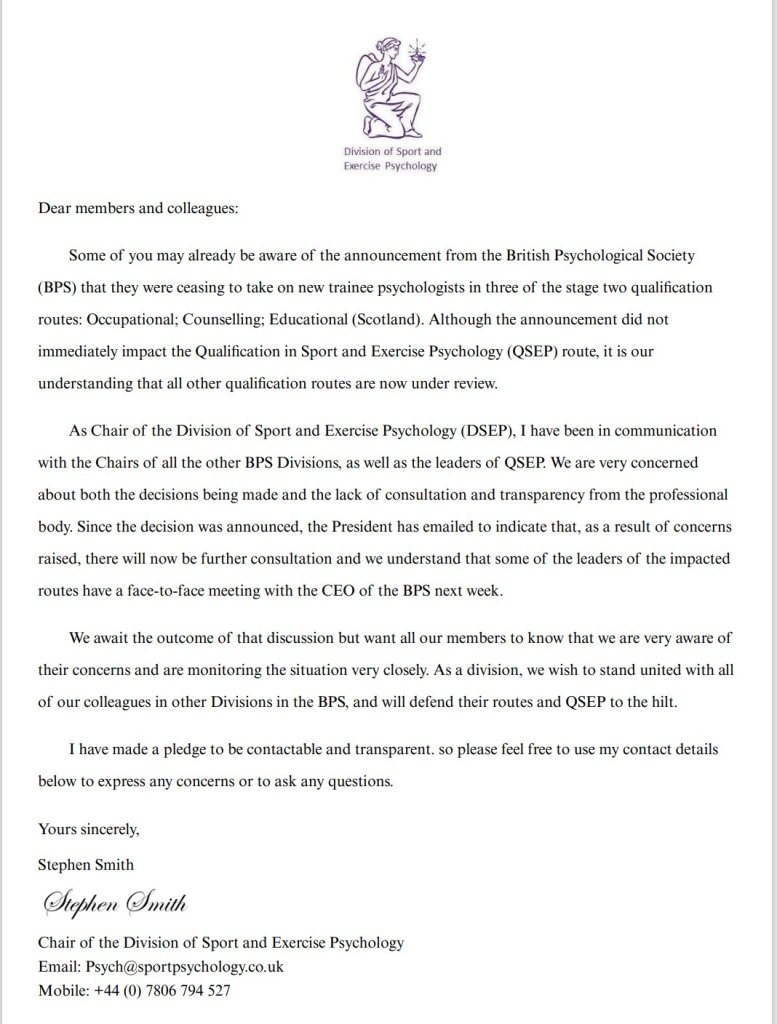
This blog in other recent posts has covered the objections and responses including open letters from the various Divisions affected or threatened. These are Division of Counselling Psychology, Division of Occupational Psychology, Division of Sports and Exercise Psychology, Division of Health Psychology, Division of Forensic Psychology. The myriad reasons why this was a serious error include:
- he had not consulted the Divisions that this would affect
- he had not taken advice about how this could have been better managed to increase efficiency and decrease costs
- he did not appreciate how this undermines the perceived role and function of the BPS
- his proposals expose the straying of the BPS mission from promotion of psychology in society and supporting members into a crude business model which he has proved himself incompetent to oversee
The belated statement issued by the BPS after the uproar occurred from Divisional chairs and members did little to assuage the anger and anxiety, and meetings with the CEO were said to be unsatisfactory. These Divisions contain many of the senior practitioners of Psychology in the UK who have doctoral level qualifications and are trying to grow their respective professional numbers in what should continue to be a favourable social and economic environment for these practices of psychology. The CEO, however, turned his myopic business eye on a hoped-for influx of new members, graduate or otherwise, much less qualified, which although more numerous is risky when the economic climate more generally is afflicted.
From the latest of these messes under the CEO’s leadership comes an early resignation from the first independent Chair of the BPS Board of Trustees, and a petition to remove the CEO from office.
The erstwhile chair has now retreated to what is probably a much saner as well as safer place. The question now is not only can the CEO survive, but can the BPS?



 psychology UNREDACTED