Annual Report, Change Programme, Financial issues

Over 38 000 emails…..

Peter Harvey posts….

Members will be ecstatic to know the BPS is so proud of the fact that it was able to handle over 38 000 emails last year that it got a special shout-out in the CEO’s introduction to the Annual report (see here). In fact, this is such a significant achievement that it is the very first fact that he mentioned. I can hardly contain my sense of pride in the Society’s important step towards its aim of promoting the advancement and diffusion of psychological knowledge, both pure and applied (see the Royal Charter). But there is more – 244 queries directly relating to practice issue were responded to (another highlight from the CEO’s report). This is all too much excitement at my age.

I really, really would like to say that it gets better but the Annual Report is a shambles – trivial, over-confident, smug and looks as if it is a not-very-good trainee’s branding and PR project. I expect next year’s will be published electronically in emojis. To save you the effort of having to expose yourself to the glossy visual overload and assorted trivia, here are my key take-aways.

Falling membership. One of the more serious and worrying facts is that membership is falling. The total in 2024 was 58 387, down from 61 149 in the year before and, most significantly, from 66 098 in 2020. It is inordinately difficult to find accurate membership figures if we want to put this in a historical context: in 2018 it was said to be “...just above the 60 000 mark…”;  in 2019, two different figures are quoted, one of  60 000 and one of 70 000 (both approximations); I cannot find a figure for either 2021 or 2022. I would have thought that the all-singing, all-dancing £6m Change Programme (about which we have yet to receive a full evaluation – bland reiteration of the phrase “…it has been a great success…” simply won’t do) would be able to provide such information at the touch of a button. I have been a member long enough to remember when the full membership figures (including past years) were a regular feature of the Annual Report (and this was before the much hyped Change Programme). This fall in membership is important especially in light of some other data and it links to finance (see below). According to the Board of Trustees (BoT) minutes of 16 December 2024, 18% of members benefit from free membership (full disclosure, as a retired member I am in this category), including first-year students. In the BoT Minutes of 8 May 2025 it is stated that “… significant numbers of students do not continue membership when it continues to be free and many graduate members cease to be members when the discounted rate ends…”. As subscriptions make up 57% of the BPS’s total income this is a worrying trend.

Psychology as a career. The Psychology Careers Festival which was attended by 2596 people is heralded as a significant success (page 7 of the Annual Report). Perhaps some context might help here. According to the Higher Education Statistics Agency latest figures (see here) some 119 120 people were studying psychology in 2024/25 (an interesting side note here – this is a significant drop from a peak of 141 095 in 2022/23).  Considering there were 120 speakers over 80 sessions (a large investment of time both organisationally and by the speakers) I am not sure that getting just under 3% of your target population is an outstanding success.

Staffing. Hidden deep within the impenetrable financial report (see below) is this important fact. In 2023 the BPS underwent a restructuring process – this resulted in the loss of 30 posts (including 12 voluntary and 4 compulsory redundancies) (see page 60 of the Annual Report and there is more on this below under Finance). How much of the detail of the restructuring and change, as well as the need for it, has been fully and properly reported to the membership who actually pay for all this? A gentle reminder here to the BoT and the Senior Management Team about their accountability to the membership – it is both a moral duty and a requirement of the Charity Commission to tell us what is happening to our Society.

What’s missing. To my mind there is a great deal missing from the main body of the report. No mention of how the BPS has responded to a key shift in the law (the Supreme Court ruling on Sex and Gender), the fact that two serious incident reports have been made to the Charity Commission (see BoT Minutes, 16 December 2024, Item 1.8), no mention of the fact that the BPS has been running a “…number of years of deficit budgets…” (see BoT Minutes, 16 December 2024, Item 2.3, Noted 3). There is much more so I suggest that you read past blog posts on BPSWatch.com to find out what you are missing (and then we can trumpet the fact that our numbers are up).

Finance. In stark contrast to the glossy fluffiness and inanities of the previous 29 pages, the financial statements are an accountant’s delight. Opacity and complexity spring to mind as apt descriptors. Is this a deliberate ploy to obfuscate and confuse the inexpert reader (as are all of us not versed in the mysterious jargon of finance)? Why doesn’t the BPS present a simple one- or two-page graphic (complete with the ubiquitous pie chart) for us simple souls? Virtually every organisation of which I am a member (such as the Royal Society for the Protection Birds) manages this in their annual reports. If I could do this on my computer using Excel and PowerPoint (and no, I am not going to do it) surely the all-singing, all dancing IT system funded by a £6m Change Programme should be capable of this simple task? A more suspicious person than I might even suggest that this is not a mere accident – as I have noted in a previous post (see here), members are regularly denied important information about the finances of their society. And by the way, while we are on the topic of finance, how many of you knew that there have been six Heads of Finance over the past seven years . This is a rate of change that even I, untutored as I am in the ways of business, suggest is not a Good Thing.

So, to the detail (and apologies in advance if I have missed anything, this is not an easy task). 

  1. Income is up. Yes, there is an approximately £1m increase in subscription income BUT, we have seen, this is not due to an increase in membership so, ipso facto, it is due to an increase in fees. This is not good – there will be a point at which members will ask the ‘value-for-money’ questions and I have already noted the fall-off in student and graduate members. In addition, there is (an admittedly small) drop in Chartered members but with organisations such as the Association of Clinical PsychologistsUK (full disclosure, of which I am a member) offering  a very attractive alternative to clinical psychologists, the BPS should be worried (especially as the Division of Clinical Psychology is still the largest of the sub-systems in the Society).
  2. Income is down. In contrast to the above, other sources of income do not look good. The BPS has a number of revenue streams apart from membership fees. These include Registers and Directories (down from 2023), Conferences and Events (down from 2023), Journals and Book Publishing (down from 2023), Advertising revenue  (down from 2023), Examination income (down from 2023), Professional Development Centre (down from 2023). Two other streams (Quality Assurance and Rental Income) show an increase (see page 49 of the Annual Report for full details). This is a worrying trend as these declining sources are unlikely to increase and it only needs a change in the Quality Assurance stream (the largest) to be compromised and the BPS will need more than the sale of the Leicester office to keep afloat.
  3. Staff costs. Staff costs are down due to the loss of people noted above, the overall cost of this exercise over the two years 2023 and 2024 being £763 000 and is unlikely to be repeated. However, there is a continuing cost of those on higher salaries (defined as those earning > £60 000 p.a.) of whom there are now 12 (down from 15 in 2023). Without making any value judgements or allusions to individuals, four of that number are earning over £100 000 p.a. (excluding pension contributions – see page 55 Annual Report) which (taking the median of the ranges provided) totals just over £500 000. I leave these figures with you upon which to contemplate.

As some of you know, I and my associates on BPSWatch have a long history with the BPS, contributing (we hope) positively and constructively to its aims of developing a responsible, serious and thoughtful science and practice of psychology. The current Annual Report (and those of the recent past) suggest that our efforts have so far been in vain and that the organisation is failing its members, the public and the discipline of psychology.

"The Psychologist", Charity Commission, Expulsion of President-Elect, Financial issues, Governance

The BPS in court – again

Yet again the BPS is spending your money – despite its financial difficulties – on expensive barristers and KCs. This is taken from a press release published today (22 July): 

The Employment Appeal Tribunal will this week (24 and 25 July) hear a landmark whistleblowing claim that could ensure protections to over 900,000 charity trustees who might need to blow the whistle on corporate governance failures within the charities they oversee.  

The claim is being brought by Dr Nigel MacLennan against the British Psychological Society (BPS) in a legal case that could extend the same protections that workers and employees enjoy under whistleblowing legislation to the many thousands of trustees, school and NHS governors, and other volunteers who play a vital role in upholding proper corporate governance standards and ethical conduct within the organisations they have duties to serve and protect.  

Dr MacLennan was a Trustee and President-Elect for the BPS at the time of his expulsion in May 2021. Following his appointment, he uncovered serious concerns of corporate governance failings within the BPS, including potentially illegal practices, which he reported to the Charity Commission.  

The Charity Commission made the first of four regulatory interventions into the BPS within 11 days of Dr Nigel MacLennan taking office, based on his evidence. Despite this, Dr Maclennan was expelled and dismissed from office by the BPS, causing profound damage to his reputation and career, and significantly impacting his mental health.  

Dr MacLennan took his claim to an employment tribunal which found that he was not protected by whistleblower legislation and he was not a worker of the BPS. 

In bringing this appeal, Dr MacLennan and his legal team will argue that he entered into a contract with the BPS and was fulfilling his legal obligations in blowing the whistle, and should therefore be protected. They will also argue that Dr MacLennan and other trustees are protected from reprisals for blowing the whistle under Articles 10 and 14 of the European Convention on Human Rights (ECHR). 

The significance of this case has been underscored by the Judge of the Employment Appeal Tribunal, who, in allowing the appeal, made an order that the Government be invited to intervene in this case because of its significant public interest implications

Just to be clear, this Appeal is to clarify an important legal principle rather than an appeal against Dr MacLennan’s expulsion by the BPS. Should the Appeal be upheld then it will allow him to take to BPS to court to contest his (in our view, unjust) expulsion (for more on this see previous blog posts Part 1, Part 2 and Part 3).

What may be news to you is the first sentence of the fourth paragraph. How many of you knew that the Charity Commission (CC) made four interventions? This is truly astonishing. It’s even more astonishing that the CC did not take any further action. However, why I raise this matter here is the fact that, as far as I am aware, this information has not been made public before. In its usual tight-lipped secretive manner [see here] the BPS has kept schtum and not any of of this has been shared with the members  – the people on whom the SMT relies for their high salaries. I cannot imagine that the CC recommended that their intervention and the subsequent actions (if any) should be kept quiet. I would hope that the CC would have encouraged (if not made it mandatory) for the BPS to keep the membership fully informed. But no – a total comms blackout. We don’t expect anything from The Psychologist, of course, which seems to take perverse pride in not reporting on Society matters of critical importance to the membership.

We will keep you updated (although the judgement of this appeal is unlikely to appear immediately) on any other previously unknown information which comes out.

Peter Harvey

Blog Administrator

Board of Trustees, Change Programme, Financial issues, Governance

Openness, [REDACTED] & [REDACTED]

Peter Harvey posts….

We look to do the right thing in an honest, fair and responsible way through appreciating others’ opinions, viewpoints, thoughts and ideas so that we build strong and trusting relationships. 

We keep people informed through clear, open and honest communication.

These two statements are taken from the BPS’s 2024 Strategy document [see https://cms.bps.org.uk/sites/default/files/2024-01/BPS%20Strategy%202024_0.pdf]. Along with a whole collection of vacuous feel-good, virtue-signalling, management-speak phrases the commitment to openness appears on the very first page of the document. It must be important then.

But, in a phrase much used by my old head of department, the late Bill Trethowan (yes, for those of you with long memories, that Trethowan) when testing for thought disorder “Fine words butter no parsnips”. How do these fine words translate into behaviour?

If we take the latest minutes of the Board of Trustees (BoT) [note: access to these on the BPS website is restricted to members, so I have included screenshots of the relevant sections]. These were published around the middle of March 2024 and refer to the meeting held in November 2023. Two things to note here – the long gap between meetings of the BoT as well as the delay in publishing them. We have pointed out previously that the BPS is undergoing serious financial problems and we are aware that a number of staff have been/are being made redundant (we can say no more than that because the BPS has been completely silent on this critically important matter). It comes as something of a surprise that at a time of such serious financial pressures there were not more meetings. And, by the way, don’t bother trying to find anything in The Psychologist. As ever, it shows absolutely no interest in keeping the membership informed about anything to do with the management of the BPS – not enough opportunity for virtue signalling I would guess.

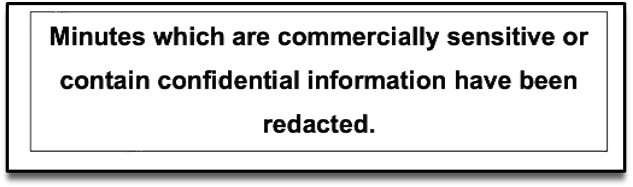
You might imagine, as a member of an organisation that you pay for, you might be able to see just how your money is being spent. Please add your own hollow laugh at this point. At the top of the BoT minutes the following appears:

I can fully appreciate the need for redacting information that relates to individuals – so far, so understandable. But the phrase “…commercially sensitive…”  is a bit more problematic. Correct me if I’m wrong but the BPS is a membership organisation and a charity – it is not a business. I accept that the organisation should be run in a business-like manner, ensure that income is at least equal to expenditure.  So far, so GCSE Business Studies. If the BPS were a company in the commercial sector where activist shareholders or predatory asset strippers prowl in the shadows, keeping your accounts under wraps is understandable. Could this be true of the BPS? Is the Royal College of Psychiatrists about to make a hostile take-ever bid? Perhaps Stonewall want a new identity and is looking to the BPS (on second thoughts, some recent pronouncements from a BPS Officer suggests that has already happened)? Is the BPS in such robust good health financially that a sanctioned oligarch sees the opportunity to launder their ill-gotten gains through  a ‘respectable’ UK organisation? (To borrow from Private Eye – That’s enough, Ed). 

I think not, m’lud. In truth, the BPS is a completely unattractive proposition for any potential buyer (perhaps we should run a competition – devise a sales prospectus as if for floating a company) – unless Del Trotter might be interested, of course.

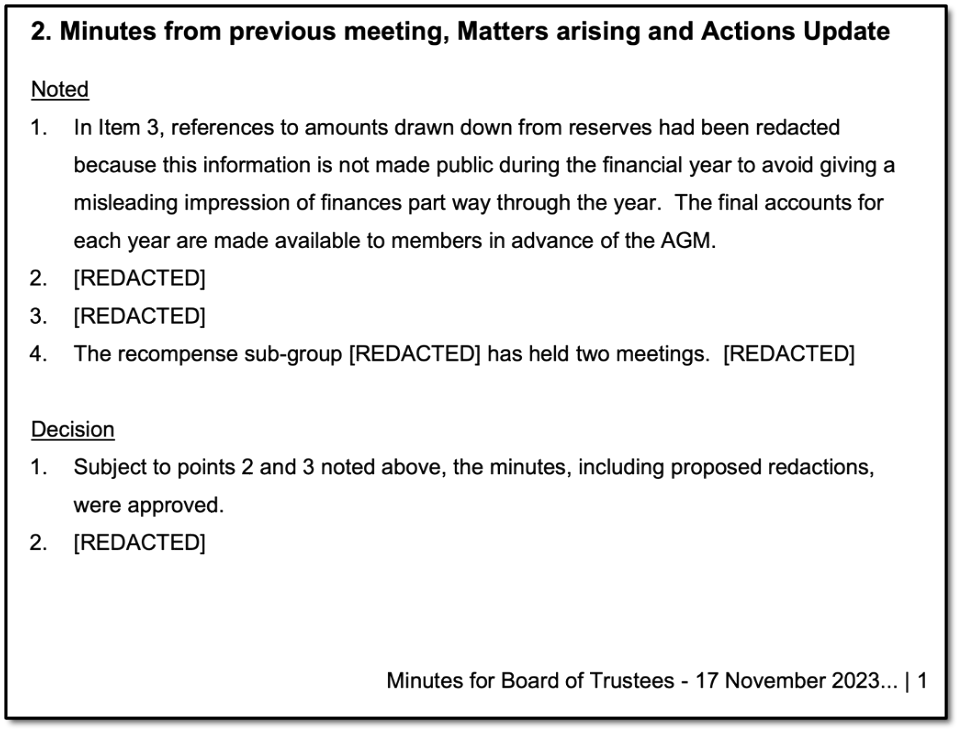
Back to reality. The statement above is played out in practice….

What an interesting phrase “..giving a misleading impression…”. I leave it up to you, the reader, to make what you will of it. In all, there are 16 redactions.

Perhaps the BoT needs to be reminded of some important things:

  1. The money is not theirs, nor the Senior Management Team’s. It is extracted from the members to pay for services.
  2. Members have a right to know how that money is spent.
  3. Trustees – acting on behalf of the fee-paying membership – have a duty under the law to ensure that “…your charity’s money is safe, properly used and accounted for. Every trustee has to do this…” [https://www.gov.uk/guidance/managing-charity-finances].

How can members, either indirectly through the Trustees or directly as an individual member, find out if their money is being spent wisely, if all the relevant information is withheld? This is made all the more difficult by reference to the following statement (again from the November BoT minutes: (under 8. AOB, noted 3)…

I refer you back to the statements at the start of this post. Can anyone explain to me how the extracts above square with these?

Now I am sure that the BPS will argue that it follows due process by publishing fully audited accounts for the membership at the AGM. Of course they do, for otherwise the Charity Commission would be sniffing around (again!). But for those hardy souls who choose to plough through all 48 pages of the last consolidated financial statements there are two things to note: (1) that they are anything but recent (they only cover the year up to 31 December 2022); and (2) they have all the detail and clarity of a political party’s election promises. For example, try to find out how much was spent on legal fees and external consultancies (if you find it, please let me know). Up-to-date information about finances is (or should be) available to the BoT and the SMT (although if our experience with the much vaunted £6 million Change Programme is anything to go by I wouldn’t guarantee that). Surely it is possible to able to provide meaningful information to the membership without compromising any properly confidential detail? 

Secrecy is a pernicious poison, sowing mistrust, suspicion and disbelief. The recent furore about the manipulation of photographs (as well as the wider debate about ‘fake news’ and AI-influenced material) should give us all cause for concern. Why deny members access to information to which they have a right? To remind the BoT – it is the members’ money you are accountable for. You have a duty to be open and honest – let our parsnips be well and truly buttered by your commitment to truth and transparency.

"The Psychologist", Board of Trustees, Change Programme, Expulsion of President-Elect, Financial issues, Governance

Junkies, Fraud and Spin Doctors: The BPS Kakistocracy

David Pilgrim posts…..

Editing a book on the crisis in the BPS was in one sense easy. It was like shooting fish in a barrel. The Society is so dysfunctional and corrupt that the facts just spoke for themselves. I did hit some problems though. I had to lose some important contributions for reasons of sub judice. This was not because the claims to be made were untrue and without an extensive evidential basis. It was because the victim of a gross injustice, President-Elect Nigel MacLennan, was pursuing his legal right to redress, which I could not jeopardize by going public too soon with every damning fact known to me and other writers in the book.  

In continuing their own desperate defence of past actions, the BPS leaders will take even more money from a currently uninformed membership. The latter deserve a detailed list of the costs involved in the campaign to persecute MacLennan. We are probably talking not tens of thousands of pounds, as was the case in relation to the fraud perpetrated by the PA of the CEO (see below) but hundreds of thousands, with the bill still mounting. Whose interests exactly have been served in this expensive campaign of disparagement of an individual, who was acting in good faith to improve governance in the BPS? When the dust settles on his case the costs to members entailed should be made known, given that to date the leaders have been coy about their accounting practices. 

In my view, looking at the arc of this story and the evidence we have, it was because MacLennan was an incipient whistleblower that the cabal went out to get him, a process that had started early on in his tenure. The SMT and the Board of Trustees spotted a troublemaker in their midst, who might spill the beans on what was wrong in the Society and whose moral and legal culpability might be exposed.  He was probably seen initially as an agitator for governance reform (his candidate statement for President forewarned them). When he moved from agitator to whistleblower (with Charity Commission interest becoming more evident) then his days looked numbered and his expulsion could soon be contrived. Whistleblowers blow the cover on dubious practice and there was much of this waiting to come out.

The problem of opaqueness and the cant in the BPS about its claimed ‘transparency’ have recurred in our critique of the BPS culture. Although the facts do indeed speak for themselves, secrecy and spin, ensured by the censorship role of the Comms Team and the silence of The Psychologist, meant that they were by no means all that easy to either come by or broadcast (Harvey, 2023). 

When writing my history of the BPS across chapters in the book, I cautioned that the full details behind our criticisms were still patchy and shrouded from view. We may have got it wrong in whole or part: who knows for certain? The long standing organizational malaise in the BPS could all have been a set of innocent human errors, made by people of good will. On the other hand, the Machiavellianism could be much worse than even we have described. Indeed it is because leaders in the BPS have covered their tracks with such assiduous effort that we may never know, for certain, what has really happened in the Kafkaesque Leicester HQ. 

We await a rebuttal of the arguments in our book from BPS officialdom but no effort has been made to date to offer a celebratory history of the Society, maybe for very good reason. Where would that celebration start exactly? How about the twice President and dodgy eugenicist Cyril Burt during the Second World War? How about the failure to set up an independent Board of Trustees in 1966 and missing a second bite of the cherry in 1988? How about the crash down of British empiricism and positivism in the wake of the postmodern turn in the discipline during the 1980s and 90s? How about the departing CEOs and other senior officials in the wake of financial crises, after the turn of this century? How about the New Public Management model and its consequences for a bloated economy in the Society? How exactly would this sow’s ear picture be turned into a proud silk purse for posterity? Spin in the present understandably does not welcome historical candour. 

The spin is what has been said but the main strategy to keep members in the dark has been silence, ‘Keeping schtum’ has served self-interest at the top well.  Call it what you wish (‘cover up’ ‘mystification’ ‘spin’, ‘bullshit’) the outcome is the same: the BPS is not and has never been transparent. Its ordinary members and the general public have been shielded from anything other than good news stories. 

The surviving and still extensive contributions in the book were certainly damning enough. They demonstrated that the BPS has never had a fit-for-purpose Board of Trustees since it was recognized as a charity in British law. That lack of independent oversight has ensured organizational dysfunction, a lack of membership democracy, a lack of transparency, recurrent policy capture, the abandonment of freedom of expression and academic probity at the altar of modish identity politics, as well as of course financial mismanagement and then the corruption, with a prison sentence eventually attached. Thus, the lack of proper governance has triggered more than financial concerns alone. 

I expand this point now more by looking at junkies, fraud and Pollyanna spin doctors as symptomatic aspects of the BPS organizational malaise. Together they have constituted a ‘kakistocracy’. The ugly but apposite term comes from the old Greek ‘kakistos’ meaning ‘worst’ and ‘kratos’ meaning ‘rule’.  

BPS junkies

When then President Ray Miller quipped that he was a ‘BPS junkie’ we will never know why; the claim was fair comment but his motive for making it could reflect guilt, pride, either or both.  The context was important though. He was in conversation with an early representative of the New Public Management approach, the CEO Tim Cornford, flexing its muscles at the turn of this century (Miller and Cornford, 2006). These two leaders of the organization ‘in conversation’ reflected a tentative hand over of power between the old regime of oligarchs and the new managers. Many of them, as was to become apparent, were not psychologists but some were. Together they shifted the organizational emphasis from academic values to those of a managed bureaucracy; a wider feature in the UK in the 1990s. (Third sector organizations, like those in the public sector, became both more marketized and more bureaucratized.) 

With a shift from the traditional power of oligarchs with their recycled names to the controlling role of new management class with their invented new Orwellian titles, a struggle for who was top dog ensued. The controversial ‘Change Programme’ and the spiraling costs at the centre of the organization were symptoms of an insidious shift to unaccountable managerial power and financial profligacy. Fifteen years after Miller’s confession, President David Murphy made much of this popping financial bubble in his resignation letter, placed for all to see on social media. Seemingly, in his eyes, not only the crooked PA had been on a self-indulgent spending spree (see below).

Miller may have confessed his guilty secret but he was by no means the only recycled name at the top. Some, such as Ann Colley, upstaged him by being both the BPS President and CEO. Some took on the sinecure of ‘Honorary General Secretary’. Grand in its title, what it was, when the payment for it stopped, and for what reason, are like many things in the BPS lost in the haze of time.  Hypnotized by personal cunning plans or seduced by old fashioned vanity, so much still remains unknown about these recycled names. Maybe they did it just because they could and it would always look good on their CV. ‘Junkies’ may be a metaphor for personal addiction to bureaucratic status and power in this context. However, the governance vacuum created by a lack of an independent Board of Trustees opened the door very widely to such personal craving and it then rewarded addicts. The latter could readily rationalize their overly-long involvement as service, but who were they serving? 

One lesson we have learned in our campaigning is that some senior colleagues with long term involvement in the Society we have spoken to manifest degrees of ‘Stockholm Syndrome’. They counter our criticisms by arguing that if only this person rather than that took over as the Chair of this or that sub-system, or could join the faux Board of Trustees, then the BPS dysfunction would soon be rectified. Another aspect of this quick ‘fixit’ mentality is the idea that a quiet private word with individuals at the top will ensure that a particular grievance or inefficiency will soon be resolved. We should stop our negativism and look on the bright side, curry favour with those in power now or prospectively, and it will all be OK. This theme of a new world coming in a BPS with bushy tailed innovators recurs over and over again (see below). 

One ex-President we contacted was shocked by our sleuthing saying that she thought that she had, like Hercules, successfully ‘cleaned out the stables’ during her tenure. She accepted what we said but really believed that she had fixed the problem. Such defences of the old regime by senior colleague are, to put it politely, highly irrational. How precisely would individuals in their efficiency and integrity singlehandedly solve a structural problem? This naïve assumption could be a function of psychological reductionism and vain individualism but we know that other organizations can be oligarchical and lacking in insight. The shock here though is that psychologists are expected to at least reflect on their problems; they are allegedly experts on that reflection about individuals and groups. In practice this reflexivity has been notably absent in the culture of Leicester. 

Fraud

Even today I meet BPS members who are unaware of the major fraud in the BPS. This is because it was not reported in The Psychologist or announced by the SMT or Board of Trustees. It was reported though in the Leicester Mercury (as was an arson attack at BPS HQ). So if a member wants to understand their professional organization they would do well to take this local newspaper rather than rely on BPS statements and publications. 

The gist of the unedifying main story is that a woman who had numerous previous offences of the same type had used the BPS credit card for over £70K of spending (on amongst other things a cruise and Jimmy Choo shoes).  After the fraud was eventually discovered and reported the offender was tried and sent to prison for 28 months. In court she reported that it was like being a ‘kid in a candy shop’.

A naïve outsider faced with this picture may well assume that those responsible for appointing her would be disciplined or sacked. They might also assume that as she was the PA of the CEO, the latter would have signed off fraudulent claims. They might also assume that oversight of financial probity would be the responsibility of the Finance Director.  They might also assume that as well as the end-point offender being held to account in a court of law, that the legal liability or ethical culpability of other key players would be under scrutiny. These are all fair assumptions. So this is what happened in practice.

News of the fraud was buried in a line or two of the annual accounts as a minor irrelevance. No report of the organizational background to story was supplied to the membership. The CEO and Finance Director were suspended and placed under investigation. The former stayed suspended for a year and then returned and is still now in post. The latter went off to be employed by the National Lottery Community Fund within a month of his suspension (presumably with a reference dutifully given by someone in the BPS). He remains employed there. To date no one in a leadership role has offered a transparent (that word again) account to the world of what went so badly wrong about financial probity. Thus the only disciplinary consequence on public record has been the imprisonment of the PA. None of this drama has been reported or discussed in The Psychologist or any other BPS outlet. Silence has been the main cover-up tactic. 

Here are the loose end questions that members and the general public may be interested in. Did the ‘Board of Trustees’ discuss the termination of employment of the CEO and FD? Were they unanimous in their decision to suspend them both? Did they examine the evidence related to the CEO’s sign offs of multiple fraudulent claims and the due diligence of his FD in overseeing those sign offs and confirming their legitimacy? Did they put in place plans to investigate who was responsible for the appointment of a convicted fraudster? Did the BoT suspend the two senior employees at once or did several months elapse between the fact of the fraud being known and their eventual suspension? If so why? Did the CEO return to post after a year because he was totally and unambiguously exonerated of any negligence or wrongdoing? Instead might his retained role be explained by another reason? Why have the members been given no answers to these questions? Does that silence reflect a norm of mystification in the BPS, which it turn reflects a failure of governance over decades?

And there is more. If the FD and CEO have had their salaried posts and reputations left unscathed by the fraud, what of the parallel drama at the time of the expulsion of Nigel MacLennan?  Did he commit a criminal offence or was any form of illegality committed instead against him in relation to employment law, personal disparagement and his human rights? Soon we will find out the answers to these questions but not before the BPS leadership will pour even more into the legal costs sustaining their attack on MacLennan. Where will that money come from? (That question is rhetorical not open.)

Where is the evidence that he actually did anything wrong? Why did the video about his expulsion appear as an act of deliberate public humiliation on YouTube, fronted by the Acting Chair of the BoT, before MacLennan even had the time to appeal the decision (McGuinness, 2021)? Were those appointed to investigate the charge against him truly independent of vested interests in the BPS leadership? Do they today stand by their decision and approve of the YouTube posting?  Any fair minded outsider would surely smell a rat about this scenario, unless all of the questions I posed above were answered in a convincing manner (rather than being spin or bullshit). This cues the next and final section.

Pollyanna spin doctors 

The unreal culture of the BPS is fascinating. On the one hand its ‘officers’ send po-faced letters marked ‘private and confidential’ about minor bureaucratic details pertaining to an investigated complaint, which has typically run into the sands, as if they are gravely concerned about standards.  On the other hand, they are quite happy to publicly trash people like Nigel MacLennan with impunity, as I have just noted. What ethical ‘standard’ was being applied precisely in his case? On the one had they say that complaints against individuals are not investigated by the BPS but on the other hand they deploy self-declared BPS junkies to pursue such an investigation, when it suits the interests of those in power. On the one hand they boast that ‘transparency’ is a key value of the organization and on the other hand they fail to report any event that might get in the way of the narrative that everything in Leicester is just fine and, if it is not, then improvements are just around the corner.

Whistling in the dark and pretending everything is fine and under control have attended the demise of the BPS in recent decades. Silence in The Psychologist and the weasel words of the anonymous apparatchiks of the Comms Team have always been on hand to maintain this madness with its underlying method or aim, but there are other key players. One group are those manifesting variants of ‘Stockholm Syndrome’, noted above. However, at the top of the pyramid are the SMT and the Chair of the Board of Trustees. The latter used to come with the job of being the President. That is no longer the case as the role has now become merely ‘ambassadorial’. 

This tweak might have passed the average member by but it is important. Now we have a new and independent chair and three independent colleagues. At last there has been some sign after years of Charities Commission pressure of a shift for the first time towards an independent Board. For now the majority are still old school appointees from the sub-systems, there by Masonic-style nod and a wink trickery. They still have conflicts of interest but this new picture is at least a start. A fully independent BoT would be a necessary but not sufficient condition for confronting the gross mismanagement and misdemeanors of the past, but note that it is a necessary condition.

Under this shift towards independent scrutiny, the old habit of Pollyanna spin from the SMT and Presidents is potentially now open to challenge. Maybe the stop button on the BPS bullshit generator might at long last be pressed by these newcomers. Sadly that is not what appears to be happening. The neophytes seem to have ‘gone native’. I have been in correspondence with David Crundwell, the new chair and he has been polite and he has replied at length. (This is an improvement on being totally ignored or threatened with disciplinary action, which was the stance of the SMT in recent years since BPSWatch emerged.) 

I sent Mr Crundwell a copy of our book, at his request. He was concerned to anticipate what he called ‘accusations’ and I preferred to call ‘empirical facts’. I asked him to report any factual inaccuracies about the claims being made in the book but he declined on the grounds that it was all before his time. This is a bit odd, given that any of us can offer a view about anything that has happened in the past and drawn to our attention now in evidential detail (that is how the jury system works). I also asked him to join a panel at a launch of the book but he declined the invitation. Nobody from the SMT or BoT have yet complained about the facts recorded in the book, which is relevant for the historical record. Their silence is telling and a full debate with them would be intriguing for any listener.

On the positive side, Mr. Crundwell has agreed that the high rate of redactions still common in BPS Board meetings is incompatible with a spirit of transparency. He truly appreciates that claiming transparency and being transparent are not the same thing, which was an insight clearly lost on the old regime. And a certain degree of caginess is understandable, given that he has had to work with a dysfunctional leadership which was not of his choosing. However, sadly that caution has now tipped over into Pollyanna spin and so is compounding, not challenging, old bad habits.

Reasons to be cheerful with no rear view mirror

Ian Dury’s long shopping list of ‘reasons to be cheerful’ was tempered at the end by the wise caution of ‘perhaps next year or maybe even never’. Pollyanna managers are less sophisticated about the complex relationship between past, present and future. Patterns connect through time and old habits die hard.  Stock-taking about the legacy of the past for naïve optimists is threatening to them because it gets in the way of their current rhetoric of shiny future prospects. It is dangerous for them because they are wrongheaded and so they will be prone to mismanage and be exposed for their folly. It is dangerous for others because it is misleading about unrecognized risks for the general good. 

‘Reasons to be cheerful’ rhetoric means not having to deal with the grim reality of what has been inherited but living instead in a comforting imaginary world. Who can object to good intentions even if they may risk paving the way to hell? They sound plausible and are an example of the power of positive thinking but they are actually profoundly illogical at times.  In Peter Barham’s poignant account of psychotic patients going ‘over the top’ in the First World War, oblivious to the dangers they were facing, being out of touch with reality meant making their vulnerable lives more, not less, risky (Barham, 2004).

A theme in my correspondence related to Mr. Crundwell’s preference not to look in the rear view mirror (his chosen metaphor not mine). In response I noted that a car minus a mirror will fail its MOT. My metaphor seemed to cut no ice. He wanted instead to look only optimistically to the road ahead. He even invited me to get in the car and enjoy the ride with other BPS members about ‘exciting prospects’ envisioned but not elaborated in any detail. 

What Mr. Crundwell does not seem to understand is that in the rear view he is choosing to ignore, there are not only shocking past events but also impending and foreboding consequences.  The reality of the past and the present and the future are bound up together in all open human systems. Any manager ignoring that truism is, to say the least, unwise. I did point this out to Mr. Crundwell (boringly and repeatedly) but my view was ignored. ‘Line drawing’ is just magical thinking. Forget complexity and focus on comforting future fantasies. The contempt this shows for the importance of history is jaw dropping.

Of course we have heard this ‘drawing a line’ sort of argument recently from Crundwell’s new colleagues. It came from the CEO and the then new President installed as a safe pair of hands to replace the expelled MacLennan, following the nifty imposed rule change that only allowed Senate members to be candidates. Carpenter and Bajwa (2021) then were singing the same refrain as Crundwell is now. I have no idea whether they coached him in a ‘party line’ or he came to the same unwise stance with no help from them (our correspondence was polite but not a mutual confessional).

The ‘drawing a line under the past’ management cliché undermines three linked imperatives for a healthy organization. The first is justice. Justice requires truth. Without truth there can be no redress for, and reconciliation about, historical wrongdoing. Hiding the detailed facts of the fraud or MacLennan’s kangaroo court expulsion helps few, other than those with the self-interested need to cover up the evidence of their past culpability. 

Second, when those in power go into hiding, then trust is broken in them. If the BPS leaders do not report adverse events to members, why should the latter have any trust in them? When that trust breaks down some members stay and fight (as we have done), some become passive cynical onlookers and some resign in contempt for their professional and disciplinary body. New psychologists will be wary of joining a discredited organization. A measure of this in applied psychology has been the formation of others splinter groups (the AEP, ABP and ACP), where greater trust is invested. Another has been that now most psychologists registered with the HCPC are not BPS members.

Third, future improvements only come about as a result of organizational learning. That is why I have attacked the BPS for being an ‘organization without a memory’ (Pilgrim, 2023a; cf. Donaldson, 2002). A necessary outcome of that contrived amnesia is its need to produce organizational bullshit (Pilgrim, 2023b; Spicer, 2020).  For example, those working in the NHS understand from painful experience the importance of critical incident reporting and constant reflection about lessons learned. When that duty (and it is a duty) of learning is evaded about the past, then we tend to have unnecessary deaths in the future. The consequences for critical incidents in the BPS may be less dramatic but they still implicate risks to the public, as we know in relation to policy capture.

Conclusion

The BPS is a kakistocracy. Those addicted to status, those using it as a cash cow and those expert at spin and bullshit to defend the indefensible, have aggregated in its culture in the past decades. They have been joined by a self-interested expansive management class. None of these have had any inclination to come clean about all of the matters that we in BPSWatch have insisted on unpicking in the past couple of years. 

The next phase of decline, and maybe fall, awaits with leaders driving with no rear mirror. Tailgating the jaunty BPS car is a juggernaut of legal reckoning and the prospect of a scattering loss of those psychologists who have simply had enough of an implausible charity and professional body that has lost academic credibility. Any members left behind will continue to fund the antics of the kakistocrats. They would do well to ask for a detailed receipt.

References

Barham, P. (2004) Forgotten Lunatics of the Great War New Haven: Yale University Press.

Carpenter, K. and Bajwa, S. (2021) From the President and the CEO The Psychologist November.

Conway, A. (2023) BPS Policy Capture (2): selective ‘memory science’ and the betrayal of victims of abuse. In D.Pilgrim (ed) British Psychology in Crisis: A Case Study in Organizational Dysfunction Oxford: Phoenix Books.

Donaldson L. (2002) An organisation with a memory. Clinical Medicine Sep-Oct;2(5):452-7

Harvey, P. (2023) Resisting the silence of the cabal:  resorting to social and alternative media. In D.Pilgrim (ed) British Psychology in Crisis: A Case Study in Organizational Dysfunction Oxford: Phoenix Books.

McGuinness, C. (2021) The Society is at a Crossroads The Psychologist June 34, 4-5. 

Miller, R. and Cornford, T.  (2006) Double top – Ray Miller in discussion with Tim Cornford: The Society’s new President in discussion with the Chief Executive. How do their roles work together, and where do they see the Society going? The Psychologist April, 19, 20-21.

Pilgrim, D. (2023a) An organization without a memory? In D.Pilgrim (ed) British Psychology in Crisis: A Case Study in Organizational Dysfunction Oxford: Phoenix Books.

Pilgrim, D. (2023b) BPS Bullshit In D.Pilgrim (ed) British Psychology in Crisis: A Case Study in Organizational Dysfunction Oxford: Phoenix Books.

Spicer, A. (2020) Playing the bullshit game: how empty and misleading communication takes over organizations Organization Theory 1, 1-26

"The Psychologist", Board of Trustees, Change Programme, Charity Commission, Financial issues, Governance

The demise of the British Psychological Society, preparing for the autopsy

Pat Harvey posts….

A bloated, incompetent, arrogant discredited learned and professional body is determinedly destroying itself. This post will assert that the BPS has passed a point of no return. It suffers from severe and seemingly intractable organisational dysfunction. There have been many signs of the body’s “organ failure” but much has also been hidden in the recent decade. What follows are some hints of what we know and what we have yet to find out. If and when there is an autopsy, hindsight will no doubt allow a fuller picture than members were ever able to piece together, and key players who have been silent may spill some beans.

Two and a half years ago I was one of the three alarmed colleagues, supported by a recently formed network of similarly frustrated long term members, who formed BPSWatch.com. We have posted nearly 70 blog articles examining instances of BPS dysfunction. We were immediately threatened with legal action when we reported something all subscribing members were entitled to know – that the CEO was suspended. The Head of Legal and Governance who made that threat to us formally in writing is no longer in post and has removed all reference to their employment by the BPS from LinkedIn. There is a back story there that cannot yet be told, but hopefully will emerge from the “wheels of justice that grind exceeding slow”.

There is another, as yet untold, back story as to why the CEO was subsequently able to return after a year’s gardening leave to his very highly paid post with apparent impunity. This was somewhat surprising since his Executive Assistant, appointed via expensive recruitment outsourcing, happened to be a fraudster with numerous previous convictions. They hadn’t done the checks. She proceeded to sneak through under his nose over a thousand fraudulent uses of a credit card for which he was responsible. Misconduct or gross misconduct on his part? Apparently not. She, however, was jailed. Thanks are due to the Leicester Mercury for reporting all this, since we were never given the basic facts by the BPS, let alone any lurid details of her £70k+ spoils of underwear, Jimmy Choos, hairdos, cruises and a new kitchen. The newspaper noted: “The prosecutor said it led to others being criticised for not correctly following procedures that may have prevented the fraud.”. Astonishing. And has there been any recompense sought from the clearly incompetent recruitment agency? We should be told.

It was also the Leicester Mercury who had previously reported that the BPS Offices were subject to an apparent arson attack being investigated by the police. Members were not told of that, neither by the tight-lipped BPS website nor by the treacly, sycophantic Fanzine that is The Psychologist. BPS News in the Round has been covered beyond local press by sporadic articles in The TimesThe Telegraph and Third Sector, all behind paywalls, but it has required more regular updates from social media on my @psychsocwatchuk to give members some continuity of ideas about what is going on. I had to circumnavigate the suspensions of our first attempts at Twitter accounts owing to complaints that we were “impersonating” the BPS (truly LOL). So we have an active feed that puts out almost daily content to a following which is evidently much larger than the 1000+ prepared to be visible. Despite frequent appeals, The Psychologist has refused to remove its petty, petulant pointless block, which only serves better to make our case against its raison d’être. Frustrating. Silly. Childish.

This is just some of the very recent evidence of individual frailty and incompetence. But there are so many other back stories that members do not know about. These we will endeavour to pursue as the BPS heads towards the self-destruct coded into what can be read from the recent highly redacted minutes of the Board of Trustees. The stories are interesting because they demonstrate core psychological concerns about personality, motivation and group processes/dynamics.  Obviously in play are power, ambition, defensiveness, hubris. Maybe a reductionist would be citing the three pillars of Money, Sex and Status.  Here are some more of the back stories we have mused upon.

The tempting BPS credit card

  • Credit Card Story (1) – the really lurid tale of the first CEO. “Shush, we don’t talk about this”. Was there a non-disclosure agreement?
  • BPS Credit Card Story (2) – unbeknown to the Board of Trustees, someone senior leaves under another cloud, not long before…
  • BPS Credit Card Story (3) – the extraordinary spree of the fraudster whose card-work evaded not only the current CEO but also the Finance Director (FD). What fancy footwork was involved in this latter jointly suspended senior officer moving swiftly on and out of his suspension by the BPS, directly into a finance post in – wait for it – the National Lottery Community Fund? The same person who reassured the Board of Trustees that greater safeguards were in place after previous concerns.

“A kid in a candy shop” was the term used by the fraudster to describe to the court the temptations of laissez-faire easy access to credit card sprees. CEO and FD appear to have suffered no financial or status detriment.

Democracy Discomfited – undermining member-elected presidents

There are the untold stories of a number of presidents (and a DCP chair) that we know about over the last decade. These volunteer leaders, who were undermined, even threatened with legal action, had been forced to resign early and latterly one was expelled. The National Council for Voluntary Organisations (NCVO), recruited as consultants, recoiled and ran away from a toxic climate where there was serious conflict between senior managers and post-holding volunteer psychologists. Status and power battling it out?

Lashing out on lawyers

Members will be aghast if they ever finally find out how much has been spent on Betsan Criddle, Elena Misra, Newby Castleman etc, and how much is still being, and will be, spent on litigation relating to silencing and defaming a publicly expelled would-be reforming elected President. Costly defensiveness turbo-charged?

The Change Programme (heavy irony)

Or how to squander £6 million. The back story is how this was procured and how real benefits for members have NOT resulted. Suspicious?

Bloating

The back story here is how reckless overstaffing/salary escalation was achieved and how presidents were thwarted in questioning this. Resigning Vice-President David Murphy (he cites “rising staff costs resulting from increases both in staff numbers and senior staff salaries”; “staff costs risen by 73%”; “operating deficit”; “approved budget will be higher than the total income from basic membership and member network subscriptions combined”) has sounded the alarm on this to no apparent avail. A story lies behind the changing profile of more staff, less members, more political activism, less core concern about psychology. Narcissistic grandiosity?

Outsource, Outsource, Outsource

Get in consultants willy nilly. In some instances, get heavily criticised by them (NCVO, Korn Ferry). Get more defensive. Make heavy use of the Comms approach. Back stories will reveal how spin, denial and obfuscation trump reflection and learning. Transparent lack of transparency. PR Rules – OK?

Problem, what problem? Complaint, what complaint?

We have heard dozens of similar back stories from individual members who have persisted with concerns and have been ignored or worse – ominously threatened with having Member Conduct Rules used against them if they persist with “bullying and harassment”. DARVO is the acronym which describes what happens when you complain and the tables are turned against you. Deny. Attack. Reverse Victim and Offender. In 2020, the Charity Commission wrote to me “We are currently engaging with the society over a number of issues and have found deficiencies in some areas of operation. Whilst I would expect the charity to have a robust and well managed complaints process, this may have not been the case in the past.”. When I challenged the BPS with this, they complained to the Charity Commission about their response to me. They DARVOed the Charity Commission.

Clearly there is also a back story of why and how the BPS subsequently revised the complaints procedure the way they did, so that now they will not investigate complaints about the content of a Society publication, a Society policy position, a Society decision to take, or not take, a particular course of action. A great society if it were not for the nuisance of members?

Not “sticking to the knitting” and becoming a society focussed on activism

There will be many back stories about policy formation when we come to understand in hindsight how loss of core purpose and defining philosophy took the BPS into trans activism, false memory campaigning and demands about the amount of Universal Credit the government should be giving to poor people.

Meanwhile, as indicated above, you won’t have been able to make a formal complaint about the political stances the Society took. Fundamental core purpose and philosophy of the BPS subverted? 

Evidence leaking out – the Board of Trustees’ recent minutes

Members who understand the serious deficits in governance of the BPS may be holding out hope that the recent changes which have brought an independent chair of the Board of Trustees and 3 new independent trustee appointments will rein in the worst of organisational dysfunction and resultant cronyism and capture. Will those independent leaders be able to resist the machinations of the cabal still in residence, perceive and undo enough of the mess referred to above. Or is it too late?

If you are a BPS member you can read the minutes of the Board of Trustees but you will discover that they are remarkably like documents wrested from Whitehall, redacted on the grounds of national security. Members of our network who are/have been trustees of other charity organisations say that the level of redaction is extraordinary and clearly unjustifiable because there are usually clear and very limited grounds for deciding what needs to be redacted. 

Taking the last two sets of minutes available since the independent chair was appointed, it is ascertainable (despite multiple unexplained redactions) that there are now being considered matters which should, in the current situation, raise very serious anxieties about the viability of the BPS. Below are listed some of the non-redacted matters from those minutes:

  • Well-being of volunteers.
  • Risk appetite: Operational, Legal, Property, Finance, Reputation.
  • Consultant use; some implication of less engagement and more judicious use than previously.
  • Contentious policy issues. How the society should engage with contentious issues on which “there will be strongly held divergent views among members and beyond”. BPS doesn’t always have to take the lead in order to reduce its risk, i.e. take cover with others?
  • Reputational Risk referred to and clearly related to the above
  • Poor customer care: concerns from members 
  • Sustainability of the Organisation: Responsibilities to staff (implies overstaffing at the level it is now?)
  • Membership loss: membership down significantly
  • Finance: “October management accounts show an income shortfall of £1.26m (13%) against budget. Over 90% of this is due to member subscriptions. Costs are being tightly controlled. Operating deficit at year end is expected to be about £1.9m. Overall deficit is currently £3.9m. Investments are currently £10.6m after withdrawal of £1.7m to repay the CBILS loan and realised and unrealised valuation losses of £1.1m.”. Not healthy at all. David Murphy’s resignation letter had sounded the warning.
  • Possible HQ Property Sales: maybe London office because they refer to Peldon Rose, a specialist London firm. Minutes refer to “the need for a ‘visible and physical presence’ for the organisation, and that the future of the properties should be seen as part of a wider coherent strategy for the organisation. Any decisions about use of assets should be aligned to the charitable objects, and the Charity Commission guidance on property disposals. The Chair observed that a number of issues had been raised which were linked to the broad question of sustainability of the organisation; and it was good practice to review all assets and whether they are being utilised in the most effective way for the benefit of members and the organisation’s said charitable objectives.”.

The Future, Any Future?

In our forthcoming book British Psychology in Crisis: A Case Study in Organisational Dysfunction Editor: David Pilgrim (2023) https://firingthemind.com/product/9781800131842/ I express a pessimistic view about the survival of the BPS, believing it fails to meet the needs of its existing and potential future membership and membership is confirmed as significantly falling in number. As existing members register discontent by voting with their feet and removing their subscriptions, the organisation is showing no signs of becoming more transparent and receptive to the expressed concerns of its remaining subscribers. It has pursued a number of high profile and contentious policy positions outwith the balance and authority expected of a learned and professional body. It has attracted bad publicity accordingly. Its shop-front magazine The Psychologist has failed to properly inform readers about BPS matters, remains highly conflict averse and clearly captured on one side of current contentious debates, suppressing discussion of alternative views. It is, in a word, “boring”. 

At the end of the day, however. It will be The Money that “does for the BPS”.

It will not be able to afford itself.

Board of Trustees, Financial issues, Governance

“A kid in a candy shop” or scapegoat.

Peter Harvey posts…

The above quote is how Viola Sander, until 2020 Executive Assistant to the CEO of the BPS, described her behaviour when she defrauded the BPS of around £70000. So, if a child runs amok in a tempting sweetshop because the fare is “too tempting”, what is the responsibility of the caregiver or the staff? None at all?

Now that (at least some of) the details of the major fraud have emerged (see Leicester Mercury, 8 February 2022), we can be more open about questioning just what has been going on at the BPS. We plan to disclose even more disturbing information about just how dysfunctional the BPS actually is. Amongst the multitude of questions to be raised in this particular instance, I want to focus on three main areas (1) how Ms Sander was selected and appointed; (2) why the oversight of her activities was so defective; (3) the accountability of her managers.

Just to remind you, Viola Sander had form, as the following extract from the Leicester Mercury makes clear

In 1984 she was prosecuted for a dishonesty offence and using ‘a false instrument’ and in 1998 she was given a 12 month suspended sentence for theft from an employer, the court heard.

That sentence was activated the following year, when she committed further thefts as an employee, and was jailed for a total of 15 months.

In 2006 she was given a community order for stealing from an employer.

In July 2014 she was jailed for two years for defrauding Leicester University out of £30,000.

She has 17 previous crimes to her name.

Selection

The post was Executive Assistant to the CEO – an important post, no doubt – but did its filling actually need to be outsourced to an external agency? The bland statement from the President to The Senate (7 February 2022) tells us that

“…the BPS used an external agency to perform reference checks for new employees…”

I can understand why the most senior posts within the BPS might benefit from being able to access a wider range of potential candidates than standard advertising might do, but this is not at that level. Surely, within the BPS administrative structure, there are able and competent managers part of whose job is to select and appoint staff? In addition, it is hard to comprehend why a psychological society with access to many specialists in organisational and occupational psychology as well as to many senior professionals who have extensive experience of selection, failed to use what expertise it has so readily available. Not only will this catastrophic failure have cost a good deal of money (from members’ subscriptions, of course) and caused serious damage the BPS’s reputation, it was quite unnecessary. Who authorised and approved the use of an external agency? Who chose the agency? What tendering and evaluation of the various bids took place? Who oversaw the process and was responsible for signing off the short-list? Did anyone actually check whether admission of previous criminal activity was included in the selection criteria (she is quoted as saying that she never told anyone because no-one asked)? What redress has been sought by the BPS from the agency? And who in the BPS hierarchy has been disciplined for gross negligence? And who, of those clearly accountable within the BPS, is still in post?

Oversight

This heading should be seen as ironical. Again, from the Leicester Mercury

The criminal activity began in August 2018 and continued until it was discovered in January 2020.

and

…a 17-month crime spree, which involved more than 900 fraudulent transactions.

There is reason to believe that the total amount may be higher than £70000 as there are a number of unaccounted for transactions.

From the Leicester Mercury again

Viola Sander’s underhand activity included spending £26,000 on Amazon purchases as well as £1,470 on hairdos at a Nicky Clarke salon and £450 on a pair of Jimmy Choo shoes.

Her taste for the high life also saw her spend £1,981 on taxis, £1,369 at an opticians, £600 on lingerie while also treating herself to trips to Paris and Frankfurt, a cruise, watches, a sofa and other indulgences

Was there no upper limit to expenditure that needed approval from a senior member of staff? Didn’t procedures within the BPS require that any expenditure over £1000 needed prior authorisation? Was there a level within the BPS at which non-compliance with procedures was routine? To say that there was a failure of oversight is something of an understatement. Were full and detailed receipts submitted? Were they elegant forgeries, crude alterations or simply non-existent? And if they were, who at Director level signed them off?  Did no-one smell a rat? Did any junior staff become suspicious? If so, did they feel safe to raise them with those above them? Or did they raise them and they were ignored? Who was Ms Sander ultimately accountable to? Has anyone else within the organisation been disciplined for incompetence?

Accountability

Someone in the BPS was managerially responsible for this employee – she reported to someone. Someone in the BPS was responsible for scrutinising receipts and expenses claims. Someone in the BPS was responsible for the day-to-day monitoring of finances. Someone in the BPS has the responsibility to ensure the financial probity of the organisation.  Who set up and monitored the financial controls and procedures? We understand that there had been a previous recent (unconnected) fraud following which strict financial controls were put in place. Were these followed or was there a culture of non-compliance? Would it be too much to suggest that the ultimate financial management the organisation starts with the Director of Finance (DoF)? The CEO and DoF were suspended after the discovery of the fraud. However, the DoF left soon after that as reported by the Third Sector 

“…it was revealed that the charity’s chief executive, Sarb Bajwa, was on “extended leave”, according to the charity, and its director of finance and resources, Harnish Hadani, resigned in December 2020 to start a new role.

Note that the resignation of the DoF took place whilst he was suspended. So one of the key individuals who would be able to throw some light onto this murky affair is not available for comment. This is particularly important as his Linkedin page records that, during his time as Executive Director of Finance and Resources at the BPS, he was responsible for  

“…finance, human resources, facilities and procurement.”

We believe that he is currently CFO/Finance Director of the National Lottery Community Fund.

But others must take their share of responsibility too. These are the Trustees. One of the key tasks of Trustees of a charity is 

As a trustee you must take steps to make sure that your charity’s money is safe, properly used and accounted for. Every trustee has to do this. Even if your charity has an expert to manage its finances, you are still responsible for overseeing your charity’s money

So however much they might want to distance themselves, each and every one of the Trustees in post during the time of the fraud bears some responsibility.

We have identified in other posts (see here and here) the significant failure of the BPS to ensure the true independence of Trustees. The Board, as currently constituted, is simply made up of members with multiple roles in the BPS and long-serving BPS junkies. I would suggest that a truly independent Board with expertise and insights into the actual management of a large organisation and with nothing to lose by rocking the boat, might have avoided this scandalAnd note that the proposal for three new trustees outlined in the Charter changes goes nowhere near far enough to remedy this problem.

This is a shameful and sorry reflection on the British Psychological Society.  And we need to remember that the Vice-President (President during the time of fraud), in his resignation letter, stated that he had 

“… repeatedly raised concerns about aspects of the management of the Society and inadequacies in the oversight the Board has provided.”

and, further

“I believe this has also been evidenced in the failure to communicate openly with members or staff about the issue of irregular expenses payments made to a former member of staff and the serious inadequacies of financial controls that were identified in the subsequent external investigation…”

The President-Elect (who could not possibly have been involved in this), who set out his stall to change and reform matters, was cruelly hounded out of his elected position and publicly vilified. This dysfunctional and misgoverned Society needs radical reform which won’t happen either by glossing over past problems or by aspirational Pollyanna statements (see here). In their joint statement to the membership, the President and the recently returned CEO stated

“…we will need to be open, flexible, and reflective to meet these challenges. We can commit from the outset, however, always to do our best to communicate openly and transparently, and to be the sharer of good news and bad.”

If we are to take this seriously then they can start by being open and transparent about all of what has gone on with this case. And despite the continued references to the “…last twelve months..” we would remind you that many of the problems identified here have existed for years and remain unexamined and unacknowledged. Perhaps now would be good time to put these claims of openness to the test.

Change Programme, Financial issues, Governance

Carpetbaggers and their customers

David Pilgrim posts…

BPS bullshit has features that illustrate the phenomenon more generally, but are also peculiar to it as a case study in collective deceit and inauthenticity (Christensen, et al, 2019; Frankfurt, 2005). The general features include an indifference to the truth and a concerted effort to massage reality in favour of those in power. The specific features include the recurring silence in the pages of The Psychologist about any news that might expose the grubby crisis in the Society, as well as video propaganda from the Board of Trustees about the President Elect, who they stitched up and spat out. Latterly this BPS bullshit has been joined by Pollyanna blandishments about a new dawn from the illegitimately elected new President Elect, which makes no allusion at all to the wreckage of the past.

Keeping the customers satisfied…..

Recently members (note notionally they are still members), received this in their inbox from ‘the BPS’:

Important information about our new Customer Relationship Management system

We’re getting in touch to let you know that our new Customer Relationship Management system will be launching on Monday 25 October.

This will allow you to manage your membership from one self-service portal on our website, and help us to provide you with a better customer service experience.

To make the change happen, we need to transfer data from our current database across to the new system.

To ensure that this process goes smoothly, from 4pm on Tuesday 12 October there will be some things that you’ll be unable to do within your account.

As you may have seen, we’ve been reaching out to members asking you to update your contact details ahead of the switchover. From 4pm on 12 October, you’ll be able to log in to your account and access the BPS website as normal, but you won’t be able to update details such as your email address, contact details and password.

We will also be unable to take any online subscription payments during this period, while we make sure that our finance infrastructure is integrated with the new system.

For our online communities, events platforms, BPS Learn and our online shop, you will be able to log in with your existing details and access their features as normal, but you won’t be able to update your details within them.

We’re sorry for the inconvenience of a restricted service over the coming days and the short notice about the freeze period. If you have any concerns about how this might affect your membership, or any urgent issues created by the limited functionality, please get in touch with our customer support team at 
info@bps.org.uk or by calling 0116 2549568.

We’ll be in touch again soon with details on how to register for the new portal – thank you for your continued support and understanding while we make this change.”

Fascinating and unnerving stuff

This is fascinating and unnerving stuff. Who are the ‘we’? Why are ‘we’ sort of apologising for an inconvenience? Does this imply members habitually understand and appreciate what ‘convenience’ means? Is membership democracy now defined merely by technical efficiency in a digital system? ‘We’ are ‘reaching out’ (Four Tops style) to members but is this for a hand of friendship or cooperation or opinion or compliance? Will democracy and the individual member’s quality of life be enhanced by their new opportunity to ‘manage’ their membership “…from one self-service portal on our website, and help us to provide you with a better customer service experience…”

Well that all sounds very considerate and ‘customer focused’. We are all now used to this stuff from our dealings with any company or utility in our lives.  ‘Is it OK if I call you David?’ from the phone operative you have never met and never will, in a brief encounter of the commercial kind. I am sure that the junior employees, unnamed in the team, just like underpaid phone operatives, are good people committed to their work. But what is the ideological function of creating this illusion of person-centredness, today, in the organisational car crash of the BPS run by a ruthless cabal? 

The latter have, in their wisdom, asserted their mandate to call members ‘customers’. This is politically disruptive because it turns the historical assumption of collective decision making, and the possibility of eventual membership democracy (still woefully unfulfilled), into a system of atomised consumers. That shift of organisational ideology seals off the membership from having a collective voice. It is one of many aspects now of the members being kept in the dark, reinforcing a tradition already established in a more amateurish way by the old oligarchy. The New Public Management model now puts the seal on that process and gives it a plausible gloss.

The tone of the citation above is a mixture of assured declaration (there is no alternative – this is the way things run nowadays in the BPS, take it or leave it) and ingratiation. It is also both informal in style and totally impersonal. No author is attached and no named source of the policy is identified.  

Whether members make complaints or try to actually engage with employees of the BPS about a serious matter, the typical experience is one of mystification. Communications are unsigned or the person (sometimes simply using their first name) replies on behalf of a ‘team’. The rationale for a reply and the policies or procedures governing them may have no transparent source. 

There is a semblance of friendliness above from the ‘team’ but no clear grounds for establishing actual personal trust, in an objective context, in which the trustworthiness of what is happening at the centre of the BPS is now under such strain. Do ordinary employees (just like ordinary members) really appreciate the trouble the Society is now in? Why are members and employees not talking about the crisis openly? Is that from genuine ignorance, whistling in the dark or fiddling while Rome burns? 

Atomised consumers, personal ‘journeys’ and nervous birds scattering

Some members may wonder why the strategic rhetoric of a ‘journey’ has been so close to the heart of the leadership of the BPS in recent years. One answer is that such a comforting narrative diverts our attention from the pressing need for deliberative membership democracy. Pollyanna vagueness ensures that critical reflection is not required. We all just need to get on board the management-inspired ‘member journey’ train. All happily chugging along in our personally booked seats, there will be no chatter about power, mismanagement and corruption. If this interpretation is in doubt simply read this: The BPS Member Journey. <br/>Co-creating a better future for Psychology — The Social Kinetic. On it we are told that this is “…an ambitious design thinking journey (sic) across the 4 Nations of the UK. Together with The British Psychological Society and its members we co-produced the future vision, plan and roadmap. From Cyber to clinical psychologists – students to influencers…”

The role of the paid consultancy, Social Kinetic, warrants a separate post but my focus here is on the ideology of atomised individualism of the ‘member journey’.  Note the singularity of the ‘member’ – not even a greengrocer’s apostrophe is present to raise a smile. Those individuals are offered a sunny uplands view from the BPS train driven by the cabal. A PhD in critical discourse analysis is waiting in the wings about this online piece. 

One ‘graduate’ tells us anonymously that the “…BPS now really feels so responsive, creative, inclusive and proactive that it’s starting to feel as if being a member is a necessity. And that’s the way it should be. It finally feels like this is really going to happen…” The heartfelt gushing enthusiasm of this statement is clear. However, reading and re-reading it, I have absolutely no idea about what it actually means, especially given the context of the serious BPS crisis. How is the statement at all feasible in reality, given the broken complaints system and policy capture we have demonstrated on this blog?

The (then) BPS Policy Director Katherine Scott (pictured but not named on the Social Kinetic online posting) explains, ‘Its such an important thing for us to bring together our members to co-create solutions and think about the future of the BPS’. Co-creation itself has an ambiguous legitimacy today. The good news is that it entails ‘customer’ involvement. The bad news is that the managers remain in charge and they can selectively attend to the interpretation of the outcome of that involvement (Alford, 2009).

In the context of the current crisis, we would be wise to take all of this management meringue about ‘customers’, ‘journeys’ and ‘co-creation’ with a large pinch of salt. Katherine Scott (The Psychologist, July 2020), in an interview with the editor Jon Sutton, gazed sagely into the future about the direction of the Society. Within months the CEO (just before he was suspended) was announcing that Scott was moving on to work for Lego, to build a different future there (co-created or not). 

The phrase co-creation shows the shallowness of its meaning when we consider the refusal of the BPS to produce a new version to the law and memory report. That was certainly not co-created with the legions of survivors of sexual abuse in our mental health system (Pilgrim, 2018). Instead, the much-needed revisions and updating were halted (despite significant agreement within the working group) on the spurious grounds that consensus could not be reached. Thus the narrow interests of one academic group excluded the wider voice from survivors and those working with them.


A  number of senior managers in the BPS have bailed out in the past two years. This mirrored the disappearance over just a two month period of three elected Presidents.  Also the Finance Director, Harnish Hadani (now in the same role in the National Lottery Community Fund), departed quickly in the heat of the crisis (December 2020).  Hadani failed to prevent the large alleged fraud, which is still awaiting its court hearing but was conceded de facto in the accounts reported at the recent BPS AGM and not even noted as ‘alleged’. In part this may have been a function of his lack of experience of working in the charity sector and his weak appreciation of its notorious vulnerability for financial corruption. Ironically he was appointed in part to deal with the aftershock of a pre-existing fraud in the Society. How many members, I wonder, were aware of that past misdemeanour? (As a technical aside of relevance to public information and trust, the National Lottery, unlike the BPS, does not come within the regulatory scrutiny of the Charity Commission, but instead of the Gambling Commission.)  

Just how many other senior employees now might scatter, like nervous birds, will become evident in the coming months. Their culpability in the crisis might well be protected by the corporate liability of their ex-employer. However, that cover will not be offered to the Board of Trustees (BoT), who as non-employees, present or past, will retain a legacy liability for any misgovernance or corruption that took place under their watch. The clue is in the word ‘Trustee’.

A change of heart not millions misspent

The BPS does not need a multi-million pound ‘Change Programme’, with its ersatz trappings of commercial efficiency, but a genuine change of heart. Such an exercise in truth and reconciliation would be materially inexpensive but personally painful for the recent cabal and the oligarchs of the past. By contrast, ordinary employees and ordinary members have nothing to lose but their current illusion of shared friendliness. At the end of the process, they may find ways of really trusting one another.

Informality is often a tactical part of the con trick of bullshit; ingratiation is a common disarming component of impression management (Goffman, 1959). When mixed with anonymity and other forms of vagueness, the trick is complete. The current offer of a ‘better customer service experience’ is part of a bigger neoliberal cliché, which is pulling the wool over our eyes to disguise profits in big business and the hidden self-serving abuse of managerial power in both the public and charity sectors. In the case of the BPS, we have been turning this topic over in various posts, but this one allows me to revisit briefly the character of the cabal.

The mystifying shenanigans at the centre of the BPS in the past few decades have intensified since the current Senior Management Team (SMT) joined the system in 2018. Because they have refused at all costs to wash their dirty linen in public, any historian of the Society may need to wait a while for the facts to come out. We are doing our best to tell the story that the SMT, the BoT and the editor of The Psychologist do not want the ‘customers’ to hear or see. However, we, like others, have been kept in the dark, despite our amateur sleuthing with a torch. Journalists and litigants hereafter will open up the can for the worms to slither out, but that full slimy technicolour spectacle is to yet come.

What we can say about the cabal, with its habitual secrecy and ‘damage limitation’ modus operandi, is that it is not a monolith. The key BoT meeting in November 2020, with its heavily redacted minutes illustrates this cultural complexity. The CEO was suspended but this was not a unanimous decision. Some Trustees complained about the process of the meeting. So, the older oligarchs were factionalised, with some supporting the power of the SMT and the £6 million ‘Change Programme’, with its hollow rationale and mysterious or absent performance indicators. We are left wondering what differentiated the ‘pro’ from the ‘anti’ Trustee sub-groups. We wait to hear in our perplexed darkness. 

Postmodern carpetbaggers and their allies

I mentioned the here today gone tomorrow senior managers. They are today’s version of carpetbaggers. Most are not psychologists, so they have no respect or affection for, or understanding of, the discipline. Most have passed quite quickly through management roles elsewhere. For example, although the current Deputy CEO, Diane Ashby, is noted on the BPS website for working at Marks & Spencer and the Body Shop, there is a coyness about her role in other ‘change programmes’, when working for Southern Water and West Sussex County Council. 

A further sub-plot in the recent shenanigans relates to HR processes and their failure to head off incompetence or corruption. Were they applied properly and transparently, when the SMT (and, note, their administrative support staff) were all appointed? Were Trustees properly involved with these appointments? Again the future historian may well have something to tell us when the courts, employment tribunals and curious journalists have elicited the answers to these questions.

And although some in the cabal have actually been psychology graduates, this has not guaranteed their loyalty to the long-term integrity of the discipline, as they have got sucked in to political short-termism. It has certainly not ensured their commitment to academic freedom or transparency, or a prioritisation of accountability for their fellow BPS members. They have just become incorporated, wittingly or unwittingly, into the BPS bullshit generator.  

From NHS CEOs and over-paid University Vice-Chancellors to footballers kissing their shirt badge when scoring a goal, knowing their agent has just fixed a more lucrative deal with another club, money and power today encourage short term faux-loyalty and hypocrisy. Non-disclosure agreements with pay-offs are part of the picture; again the history of the BPS told in the future may have something on this topic. Carpetbaggers now come in so many postmodern guises, with their own particular tricky rhetorical skills. Their ‘customers’ are not well served by their antics.

Alford, J. (2009) Engaging Public Sector Clients: From Service Delivery to Coproduction. London: Palgrave.

Christensen LT, Kärreman D, Rasche A. (2019) Bullshit and organization studies. Organization Studies. 40(10):1587-1600. 

Frankfurt, H. (2005) On Bullshit Princeton, NJ: Princeton University Press. 

Goffman, E. (1959) The Presentation of Self In Everyday Life New York: Overlook Press. 

Pilgrim, D. (2018) Child Sexual Abuse: Moral Panic or State of Denial? London: Routledge.

Blog Administrator’s note; This is a revised version of the original post.

Board of Trustees, Change Programme, Financial issues, Governance

15 questions about the Change Programme

BPSWatch received the following letter from a counselling psychologist and BPS member. The letter is signed but published anonymously.

Dear BPSWatch,

I am no expert in Change programmes, but I have some common sense observations and questions.  Does anyone outside the BPS SMT know the answers to any of the questions?

1.      So … “The objective of the Change Programme is to deliver the scope agreed by the Board of Trustees at their meeting in June 2019, on time and within budget.”  This is a completely useless response when what the Board of Trustees decided in that meeting is kept secret.  It is highly disrespectful to members.

2.      Have the consultants being used for the change programme changed?  If so when did that happen?  For what reason? And who made the decision to use the first and then switch to the second?

3.      There is a rumour that someone on the BPS SMT has a social relationship with the CEO of Social Kinetic. Is that true?  If so, was this considered as a potential conflict of interest in the appointment?

4.      Did the BPS seek advice from their own expert Occupational Psychologists on the Change Programme?

5.      What was the procurement process?

6.      What is the vision for the change programme?

7.      What are the specific objectives?

8.      What are the outcome measures for each objective?

9.      How were the objectives going to be achieved?

10.   What is the oversight management plan?

11.   How would progress be communicated to the SMT, Trustees and Members?

12.   How were those involved assessed for their competence to deliver the programme?

13.   What was the plan to monitor change communication effectiveness?

14.   Is progress so far considered good value?

15.   Why is there not a document available for members explaining all this?

The best change that I can think of right now would be to have transparency, and open, clear communication from the BPS.

Yours sincerely.

"The Psychologist", Financial issues, Governance

Faux-accountability from the cabal

David Pilgrim posts….

Recently we have been exploring BPS bullshit [see here]. Peter Harvey’s recent post is a good example. He describes a simple request to The Psychologist to have pertinent questions answered in a public space, where the members of the BPS might have his shared curiosity. The letter was not published but passed on to the editor’s employer. A relevant reminder here is that The Psychologist is ‘...the magazine of the British Psychological Society…’. It is not refereed and all decisions about letters and articles rest in the sole hands of the editor.

Critical commentary from David Pilgrim

What can we glean from this exchange? Well, the letter was clearly too hot to handle for the editor of The Psychologist, Jon Sutton, even though its content was relevant for the BPS members who are its readership. Indeed, it raises the question about what – if anything – he might publish in a letter that pertains to the Society (rather than a response to material he has already sanctioned in previous editions). Bullshit is as much about what is not said as what is said (for the philosophically minded this invites an ‘omissive critique’). The past two years have provided those in power with the convenient shared boat experience of the pandemic. However, our collective plight has been used at times as a cover story for evasions that would probably have been there in any case. 

By blocking the publication of the letter in The Psychologist and deliberately opting to hive off the exchange to a personal response to Peter Harvey, this ensured that the whole readership was then kept in the dark about crucial matters. Jon Sutton and Diane Ashby between them yet again limited what was being explored publicly and in the public interest about an organization in crisis. From Ashby the vague descriptions we have become used to are also present in this individualized response. For example, we are offered these two desultory sentence about a grave matter that merits a full discussion for, and with, the BPS membership:

“Once the fraud was discovered an independent investigation was immediately commissioned by the Board of Trustees and actions have been taken based on its findings. You will be aware that the Chief Executive is currently on extended leave from the society.”

Here are some relevant questions that ordinary members might be interested in:

Why did many months elapse between the police investigating the fraud and the CEO being suspended? Why, initially did the Board opt to make the CEO the liaison link with the police? Why was the CEO suspended and not simply sacked? What grounds were discussed in the Board for the suspension option? Did some Board members resist any action being taken against the CEO? What actions have been taken as a result of the investigation? Ashby’s failure to provide routine bulletins to BPS members is part of a strategy from the cabal: remember the vacuous phrases about the Society being at a ‘…crossroads…’ after a ‘…challenging year…’ from Carol McGuinness in her infamous and now removed Youtube video? This vagueness signals that those in power are ‘in the know’ but are not prepared to tell ordinary mortals what they know. 

I suspect that this concerted silence about the material facts of what is happening at the centre of the BPS would have been broken had the Board been dominated by truly independent Trustees, rather than an acculturated cabal with inherent conflicts of interest. Pompous rhetoric about confidentiality was soon their cover story for secrecy. As we do not have an organization with independent Trustees, this is my guess about a path not taken since 1988.

It is important to note that Ashby was primarily appointed to lead the ‘Change Programme’ and at times she has adopted that title in correspondence, rather than ‘Deputy Chief Executive’.   But within the latter role, which she has been in now for nigh on a year, why has she not kept the members informed at all times of the crisis at the centre of the organization? Surely, that would be a primary expectation of the Charity Commission of good management practice. Those absent bulletins from Ashby might have mentioned a few facts that will be of relevance to the history of the Society in years to come. 

Apart from the silence about a major fraud and a fire at the Leicester office, other points for the imagined bulletin board would have been her comments on matters of broken governance. Paraphrasing Oscar Wilde, to lose one President was unfortunate, but to lose two was careless, and to lose three (note over just a two month period) was a governance catastrophe.  Ashby prefers instead to keep up appearances of probity and a ‘problem what problem?’ stance to what is being said in public. 

Other absent items from her bulletins relate to the NCVO commenting on the psychologically unsafe culture in the BPS (reported in Third Sector). No news either from her about the considerable amount of money paid to fancy lawyers, to set in train the removal a radically reforming President Elect, who was both intent on cleaning up the longstanding misgovernance and a whistle blower in waiting. Some members might have a view on whether this vindictive use of lawyers was a good use of their fees. They may have to wait some time for the facts to emerge to make that judgment but those payments were made and, to my mind, their ethics remain in considerable doubt.

Moving from the silences to what Ashby does say above, a first impression is that it seems like a lengthy exercise in transparency, especially compared to the norm from the SMT in the past year of evasions. Demands for accountability from us have been either ignored or, if they have been too persistent, elicited charges of us bullying or harassing BPS employees. Prior to that we were issued with a cease and desist notice for simply mentioning that the CEO was suspended in November 2020. 

At that point the cabal could not discern the difference between material facts (he was and remains on extended leave following his suspension) from matters of confidentiality. Maybe since then their legal advice about that distinction has now prompted Ms. Ashby’s willingness to discuss that material fact in her mail. Maybe members might also be interested in how the resolution to the hiatus in his employment will now be resolved. Such a process itself is a material fact that is known to the cabal but is not being revealed to ordinary BPS members. 

The pressure from the Charity Commission might now be a factor in this seeming change of style from the ‘Deputy Chief Executive’. Although the Commission should have done more to date, they are still ‘engaged’ in relation to changes about the lack of independence of the Board of Trustees and the broken complaints system.

In light of the above silences, why this sort of letter now and what is it actually telling us beyond waffle about everything in the garden being rosy? The answer is that it is the picture Ashby wants us to believe about the purported organisational panacea of the Change Programme. The development of the latter was an early trigger point for the removal of the President Elect. He was demanding, on behalf of the membership, a coherent rationale with credible details attached transparently about the benefits being claimed. The SMT failed to provide the Board of Trustees with that needed information; he stood firm in his demands and he paid a high price. 

This exercise in faux-accountability reveals the political relationship between The Psychologist and those who ultimately control its content. By taking control of the discourse about the current and unresolved crisis, Ashby is doing her best to pretend that the crisis does not exist. But if it does exist then her control of the discourse will eventually become threadbare. The Society will disintegrate and its legitimacy will crumble, whatever we, or Ashby, say or do not say. 

A delusion now common in politics, large and small, is that discourse is everything; that if we can develop the right ‘narrative’ then reality will be what we want it to be. This postmodern Alice-In- Wonderland madness has not just created the implausible contortions of identity politics (another instrumentally embraced convenience for the BPS cabal), it has also led to extra-discursive causal powers being ignored at our peril. Donald Trump said that global warming was not a problem and we should just sweep up leaves differently to stop forest fires. Diane Ashby says everything is under control and no problems of probity exist in the BPS. They are both wrong and this letter to Peter Harvey is a recent illustration of this point.

"The Psychologist", Change Programme, Financial issues, Governance

Where does your money go?

Peter Harvey posts….

For those of you who are not “BPS junkies”, the desire to read the Trustees Annual Report, particularly the 30 pages of accounts, may be low on your list of things to do before you die. So, more out of a sense of duty than for pleasure, I trawled through them in an (admittedly, accountancy-lite) attempt to see how members’ money was being spent. I was particularly struck by some significant sums spent on the Change Programme, high salaries and a £2m loan, so I felt that a more public debate might be of help to the membership, and a letter was sent on 17 August to the editor of The Psychologist, asking him to consider publication. 

Dear Editor,

The constraints in place around this year’s AGM mean that opportunities to ask questions were much reduced. However, in the interests of openness and transparency, I would ask that the membership has answers to the following (and, please, can we have a named, senior office-holder to respond, not an anonymous “The BPS” statement ).

1 The Change Programme has cost each member about £22 this year. Where are the objective, measurable outcomes for what amounts to about 16% of their subscription?

2 The BPS took out a £2 million loan to cover Coronavirus interruption. This is a considerable sum (subject to base rate + 1.69% interest after 12 months) for an organisation that clearly is in a very different financial situation to those businesses which depended on day-to-day income (such as the hospitality sector). The BPS also has over £21 million worth of assets. Why does the BPS add to its debt burden in what looks like an unnecessary fashion?

3 There has been a doubling of staff being paid over £60 000 (from five in 2019 to 10 in 2020). This is likely to have cost around £500 000. Is this good value for money and how is their performance measured in terms of real member benefits?

4 The total cost of these 10 relatively high earners is probably (as an estimate) around £1 000 000. This accounts for about 15% of the BPS’s total salary bill and costs each member (paying full subs)  around £10 p.a. These are the same people who, along with the Trustees, were in post whilst an alleged significant financial fraud took place. What actions has the BPS taken to hold to account any or all of any of these people, paid or otherwise, who are ultimately responsible to the membership for ensuring that there are proper financial controls not only in place but closely and effectively monitored?

You will note that I asked him to “…consider…” publishing, to which I got the reply (by return), “Will do.” (clearly a man of few words). Being a simple soul I wrote back “Not quite clear as to whether the ‘will do’ applies as in ‘will consider’ or as in ‘will publish’?”, to which I got the reply “Will consider.” (clearly no lover of verbosity). So when the October issue appeared – minus my letter  – I contacted the editor:

Dear Jon,

 I see that my letter did not appear in the month’s Psychologist. Does this mean that you are still considering it or that you have chosen not to publish. If the latter, please could you let me know why.

 Many thanks,

 Peter

who replied

Dear Peter,

I’m afraid we didn’t select it for publication. I did encourage senior management to get back to you with a reply; I can chase that if it hasn’t been forthcoming.

Best wishes

Jon

My reply to this was

Dear Jon,

No, I have heard absolutely nothing from senior management. And my question about the reasons for non-appearance remains unanswered.

Best wishes,

Peter

All these were dated 23 September and the next day I got the following email

Dear Peter

I am writing in response to your letter to the Editor of the Psychologist regarding some questions following the AGM on 26 July. As you are aware, AGMs held in 2020 and 2021 were virtual events due to the government guidelines requiring us not to meet in person due to Coronavirus. For both meetings, we asked for questions before the meeting and responded to those as part of the presentations during the event. We also asked for follow up questions to be emailed to our Governance team and we have responded to those via email. I am therefore answering your questions using that approach.

1.      The Change Programme has cost each member about £22 this year. Where are the objective, measurable outcomes for what amounts to about 16% of their subscription?

The objective of the Change Programme is to deliver the scope agreed by the Board of Trustees at their meeting in June 2019, on time and within budget. This is an investment programme so outcomes include:

·      better support for our members to take active roles in the society

·      increased connectivity between member groups

·      updated ways of working which are co-created with our members and reflect changes in the profession

·      modern, up to date IT systems which meet members expectations of a digital world

2.      The BPS took out a £2 million loan to cover Coronavirus interruption. This is a considerable sum (subject to base rate + 1.69% interest after 12 months) for an organisation that clearly is in a very different financial situation to those businesses which depended on day-to-day income (such as the hospitality sector). The BPS also has over £21 million worth of assets. Why does the BPS add to its debt burden in what looks like an unnecessary fashion?

The Board of Trustees agreed to the £2m loan in October 2020 when the implications of Coronavirus were still relatively unknown for the society. It was a way of hedging against any unknown impacts. As you will have seen in the annual report and accounts, the loan can be repaid from the reserves of the society when necessary.

3.      There has been a doubling of staff being paid over £60 000 (from five in 2019 to 10 in 2020). This is likely to have cost around £500 000. Is this good value for money and how is their performance measured in terms of real member benefits?

A new senior management team structure was designed and implemented in 2019 to ensure the strategic plans of the society could be implemented. Some of these roles were more senior than before but all roles were independently evaluated before implementation. Performance is measured against personal objectives which reflect the strategic aims of the society, including member benefits.

4.      The total cost of these 10 relatively high earners is probably (as an estimate) around £1 000 000. This accounts for about 15% of the BPS’s total salary bill and costs each member (paying full subs) around £10 p.a. These are the same people who, along with the Trustees, were in post whilst an alleged significant financial fraud took place. What actions has the BPS taken to hold to account any or all of any of these people, paid or otherwise, who are ultimately responsible to the membership for ensuring that there are proper financial controls not only in place but closely and effectively monitored?

You are in error in asserting that the same people were in post on the SMT and on the Board of Trustees for the entire time the fraud was being committed.

Once the fraud was discovered an independent investigation was immediately commissioned by the Board of Trustees and actions have been taken based on its findings. You will be aware that the Chief Executive is currently on extended leave from the society.

At the AGM in July I said:

I understand that, as members, you will have real concerns about how we protect the money that ultimately comes from your membership fees.

I want to assure you that we’ve learned a great deal from the incident, and have reviewed and significantly strengthened our internal process around expenses and the use of credit cards.

Over the last year, the society has had to navigate a number of highly sensitive and confidential processes, including those directed by the police, legal specialists and our own Member Conduct process.

Some of these process are still ongoing and must remain confidential at this time, but when we are able to, we will provide a fuller explanation. I want to thank you for bearing with us on this.

Yours sincerely

Diane Ashby

Deputy Chief Executive

My initial reaction is that this leaves a number of questionable statements which I will be following-up with Diane Ashby shortly. But I present the story here so far as my initial impetus was to open a public debate (hence a letter to our house journal which proudly proclaims its function as a “…forum for communication, discussion and controversy…”), so please feel free to comment, post and discuss.  A critical commentary from David Pilgrim follows in the next post.

Oh, and the editor still hasn’t told me why he didn’t publish.