Annual Report, Change Programme, Financial issues

Over 38 000 emails…..

Peter Harvey posts….

Members will be ecstatic to know the BPS is so proud of the fact that it was able to handle over 38 000 emails last year that it got a special shout-out in the CEO’s introduction to the Annual report (see here). In fact, this is such a significant achievement that it is the very first fact that he mentioned. I can hardly contain my sense of pride in the Society’s important step towards its aim of promoting the advancement and diffusion of psychological knowledge, both pure and applied (see the Royal Charter). But there is more – 244 queries directly relating to practice issue were responded to (another highlight from the CEO’s report). This is all too much excitement at my age.

I really, really would like to say that it gets better but the Annual Report is a shambles – trivial, over-confident, smug and looks as if it is a not-very-good trainee’s branding and PR project. I expect next year’s will be published electronically in emojis. To save you the effort of having to expose yourself to the glossy visual overload and assorted trivia, here are my key take-aways.

Falling membership. One of the more serious and worrying facts is that membership is falling. The total in 2024 was 58 387, down from 61 149 in the year before and, most significantly, from 66 098 in 2020. It is inordinately difficult to find accurate membership figures if we want to put this in a historical context: in 2018 it was said to be “...just above the 60 000 mark…”;  in 2019, two different figures are quoted, one of  60 000 and one of 70 000 (both approximations); I cannot find a figure for either 2021 or 2022. I would have thought that the all-singing, all-dancing £6m Change Programme (about which we have yet to receive a full evaluation – bland reiteration of the phrase “…it has been a great success…” simply won’t do) would be able to provide such information at the touch of a button. I have been a member long enough to remember when the full membership figures (including past years) were a regular feature of the Annual Report (and this was before the much hyped Change Programme). This fall in membership is important especially in light of some other data and it links to finance (see below). According to the Board of Trustees (BoT) minutes of 16 December 2024, 18% of members benefit from free membership (full disclosure, as a retired member I am in this category), including first-year students. In the BoT Minutes of 8 May 2025 it is stated that “… significant numbers of students do not continue membership when it continues to be free and many graduate members cease to be members when the discounted rate ends…”. As subscriptions make up 57% of the BPS’s total income this is a worrying trend.

Psychology as a career. The Psychology Careers Festival which was attended by 2596 people is heralded as a significant success (page 7 of the Annual Report). Perhaps some context might help here. According to the Higher Education Statistics Agency latest figures (see here) some 119 120 people were studying psychology in 2024/25 (an interesting side note here – this is a significant drop from a peak of 141 095 in 2022/23).  Considering there were 120 speakers over 80 sessions (a large investment of time both organisationally and by the speakers) I am not sure that getting just under 3% of your target population is an outstanding success.

Staffing. Hidden deep within the impenetrable financial report (see below) is this important fact. In 2023 the BPS underwent a restructuring process – this resulted in the loss of 30 posts (including 12 voluntary and 4 compulsory redundancies) (see page 60 of the Annual Report and there is more on this below under Finance). How much of the detail of the restructuring and change, as well as the need for it, has been fully and properly reported to the membership who actually pay for all this? A gentle reminder here to the BoT and the Senior Management Team about their accountability to the membership – it is both a moral duty and a requirement of the Charity Commission to tell us what is happening to our Society.

What’s missing. To my mind there is a great deal missing from the main body of the report. No mention of how the BPS has responded to a key shift in the law (the Supreme Court ruling on Sex and Gender), the fact that two serious incident reports have been made to the Charity Commission (see BoT Minutes, 16 December 2024, Item 1.8), no mention of the fact that the BPS has been running a “…number of years of deficit budgets…” (see BoT Minutes, 16 December 2024, Item 2.3, Noted 3). There is much more so I suggest that you read past blog posts on BPSWatch.com to find out what you are missing (and then we can trumpet the fact that our numbers are up).

Finance. In stark contrast to the glossy fluffiness and inanities of the previous 29 pages, the financial statements are an accountant’s delight. Opacity and complexity spring to mind as apt descriptors. Is this a deliberate ploy to obfuscate and confuse the inexpert reader (as are all of us not versed in the mysterious jargon of finance)? Why doesn’t the BPS present a simple one- or two-page graphic (complete with the ubiquitous pie chart) for us simple souls? Virtually every organisation of which I am a member (such as the Royal Society for the Protection Birds) manages this in their annual reports. If I could do this on my computer using Excel and PowerPoint (and no, I am not going to do it) surely the all-singing, all dancing IT system funded by a £6m Change Programme should be capable of this simple task? A more suspicious person than I might even suggest that this is not a mere accident – as I have noted in a previous post (see here), members are regularly denied important information about the finances of their society. And by the way, while we are on the topic of finance, how many of you knew that there have been six Heads of Finance over the past seven years . This is a rate of change that even I, untutored as I am in the ways of business, suggest is not a Good Thing.

So, to the detail (and apologies in advance if I have missed anything, this is not an easy task). 

  1. Income is up. Yes, there is an approximately £1m increase in subscription income BUT, we have seen, this is not due to an increase in membership so, ipso facto, it is due to an increase in fees. This is not good – there will be a point at which members will ask the ‘value-for-money’ questions and I have already noted the fall-off in student and graduate members. In addition, there is (an admittedly small) drop in Chartered members but with organisations such as the Association of Clinical PsychologistsUK (full disclosure, of which I am a member) offering  a very attractive alternative to clinical psychologists, the BPS should be worried (especially as the Division of Clinical Psychology is still the largest of the sub-systems in the Society).
  2. Income is down. In contrast to the above, other sources of income do not look good. The BPS has a number of revenue streams apart from membership fees. These include Registers and Directories (down from 2023), Conferences and Events (down from 2023), Journals and Book Publishing (down from 2023), Advertising revenue  (down from 2023), Examination income (down from 2023), Professional Development Centre (down from 2023). Two other streams (Quality Assurance and Rental Income) show an increase (see page 49 of the Annual Report for full details). This is a worrying trend as these declining sources are unlikely to increase and it only needs a change in the Quality Assurance stream (the largest) to be compromised and the BPS will need more than the sale of the Leicester office to keep afloat.
  3. Staff costs. Staff costs are down due to the loss of people noted above, the overall cost of this exercise over the two years 2023 and 2024 being £763 000 and is unlikely to be repeated. However, there is a continuing cost of those on higher salaries (defined as those earning > £60 000 p.a.) of whom there are now 12 (down from 15 in 2023). Without making any value judgements or allusions to individuals, four of that number are earning over £100 000 p.a. (excluding pension contributions – see page 55 Annual Report) which (taking the median of the ranges provided) totals just over £500 000. I leave these figures with you upon which to contemplate.

As some of you know, I and my associates on BPSWatch have a long history with the BPS, contributing (we hope) positively and constructively to its aims of developing a responsible, serious and thoughtful science and practice of psychology. The current Annual Report (and those of the recent past) suggest that our efforts have so far been in vain and that the organisation is failing its members, the public and the discipline of psychology.

"The Psychologist", Gender, Governance

Bullying, harassment? It’s not the members, BPS.

Pat Harvey posts….

Dealing with the many ongoing dissatisfactions of members at BPSWatch, I have just received yet more alarming information about the way in which members are actively dissuaded from persisting to query unsatisfactory responses to their concerns. They are threatened and bullied. This post will provide examples of such evidence that will not breach the confidentiality of those who have brought their reports to us having received the same treatment as I will outline below. We consider this scandalous and worthy of immediate re-scrutiny by the Charity Commission.

Right at the outset when we were propelled to launch BPSWatch.com due to the plethora of concerns amongst psychologist colleagues about their professional body, we were astonished to discover that the CEO of the Society had been suspended, along with the Finance Director. We reported this as mere fact, as we believed that the members had a right to know that some kind of serious incident had occurred. Suspensions of such senior officers in large organisations are often reported as matters of fact which can be expected to have an important impact upon the functioning of that organisation in the short term at least. We received a letter from the then Legal and Governance Officer at the BPS claiming that this was defamatory content. Inexperienced, we were alarmed by this and removed it. AI gives in the footnote below the reasons why we should have stood firm [1]. [This footnote appears at the end of the post].

The behaviour of the BPS towards its members subsequently has given us ample reasons for saying, five years down the line, that we would not respond to threats and bullying because they are the modus operandi of dealing with dissatisfied members who challenge Senior Managers, the Editor of The Psychologist or sometimes Elected Officers. This is a very strong allegation to make, but it has been reported to us by numerous individuals who have persisted with complaints or have challenged policy. We have kept the evidence that has been given to us, often by individual members who feel they have been suddenly subjected to extremely inappropriate threatening communications when they are acting as questioning members whose fees keep the Society afloat and senior staff handsomely remunerated, are entitled to do.

It is as if the BPS are operating the DARVO (Deny, Attack, Reverse Victim and Offender) playbook when they are called to account on highly controversial policy pronouncements, failure to respond to important practice issues, publication bias, censorship of debate, communication blackouts and more (see here). It almost seems as though at some stage there has been a policy directive: “If you want to close the member communication down, tell them their persistence is bullying, harassment or vexatious, perhaps threaten them with member conduct rules or violating dignity at work, or legal action”. I think that it is now long overdue that we provide for members/readers the evidence of this ‘BPS as the victim of its members’  stance. 

 It is notable that the exactly the same phraseology is used by different senior staff regarding different issues to different members and this is particularly evident in direct quotes below:

Response to representations about governance and concerns about openness and transparency – reply from the Deputy CEO:

“I ….will not be engaging in any correspondence relating to the internal affairs of the society. I feel that some of your phrases, and the volume of repeated correspondence when answers have been provided, can be construed as harassment and bullying and I will not allow my team to be subjected to inappropriate behaviour. I would like to draw your attention to both the BPS Dignity at Work policy (attached) and the Member Code of Ethics and Conduct.”

Response to communications critical of media engagement of the BPS – reply from Director of Communications and Engagement:

“I also note that some of these emails have been sent early morning, some on Easter Sunday and others at weekends. I would respectfully ask you to review how you correspond with the society. I feel that some of your phrases, and the volume of repeated correspondence when answers have been provided, can be construed as harassment and bullying and I cannot allow my team to be subjected to inappropriate behaviour. I would like to draw your attention to both the BPS Dignity at Work policy (attached) and the Member Code of Ethics and Conduct.

It is laughable to complain about the timing of emails. Staff need only open work emails during working hours whereas some members will be attending to issues whilst outside their working hours and their working week!

Response to communications about extended debacle surrounding the BPS Memory and Law Group and failures to reply- reply from Director of Knowledge and Insight:

” I feel I have responded to your substantive comments, so I will regard our correspondence as closed. I did not intend my emails to be made public, however one of my emails to you has been posted on the BPSWatch blog with my name, under the heading “Dereliction of Duty”.  I reserve the right to take action in relation to any inappropriate reference to me in any public domain”. (See, however, here for full context of blog article “Dereliction of Duty”)

With regard to the above instances, these are a sample of the many related to us over the past 5 years. Members have told us that they are frustrated, dissatisfied – worse still – intimidated by the direct or implied threats of censure and expulsion. In those instances we have heard and seen nothing to suggest personal abuse against BPS staff and officers or actual harassment of them. The communications have been with personnel who are in a formal role and hence accountable for their actions as representatives of the organisation.

Very frequent and particular concerns have been expressed about the role and function of the BPS magazine, The Psychologist, and decisions of its managing editor, recently retitled Head of Science Communication/ Managing Editor, and his Editorial Advisory Committee (PDEAC). The concerns range from failure to inform, or inform accurately and openly (see below), important relevant Society business when it is not bland, comfortably self-congratulatory, or when it is subject to controversy. With regard to controversy, members have long stated that there is a party line and that the Editor, supported by the PDEAC, resists initiating publication of material which goes against the prevailing editorial position and also resists printing a full range of critical responses.

For example, in 2021, the Editor reprinted a one-liner from the acting Chair of the Board of Trustees:  “… In February, our Vice President David Murphy chose to resign from the Board of Trustees…”. This resignation by a very long serving volunteer and member-elected officer merited coverage in external publications:  Civil Society (see here)  reported that “…In February 2021, a long-standing trustee and former president of the BPS, David Murphy, resigned citing concerns about governance, spending and transparency...” and Third Sector  (see here) noted that “…A long-standing trustee and former president of the British Psychological Society has resigned citing concerns about governance, spending and transparency...”. Dr. Murphy was aggrieved and had to take to X: “I was disappointed to read the statement in @psychmag today  https://thepsychologist.bps.org.uk/volume-34/june-2021/society-crossroads which states that I “chose to resign” without any mention of the reasons. The subsequent focus on gender & prescribing issues may imply these were involved, I’ve posted my resignation letter below.”. That letter can be read here and it is also referenced in a previous blog post here. None of this controversy about profligate spending, transparency and openness was mentioned in The Psychologist and only favourable propaganda about the organisation appears in the publication to this day, hence the continuing function of BPSWatch.

One of the most serious issues that we have covered in this blog has been the avoidance of discussion of the matter of gender ideology and activism and its impact upon controversial psychologist-led services for children. During this last five years the UK has seen relevant judicial rulings, the closure of the national service at the Tavistock and the Cass Inquiry Report. My own complaint about the lamentable BPS Gender Guidelines (2019) secured one concession in 2022, a rebadging to indicate that these did not apply to minors under 18 years of age. Since then the BPS has failed to produce professional practice guidelines for children. The Editor has been reluctant to initiate publication of any articles which are not firmly espousing the trans gender affirmative line and has actively sought articles to promote an evident bias about which he is openly proud. He has stated categorically to me and others that he will always prioritise material on this subject from transgender people and those who work directly with them. He has put this in writing to individuals and in print as a response when pressurised to publish a multi-signed letter from practitioners, a number of whom were former workers who left the discredited services due to concerns (see Editor’s Response here). Despite the assertion “In terms of our own coverage, we are a forum for discussion and debate and we are keen to hear from a range of voices, including trans people and those psychologists who work directly with them. We will begin to publish a selection of responses here.”, only 4 were published, 3 of which were trans ideology affirmative. We know that more responded and that others were immediately discouraged, seeing the caveat of preference expressed by the Editor. The privileging of lived experience as the foremost influence upon, and basis for, policy-making is now the subject of much concern, even from campaigners who are stressing the need for objectivity and balance. A search will demonstrate that proportionally, very little has been published about or by detransitioners or by practitioners who are sex realist and critical of gender ideology and of the medicalisation of gender distress. 

So, having considered above a highly topical issue which has psychological principles and practice at its heart and has suffered suppression by editorial bias at The Psychologist, how is the “reverse victim and offender” seen in its pages? A statement was issued here which reads as defensive of wider criticisms. It also includes “…with extra online comment from the Managing Editor…“. Here the Editor states:

Challenge and criticism are to be expected and even welcome. But I will no longer engage – I can no longer engage – with false information and the targeting of individual, named staff in repeated abuse. There have to be boundaries for professional and constructive discourse. And I’ve been particularly shocked by accusations of playing the victim or weaponising mental health: perhaps it’s time for a discussion on how we talk about such areas, and my own feeling is that as psychologists we must do better“.

I complained about this to the Chair of the PDEAC at the time. I stated:

“But I will no longer engage – I can no longer engage – with false information and the targeting of individual, named staff in repeated abuse. There have to be boundaries for professional and constructive discourse. And I’ve been particularly shocked by accusations of playing the victim or weaponising mental health: perhaps it’s time for a discussion on how we talk about such areas, and my own feeling is that as psychologists we must do better.”

These allegations are easy to make, easy to exaggerate, easy to stir up disapproval when you are in the position to publish them mainstream. They should not be made in this way unless there is evidence given and they are serious enough to be actionable. Robust criticism in this context is not abuse. If “false information” is being propagated this gives an opportunity for clarification and correction. Controversy can be debated in a healthy fashion if it is open to general scrutiny. These accusations are not, and are being used in a way currently being referred to as “cancel culture” and “the right not to be offended”.

The comments made in this section are particularly provocative in a circumstance where The Psychologist previously linked the now infamous Youtube video impugning the integrity of the deposed President Elect made by Carol McGuinness (the link posted on The Psychologist which was removed, as it now has been by the BPS themselves). It will undoubtedly be contended legally that this widely circulated and publicly available video constituted harassment and detriment to an individual at the point at which legal redress is sought. It can only be at best insensitive and at worst excruciatingly provocative in such circumstances for Sutton to juxtapose the innuendoes about member abuse with specific reference to Carol McGuinness’ exhortations in the following manner: “…I can only echo Professor McGuinness’s request that we debate with courtesy and respect; give trustees and staff support; and stand for elected roles…” when Carol McGuinness was visibly at the forefront of that attack on an elected officer.

OPPORTUNITY TO COMMENT/DEBATE:

This article appeared in the Debates Section. When I saw the article I checked to see whether anyone had commented, comments section being open and there were none. Later I checked again, and the comments section was no longer open.

I tweeted the following:

DEBATES SECTION: “From the Psychologist and Digest Editorial Advisory Committee…with extra online comment from the Managing Editor”. Accusations made here of “false information” and “repeated abuse” – BUT MEMBER COMMENTS ARE DISABLED ON THIS (see here)

… after which this appeared:

“P.S. And yes, comment is disabled on this post; I feel for very good reason given past experience. This is an opportunity to explain our position, rather than an invitation to debate. However, email addresses are there for both the Chair of PDEAC and myself, and any letters for publication will be considered in the usual way.”

I think many members will agree that this is a petulant, disrespectful and entirely inappropriate way for an editor to behave towards members – anticipating responses that had not occurred! Far from the supposed contrition of the earlier comment “I’m the first to admit we’ve never quite nailed that ‘discussion and controversy’ aspect. We’re far from perfect, and I’ve personally made some big errors of judgement over the years”

Sutton escalates hostility to which only alternative media would be able to reply. I am the author of the Twitter @psychsocwatchuk. I am named on the site. The added PS of the article which appears after I tweeted begins “…and yes, comment is disabled on this post etc…” appears to be a direct response to me and Sutton has blocked my twitter where he might have properly and openly responded to me instead of using the pages of The Psychologist. Something of a power imbalance, but one I as an individual member can do little about. It is precisely for these kinds of reasons  of shutting down debate that alternative media BPSWatch.com and @psychsocwatchuk have come into existence. It seems they continue to be needed.

The response was as follows:

“Thank you for your letter. After careful consideration I am of the mind that your complaint is about Jon Sutton’s conduct as a BPS member rather than any misapplication of PDEAC policies and procedures. I would therefore advise that you submit it via these channels: https://www.bps.org.uk/contact-us/complaints

I would add that the PDEAC (the committee) had oversight of Jon’s letter and approved it, and I personally stand by the content. PDEAC agreed at the time of conceiving of the two letters that their purpose was to put out a clear statement dispelling the suggestion that The Psychologist was being silenced. I would invite you to continue the debate by writing a letter to The Psychologist.”

Unsurprisingly, I got nowhere with an impervious environment at The Psychologist. To edit a publication which claims a readership online of 200,000 per month and to choose what to put out to those readers is an onerous responsibility. To choose to characterise dissent amongst members with dark undemonstrated allegations of this kind and to block comments is an abuse of responsibility by a powerful voice in the British Psychological Society.

David Pilgrim, alongside us at BPSWatch, edited a book on the BPS in 2023 . Its title “British Psychology in Crisis: A Case Study in Organisational Dysfunction” remains pertinent today as we have kept all the receipts that have come to us since its publication. The disregard and disrespect for members and for the important psychological issues continues apace. Student members are failing to join on graduation, practitioners are leaving. Membership has dropped by around 8000 since 2020. Fees have gone up. The headquarters is being sold. No reflection has taken place, no lessons have been learned.


[1] AI Overview

Members of the British Psychological Society (BPS) have a right to be informed about the suspension of the CEO and Finance Director, especially given the Society’s structure as a charity and professional association, and the potential legal and ethical ramifications of such a suspension. A member of a similar group, bpswatch.com, was threatened with legal action for reporting the suspension of a CEO, indicating that such information is considered to be something members are entitled to know. 

Why Members Have a Right to Know

  • Charity Governance: 

As a registered charity, the BPS has a duty of care and transparency to its members, who are stakeholders in the organization. This includes informing them of significant leadership changes or issues that could impact the organization’s operations or finances. 

  • Professional Association: 

The BPS also serves as a professional association, and its leadership structure is integral to its functioning and reputation. Members rely on the Society for professional development, standards, and ethical guidance, making them invested in its governance. 

  • Ethical and Financial Implications: 

The suspension of key positions like the CEO and Finance Director suggests potential serious issues within the organization, such as financial misconduct or mismanagement. Members, especially those holding high standards like Chartered Psychologists, have an interest in upholding the ethical and responsible governance of their professional body. 

  • Transparency in Professional Bodies: 

Professional bodies like the BPS are expected to operate with a degree of openness and accountability to their members, particularly when leadership is involved in significant internal issues. 

Therefore, withholding this information would contradict the expectations of good governance for a charity and professional association, and could be seen as a failure to be transparent with its membership. 

Board of Trustees, Governance

Openness and transparency – again

Peter Harvey posts….

We have long complained on this blog about what we see as the lack of openness and transparency about the workings and decision-making processes within the BPS. Despite regular – almost monotonous repetitive mantras – from incoming  Presidents and Chairs of Boards, little seems to have actually changed. And one might ask why such statements appear so frequently – perhaps it’s a reflection of the very absence of these characteristics that requires a constant re-iteration of their importance. 

So as not too seem too carping, however, and in the spirit of constructive criticism, I am going to make some simple, easy-to-implement suggestions that might make a difference. But first, let’s see why we continue to claim that things still need to change. 

I refer the interested reader to the two most recent published minutes of the Board of Trustees (BoT) (see here for the December 2024 meeting, here for the May 2025 meeting)[note, non-BPS members may not be able to access these]. In passing, I am mystified by this comment in those latter minutes under the heading Minutes of Previous meetings:

“….The minutes of the meeting held on 21 February 2025 (not for posting on the website) were approved…”.

If the minutes have been approved why are they not being published? 

[REDACTED][REDACTED][REDATED]

For those of you unfamiliar with reading these documents I need to point out to you that there is a policy of redaction for matters that “…are commercially sensitive or contain confidential information…”. The redaction of material that is personal or is relevant to an individual (such as HR-related issues) should generally be kept confidential and I have no problem with that.  It is the phrase “…commercially sensitive…”  that is of concern. When it comes to looking at many BoT minutes, it is seems (to my mind, at least) to be used to hide virtually all detailed financial information about the BPS. Under some circumstances there may be a genuine commercial need to keep information confidential – at least temporarily – although as a membership organisation and a charity such circumstances are the exception rather than the rule. Members who pay their subscriptions to the BPS are, in essence, in a quasi-contractual relationship with the organisation. They give their money to ensure that the agents of that organisation deliver services that benefit members and further the charity’s aims. In my view members are entitled to – indeed are obliged to – know just how that money is being spent so that those people employed by the Society and its financial guardians (the Trustees) are using that money appropriately and can be held accountable by the membership. Publishing an annual Statement of Accounts is one – and only one – route to that accountability (I am preparing another post on the Annual Report and Accounts to  appear soon). I can find no compelling reason that the membership (to whom both staff and Trustees are accountable) should not receive regular updates on how the organisation that they fund is actually spending their money. To hide behind the mask of commercial sensitivity as a blanket excuse to reveal virtually nothing is not, as they say, a good look. It engenders suspicion and mistrust and is certainly neither transparent nor open.

Information, information, information.

There is a more general set of comments to be made, however, concerning the management of information. Many, if not most, organisations’ deliberations do not excite or entrance members nor attract much attention. After all, we elect or pay other people to do the necessary legwork to keep the organisation running smoothly.  Despite that, those same people owe the membership some responsibility to make those deliberations as open as possible without either compromising confidentiality or overwhelming them with verbiage. As far as I am aware (and I am open to correction if wrong)  dates of meetings of Boards are not pre-announced.  I am old enough to remember the days when the Bulletin (forerunner of The Psychologist) published dates of all major Board meetings well in advance. However, even If I have this wrong and the dates are somewhere on the website, I am pretty sure that Agendas for these meetings are not made available, nor are supporting papers. However, it should be noted that even the Board members themselves have a problem with this; in the Minutes of the BoT  dated 16 December 2024 is the following statement

 Some trustees felt it was inappropriate to have information visible for the first time during a BoT meeting. Information should be made available in advance to allow proper consideration. (BoT Minutes, 16 December 2024, Section 3, Noted para 2 p 7).

Proper and open debate requires information. Clearly, Board members feel hampered so how can we as members engage with debate if we are not aware of what is being debated?

As I have already said, minutes of meetings are not literary masterpieces, nor should they be. But they should be informative and they should be timely. As to the former I am surprised that there is no narrative version of the meetings available to the members. In actual fact, this has been explicitly rejected by the Board. On page 2 of the BoT Minutes of the meeting held on 8 May 2025 is the following statement:

The proposal that a narrative summary of Board of Trustees meetings be prepared had been considered further. It would involve a disproportionate amount of work relative to the number of people who read the minutes on the website and would therefore not be implemented. The decision could be reviewed at a later date if appropriate. (1.5 Action Log; Noted 2).

Frankly, I don’t think this is good enough. The Royal Photographic Society (of which I am also a member) has a membership of over 10 000 and an income of approximately £1.7m – a significantly smaller organisation than the BPS. Yet its Journal manages to publish a full and detailed narrative summary of each and every Trustees meeting without fail. But, and more importantly, the crude cost-benefit analysis (we are not going to do it because too few people access the minutes) is risible and demonstrates a sense of that making an effort to inform the membership doesn’t actually matter. Perhaps one reason that the minutes get so little web traffic is that members are not notified of when meetings are, what is being discussed, the delay in publication and the lack of meaningful information when they finally arrive. 

I mentioned the delay in availability above. Now I know that Minutes have to be approved  and so forth but, in this electronic age (and particularly with the brand spanking new £6m Change programme benefits), why is it not possible to streamline the whole process and have Minutes reviewed and agreed electronically within two weeks of the meeting. 

Six Suggestions

1 Whenever an item is deemed worthy of redaction, the Minutes state whether it is Personal/Confidential or Financial.

 2 As a general rule, detailed financial information is included in the Minutes: for example, if we take item 2.1 (CEO Report) from the December BoT the following statement is made “… 2024 management accounts showed a [REDACTED] surplus…” it should clearly state the actual numbers.

3 The agendas of all the major Boards of the BPS are made available to the membership at the same time as they go to Board members. 

4  All papers associated with the upcoming meeting are also available for all members prior to meetings unless they are confidential (bearing in mind the comments made above). This will allow interested members to make comments to Board members to inform the debate.

5 A narrative summary of all major Board meetings is published regularly (ideally in The Psychologist, but the magazine seems resolutely opposed to publishing any detailed information about the Society’s internal processes) after each meeting.

6 All major Boards are obliged to published agreed minutes within 2 weeks of the meetings.

Note that these suggestions are minimal cost options as this can all be done electronically, and are an obvious and clear signal that the membership is important enough to be told what is going on.

For the BPS to thrive it depends on its members and their interest and commitment. My suggestions are neither complex nor earth-shattering nor will they deal with all the problems that are facing the BPS. But perhaps they could be an outward and visible sign that making efforts to engage members in the running of their Society is something that is taken seriously.

Board of Trustees, Governance

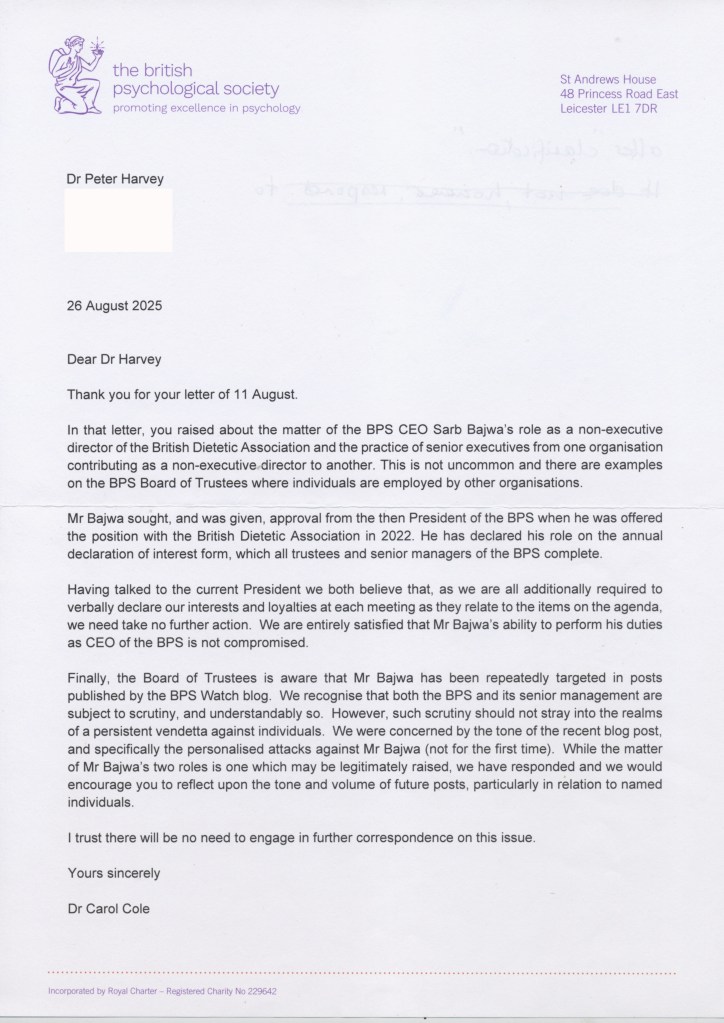
The curious case of Sarb Bajwa and the British Dietetic Association – BPS response.

We sent a copy of our recent blog post regarding the CEO, Sarb Bajwa, to the President and Chair of the Board of Trustees for comment. Dr Carol Cole, Chair of the Board responded and her reply is shown, in full and unedited (except for the redaction of my home address), below and is published with her permission. Note that this correspondence was originally by old-fashioned letter as, at the time of initial contact, the BPS did not have a way of contacting either the Chair or the President except by the CEO’s email; this is now no longer the case and both officers have individual email addresses at the BPS. In separate correspondence she also referred us to a statement by the BPS concerning Mr Bajwa’s return to work after his suspension and we are happy to post the link here.

Board of Trustees, Governance

Opacity and inertia at the BPS

This letter was sent to the Chair of the Board of Trustees, the President, the CEO and the Chair of the Practice Board (via email) at 0700 on Thursday 18 September, having been drafted the day before. By 0930 on Thursday 18 September the Minutes of the Board of Trustees meeting held in May 2025 appeared on the BPS website. As an aside, it is surprising that the Board hadn’t met since December 2024, a gap of 4 months. For comparison purposes the Board met eight times in 2021, nine times in 2022, five times in 2023 and five times in 2024. The minutes of the Practice Board (as of 0950 on Thursday 18 September) remain unpublished.

Dear Chair,

I write to you repeating concerns expressed since the inception of BPSWatch.com,  which was formed 5 years ago by three people who between them had more than 150 years continuous membership, track records of holding significant office within the Society and lifetime careers as practitioners. We have repeatedly during that period raised failures of openness transparency and accountability as well as restriction of debate around contentious issues.

We have had to contact the Society on a number of occasions to point out that minutes are not posted in a timely fashion for key boards. 

Importantly, there are no minutes of the Board of Trustees meetings for the whole of 2025 and it is now September. Have any meetings actually taken place? If so, why is it not seen as important to post records of the deliberations and decisions?

There are no minutes for the Practice Board since those for March 3rd, a gap of six months. Information on the of this Board should be a key focus for practitioner psychologists as they should inform us about matters discussed relating to the interface with public policy, public institutions, media and the wider public. The workings of the Practice Board should enable practitioner members to understand and contribute to the thinking, discussion and practice development of applied professional psychology in the UK. Many current and important policy issues clearly have psychology and psychologists at their heart. The almost information-free Practice Board Minutes of 3rd March do nothing to assist, let alone engage, practitioners in matters directly impinging upon their work. Taking the very high profile matter of post-Cass development of NHS services, the minutes merely state “Children and Young People Gender Group: The first meeting has taken place, and a discussion paper is in development”. Apparently nothing further is forthcoming since 6 months ago. Given that the Chair of the Practice Board and the President know from direct contact with concerned psychologists how much anxiety and energy was invested by senior practitioners in ensuring that post-Cass there would be credible input to future services, this parlous situation is wholly unacceptable. A further question, in the absence of any information whatsoever, concerns the ongoing dislocation of the BPS and the content of its Gender Guidelines from current review and policy discussion of adult gender services in England and Wales. We know that the ACP UK have been actively involved.

We received an assurance from the Chair of the Practice Board that given the gaps between meetings and the ratification of minutes there would be helpful updates of relevant policy development. These have not materialised.

Nor, as far as we are aware have there been helpful updates on any regular basis from the CEO, something we were led to expect when he was appointed. There is no open discussion of the BPS’s challenges and problems.

The Annual Report made available for the AGM was entirely unhelpful. It consisted of embarrassingly hearty self-congratulatory PR and little else beyond accounts which tell us we are now paying four senior staff over £100k per year, 2 of whom receive over £140k. There is declining membership reported, now significantly below 60k and many reports to us of poor Customer Relations Management. However, your restructuring saw the conspicuous disappearance of a Director level head of Membership and Professional Standards. You intend to sell off the Leicester Office base. This all sounds to members like declining health of the organisation, yet we are given no idea whatsoever what possibly questionable business plans have been running the Society from behind the scenes, and whether a radical change of course is desperately needed. From our position it seems that the focus is most definitely NOT on the professional career section of psychologists and a there is widely reported hostile reluctance to engage with senior experienced professional psychologists unless they toe particular ideological lines. This of course is a well known symptom of managerialism’s efforts to contain and suppress senior members who may challenge. BPS members are paying a lot for an unsatisfactory level of support and general performance. When we have challenged this, as we are entitled to do, this is deemed to be attacking staff personally rather than critiquing performance and outcomes. 

The BPS only exists because of members’ subscriptions. Paid and elected officers are accountable to that membership. Depriving that membership of information concerning matters of policy and decision making can  be deemed misgovernance and goes against Charity Commission requirements. 

Pat Harvey 

on behalf of BPSWatch.com

"The Psychologist", Gender

The Psychologist and the Continuing Decline of Content

Pat Harvey posts……

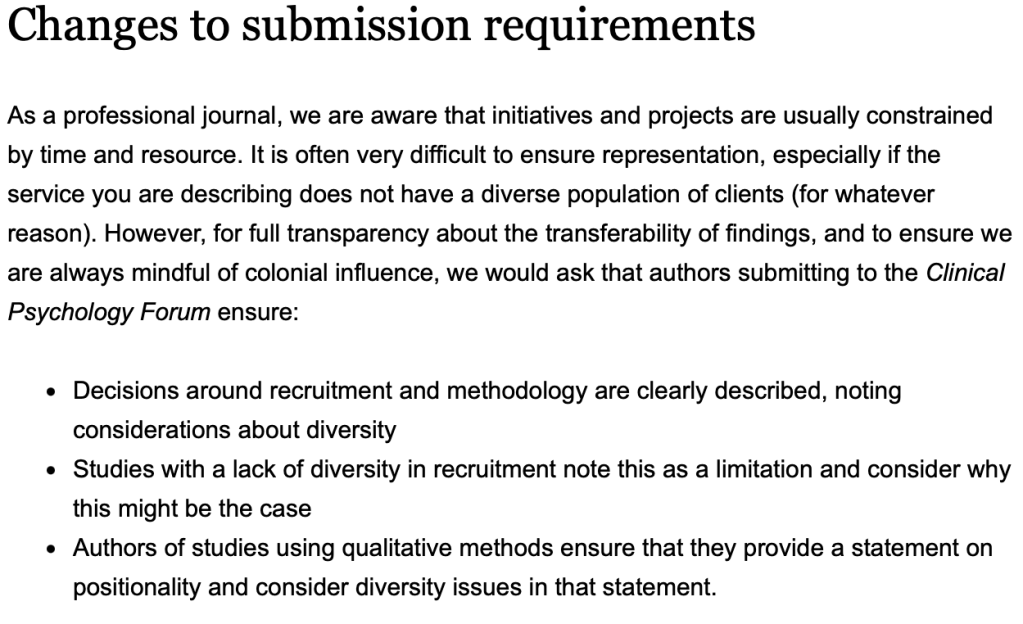
Two articles have been published in the August 2025 issue of The Psychologist of such poor quality and legitimacy that they suggest personal bias on the part of the editor and further bring into question the operation of editorial policy governance by the British Psychological Society itself.

Context

The Psychologist is the monthly online and hard copy magazine of the British Psychological Society (BPS). It publishes articles, letters, book reviews, news, interviews, and information on careers and professional development in psychology. It purports to be a forum for communication and debate among members of the BPS, reaching a broad audience within the UK’s psychology community, to promote the advancement and diffusion of psychological knowledge (both pure and applied) more widely and to provide a platform for communication among professionals. Its editor, Dr Jon Sutton, has been in post for 25 years. He is an associate fellow of the BPS as well as an employee of the Society, and he has recently been accorded the title of Head of Science Communication.

In the view of some of its longer term members and practitioners, the BPS has moved beyond its core purpose into a weighted focus on social justice, equality, diversity and inclusion. This has also been very evident in its publication. In one area of current controversy and public concern in particular the editor has eschewed inclusivity. He has failed to foster, even to allow, balanced debate around gender ideology and adequately to cover related legal and social policy changes that have been occurring globally and particularly prominently in the UK. The publication has, over recent years, demonstrated an editorial bias by regularly promoting the views of proponents of transgender ideology and by actively suppressing those of gender critical or sex realist psychologists. Very sparse  coverage, and almost no discussion and debate, has been afforded to the Cass Report, the closure of the psychologist-led Tavistock Gender Identity Service (GIDS), and the governmental banning of puberty blockers. The thrust of editorial hostility to these developments could be seen in such articles as A blow to the rights of transgender children [see here] which was ready and published a mere 3 days after the Bell vs Tavistock Judicial review. The editor confirmed to me in writing that this article had been solicited in months previous to the review and amended in the light of the ruling so as to achieve a rapid publication. Whilst the BPS offered support [see here] to psychologists ‘upset’ and ‘unsettled’ by GIDS closure (a unique response over years of NHS upheaval and cuts), The Psychologist has never allowed for the full debate and discussion needed around the multiple research, therapy and service provision issues informed by a psychological child development perspective. Nor, it must be noted, has it ever fully considered that the psychologist-led model might itself be seriously flawed. Indeed, members have reported the refusal of the editor to publish a number of submissions on these topics from senior practitioners.

A frightening agenda for Child Development?

The above gives a concerning context for the editor’s decision to publish the first article Is the future gender creative by Max Davies  [see here – this is a series of articles about creativity, and the reader will have to scroll through towards the end as there is no separate link for it]. 

The author is self-styled as Mx, a nonbinary female doctoral research student whose university profile cites a master’s degree in Equity and Diversity in Society [see here] where we are told the following: 

Max’s master degree dissertation topic focused on raising Theybies and how they navigate within a gendered world.gender creative parenting…. a new phenomenon where parents do not assign a gender at birth, use they/them pronouns and create an environment away from gender socialisation as much as possible for their children. 

It is unclear how The Psychologist’s editor might have come to commission this article when, given the central relevance of developmental psychology to what might generally be considered extreme parental practices, Mx Davies does not cite a first degree in psychology or membership of the BPS. 

The content of the article is very concerning in terms of child safeguarding. It states: 

As a nonbinary person, traditional gendered parenting did not seem like the right path for me. I sought something different, but I did not know what that was. 

What follows is, in essence, Davies’ blueprint for a highly specific personal agenda. The key points made by Davies are reproduced below:

To begin, I instilled a stronger sense of the existence of LGBTQ people through embodiment, literature, and experiences such as participating in Pride… this is about holding space that one day our child may also be a part of this community, and we won’t cause harm through incorrectly misgendering or raising our children solely one gender or the other from birth… not disclosing or displaying my child’s anatomy publicly, where possible…. I do not allow associative networks to form in others to align a sex to my child… change the meanings of one’s body parts…… disrupting binary language in my vocabulary… I would use a combination of neutral pronouns and would mix pronouns around in reading to reconstruct narratives in stories. Once children move beyond the home into daycare, ….challenge institutions and their assumptions and restrictions (Morris, 2018; Rhailly, 2022. [Author’s note – references not given in usable form). Without challenging institutions, we are sending our children into a very gendered and binary world….we try to disrupt this where possible and limit these interactions as much as we can.

An irony, which appears to be lost on Davies, is the article’s claim:

 What I did through this experience is give my child the freedom to interact with and make their own choices of toys, books, and clothes….

The writer has failed to consider the basic realities and the fundamental experiences that have been denied to this baby who was planned to become ’theybie’. These realities include the personal reality of its sexed body and the interpersonal realities of normal social interactions not manipulated or restricted by the extreme controls intentionally being imposed on social encounters. Did Davies ‘correct’ other small children as well as adults using ‘incorrect’ pronouns? What if they asked whether the child was a boy or a girl and what if the child came to ask this themselves? Were they fobbed off? How disruptive of normal social encounters did this prove to be? Did this child go to daycare or to school, and if so, what stringencies were imposed by Davies? Does Davies feel able to let this child go anywhere beyond parental scrutiny and outside the LGBTQ+ community where it might meet alarmingly binaried strangers? The child is displayed prominently in an Instagram photographic record which is annotated with “Max and River, home schooling, travelling, #travellingtogether“. One particular photograph is labelled “This theybie now a fully grown princess taking the world one adventure at a time.” Is this weirdly gender stereotyping a little girl or celebrating a ‘trans’ little boy?

Thirty years of practice in clinical psychology prompts me to express alarm for the emotional development and wellbeing this child. This parent is so patently denying the reality of the effects of their own self-absorbed personal obsessions and needs. The impact on a child so cloistered from the normal diversity social influences may well be a hyper-awareness of that parent’s moods and wants and an acute need for parental approval and reassurance. Adolescence may well be a different story. Davies blithely concludes:

Gender-creative parenting, to me, is about providing space for free creative exploration. A journey of self-discovery to develop a personal and unique sense of one’s own gender, wherever that may lead. Creativity is the embodiment and expression of my gender, and as parents, we can allow our children access to an open art box; they may make a mess on their journey, but the finished piece will always be a beautiful, unique masterpiece.

This approach surely allows no space for a child’s free creative exploration, no access beyond an art box with a limited palette curtailed by a determined parent. The ‘finished piece’, as so many unhappy stories in clinical settings attest, is cruelly all too often not a beautiful masterpiece.  The notion of childhood becoming a ‘finished piece’ begs many questions in itself, and certainly sets off alarm bells in my mind. I therefore suggest that the editor – Head of Science Communication – is to be admonished for irresponsibly publishing this extreme ideological piece.

Further context

Alongside the parlous recent record of coverage and discussion about children, adult transgender issues have fared similarly badly at the BPS and in The Psychologist. By giving the lead role of Chair to a male-to-female transgender activist to produce guidelines for psychologists and their colleagues, the resulting 2019 Guidelines for psychologists working with gender, sexuality and relationship diversity demonstrated the dire consequences of prioritising  lived experience over reflective objectivity. After publication, two of the working group demanded that their names be removed from the highly contentious and professionally embarrassing Guideline. In this document, research was misrepresented and debate had previously been deemed [see here] by the chair to be “…shut. There is not a debate about this anymore…”. Sexuality and Gender were lumped together to the detriment of the proper consideration of their separateness. The publication failed to make clear whether the guidelines applied to children until, following my formal complaint, the guidelines were rebadged as applying to 18s and over.  References to BDSM and Kink, and the inclusion of the word ‘slut’ in using clients’ preferred terms, clearly related to a personal emphasis of the chair who has spoken and published frequently on those matters. Unsurprisingly in such a context the gender guidelines were resolutely ‘affirmative’ and they overtly minimised the importance of co-morbid mental health conditions stating

…While GSDR identities and behaviours are not, in and of themselves, mental health conditions, in some rare cases people may have mental health conditions which present themselves in a similar way…”

as opposed to their view that societal oppression was the prime cause of distress and dysfunction .

In 2024 the guidelines were revised and essentially watered down in terms of the wholly affirmative approach and Kink and ‘Slut’ disappeared. However, the BPS chose to replace the two professionals who had removed themselves from association with the document with two avowedly trans gender activists, making that the stance of all the revision group. Hence the revised guidelines are effectively unhelpful and unbalanced in the current rapidly changing context. 

That context includes a post Cass review of England’s adult gender identity services. The Psychologist has singularly failed to publish discussion and debate as to how psychology and practitioners should contribute to new models of service provision. In April 2025 the UK Supreme Court ruled that the terms ‘man’, ‘woman’ and ‘sex’ in the Equality Act 2010 refer to biological sex (sex at birth) [see here].  This means that biological sex is real and fundamental in legal terms. Crucially, matters of internal or subjective realities figure centrally in gender, and reality is a substantial critical issue for science, philosophy and psychology and one which any editor and Head of Science Communication at the BPS should be flagging up. Instead of that we are subjected to a questionable published article discussed below.

Reality, Normality and the pursuit of a lucrative selling point?

The second article of serious concern in the August 2025 edition is Becoming a gender specialist: What’s normal anyway? by Laura Scarrone Bonhomme [see here].

Ironically this article is dignified by a heading which includes the tabs Ethics and Morality.  Google Laura’s name and she is identified immediately. This psychologist is a private practitioner who offers an explicitly and unapologetically affirmative approach [see here].

Dr. Laura Scarrone Bonhomme is a Consultant Clinical Psychologist and global leader in gender-affirming mental health care. With over a decade of experience across the UK, Spain, and Chile, she’s supported hundreds of trans, non-binary, and LGBTQ+ clients through therapy, research, and clinical supervision. A chartered member of the British Psychological Society, she’s also the co-founder of Affirm, a global training platform equipping clinicians to provide inclusive, trauma-informed care. Dr. Scarrone Bonhomme is the author of Gender Affirming Therapy: A Guide to What Trans and Non-Binary Clients Can Teach Us and a regular voice in international media and conferences, challenging bias in mental health systems and advancing care rooted in dignity, self-determination, and liberation.

A Reddit user tells us [see here] on the first Google page:

Laura is a great consultant at £500 for an 80 minute consultation and £150 for a follow up appointment (if necessary) – with a referral for HRT if diagnosed”

Hence Laura is easily identified by those who want a fast track to medicalisation. She is easily verifiable as a psychologist willing to meet their affirming gender journey demands. She confirms her membership of WPATH  (the World Professional Association for Transgender Health) where health has come mostly to mean medicalisation with drugs and surgery on demand as of right. WPATH has attracted damning criticisms about suppression of research and of its latest Standards of Care 8 which have now included eunuch identification.  Individuals assigned male at birth who identify as eunuchs may also seek castration to better align their bodies with their gender identity because WPATH sees this as valid reason for surgery, as with other gender affirming care. Laura is also a member of BAGIS, the British Association of Gender Identity Specialists, which is the UK’s version of WPATH, a body which NHS England is now more reluctant to consult.

Examination of this article again leads to astonishment that it was sought and accepted by the editor. It makes what can only be regarded as outlandish and extraordinary statements for a psychologist in a publication of this sort:

As psychologists carrying the weight of medicalisation, it can often feel as if we are perpetually searching the ‘holy grail’ of what’s wrong…. And you realise that, perhaps, and only perhaps, there are things we cannot comprehend.

I have realised that you are more likely to become pregnant using contraception (between 0.1% and 28%) than you are to regret having transitioned (between 0 and 13.1%). After over a thousand patients, I have come to terms with the possibility that some people might look back and wish they didn’t. Though, having transitioned might have been a crucial step in their realisation. (MY EMPHASIS) My question here is: if this is such rare occurrence, why draw so much attention to it? What narrative is being created as a result of it? I’ll leave you pondering.

The stark reality is that, in the UK, trans people are denied body autonomy. Brazilian butt lifts, liposuctions, and dermabrasions. Botox, fillers and even vaginal rejuvenations. We lift, we suck, we burn and freeze to your heart’s desires. Any cosmetic treatment a cisgender person requires is granted reasonable but daring to feminise a body that wasn’t assigned female at birth, or masculinise a body that wasn’t assigned male at birth… that, I am afraid, is a step too far. It seems like we still believe that men should be masculine and women feminine, and anyone outside those boxes is subjected to close examination. Even treatments that could be classed as cosmetic and not necessarily gender-affirming, like facial feminisation surgery, are frequently gate-kept from trans and non-binary individuals. Why these differences? What is it about sexed characteristics that makes us so protective and afraid?

I saw myself as the Gok Wan of psychotherapy, helping people feel and look… just fab! Even though my vision didn’t materialise, unexpectedly a world unfolded, as I realised the ways in which I too had been boxed by people’s expectations. My trans, non-binary and gender-questioning patients taught me more than I can express in words. They revealed a world of distress I didn’t know existed. They uncovered a wealth of creativity, a profound analysis of society. They bared the shame, the stigma, and the fire required to live outside of ‘what’s normal’.

The non sequiturs in this starry-eyed world view, the conviction of her own worthy position as helping to deliver ‘liberation’, the minimisation of serious risky life-long medicalised trajectories is alarming. Is that what psychologists should be offering at £500 for 80 minutes? Perhaps most fearful is her proposition that the regret of a detransitioner at the end of such ‘treatment’ might be crucial to arrive at the realisation that transitioning was the wrong decision. Presumably that is how she has squared with herself her previous fear she acknowledges about detransitioners. Other ideologues have rationalised detransition as not as a ‘mistake’ but as a potential and acceptable stage of a person’s gender exploration. Such framing encourages a surgically mutilated person to banish regret and a psychologist to continue to frame their affirmation as facilitatory. With regard to the psychologist’s responsibility, Upton Sinclair is purported to have said: “…It is difficult to get a man to understand something when his salary depends on his not understanding it...”. There could be a similar quote for financial transactions causing such failures of cautious reflection in some psychologists. Likewise, an avoidance of basic curiosity, let alone seeking to formulate a client’s problem, may lead to Laura’s pearls of Queer Wisdom: 

the only way to make that right is by changing things on the outside. By making their appearance more like their mental image… there are things we cannot comprehend….. What if normal doesn’t exist?

Is this morally, ethically and intellectually acceptable from a ‘specialist psychologist’?

An end to the editor’s agenda or an end to The Psychologist?

The editor has responded to numerous efforts by senior and widely experienced clinicians, academic and applied psychologists, to redress the balance and foster debate around matters of gender. In the course of discouraging or refusing to publish, he has placed in writing to some, including to myself, an editorial position about which he is proudly intransigent. He states that he privileges and prioritises the voices of trans people and those who work directly with them. This is hugely problematic for a publication of a learned and professional body centrally implicated in education, health and social policy and is a position currently subject to active criticism by those such as Darren McGarvey [see here] . He cautions against the risk of building services around stories, rather than evidence.  Anecdotal views of individual trans-identified people may be dangerously unrepresentative. The label ‘trans’ covers diverse groups of both sexes and all ages with a possibility of a range of co-morbid mental health conditions and a wide range of social and developmental experiences. In the context of “…those who work directly with them…“, recent history of Gender Identity Services has recorded a huge rate of exodus of disaffected professionals from the limited and limiting models of service provision which are now being dismantled. Furthermore, gender should not be a corralled highly specialised topic about which only a few that the editor deems worthy of priority can comment. Many psychologists, practitioners and therapists encounter trans-identifying individuals and issues within the clinics, schools and other networks within which they work. The editor clearly owns an unacceptable bias.

This article will form the basis of further attempts to pursue formal complaint. Other instances of editorial failure will be cited. It will be argued that this publication is failing the membership, risks bringing the discipline and the practice of psychology into disrepute and fails the public. The BPS must bring the editorial policy under scrutiny and review and account to the membership and to the Charity Commission should it fail to do so.

Gender, Identity Politics

“Protect the Dolls!” Profanity, Sanity, Sanctity and Sanctuary?

A feminist psychologist seeks to promote open discussion of a trans campaigning phrase. Natalie C Rose posts….

In the United Kingdom, very recently, the government’s current Culture Secretary, Lisa Nandy, was pictured on a Pride parade wearing a t-shirt proclaiming Protect the Dolls (see here). “Dolls” in this context are males identifying as females, so-called trans women, who seek to “pass”. Passing means achieving the perception by others of the trans person being their adopted gender rather than their biological sex. For some trans people this is more important than for others. Social experiences of failing to pass are deemed to cause distress, anger and despair. Google the phrase Protect the Dolls and AI will inform you that “…the phrase originated in the 1980s ballroom scene and has become a popular slogan supporting transgender women. The term “dolls” is a term of endearment used within the LGBTQ+ community specifically by and for trans women. The phrase, popularised by designer Conner Ives (https://en.wikipedia.org/wiki/Protect _the_Dolls) is a call for protection and affirmation of trans women, especially in the face of increasing attacks and discrimination…”. This is a demand made on everyone in society. As far as I am aware there is no similar injunction pertaining to trans men.

Profanity?

But why dolls? Dolls are the archetypal toys of childhood, having manifestations across many cultures through human history. They are varied in form and meaning, witness baby dolls and Barbie Dolls™. The term Doll meaning a woman was once familiar in the all American movie. Uttered by an all-American teen or GI it objectified the glamorous female catching his attention. Dolls, however, are also the stuff of the Horror movie genre; unsettling, uncanny, creepy and threatening.  They stray easily into the profane – blow-up dolls with usable orifices for an adult market not only interested in doll adults but also in doll minors. This was presaged by the shockingly aberrant forms of the misformed sexualised child dolls of YBA’s Jake and Dinos Chapman in the art exhibition Sensation, which opened its world tour in London in 1997 alongside the famous pickled shark and the children’s handprints constructing the face of Myra Hindley (see here). Culture plays out many forms and has multiple active connotations and allusions. Sexual desires weave their way through much of this, and it seems sexual proclivities and fetishes still need material material as well as digital imagery on screen and online.

Sanity?

So, what is with the dolls of transgenderism beyond the ballroom scene that most will know little or nothing about? These trans dolls may be 6 feet 2 inches tall with unalterably broad shoulders, and the male to female dolls are the ones we are urged to protect. Within transgender campaigning, this truly concerns only the males wanting to be females not the females wanting to be males. From the perspective of psychological inquiry, this quickly takes us into the psychological world of some of that male group and their allies and into a delusion of trans-substantiation. To trans woman India Willoughby and to the gender studies scholar Professor Sally Hines, males who don female clothes and make up and also take oestrogen do actually become the 1959 Cliff Richard’s real cryin, talkin’, sleepin’, walkin’, living’ doll, – they become embodied woman, real females   “..take a look at her hair, it’s real, and if you don’t believe what I say just feel…” (see here).

How many of males currently identifying as females are actually aspiring to a notion of the living doll? More real than a real woman. Some openly describe themselves as better women than cis women;

Trans women are the only real women! Humanity through technology and medical advances has progressed to the point that cis females have gone the way of the Neanderthal; a biological dead end that’s time and purpose have passed”. (see here)

 Are we allowed to say this is not sane, call it a delusion? Here the belief system joins forces with Transhumanism, where individuals want to shuffle off the limitations of the actual mortal coil and attain their fantasised essence, incorporating and possessing it for themselves, forever. Real women, biological females, are an irritating inconvenience and are dispensable.  Surely this is a less than sane and morally offensive subjectivity?

Sanctity?

Non-doll-like, actual women are diverse, messy, imperfect, flawed. Conceived as female, born as baby girls, navigating the trials and tribulations of growing into womanhood, women make up half the human race and they sit at the heart of nature’s preferred model for reproduction of the species. From fairly early on, in all cultures, those women have a wariness (more or less conscious depending on upbringing and experience) of the otherness of males, their superior strength, their propensities for significant differences in sexual, aggressive and dominant behaviour, their gestures, gait and mannerisms. Most men, including trans women, will never understand how instantaneously women, including young girls, women with Down’s syndrome and older women with dementia will reflexively perceive that a trans woman is not a woman. This recognition is not necessarily one of perceiving an active threat, but of something disquieting, untoward. This will add to their sense of vulnerability when it occurs in the context of a woman’s sickness, psychiatric disturbance, trauma or incarceration. Sometimes there will be real danger.  

Sanctuary?

As acknowledged above, trans women, in the main, may present no physical threat to women when they enter women’s spaces, but they do disturb the precious sanctity by disturbing women’s inner peace. Sanctity for womanhood has been sought, often in vain and at a high price, in human cultures through millennia. Where it has been achieved, it is precarious and fragile. Latterly it has been threatened by chants of “Transwomen are Women”, the mantra that closes down discussion and when contested has lost women their jobs.  Sanctity needs sanctuary. Such sanctuary gives women psychological as well as physical safety. Women want it for women’s reasons, such as being able to just be off-guard, to enjoy dignity and privacy, a rest from being kind when you just feel uncomfortable. It is not wanted for the performative reasons of many trans women who seek to enter women’s spaces. As a woman out there, you can only reliably take that privacy and dignity for granted in the company of your biologically female kin in unquestionably women only spaces. 

Please now let us keep to the letter of the UK Supreme Court Ruling about those spaces (see here).

Board of Trustees, Governance

The curious case of Sarb Bajwa and the British Dietetic Association

David Pilgrim posts….

Sarb Bajwa remains the CEO of the British Psychological Society. In the view of many, he has been a lame duck ‘leader’ since his suspension in the wake of the fraud perpetrated by his personal assistant. The appointment of that assistant was surely his responsibility. She had 17 previous convictions relating to fraud. Over an 18-month period there were more than 900 authorised fraudulent transactions on their Society credit cards amounting to more than £70,000 (see here). Bajwa’s year-long suspension resulted in eventual reinstatement, but questions were raised about failures on the BPS side of the timeliness, process and probity of their investigation of his conduct.  

Astonishingly, not content to retain his full-time salary, and with his legitimacy hanging by a thread, the BPS CEO decided to branch out and offer his personal wisdom to another organization, becoming a Director of the British Dietetic Association (BDA) in 2022. This is the only body in the UK representing the whole of the dietetic workforce and it also functions as a trade union (see here).  

Whether the BDA were told of his suspension is one of many loose ends to query about Bajwa’s flirtation with ‘moonlighting’. We do not know if this unreported soft shoe shuffle was done with the complicity of the BPS Board; maybe they were allowing him a face-saving exit to pastures new. Who knows? We can only speculate because we can only do that, given that the BPS has an unfailing habit of not disclosing matters of importance to ordinary members of the Society. Members were not told about the fraud at the time, nor of his suspension, nor of the quick exit, minus punishment and whilst still presumably suspended, of the Chief Finance Officer to a post at, ironically, the National Lottery Community Fund. 

Now members have not been told, except by @psychsocwatch on “X”, that the Leicester BPS HQ office is now up for sale. For those new to the news, you may want to read that sentence again, but it is true. The BPS has run a deficit for many years and drawn down Society assets in the millions. There were many financial irregularities over the last two decades and five changes of Finance Director in about as many years. The membership has kept been totally in the dark about this dire financial position of the Society.

What purported to be a “business plan” discounted holding onto senior practitioner membership and their interests in favour of grasping at recruitment of early career graduates and their accreditation. That tactic is not turning out to be a cash cow. Rumblings about accreditation within higher education are seeing senior academics question what they actually get from the BPS, other than a tiresome bureaucracy constraining their freedom. Income streams, which sustain the highly paid Bajwa, his mysterious deputy and his Senior Management Team are clearly wobbling. The financial viability of the BPS is now highly uncertain. An Al Capone type outcome might be emerging. It is not the self-serving mendacity of the leaders, we have documented at length, that may be their downfall but mundane financial matters. However, for them it is not about owed tax but empty coffers.

Under Bajwa’s stewardship, a cabal has continued to run the BPS incorporating for a while the CV-improving applicants for Board membership. This has included cycle after cycle in the past ten years of Presidential candidates. A significant proportion of them have removed themselves before completing their three-year term. One was reportedly physically removed from the premises, one was expelled from membership and another left for personal reasons. One president, David Murphy, resigned as Vice President after the reputed breakdown of his relationship with Bajwa. Given the failure of accurate reporting by Jon Sutton, the supine editor of The Psychologist, of the true reasons for his resignation, Murphy was moved to publish his full letter of explanation on “X” (see here). The first appointed independent chair of the Board of Trustees, David Crundwell resigned without explanation after being in post for a mere 15 months (see here)

Who, other than BPSWatch has reported this shambolic picture of disaffected departures and financial meltdown? The Board have carried on regardless, with boat rocking not being permitted and the duty of transparency on behalf of ordinary members going absent without leave. Only those in the know are allowed to continue to be in the know. The antics of Bajwa have only been possible because of these other complicit actors. 

Given all of the above, what role has Bajwa been exploring on the Board of the BDA and how does he depict his claim to grand managerial authority? His statement here on the BDA website conceals his role in the BPS completely:

I am a senior manager and leader and spent the early part of my career living and working in Southern Africa for an international aid organisation. Over the last 15 years I have been working for a number of global professional membership and learned societies in a variety of regulated sectors, including: legal services; financial services, the engineering industry and health and social care. I am used to working in a changing national and international political landscape and have led these organisations through a variety of challenges. I understand the importance and value of professional bodies both for their members and the wider public good and believe that they have an invaluable role to play particularly in terms of building and sharing expertise and knowledge. I have been responsible for strategic planning; operational delivery; change management; managing campaigns and lobbying; public policy development; events and marketing; external relations and stakeholder management; customer service; financial and budgetary management I enjoy leading and driving change, being externally focused and forward facing and I have consistently delivered growth in the organisations for which I have worked. I am excited and looking forward to being part of the BDA family and contributing to our success.

This statement is, of course, not big on humility but, to be fair, we are all now used to the shameless self-promotion in the new professional class of managers. Bajwa is no more or less guilty of this sort of bullshit which we have come to expect from most of them.  But it is not what he says here that is the problem but what he does not say. We need to move into what philosophers call an ‘omissive critique’ in a wider exercise of critical deconstruction. Here I pick out some of his key claims.

Claim 1 I have been responsible for ….change management… Would that be the £6 million wasted of the members money, with no proven outcome?

Claim 2 I have been responsible for external relations and stakeholder management…. This has included becoming an expert on mental health, even getting co-authorship in an article in The Lancet, despite no clinical or research credentials in the field. As for ‘stakeholder management’, does that include the skill of keeping everyone in the dark, including his own workforce, about selling off their place of work? 

Claim 3 …..financial and budgetary management. Laugh or cry at this point? Would that be him signing off the fraudulent claims of his subsequently imprisoned PA? Would that be overseeing the demise of the Society’s financial viability, with the needed redundancies and property sell-offs first in London and then in Leicester?

Claim 4 I have consistently delivered growth in the organisations for which I have worked. Another laugh or cry moment and a reprise of the previous point.

Claim 5 I am excited and looking forward to being part of the BDA family and contributing to our success.  Well, if the BDA family was to be his new refuge, presumably he would be making decisions about living in two homes and allocating time to each.

Can a full time CEO of one organization be a director in another?

The answer to this question in a British context is ‘yes’, if it is within the law. The challenge of credibility Bajwa has here (along with the complicit actors in his ‘two families’) is not legal but ethical and it revolves around the matter of trust in principle and his personal trustworthiness in practice. This broad point contains with it the following considerations.

First, did the BPS Board approve of Bajwa’s move to a ‘new family’? Again, we do not know, but Board minutes from the time may provide that answer, unless -conveniently – the relevant content is redacted, which is a hallmark of BPS information control to the outside world. If it was approved, redacted or not, then it is not clear what benefits would accrue exactly in Leicester. Surely energy and time would be lost. Synergies might accrue but they should be proved, not assumed.

Second, are the activities of the two organisations separate enough to ensure no conflicts of interest? Neither Bajwa nor his complicit actors at the head of each organisation can reassure any sceptical onlooker. The latter first needs to discover the fact of his two-family living arrangement about the ‘challenge’ (as managers like to describe excruciatingly awkward questions) his dual role poses. Again, we may be the only source of that disclosure – it certainly has not been announced by anyone in the BPS to our knowledge.  An obvious query considering that fact relates to the professional work of dieticians and health psychologists. There may be boundary disputes between them and conflicting emphases in their client work. 

Third, there is the matter of time commitment and this links to the point about assumed synergy. If the latter cannot be proven, then why would a full-time CEO in one place be encouraged to take on the burden of a directorship in another? If Bajwa is receiving payment for his role, this is one consideration, but even if the role is pro bono there is still an opportunity cost. Bear in mind that the fraud and the financial meltdown have created an organisation in serious trouble. That being the case, surely any CEO worth his or her salt should devote 100% of their time and effort to mitigating the impact of an imminent organisational implosion. This is a crisis for the workforce in relation to their job security and a crisis for the BPS members if they unwisely still rely on the Society as a stable base for their discipline. Both staff and members are now in jeopardy, so this is not the time to fiddle while Rome burns. However, this is the BPS and the expected norms of probity and caution in publicly responsible bodies do not apply within the culture of its cabal.

Fourth, in that context, can Bajwa discharge his fiduciary duties with proper integrity to both the BPS and the BDA? This is an open question, but it needs to be asked for all those interested in credibility of both organisations. For example, the loyalty to each is strained by the conflicts of interest noted above.

Fifth, can confidentiality be sustained and kept separate when two roles are carried out simultaneously?  Scenarios may arise when the confidential interests of one organisation might interfere with the other one. 

Even a person with a proven track record of ethical integrity would struggle with these tensions. In the case of Bajwa, his integrity has been tarnished by the fraud and his Houdini-like escape from its consequences. This is not a good look for him or either of the two “families” that he currently shares. Sadly, it is what we have come to expect on this blog from those running the BPS. Few CEOs in the third sector have the dubious distinction of having a whole book published about the dysfunction of the regime over which they continued to preside (see here ).

There is a depressing symmetry between a failed organisation and its failed managers. The former may have emerged anyway, given changes in the economic viability of siloed uni-disciplinary authority; a norm in the last century, which has fragmented in this one. Better managers might stave off the inevitable, whereas poor ones expedite the decline and fall. Bajwa and his cabal confirm this conclusion and leave us with one last query. Do those at the top of the BDA (or its’ ordinary members) have any idea at all about what has happened in the BPS? For Bajwa to have had the gall to make the statement he did on their website reflects his character and maybe their naivety about welcoming him into their family. 

EDI, Gender, Identity Politics

Open letter to the British Psychological Society

Pat Harvey reviews the incredible actions and inactions of an incompetent BPS in relation to debates in which it should have taken a strong and credible lead in a letter on behalf of BPSWatch to the Chair of the Practice Board

Dear Dr Lavender,

Sex and Gender and the British Psychological Society’s Ongoing Failures

We are writing to you in your capacity of Chair of the BPS Practice Board. We have concerns which we wish you to formally bring to the Practice Board for discussion as a matter of urgency. These concerns relate to the continuing dereliction of the BPS as a learned and professional body in relation to its duty to assist and, indeed, lead the continuing public debate on sex and gender. These are clearly matters falling directly – even centrally – within the purview of academic psychology and of psychologist practitioners and about which the BPS should have authoritative statements. They are impacted by an evolving context of government policy, service reviews and legal judgements towards which the BPS has latterly taken a decidedly “spectator” stance. This is embarrassing for members, and not what they pay their fees for.

Adult Gender Services

The Practice Board ratified a revision of the 2019 GSRD Guidelines in 2024, although we note from other minutes available to members, not without some concern about how the process was conducted, including the fact only the chair had seen the final draft. There had been a very evident changing context since 2019, signposting the subsequent and ongoing review of adult gender services  (https://www.england.nhs.uk/long-read/review-of-nhs-adult-gender-dysphoria-clinics/)  which noted:

  • concerns put to the review team by current and former staff working in the adult gender clinics about clinical practice, particularly in regard to individuals with complex co-presentations and undiagnosed conditions
  • lack of a robust evidence base; being mindful that the majority of referrals to the adult gender clinics are of natal females who are aged between 17 and 25 years, and that the historical evidence base that has informed clinical practice relates to an older cohort of natal males
  • limited information on short and long-term outcomes, particularly for those individuals who transferred to adult services from paediatric services
  • an increasing incidence of individuals seeking to ‘detransition’ following previous gender affirming interventions and the absence of a consistent, defined clinical approach for them.

Astonishingly, the BPS chose to replace the two members of the 2019 Task and Finish Group who had demanded their names be removed from that document with two individuals associated with strong trans ideological/activist connections. That ensured that the whole revision group came from one position in the debate and one provocatively at odds with changing knowledge and opinion. It was also unacceptable that the chair remained an individual about whom formal complaints have been made concerning the public statements that research on surgical treatments for transgender people indicate that “…that debate is shut, there is not a debate about this anymore…” (https://www.youtube.com/clip/UgkxRGiT6y5ouSa6T9Nes0om-J6HWo7otLDx). This statement had been patently false, irresponsible and unethical, and unacceptably the BPS had supported that position. It has had no excuse subsequently, however, not to have been fully aware of the incongruity of retaining that chair to lead the process of reviewing the BPS guidelines .

A wise and reflective British Psychological Society would have been following social and professional developments in the period since 2019 and decided that the original Guidelines were patently and wholly unfit for purpose, and scrapped them. It would have set up a new group, carefully considered the Society’s position, acknowledged controversies and social pressures and supported practitioners back in their clinical and educational environments/teams to be able to discuss the management of gender distress with balance backed by confidence in their professional body. As the Guidelines now stand, they are unhelpful, biased and ideological rather than research and practice based. They are discredited. As such they undermine the credibility of the Society. They are not only embarrassing, they fail the public. And, most importantly, they fail the very people who are asking for help.

Children’s Gender Services

At the point at which new services, with stated aims to provide holistic models of multidisciplinary care required by the Cass review, are being developed, the BPS has entirely abrogated its right to a seat round the table of discussions about the central role that Psychology – academic research and therapy – could and should be fulfilling. The last Practice Board minutes available to members (weren’t we going to get summaries of what was going on in the Board to bridge the gaps?) stated that there had been a first meeting of a group (recruitment criteria unknown, membership unknown, chair unknown) and “a discussion paper is in development” (March 3 2025) This is a stable door creaking on its hinges as the horse is running many furlongs in the distance. 

Further Questions

What of Women’s rights and a Society response to the recent Supreme Court ruling which clarifies that biological males, even those with a GRC, cannot be considered women under the Equality Act when it comes to single-sex spaces or services? No comments?

What of the difficulties researchers have experienced in carrying our basic research on sex and gender (see “Review of data, statistics and research on sex and gender Report 2: Barriers to research on sex and gender” (2025) https://www.sullivanreview.uk/barriers.pdf ) such as Professor Sallie Baxendale, clinical neuropsychologist, who experienced repeated rejection of her work by journals on the impact of suppressing puberty on neuropsychological function, saying: “It wasn’t the methods they objected to, it was the actual findings.” No comments?

Beyond that series of instances of barriers, there is a question that perhaps a healthier BPS might be able to address, what are the social psychological implications of gender “exceptionalism” that have led to an extraordinary breakdown of norms in academia and in clinical practice? Might not the BPS be directly implicated in that breakdown?

The Future of Psychology and the BPS in relation to Gender

Clearly there has been an inherent breakdown in how the BPS has and is still responding to the wider controversies on Sex and Gender. The Practice Board has clearly failed in its remit. To undo actual damage to credibility and reputation, It should start by withdrawing the GSRD Guidelines and scrupulously review the energy and activity of the current Children and Young People Gender Group. The BPS as a whole needs to acknowledge its shortcomings and seek a widespread and vigorous consultation with members.

The hitherto biased and resistant editorial policy in respect  of The Psychologist should be urgently reviewed.

Given this unfortunate history and the suppression of debate within the BPS and in the pages of The Psychologist, BPSWatch.com intend to continue a challenging series of articles under the title psychology UNREDACTED. The first two and a response of these should be read by interested parties:

The next article in BPSWatch.com will be this open letter to you. 

We demand action.

Yours sincerely,

Pat Harvey

Peter Harvey

David Pilgrim

BPS members and BPSWatch.com

cc. 

President of the BPS

Chair of BPS Board of Trustees

CEO

Director of Knowledge and Insight (as currently still designated on website)

EDI, Gender, Identity Politics

How is Gender Different? Let me Count the Ways

Work with gender discomfort often seems to lead to very different approaches to those used in any other area of distress. John Proctor considers just how strange this is.

It happened at the end. At an event to discuss whether mental health initiatives in schools might sometimes be unhelpful. Short answer: yes – but it was the discussion that was illuminating. For two hours we considered Mental Health First-Aid, self-diagnosis via TikTok, and how ordinary feelings can be pathologised. Above all we debated how to work with teenagers who adopt diagnostic labels as identities. Then, just as we finished, one young audience member made a final point: “As someone who works with LGBTQ+ youth, their problem is external oppression. It’s about not being accepted for who they are.” [My emphasis]. No chance to reply. While initially frustrated at the lack of space for a response, I’ve thought about that statement many times since. More recently, I appreciate such a clear pronouncement on how we should work with gender discomfort, and such an explicit signal as to what our responses, including those of psychological practitioners, should be. Apparently these need to be different to those provided for any other kind of distress. And this is indeed what we have done over the last few years. Here I’d like to think about the ways we have treated gender as exceptional, and some of the resulting problems.

The first area of difference is the conflation of one issue with another: in this case of sexual orientation with gender. We frequently hear the letter combination LGBT, and the old rainbow flag has been replaced by the ‘Progress’ version. I do often wonder though if these labels actually belong together. It’s worth remembering that this teaming is a recent thing. Adopted for campaigning purposes, it steps adroitly over the fact that the issues raised by same sex attraction may be very different from those raised by gender identification in a way different to your sexed body. For example, being gay does not lead to either arguments about competing rights or to a proposed medical pathway. Indeed, far from a happy coexistence, some ideas about trans rights may be antithetical to the LGB part of the rainbow, as same-sex attraction may be replaced with the idea of same-gender (thus mixed-sex). This was a significant issue in the recent Supreme Court case brought by For Women Scotland in the United Kingdom.

While the commenter in my session only made a single remark, I think the reason it has stayed with me is that ideas of acceptance as primary have become very familiar in my professional circles as a psychologist. In particular, I often hear an emphasis on the validation of gender identity placed ahead of any attempt at investigation and of developing a detailed picture of why someone may feel the way they do. It’s been well documented how, in the UK’s primary specialist service for children with gender issues (the Gender Identity Development Service at the Tavistock Clinic), many clinicians turned away from a more exploratory approach to gender discomfort. Instead a more affirmative stance became favoured. Though some staff clearly held to a more traditional model of working (understanding and formulating), others wouldn’t, or couldn’t, do so. More worryingly this also led, for many, to referral for endocrinology treatment. The evidence for the effectiveness and safety of those treatments has been seriously questioned

Professional bodies have also taken steps towards encouraging more affirmative, identity-based, working with adults. For example, The British Psychological Society’s Guidelines for Psychologists Working with Gender, Sexuality and Relationship Diversity, as well as conflating sexual orientation with gender self-identification, place an emphasis on rights and on de-pathologising any aspect of sexuality or gender. There are cautions not to engage in “conversion therapy” and to make sure you make no judgement on someone’s choices. This makes sense to a point. Of course psychological practitioners wish to respect the people they see. But there is, perhaps, some balance needed.  The primary message is that the experience of being uncomfortable with your sexed body in particular is, in these guidelines, not something we aim to understand, but rather an identity that needs to be validated. Any idea that a therapist might think about the function of trans identification in managing painful emotions, or identification away from your bodily reality as a response to experience, is nowhere to be found.

At organisational levels too this idea of validation takes us along a different path from the one we might take for other issues. We fly flags in our departments, display posters, and put pronouns in our email signatures. All in the name of inclusion and allyship. Some colleagues even offer the idea that clients will know they are “safe” if they display these concrete signs. Presumably not offering such signs is therefore unsafe? And, uniquely, we decide that this issue, out of the many available, is the one we’ll announce a position on. However, for psychological therapists, neutrality is quite central to our ordinary stance. People come through the door and we think with them about their experience. It is not normally our job to pre-empt our conclusions or to take sides in painful and divisive areas. And yet our organisations decide for us that the task is to affirm the identity beliefs of clients. Good outcomes are already being framed according to our ability to agree with someone rather than to explore.

So why this need for validation: individual, organisational, and even societal? Again, I think the speaker at my meeting caught the essence of why this should be so. It’s because of “external oppression”. Over the last few years we’ve heard a narrative of marginalisation and powerlessness in answer to any questioning of how we respond to gender-related matters. Whether the conversation has been about women’s rights and protections, or about questions over puberty blockers, the response is so often that a marginal group is being attacked. The protection of a group we judge vulnerable is an imperative so strong it seems to stop thought about whether there is a different way to approach things. Additionally, we have tools to codify where privilege and powerlessness reside, and certain groups are always deemed to be at the margins. The listening and thinking, which are the work of therapy, are apparently no longer necessary. I sometimes wonder if such a prescriptive approach is to ordinary therapy as colour-by-numbers is to actual painting.

Such responses always raise my curiosity. Are we really talking about the most marginal and powerless group here? Some dispute it, and the prevalence of “trans rights” promotion (from road crossings to HR policies, to arguments made at public expense) in UK public life leaves the powerless narrative looking rather less than convincing. I see nothing comparable for marginal groups such as people with disabilities, or dementia, or who are homeless. In the area of sex and gender the powerlessness seems to me to be far more plausibly located in the people who have had to fight, through the courts, to express beliefs which go against our most recent orthodoxies. For some organisations taking a strong position has not been enough. Legitimate alternative views have also not been tolerated in the face of an axiomatic presumption that there is only one right perspective. This has not only been a divergence from our way of looking at other areas, but also more than a little alarming. 

It’s perhaps only when we consider how different all this is from the way we approach other forms of distress that it becomes apparent just how strange it all is. Let’s think for a moment how it would look to treat eating issues in a similar fashion. The similarities between eating disorders and gender discomfort are evident. Both may be characterised by unease with one’s body, by steps to respond to that distress with quite extreme physical changes, and an underlying context of trauma. After the initial similarities however, gender issues and eating issues part ways. Generally the response to eating disorders is grounded, very firmly, in attempts to understand and work with the experiences and the feelings we encounter. Psychotherapeutic approaches are to the fore and, in cases where greater physical harm is a risk, compulsory hospitalisation and even force feeding come into play. While I, and many, have reservations about the compulsory aspects of treatment, it’s understandable how we get there. Sufferers are at risk of permanent physical harm, or even death. We struggle to let that go unaddressed and tend to use any means we have available to stop it. No surprise therefore that, societally, our response to “pro-ana” advocacy (the idea that starving yourself and extreme thinness is a human right or lifestyle choice) has largely been one of horror. The contrast with gender is striking. At no stage do health professionals working with eating disorders wear “pro-thinness” lanyards, promote bariatric surgery as a human right, and include celebrations of our true body shape in our messages to colleagues and service users.

You could make a similar case related to self-harm, body dysmorphia or a belief one is Jesus. In each case therapists balance empathy with careful exploration of underlying causes. They don’t typically affirm harmful behaviours, quickly move to physical interventions, or suggest that the primary source of distress is others’ failure to understand that someone really is the Son of God. Yet, in gender therapy, chest-binding and surgical alteration can become marks of autonomy, and those who are cautious about someone else’s metaphysical beliefs may be branded bigots.

It is clear that at least some things are changing. The fate of the child GIDS service is, by this point, well known. The Cass Review strongly criticised existing practices in gender healthcare, particularly highlighting weak evidence for puberty blockers, and GIDS closed its doors in 2024. Cass made recommendations for a more holistic, and psychological, approach to gender distress. In the UK children’s access to puberty blocker medication and cross sex hormones has either been restricted or is under review. Adult gender services in the UK are also under scrutiny. Similar developments can be seen elsewhere. Not only have several European countries executed a volte-face in policy, but significant segments of the USA seem to be waking up to widespread public concern about “gender-affirming” medical interventions for children in particular.

Despite these increasing doubts about where we’ve been, this picture of change is, at best, partial. Though many organisations have welcomed the Cass Review, a number of others have either publicly opposed its recommendations or have experienced significant internal conflict about how to respond. There are private providers who, while they may offer assessment, still seem rooted in a belief that they can somehow divine who will benefit from irreversible medications during puberty. To use such drugs we’d surely have to be pretty certain about the predictability of a settled trans identification, something which, as Cass made very clear, we aren’t. This issue of predictability is also a serious concern given that, The UK is, at time of writing, set to press ahead with a clinical trial of puberty blockers for children. Such a step carries risks related to the effects of such drugs on brain development and bone health, as well as the established limiting of male genital development. This seems a very obvious case where a proper follow up of the cohorts who have already been given this medication is the logical initial step in developing the evidence base. Though, as some readers may know, follow up data from adult gender clinics was more  difficult to obtain than one might imagine.

Also significant is the proposed “trans inclusive” ban on conversion therapies in the UK. It looks likely that forthcoming legislation will restrict any steps to challenge someone’s sexual orientation or gender identityA number of prominent bodies representing psychological therapy practitioners in the UK (including the British Association for Counselling & Psychotherapy and the British Psychological Society) have signed something called the Memorandum of Understanding on Conversion Therapy promoting this aim. Other organisations, such as the UK Council for Psychotherapy, have signed and then, following the concerns raised by Cass, withdrawn support. In forthcoming legislation there will apparently be protections for legitimate therapeutic exploration. However, it’s unclear just how the experience of feeling misaligned with your body will be distinguished from what is deemed the existence of a gender identity. If understanding the former is legitimate ground for therapy but thinking about the latter is not, this is not a matter of trivial concern. Therapists could face prosecution if exploring underlying psychological distress around gender identity is misconstrued as conversion therapy. Similar legislation proposed in Scotland in 2024 (and ultimately withdrawn) did not succeed in making such a distinction related to legitimate therapeutic exploration, and it remains to be seen if the UK Government can do any better. Indeed Hillary Cass herself has said that such a law is likely to put pressure on therapists to inhibit exploration.

It seems the commenter in my meeting managed to summarise, in 15 seconds, several of the principles currently in operation in gender healthcare and in psychological therapies. However, such principles (conflation with other issues, an emphasis on validation of identity labels, a very fixed interpretation of powerlessness, and either disregard of or hostility to alternatives) seem to take us away from a path we are committed to in all other domains. The unique approach to gender discomfort also contrasts sharply with evidence-based practices used in other psychological treatments. Though there was no chance to answer, the questioner did, I now think, do me a favour by saying the quiet part out loud. By saying that this area is different and special. Being clear about that offers us an opportunity to think about how we have, in so many areas, embraced that difference. More than that though it offers us a chance to think about whether we want to change our approach in future. Those we are there to help deserve care that genuinely addresses their distress, not care only shaped by ideology. Young people, actually all people, of course deserve to be accepted for “who they are”. Let’s also help them try and understand what’s painful rather than jumping to tell them they’re something they are not.

The author is a clinical psychologist specialising in severe and enduring mental health problems.