EDI, Gender, Identity Politics

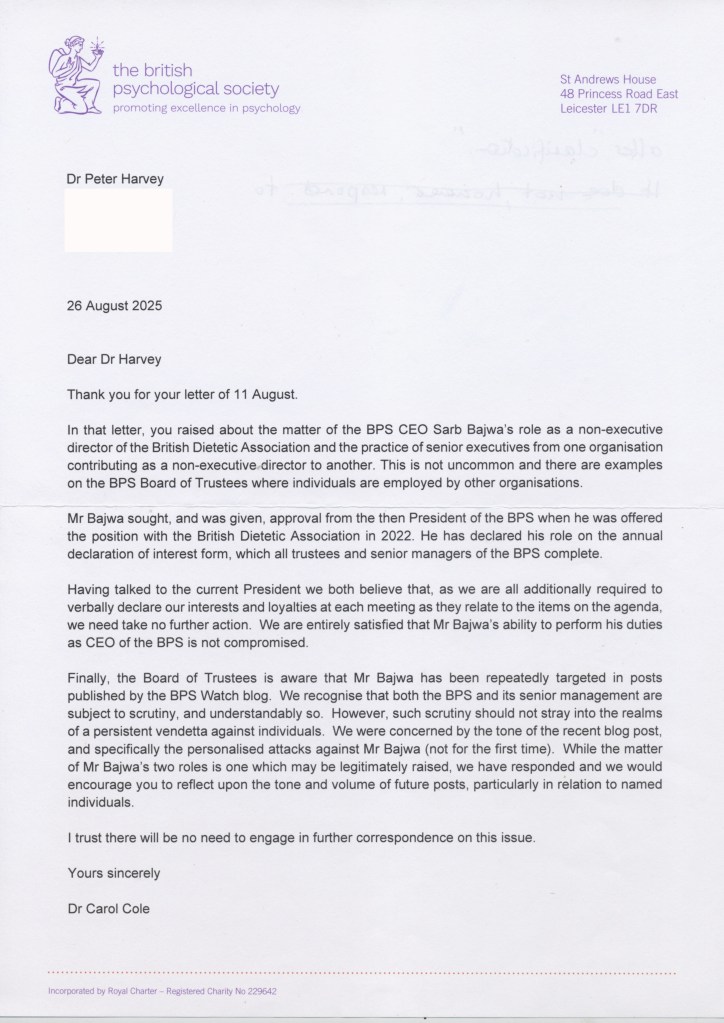
Open letter to the British Psychological Society

Pat Harvey reviews the incredible actions and inactions of an incompetent BPS in relation to debates in which it should have taken a strong and credible lead in a letter on behalf of BPSWatch to the Chair of the Practice Board

Dear Dr Lavender,

Sex and Gender and the British Psychological Society’s Ongoing Failures

We are writing to you in your capacity of Chair of the BPS Practice Board. We have concerns which we wish you to formally bring to the Practice Board for discussion as a matter of urgency. These concerns relate to the continuing dereliction of the BPS as a learned and professional body in relation to its duty to assist and, indeed, lead the continuing public debate on sex and gender. These are clearly matters falling directly – even centrally – within the purview of academic psychology and of psychologist practitioners and about which the BPS should have authoritative statements. They are impacted by an evolving context of government policy, service reviews and legal judgements towards which the BPS has latterly taken a decidedly “spectator” stance. This is embarrassing for members, and not what they pay their fees for.

Adult Gender Services

The Practice Board ratified a revision of the 2019 GSRD Guidelines in 2024, although we note from other minutes available to members, not without some concern about how the process was conducted, including the fact only the chair had seen the final draft. There had been a very evident changing context since 2019, signposting the subsequent and ongoing review of adult gender services  (https://www.england.nhs.uk/long-read/review-of-nhs-adult-gender-dysphoria-clinics/)  which noted:

  • concerns put to the review team by current and former staff working in the adult gender clinics about clinical practice, particularly in regard to individuals with complex co-presentations and undiagnosed conditions
  • lack of a robust evidence base; being mindful that the majority of referrals to the adult gender clinics are of natal females who are aged between 17 and 25 years, and that the historical evidence base that has informed clinical practice relates to an older cohort of natal males
  • limited information on short and long-term outcomes, particularly for those individuals who transferred to adult services from paediatric services
  • an increasing incidence of individuals seeking to ‘detransition’ following previous gender affirming interventions and the absence of a consistent, defined clinical approach for them.

Astonishingly, the BPS chose to replace the two members of the 2019 Task and Finish Group who had demanded their names be removed from that document with two individuals associated with strong trans ideological/activist connections. That ensured that the whole revision group came from one position in the debate and one provocatively at odds with changing knowledge and opinion. It was also unacceptable that the chair remained an individual about whom formal complaints have been made concerning the public statements that research on surgical treatments for transgender people indicate that “…that debate is shut, there is not a debate about this anymore…” (https://www.youtube.com/clip/UgkxRGiT6y5ouSa6T9Nes0om-J6HWo7otLDx). This statement had been patently false, irresponsible and unethical, and unacceptably the BPS had supported that position. It has had no excuse subsequently, however, not to have been fully aware of the incongruity of retaining that chair to lead the process of reviewing the BPS guidelines .

A wise and reflective British Psychological Society would have been following social and professional developments in the period since 2019 and decided that the original Guidelines were patently and wholly unfit for purpose, and scrapped them. It would have set up a new group, carefully considered the Society’s position, acknowledged controversies and social pressures and supported practitioners back in their clinical and educational environments/teams to be able to discuss the management of gender distress with balance backed by confidence in their professional body. As the Guidelines now stand, they are unhelpful, biased and ideological rather than research and practice based. They are discredited. As such they undermine the credibility of the Society. They are not only embarrassing, they fail the public. And, most importantly, they fail the very people who are asking for help.

Children’s Gender Services

At the point at which new services, with stated aims to provide holistic models of multidisciplinary care required by the Cass review, are being developed, the BPS has entirely abrogated its right to a seat round the table of discussions about the central role that Psychology – academic research and therapy – could and should be fulfilling. The last Practice Board minutes available to members (weren’t we going to get summaries of what was going on in the Board to bridge the gaps?) stated that there had been a first meeting of a group (recruitment criteria unknown, membership unknown, chair unknown) and “a discussion paper is in development” (March 3 2025) This is a stable door creaking on its hinges as the horse is running many furlongs in the distance. 

Further Questions

What of Women’s rights and a Society response to the recent Supreme Court ruling which clarifies that biological males, even those with a GRC, cannot be considered women under the Equality Act when it comes to single-sex spaces or services? No comments?

What of the difficulties researchers have experienced in carrying our basic research on sex and gender (see “Review of data, statistics and research on sex and gender Report 2: Barriers to research on sex and gender” (2025) https://www.sullivanreview.uk/barriers.pdf ) such as Professor Sallie Baxendale, clinical neuropsychologist, who experienced repeated rejection of her work by journals on the impact of suppressing puberty on neuropsychological function, saying: “It wasn’t the methods they objected to, it was the actual findings.” No comments?

Beyond that series of instances of barriers, there is a question that perhaps a healthier BPS might be able to address, what are the social psychological implications of gender “exceptionalism” that have led to an extraordinary breakdown of norms in academia and in clinical practice? Might not the BPS be directly implicated in that breakdown?

The Future of Psychology and the BPS in relation to Gender

Clearly there has been an inherent breakdown in how the BPS has and is still responding to the wider controversies on Sex and Gender. The Practice Board has clearly failed in its remit. To undo actual damage to credibility and reputation, It should start by withdrawing the GSRD Guidelines and scrupulously review the energy and activity of the current Children and Young People Gender Group. The BPS as a whole needs to acknowledge its shortcomings and seek a widespread and vigorous consultation with members.

The hitherto biased and resistant editorial policy in respect  of The Psychologist should be urgently reviewed.

Given this unfortunate history and the suppression of debate within the BPS and in the pages of The Psychologist, BPSWatch.com intend to continue a challenging series of articles under the title psychology UNREDACTED. The first two and a response of these should be read by interested parties:

The next article in BPSWatch.com will be this open letter to you. 

We demand action.

Yours sincerely,

Pat Harvey

Peter Harvey

David Pilgrim

BPS members and BPSWatch.com

cc. 

President of the BPS

Chair of BPS Board of Trustees

CEO

Director of Knowledge and Insight (as currently still designated on website)

EDI, Gender, Identity Politics

How is Gender Different? Let me Count the Ways

Work with gender discomfort often seems to lead to very different approaches to those used in any other area of distress. John Proctor considers just how strange this is.

It happened at the end. At an event to discuss whether mental health initiatives in schools might sometimes be unhelpful. Short answer: yes – but it was the discussion that was illuminating. For two hours we considered Mental Health First-Aid, self-diagnosis via TikTok, and how ordinary feelings can be pathologised. Above all we debated how to work with teenagers who adopt diagnostic labels as identities. Then, just as we finished, one young audience member made a final point: “As someone who works with LGBTQ+ youth, their problem is external oppression. It’s about not being accepted for who they are.” [My emphasis]. No chance to reply. While initially frustrated at the lack of space for a response, I’ve thought about that statement many times since. More recently, I appreciate such a clear pronouncement on how we should work with gender discomfort, and such an explicit signal as to what our responses, including those of psychological practitioners, should be. Apparently these need to be different to those provided for any other kind of distress. And this is indeed what we have done over the last few years. Here I’d like to think about the ways we have treated gender as exceptional, and some of the resulting problems.

The first area of difference is the conflation of one issue with another: in this case of sexual orientation with gender. We frequently hear the letter combination LGBT, and the old rainbow flag has been replaced by the ‘Progress’ version. I do often wonder though if these labels actually belong together. It’s worth remembering that this teaming is a recent thing. Adopted for campaigning purposes, it steps adroitly over the fact that the issues raised by same sex attraction may be very different from those raised by gender identification in a way different to your sexed body. For example, being gay does not lead to either arguments about competing rights or to a proposed medical pathway. Indeed, far from a happy coexistence, some ideas about trans rights may be antithetical to the LGB part of the rainbow, as same-sex attraction may be replaced with the idea of same-gender (thus mixed-sex). This was a significant issue in the recent Supreme Court case brought by For Women Scotland in the United Kingdom.

While the commenter in my session only made a single remark, I think the reason it has stayed with me is that ideas of acceptance as primary have become very familiar in my professional circles as a psychologist. In particular, I often hear an emphasis on the validation of gender identity placed ahead of any attempt at investigation and of developing a detailed picture of why someone may feel the way they do. It’s been well documented how, in the UK’s primary specialist service for children with gender issues (the Gender Identity Development Service at the Tavistock Clinic), many clinicians turned away from a more exploratory approach to gender discomfort. Instead a more affirmative stance became favoured. Though some staff clearly held to a more traditional model of working (understanding and formulating), others wouldn’t, or couldn’t, do so. More worryingly this also led, for many, to referral for endocrinology treatment. The evidence for the effectiveness and safety of those treatments has been seriously questioned

Professional bodies have also taken steps towards encouraging more affirmative, identity-based, working with adults. For example, The British Psychological Society’s Guidelines for Psychologists Working with Gender, Sexuality and Relationship Diversity, as well as conflating sexual orientation with gender self-identification, place an emphasis on rights and on de-pathologising any aspect of sexuality or gender. There are cautions not to engage in “conversion therapy” and to make sure you make no judgement on someone’s choices. This makes sense to a point. Of course psychological practitioners wish to respect the people they see. But there is, perhaps, some balance needed.  The primary message is that the experience of being uncomfortable with your sexed body in particular is, in these guidelines, not something we aim to understand, but rather an identity that needs to be validated. Any idea that a therapist might think about the function of trans identification in managing painful emotions, or identification away from your bodily reality as a response to experience, is nowhere to be found.

At organisational levels too this idea of validation takes us along a different path from the one we might take for other issues. We fly flags in our departments, display posters, and put pronouns in our email signatures. All in the name of inclusion and allyship. Some colleagues even offer the idea that clients will know they are “safe” if they display these concrete signs. Presumably not offering such signs is therefore unsafe? And, uniquely, we decide that this issue, out of the many available, is the one we’ll announce a position on. However, for psychological therapists, neutrality is quite central to our ordinary stance. People come through the door and we think with them about their experience. It is not normally our job to pre-empt our conclusions or to take sides in painful and divisive areas. And yet our organisations decide for us that the task is to affirm the identity beliefs of clients. Good outcomes are already being framed according to our ability to agree with someone rather than to explore.

So why this need for validation: individual, organisational, and even societal? Again, I think the speaker at my meeting caught the essence of why this should be so. It’s because of “external oppression”. Over the last few years we’ve heard a narrative of marginalisation and powerlessness in answer to any questioning of how we respond to gender-related matters. Whether the conversation has been about women’s rights and protections, or about questions over puberty blockers, the response is so often that a marginal group is being attacked. The protection of a group we judge vulnerable is an imperative so strong it seems to stop thought about whether there is a different way to approach things. Additionally, we have tools to codify where privilege and powerlessness reside, and certain groups are always deemed to be at the margins. The listening and thinking, which are the work of therapy, are apparently no longer necessary. I sometimes wonder if such a prescriptive approach is to ordinary therapy as colour-by-numbers is to actual painting.

Such responses always raise my curiosity. Are we really talking about the most marginal and powerless group here? Some dispute it, and the prevalence of “trans rights” promotion (from road crossings to HR policies, to arguments made at public expense) in UK public life leaves the powerless narrative looking rather less than convincing. I see nothing comparable for marginal groups such as people with disabilities, or dementia, or who are homeless. In the area of sex and gender the powerlessness seems to me to be far more plausibly located in the people who have had to fight, through the courts, to express beliefs which go against our most recent orthodoxies. For some organisations taking a strong position has not been enough. Legitimate alternative views have also not been tolerated in the face of an axiomatic presumption that there is only one right perspective. This has not only been a divergence from our way of looking at other areas, but also more than a little alarming. 

It’s perhaps only when we consider how different all this is from the way we approach other forms of distress that it becomes apparent just how strange it all is. Let’s think for a moment how it would look to treat eating issues in a similar fashion. The similarities between eating disorders and gender discomfort are evident. Both may be characterised by unease with one’s body, by steps to respond to that distress with quite extreme physical changes, and an underlying context of trauma. After the initial similarities however, gender issues and eating issues part ways. Generally the response to eating disorders is grounded, very firmly, in attempts to understand and work with the experiences and the feelings we encounter. Psychotherapeutic approaches are to the fore and, in cases where greater physical harm is a risk, compulsory hospitalisation and even force feeding come into play. While I, and many, have reservations about the compulsory aspects of treatment, it’s understandable how we get there. Sufferers are at risk of permanent physical harm, or even death. We struggle to let that go unaddressed and tend to use any means we have available to stop it. No surprise therefore that, societally, our response to “pro-ana” advocacy (the idea that starving yourself and extreme thinness is a human right or lifestyle choice) has largely been one of horror. The contrast with gender is striking. At no stage do health professionals working with eating disorders wear “pro-thinness” lanyards, promote bariatric surgery as a human right, and include celebrations of our true body shape in our messages to colleagues and service users.

You could make a similar case related to self-harm, body dysmorphia or a belief one is Jesus. In each case therapists balance empathy with careful exploration of underlying causes. They don’t typically affirm harmful behaviours, quickly move to physical interventions, or suggest that the primary source of distress is others’ failure to understand that someone really is the Son of God. Yet, in gender therapy, chest-binding and surgical alteration can become marks of autonomy, and those who are cautious about someone else’s metaphysical beliefs may be branded bigots.

It is clear that at least some things are changing. The fate of the child GIDS service is, by this point, well known. The Cass Review strongly criticised existing practices in gender healthcare, particularly highlighting weak evidence for puberty blockers, and GIDS closed its doors in 2024. Cass made recommendations for a more holistic, and psychological, approach to gender distress. In the UK children’s access to puberty blocker medication and cross sex hormones has either been restricted or is under review. Adult gender services in the UK are also under scrutiny. Similar developments can be seen elsewhere. Not only have several European countries executed a volte-face in policy, but significant segments of the USA seem to be waking up to widespread public concern about “gender-affirming” medical interventions for children in particular.

Despite these increasing doubts about where we’ve been, this picture of change is, at best, partial. Though many organisations have welcomed the Cass Review, a number of others have either publicly opposed its recommendations or have experienced significant internal conflict about how to respond. There are private providers who, while they may offer assessment, still seem rooted in a belief that they can somehow divine who will benefit from irreversible medications during puberty. To use such drugs we’d surely have to be pretty certain about the predictability of a settled trans identification, something which, as Cass made very clear, we aren’t. This issue of predictability is also a serious concern given that, The UK is, at time of writing, set to press ahead with a clinical trial of puberty blockers for children. Such a step carries risks related to the effects of such drugs on brain development and bone health, as well as the established limiting of male genital development. This seems a very obvious case where a proper follow up of the cohorts who have already been given this medication is the logical initial step in developing the evidence base. Though, as some readers may know, follow up data from adult gender clinics was more  difficult to obtain than one might imagine.

Also significant is the proposed “trans inclusive” ban on conversion therapies in the UK. It looks likely that forthcoming legislation will restrict any steps to challenge someone’s sexual orientation or gender identityA number of prominent bodies representing psychological therapy practitioners in the UK (including the British Association for Counselling & Psychotherapy and the British Psychological Society) have signed something called the Memorandum of Understanding on Conversion Therapy promoting this aim. Other organisations, such as the UK Council for Psychotherapy, have signed and then, following the concerns raised by Cass, withdrawn support. In forthcoming legislation there will apparently be protections for legitimate therapeutic exploration. However, it’s unclear just how the experience of feeling misaligned with your body will be distinguished from what is deemed the existence of a gender identity. If understanding the former is legitimate ground for therapy but thinking about the latter is not, this is not a matter of trivial concern. Therapists could face prosecution if exploring underlying psychological distress around gender identity is misconstrued as conversion therapy. Similar legislation proposed in Scotland in 2024 (and ultimately withdrawn) did not succeed in making such a distinction related to legitimate therapeutic exploration, and it remains to be seen if the UK Government can do any better. Indeed Hillary Cass herself has said that such a law is likely to put pressure on therapists to inhibit exploration.

It seems the commenter in my meeting managed to summarise, in 15 seconds, several of the principles currently in operation in gender healthcare and in psychological therapies. However, such principles (conflation with other issues, an emphasis on validation of identity labels, a very fixed interpretation of powerlessness, and either disregard of or hostility to alternatives) seem to take us away from a path we are committed to in all other domains. The unique approach to gender discomfort also contrasts sharply with evidence-based practices used in other psychological treatments. Though there was no chance to answer, the questioner did, I now think, do me a favour by saying the quiet part out loud. By saying that this area is different and special. Being clear about that offers us an opportunity to think about how we have, in so many areas, embraced that difference. More than that though it offers us a chance to think about whether we want to change our approach in future. Those we are there to help deserve care that genuinely addresses their distress, not care only shaped by ideology. Young people, actually all people, of course deserve to be accepted for “who they are”. Let’s also help them try and understand what’s painful rather than jumping to tell them they’re something they are not.

The author is a clinical psychologist specialising in severe and enduring mental health problems.

Academic freedom and censorship, EDI, Identity Politics

A response to John Higgon’s post “EDI – where did it all go wrong”

David Pilgrim posts….

John has offered us a clear critique of the mess we are in in relation to the battle between transactivists and their opponents. Rather than counter anything John has said I want to extend the implications of some of his statements (hence I cite these directly and then comment). My points make links directly to British psychology in general, which includes how the BPS has managed ideological trans capture.

But, to sex realists, sex and gender are different.  Sex refers to biology, gender refers to the expectations that culture places on men and women to behave in particular ways….” 

This is a standard and legitimate truism. However, since the shift from a largely empiricist tradition in British psychology in the 1980s towards postmodernism, a whole generation of recruits to the discipline has been exposed to the idea that ‘everything is socially constructed’. This has softened them up more generally to uncritically accept what Noam Chomsky called ‘postmodern gibberish’, epitomised in the writing of the third wave feminist Judith Butler. Reality is old hat and language is everything. To me this epistemic nihilism is a form of collective psychosis offered to us by idiots with high IQs. It has fitted hand in glove with transgender activism.

“The rights of various groups often clash, and society has to find a way to balance these opposing rights as best they can be.  This is where we find ourselves now.  Trans-identifying people should of course have rights and should not be subject to unreasonable discrimination.  But it is not self-evident that their rights should trump women’s rights.” 

The chances of clashing rights to citizenship increased with the expansion of identity politics and the emergence of an Olympics of victimhood. This is not that complicated: key groups such as the poor, women and children share clear objective criteria of vulnerability to oppression and detriments to their wellbeing. However, once subjective self-identification began to over-ride this starting point, then anyone could claim an equivalence of vulnerability. 

This has culminated in special pleading from men who believe that they are women (and demand others must agree with them), men who want to claim the right to have sex with children and men who reserve the right to pursue their autocratic theological authority (see Pilgrim (2022) for more on this point about the interaction of neoliberalism and patriarchy). The original materialist focus of intersectionality, on overlapping points of structural inequality affecting social groups, has been superseded by a version where self-identification now predominates. Now the self-declared victimhood of individuals has become a narcissistic faux-criterion of social justice.

“Trans activists have also been very successful in finding their ways into influential positions within organisations.  The BPS is no exception.  Once there, they have a more or less free rein to make whatever pronouncements they see fit, all with the implied backing of the organisation which they represent.” 

John correctly celebrates the pressure now on trans activism created by the Cass Review and the Supreme Court ruling. That strain is showing at last in the BPS. The cadre of transactivists enjoying their hegemony, say two years ago, is now fragmenting, with key figures either departing or re-grouping and licking their wounds about the battles they are losing in public policy settings.  Stonewall and Mermaids are enjoying far less patronage from public and private recently. This particular culture war is not going well for transgender activists The cases John cites of female nurses fighting back, with public support, about their privacy signal this trend. A caveat to this is that in the context of the wider culture wars, the sex/gender controversy is unusual but it is not unique (Pilgrim, 2024). 

“The problem for public sector organisations is that a whole generation of employees has been exposed to gender ideology and actively dissuaded from critically appraising it.  The challenge now is to re-engage our critical faculties so that we can develop new strategies for supporting gender-non-conforming and gender-dysphoric individuals, ensuring that those strategies are evidence-based and do not lead us into situations where one group’s rights come at the expense of another’s.  Psychologists have a role here.  We are trained to think critically.  If you are not convinced by gender ideology, surely nobody can blame you for asking an innocent question at the next team meeting.”

This is the only point where my interpretation of psychology differs from John; that psychologists trained to think critically – is that true? Certainly, during most of the 20th century, the fact that the discipline was inherently contested led to psychology students being obliged to compare and contrast conflicting theoretical approaches to experience and behaviour. However, in the past thirty years that norm has shifted. Critical appraisal has given way to a soggy consensus about methodological rigour, evading an examination of underlying metaphysical divisions and theoretical incompatibilities (Gao, 2014).

This move to ‘methodologism’ in the discipline has then been compounded by the influence John points up about the EDI movement in higher education and settings in which psychologists are now employed. This has created a disabling pincer movement, which now undermines the confidence and willingness of young psychologists to speak their minds (about anything that legitimately comes to their minds). My personal impression now on clinical courses is that trainees are culturally divided. There are the virtue signallers enjoying the glow of self-righteous performativity and quickly pointing out when they are offended or ‘feel unsafe’, when certain words are ever uttered in their presence. These are the ‘new puritans’ who thirst for the judicial logic of Salem (Doyle, 2022). However, epistemic violence and real violence are really not the same. Feeling unsafe is warranted when your village is being bombed but not because people say things that upset you. As van der Kolk, the psychiatric proposer of PTSD noted correctly, being asked to read Othello is not really the same thing as being gang raped.  

Alongside the virtue signallers are others harbouring their moral and intellectual doubts but who are wary to speak out. They may still think critically but that cannot speak critically. This scenario is a product of the betrayal of the post-Enlightenment value of freedom of expression in general and its close cousin but not twin, of academic freedom in particular. The depressing cultural outcome is not peculiar to one discipline but permeates the academy and the organisations that employ graduates. 

Thankfully there is a fightback, organised by those like the Committee for Academic Freedom and Academics For Academic Freedom. The more of us who join their ranks the better. Hovering above the tedious ‘culture wars’ is a more important consideration: can critical thinking be expressed without fear in academic settings? At present a climate of intimidation dominates higher education. Psychologists are constrained by this norm as much as any other group. I am not confident that they have any special insight or privilege to develop and articulate a needed critique but maybe John is right, and I am wrong. The fight back I think must be multi-disciplinary.

Doyle, A. (2022) The New Puritans: How The Religion of Social Justice Captured the Western World. London: Constable

Gao, Z (2014) Methodologism/Methodological Imperative . In T. Teo (Ed.), Encyclopedia of Critical Psychology, New York: Springer

Pilgrim, D. (2024) Identity politics: The sex/gender controversy Is unusual but not unique. Archives of  Sexual Behavior, 53, 2431–2443.

Pilgrim, D. (2022). Identity Politics: Where Did It All Go Wrong? Oxford: Phoenix Books.

EDI, Gender, Identity Politics

EDI – where did it all go wrong?

We are pleased to present ideas that “need to be out there”.

This is the first of a continuing series.

John Higgon, a retired clinical neuropsychologist, posts….

 We live in a diverse world.  Each of us is advantaged, or disadvantaged, by circumstances beyond our control.  In recent decades, we have come to realize that it is wrong to disadvantage a person on the basis of an irrelevant aspect of themselves over which they have no control.  This is discrimination, and, whilst there is a proper place for some kinds of discrimination (for example, in selecting the best candidate for a job based on the candidates’ skills, knowledge and experience), there is general agreement that discrimination should not be based on irrelevances such as one’s age or sex or ethnicity.  To counter discrimination of this kind, we have promoted inclusivity both as a value and as the mechanism by which equality can be more closely attained.  These aims are noble and worthwhile, and nobody would want to dispute them, I hope.  Even so, when translated into a legal framework, the perceived rights of one group (trans-identifying people) have in recent years come into sharp contrast with the perceived rights of other groups (women in general and lesbians in particular).  As a society we are in the process of navigating that, and unfortunately, current EDI practice is not helping.

Some history 

Legislation in the UK addressed discrimination on the basis of race (the Race Relations Act 1965), sex (Equal Pay Act 1970) and disability (Disability Discrimination Act 1995), but it was only in 2010 that these were brought under the umbrella of the Equality Act.  This is a landmark piece of legislation that protects nine groups of people.  Specifically, the ‘protected characteristics’ are age, disability, gender reassignment (more on this later), marital status, pregnancy and maternity, race, religion or belief, sex and sexual orientation.  So far, so good, but there is a fly in the ointment.  The Equality Act has conflated sex and gender, for in the Act gender reassignment is defined as ‘proposing to undergo, undergoing or having undergone a process to reassign sex’.  The linguistic conflation of the words sex and gender is of course not unique to the Equality Act.  We see it everywhere.  But, to sex realists, sex and gender are different.  Sex refers to biology, gender refers to the expectations that culture places on men and women to behave in particular ways: “boys don’t cry”, and so on.  And, whilst this conflation may not matter much in many day-to-day settings, it becomes very important in a legal context. 

As we know, trans rights activists sought to capitalize on this ambiguity by claiming that the Equality Act offered protection to individuals identifying as trans or non-binary.  Specifically, they claimed that the rallying cry of “trans women are women” had a legal significance, and therefore that the law supported the supposed right of transwomen to, for example, attend single-sex services, use female changing rooms and access lesbian networks.  All of a sudden, the rights of women were pitted against the rights of biological males identifying as women.  How did this play out?

Single-sex services

Here in Scotland we recently witnessed the debacle of the Edinburgh Rape Crisis centre, run by a transwoman, which refused to offer single sex groups until forced to do so by its parent organisation, Rape Crisis Scotland.  Rape Crisis Scotland noted that “We are extremely concerned that for around 16 months [Edinburgh Rape Crisis Centre] did not provide dedicated women-only spaces, as required by the National Service Standards, while declaring to [Rape Crisis Scotland] that they were adhering to the standards” (‘Our statement on the Edinburgh Rape Crisis National Service Standards Report’ (Rape Crisis Scotland, accessed on the internet 02/07/2025)).  If you believe that transwomen are women, then it follows that you were providing a single-sex, women-only space.  Unfortunately for the Edinburgh branch, Rape Crisis Scotland central office clearly did not follow this line of reasoning.

Female changing rooms

Just last month, eight nurses in Darlington won their case against their employer.  They had taken their employer to court for its failure to provide single-sex changing facilities, by allowing a biological male identifying as female to use their facilities.  Meanwhile in Fife, another nurse, Sandie Peggie, is fighting her own battle over the exact same issue.  Interestingly, Fife NHS Trust are still withholding documentation that the court has demanded in an apparent delaying tactic.  You would think that they could see where this legal case is headed, given the success of the Darlington nurses and particularly in light of the April 2025 Supreme Court judgement confirming that ‘sex’ means, and has always meant, ‘biological sex’ in the eyes of the law.  But, as I shall suggest later, public sector bodies seem to find it difficult to envisage any way of approaching the trans issue other than the current, largely affirmative, way.

Lesbians’ right to associate on the basis of sexual orientation

 Finally, we come to the infamous ‘cotton ceiling’, perhaps the most extreme example of perceived trans rights clashing with the rights of same-sex attracted women’s rights.  Just as women face a ‘glass ceiling’ in their career advancement, it’s been suggested that ‘transwomen’ (intact biological men) face a ‘cotton ceiling’ when it comes to trying to have sex with lesbians.  Since the phrase was first coined, there have been attempts to deny the sexual connotations of the term, but the ‘cotton’ in ‘cotton ceiling’ is widely interpreted as referring to cotton underwear.  It’s hard, therefore, to see how there isn’t a sexual element to this.  Any reasonable reader would conclude that some transwomen – biological males identifying as women, if you prefer – feel aggrieved that they are not considered as potential sexual partners by lesbians.  The sense of entitlement is astounding.  Indeed, you could say that there’s something quite male about it.

These cases are all quite well known and there is no need to add to the list, although I could.  The point is that the rights demanded by trans activists obviously and self-evidently clash with rights previously accorded to women and lesbians in particular.  The lawyers who drew up the Equality Act cannot have seen that coming, because, as we have seen, the Equality Act, whilst it talked about gender, really meant ‘sex’, as is clear from the definitions contained within the act.  (In fact, they perhaps should have seen the potential for inconsistencies, given that the act offers protection from discrimination to people who are merely ‘proposing to undergo’ procedures to change sex.)

Culture wars

Rights of various groups often clash, and society has to find a way to balance these opposing rights as best they can be.  This is where we find ourselves now.  Trans-identifying people should of course have rights and should not be subject to unreasonable discrimination.  But it is not self-evident that their rights should trump women’s rights.  Trans activists have responded to challenges by adopting the strategy of avoiding any debate of these issues, as recommended in the Denton Report, and for a long time they have got away with it.  Witness the treatment of Kathleen Stock.  Witness the extreme and unchallengeable assertions – “transwomen are women”.  Witness the attempts to shut down academic study that is anything other than affirming (the refusal of scientific journals to publish Sallie Baxendale’s work on puberty blockers and their potential effects on cognitive development, the expulsion of James Caspian from his psychotherapy course because of his proposed research into the experience of detransitioners, the expulsion of James Esses from his psychotherapy training course for his views on affirmative therapy).  Witness the violent protests at sex realist meetings or attempted viewings of sex realist films such as Adult Human Female.

The reason they have got away with it is that these extreme positions are both tacitly and often explicitly supported by EDI policies put together in the HR departments of institutions, in particular, public sector institutions.  It’s not surprising that these policies have developed as they have.  ‘Co-production’ emphasizes the benefits of the public sector working with marginalized groups (“Nothing about us without us”), and whilst there is a place for this, it is reasonable to ask whether trans activists have become the self-serving tail wagging the compliant dog.  Trans activists have also been very successful in finding their ways into influential positions within organisations.  The BPS is no exception.  Once there, they have a more or less free rein to make whatever pronouncements they see fit, all with the implied backing of the organisation which they represent.  In this way, a culture has gradually come into existence which promotes the incorporation of preferred pronouns into name badges, which accepts uncritically the grafting of the ‘T’ onto the pre-existing ‘LGB’, which actively promotes Pride events whilst doing far less to promote other protected groups, and which promotes Stonewall-inspired narratives about gender identity whilst coming down firmly on sex realist narratives.  The climate that has been created looks like it is very diverse and supportive, but woe betide anyone who challenges it.  

Nothing needs to be stated explicitly.  In the same way that health service employees know always to substitute the word ‘challenge’ for the word ‘problem’, employees ‘just know’ that there are things they can say and other things that they shouldn’t.  Self-censorship sets in.  Why would a young professional embarking on the early stages of their career risk gaining a reputation as ‘difficult’, ‘ideologically suspect’, ‘bigoted’, ‘transphobic’?  In a public sector service that rightly exists to cater for all sections of society, it is wise to avoid having these kinds of terms applied to you – whether they are deserved or not.  (And mud sticks.  Some students at Sussex University happily denounced Kathleen Stock as transphobic, whilst simultaneously cheerfully admitting that they had not read her book!) 

On the one hand, then, we have extreme demands from aggressive activists who are not seeking the same rights as ‘the rest of us’, but who are seeking rights that ‘the rest of us’ don’t have – in particular, the right to identify in the way that they see fit, and for the rest of society to bend around that self-identification in any way that is necessary.  On the other, a culture that has permeated large institutions, but in particular public sector institutions – one which provides the necessary intellectual air cover for the activist activity.  Health, schools, higher education and social work have all taken on board the Stonewall narrative, and it is all too easy to join the dots: children exposed to gender identity ideology at school; adolescents, often same-sex attracted, finding a health culture that is willing and able to provide the medical interventions that will realize their trans identities;  and social workers, teachers and health workers who will sideline the concerns of sceptical but deeply caring parents who never drank the Kool Aid.  

A way out

I asked at the beginning of this piece where it all went wrong.  I suggested that the apparently harmless conflation of sex and gender was seized upon by trans activists and turned to their own advantage.  I suggested that activists used tactics to shut down public debate, whilst simultaneously inserting themselves into key positions in public sector institutions, either as advisors from third sector groups, or as fully paid-up employees.  There, they developed policies that enshrined the rights of trans identifying individuals, even when these came self-evidently at the expense of other groups.

Let’s look now at how we can move on and start to put things right.  First, I think we need to support gender-non-conforming people to live the kinds of gender-non-conforming lives that they wish to.  It has been noted elsewhere that on one analysis, the trans project is in fact deeply gender-conforming: “My son played with dolls from an early age, therefore he must really be a girl”.  Second, we have to abandon the practice of creating narratives based on how we would like things to be, and get back to examining how things actually are.  Biological sex is messy, difficult in some ways to define (do we do so on the basis of chromosomes, or genital development?) but ultimately there are two sexes, each evolved to play a part in the reproduction of the species.  It’s really not that difficult.  Beyond that, we can conform to the stereotypes that attach to our sex, or not, and there should be no penalty for choosing either route.  Clinicians should acknowledge that some people are extremely distressed about their sexed bodies and/or their gender, and we should recognize that these feelings are most likely to surface around adolescence.  We need to establish, through the usual process of clinically-based research, what approaches, if any, help gender-dysphoric individuals feel better about themselves.  To date, the evidence base for hitherto standard approaches has been weak to say the least. Third, public sector institutions need to re-think how they are going to support trans and gender-non-conforming people.  There is more than one way to do this.  We can carry on doing what we have been doing: nodding along with over-valued ideas about innate gender identities numbering in the dozens, and acquiescing to every extreme demand made by ‘the trans community’.  Or we can start to think about how to balance competing rights and how to gently push back on some of the wilder unevidenced claims of gender ideology.  

The problem for public sector organisations is that a whole generation of employees has been exposed to gender ideology and actively dissuaded from critically appraising it.  The challenge now is to re-engage our critical faculties so that we can develop new strategies for supporting gender-non-conforming and gender-dysphoric individuals, ensuring that those strategies are evidence-based and do not lead us into situations where one group’s rights come at the expense of another’s.  Psychologists have a role here.  We are trained to think critically.  If you are not convinced by gender ideology, surely nobody can blame you for asking an innocent question at the next team meeting?

Academic freedom and censorship

Introducing psychology UNREDACTED@bpswatch

Pat Harvey (on behalf of Peter Harvey and Dave Pilgrim) posts…

At this stage in the life of the BPSWatch blog it has more than 80 posts with a primary focus on the governance, policy and ideological bias of the regime which runs the British Psychological Society. It remains our view, as three members with more than 150 years of shared membership of the society and lifelong careers in psychology, that the abject failings of the BPS as a professional body and learned society remain. The BPS remains a captured poor resource for psychologists

All that we can have claimed to do via this blog is to have raised the  awareness of some members. Beyond that, we have extended our own networks in different directions and come into contact with ardently engaged people we did not know before. One of us is now lead for psychological support and research in Whistleblowers UK which is a political campaign for the Office of the Whistleblower. Another has engaged with people and issues of concern around gender services, complaints procedures, Family Courts and the effects of questionable expert witness testimony. The third has edited yet another of his many published books and is in the process of authoring a further critical examination of a subject on which the BPS has a parlous record.

This blog contains much information for the record and we want it to continue in an effective way. One of our concerns has been that the many discussions we now have with our extended networks about psychologically relevant issues produces ideas that need to be “out there”. They are currently suppressed due to  what I have called “stifling and censorious latter-day orthodoxy of public and professional bodies on issues such as gender, EDI and diagnostic self-ID”. These are issues to which psychology is central, but where research and debate has become vigorously curtailed, policed and censored. That this problem is insidious and pervasive in organisations way beyond the BPS is evident from the UCL report (published 2 July 2025) Review of data, statistics and research on sex and gender Report 2: Barriers to research on sex and gender https://www.sullivanreview.uk/barriers.pdf

We hope you will not only read the forthcoming psychology UNREDACTED series, but that you will also quote, repost and even write your own contributions. 

Get in touch at bpswatch@btinternet.com

"The Psychologist", 'False Memory Syndrome', Academic freedom and censorship, Identity Politics

More hubris in the BPS: on being the ‘Head of Science Communication’

David Pilgrim posts:

Recently BPS members may have noticed that the role of editor of The Psychologist has been extended to that of being ‘Head of Science Communication’. This announcement sets many hares running. I have been a psychologist for forty years and have two higher degrees in the subject. I still could not give a coherent account of what the discipline is, which does not reflect my stupidity but my warranted caution. If psychology is a science, then how is it to be defined by those running the BPS? Occasionally it is confessed that the Society is a ‘broad church’. That is a fair starting point, but I think its flock, whether they are BPS members or outsiders, may reasonably want to hear more. What they actually get (if the content of The Psychologist is anything to go by) is a strange brew of scientism and virtue signalling. 

For example, this month (May 2025) the cover’s headline is Educate your sons (as a small blessing, we were spared today’s breathless exclamation mark)The sub-heading tells us that Jayne Meyrick will be discussing ‘gender-based stereotypes, attitudes, violence and more’. Fair enough, but why the prescriptive headline instead of the valid sub-heading not sufficing more modestly? Should any branch of human science (spoiler alert here, Psychology is not the only game in town) be so crassly preachy? Surely the values involved in parenting are not the possession of Psychology, or any other discipline. For those of us old enough to remember, we know that it is inconceivable that the predecessor of The Psychologist (the Bulletin of the British Psychological Society) would have presented such a moralistic prescription. Its possibility today emerged from a cultural context in which EDI priorities overlay most professional discourse, with identity politics, for now at least, shaping the academic agenda (Pilgrim, 2022).  Psychology with a capital P reflects its fluxing historical context (Richards, 2009) and the context we are in today is authoritarian and sanctimonious. A contempt for academic freedom, virtue signalling and Salem-style speech policing are de rigueur.

If Psychology is a moral science, which arguably it is, then its authority needs to be defended in principle, and in convincing detail, before any of us is subjected to its definitive strictures (more on this below).  This would require a metaphysical exercise to clarify basic assumptions about ontology, epistemology and ethics and how they articulate – see Brinkmann (2011).  In The Psychologist, that required exercise is ignored in favour of moral grandstanding to favour the discipline’s preferred worthy squeaky-clean image. 

Heavy is the head that bears the crown

In the midst of all of this unexplained froth about the BPS being a ‘broad church’ the task of being a communicator of science is unenviable and inevitably challenging.  However, leaders in the discipline seem unfazed by the prospect and Jon Sutton now looks forward to his authoritative role. He can join forces with his colleague with the formerly designated Orwellian title of ‘Director of  Knowledge and Insight’, now rebranded with the equally grandiose title, ‘Director of Research, Education and Practice’. The challenge for these BPS leaders is to find ways of communicating about ‘psychological science’. In the generous tradition of George Miller (1969), they might still opt to ‘give psychology away’, as if the Society is sitting on a scarce and rich body of accumulated knowledge to be shared noblesse oblige.

Miller is a key figure within the liberal wing of Anglo-American psychology and is credited with being a founder of cognitive psychology. At once this was an epistemological game changer as it displaced behaviourism, which in its salad days had allegedly dispatched psychoanalysis forever though it, of course, failed. And, as Miller’s collaborations with others was to prove, maybe philosophy, the scourge of the discipline of Psychology at the turn of the 20th century, still could pack a punch about matters psychological, as his colleague Noam Chomsky was to prove. 

So, what exactly is the big deal about the confused and confusing discipline of Psychology? After all and without looking too far we find a few other contenders offering serious insights into the human condition. Apart from philosophers, we might add topflight historians, economists, anthropologists, neurologists, psychiatrists and last, but not least, novelists. The last one is counter intuitive. However, a skilled fiction writer can explore our interiority and the subtleties of our interpersonal relationships, within a cultural and economic context of a particular time and place. That complexity rarely (if ever) appears in psychology textbooks read by undergraduates. I certainly have learnt more from good novelists than the bank of psychology books on my groaning shelves.

Then beyond behaviourism and the ‘cognitive revolution’ during the 1980s and 90s we endured radical social constructivism and the postmodernist’s Nietzschean disdain for facts. This upended positivism, and its adoration of the psychological laboratory inherited from the 19th century, alongside a eugenic actuarial approach to personality and intelligence. Followers of the competing trends probably sat together in the corridors of academic psychology departments in a state of mutual bemusement. This ‘psychological science’ stuff was becoming a complex mixture of historically layered bids for epistemological legitimacy. 

In that context, what exactly will Jon Sutton be communicating about? Will it be all these epistemological layers, or just this year’s model of disparate pieces being promoted by The Psychologist? To be fair that dilemma must also face the producers of All In The Mind, which seems to have a hotline to the BPS for advice, occasionally hosting guests to demonstrate the most recent breakthrough in psychological knowledge. Apparently, all is well then in the state of Leicester (unless, like the one in London, the office might be about to close). Until then the BPS might be thought of as the repository of the wisdom previously enjoyed by psychiatry and applied philosophy. The competitors have been seen off and ‘communicating science’ thus reinforces and celebrates that triumph. But behind the rosy picture, confusion and uncertainty reign.

Back to the strange brew

To make sense of this considerable challenge for Jon Sutton, we can return to the ‘giving psychology away’ trope of Miller. Given the sub-title of his seminal text Psychology: The Science of Mental Life (Miller, 19991), what exactly is that science being given away, and might many outside of Psychology reasonably claim some legitimate authority about ‘mental life’?  

In 2015 the Division of Academics, Researchers and Teachers in Psychology (DART-P), hosted a symposium at the BPS Annual Conference. The aim was:

…to explore current thinking, developments and practice within contemporary psychology education, with a view to stimulating critical discussion and reflection on psychological literacy and its delivery within both pre-tertiary and higher education contexts. Ultimately, the symposium, and this article are intended to facilitate exploration of the opportunities provided by psychology education, at all levels, to develop students as psychologically literate citizens. (Hulme et al., (2015) emphasis added).

The paper by Hulme et al. drew upon Miller but also the work of McGovern et al. (2010), who offered a definition of ‘psychological literacy’. It listed the skills expected of a psychology graduate:

• vocabulary and knowledge of the critical subject matter of psychology; 

• scientific thinking, disciplined analysis of information to evaluate alternative courses of action; 

• creative and ‘amiable sceptic’ approach to problem solving; 

• applying psychological principles to personal, social and organisational issues in work, relationships and the broader community; 

• acting ethically 

• competent in using and evaluating information and technology; 

• communicating effectively in different modes and with many different audiences; 

• recognising, understanding and fostering respect for diversity; 

• insightful and reflective about one’s own and others’ behaviour and mental processes 

Hulme et al. proceed though with a key insight relevant to Jon Sutton’s challenge today:

The first sentence points up the challenge of content I raised earlier – what precisely is the psychological science that is to be communicated? The laudable cognitive skills emphasised by the authors would, as they say, be important for any critically competent graduate in science but also, as they note by the end, of any graduate in the social sciences and humanities. Maybe Psychology has no mandate to claim a particular legitimacy to understand human experience and conduct. Understanding human activity and experience in its social context has been examined with some success by anthropology and sociology (the clue is in their names). When it comes to content (the elephant in the room avoided by McGovern et al.) the list of cognate disciplines I made earlier would supply the very same material. 

Maybe this coyness on the part of psychologists to define their authority over the content of their work, substituting instead a generic scientific skill set, is because they know that in truth their discipline is so hopelessly contested in terms of its theory and practice. Moreover, by focusing on the study of individual human functioning, in relation to conduct, interiority and small group interactions, they simply cannot compete with those disciplines in the social sciences and humanities offering a wider lens and a longer view.  

Surely the inherent individualism of psychology operates against a desirable outcome of comprehensive context-dependent understandings of human life. This is at its most obvious in the hubris of experimental psychologists, who privilege ‘psychological literacy’ of their own preferred type. They lament the incompetence of ordinary people to reason psychologically in their daily lives. 

A good example here is the role of experimentalists supporting the false memory movement, who disparage the reasoning of judges and juries and offer them condescending advice (French, 2018; Conway, 2011). By contrast, those recognising the implications of experiments producing closed system findings, which have poor ecological validity, have warned us quite rightly that Psychology struggles constantly to justify itself as an empirical science (Uher, 2021; Smedslund, 2016; Adolph, 2019). A symptom of the undeclared pre-Popperian legacy of naïve realism is that the BPS has been proud and unreflective about aligning its policy on memory and law with the false memory movement and its supportive experimentalists (Conway and Pilgrim, 2023). They have a narrow focus on one form of false positive, when human memory is frail across all social contexts in open systems. For example, when validly accused men who rape women and children deny their guilt, do they have a false memory? Have the experimentalists in the false memory movement ever written a book called ‘Witness for the Prosecution’ (cf. Loftus and Ketcham, 1991)?  

Trying to define psychological science is like trying to grasp fog or catch the wind. What the content is about in practice reflects layers of knowledge present since the end of the 19th century and contemporary normativity. However, reflecting a residual confidence in empiricism and positivism Hulme et al. (ibid) let slip the fetish of ‘presentism’ common in academic Psychology. That is, what has become known recently is good but what is old is inferior. They complain that A level students still learn too much about historical figures in the discipline and not enough is taught to them of findings and theories from recent decades. 

That lament reflects an unexamined assumption (or ‘doxa’) which is that ‘psychological science’ proceeds through time in an aggregating and constantly improving manner. This presumption about scientific incrementalism is pre-Popperian in its outlook. It might also explain why the history and philosophy of psychology is still taught so poorly in higher education, reflected in the very precarious survival of the History and Philosophy Section of the BPS. If A level psychology students are indeed still being fed too much information about history, then ironically that might be their only chance to see the light about a contested discipline. For example, the fetish of behavioural statistics is rooted in the empiricist Humean assumption about the causal relevance of ‘constant conjunctions’ (the correlation between two variables with the rest of reality controlled out). The limitations of that closed system thinking still haunt Psychology. 

Insights after the Popperian watershed

Before Popper’s critical rationalism displaced positivism in the philosophy of science, there was the assumption that covering laws would be discovered, which would be applicable to all times and places. The chances of this being true were high in closed systems. For example, in physics or chemistry and even in some branches of neuroscience today, context-independent findings might align with this expectation (cf. Tortorello, 2015). Also, where psychological knowledge is being applied in closed systems it might have legitimate utility. Ergonomics and attention span in pilots could be examples.  However, what all applied psychologists who work with clients from a range of biographical contexts know, is that complexity and unique circumstances require careful exploration. The imposition of forms of prepared knowledge to allcomers is unwise. 

In open systems, laboratory findings are of dubious utility leaving us at best with trends or demi-regularities and at worst with evident unpredictability in human conduct. All human activity is part of an open, not closed, system. Thus, as well as Popper’s focus on science as a social activity and his replacement of verification with falsifiability, the appearance of general systems theory in the mid-20th century advised us about the central importance of context-dependent reasoning (Bateson, 1972). 

To reinforce this point, critical realists have noted that any comprehensive human science should be sensitive to complexity and layers of reality (Pilgrim, 2020). Bhaskar (2016) offered us his four planar social being framework to this end. The first plane is our material rootedness in nature (which we emerged from and return to).  The second plane of reality is that we exist within our relationships to others from conception to grave (we are an interdependent and hierarchical species). The third plane of reality is the supra-personal socio-economic context we are thrown into at birth, which then fluxes during our lifetime. It matters whether we are thrown into a war zone or a tent of plenty, whether we are poor or rich, whether we are born male or female etc.  The fourth plane is our uniquely structured personality arising from the other planes (we have a ‘concrete singularity’). 

My view is that this critical realist framework requires human conduct and experience to be studied with a variety of methodologies and by a range of disciplines, which I listed earlier. Psychology will not only fail if it tries to colonise that inter-disciplinary challenge because it is not competent to deliver a full understanding of our four planar laminated existence but it will also lack insight into its own incompetence. 

Take the example of my complaint that The Psychologist mixes virtue signalling and scientism. That contradiction has arisen in the social context of the growth of identity politics and the self-righteous policing of speech. Being ‘psychologically literate’ might offer some contribution to understanding it, for example, in relation to binary cognitions and thinking too quickly rather than reflectively about complexity. However, those frailties also arose from the growth of a new form of authoritarianism, which encourages a form of witch-finding both on the right and left of politics. Neoliberalism and the failure of Marxist-Leninism have afforded that context of emergence for identity politics. They have fed the EDI industry at the turn of this century, leaving structural power discrepancies unscathed. 

A proper reflective exploration of this complexity is not the particular forte of Psychology but requires epistemic humility, when conversing with those from other disciplines. Without that conversation, leaders in the BPS and the content of The Psychologist will probably keep producing its strange brew of scientism and virtue signalling.  Accordingly, they will lack an understanding of their own context of theory and practice, bearing in mind that hubris often precedes nemesis.  What chance a sophisticated ‘communication of science’ in this blinkered world? Moreover, Jon Sutton has his work cut out for a pressing contextual reason: his paymasters are skating on thinning ice, as we have demonstrated repeatedly on this blog.

References

Adolph, K. E. (2019).  Ecological validity: mistaking the lab for real life. In R. Sternberg (Ed.) My Biggest Research Mistake: Adventures and Misadventures in Psychological Research pp 187–190. Sage.

Bateson, G.  (1972). Steps to an ecology of mind.  Chandler.

Bhaskar, R. (2016). Enlightened common sense: The philosophy of critical realism Routledge.

Brinkmann, S. (2011).  Psychology as a moral science: perspectives on normativity  Springer.

Conway, A. and Pilgrim, D. (2022). The policy alignment of the British False Memory Society and the British Psychological Society. Journal of Trauma & Dissociation 23(2):165-176

Conway, M.(2012). Ten things the law and others should know about human memory. In L. Nadel and W.P. Sinnott-Armstrong (Eds.). Memory and law : Oxford University Press.

French, C. (2018). Reaching ‘Brenda from the chip shop’: scientific literacy. The Psychologist March, 45.

Hulme, J, Skinner, R., Worsnop, F., Collins, E., Banyard, P., Kitching, H., Watt, R. and Goodson, S. (2015). Psychological literacy: A multifaceted perspective. Psychology Teaching Review 12, 2, 13-24.

Loftus, E. and Ketcham, K. (1991). Witness for the defense. New York: St. Martin’s Press. 

McGovern, T. V., Corey, L., Cranney, J., Dixon, W. E., Jr., Holmes, J. D., Kuebli, J. E., Ritchey, K. A., Smith, R. A., & Walker, S. J. (2010). Psychologically literate citizens. In D. F. Halpern (Ed.), Undergraduate education in psychology: A blueprint for the future of the discipline (pp. 9–27). American Psychological Association.

Miller, G. (1991). Psychology: The science of mental life  Penguin.

Miller, G. (1969).  Psychology as a means of promoting human welfare. American Psychologist, 24(12), 1063–1075. doi:10.1037/h0028988 

Pilgrim, D. (Ed.) (2023). British Psychology in Crisis  Phoenix Books.

Pilgrim, D. (2022). Identity Politics: Where Did It All Go Wrong?  Phoenix Books.

Pilgrim, D. (2020). Critical Realism for Psychologists  Routledge.

Richards, G. (2009). Putting psychology in its place: Critical historical perspectives. Routledge.

Smedslund, J. (2016). Why psychology cannot be an empirical scienceIntegrative Psychological and Behavioral Science 50, 2, 185-95. 

Tortorello, F. (2017). What is real about reductive neuroscience? Journal of Critical Realism 16 (3):235-254.

Trapp A., Banister P., Ellis J., Latto R., Miell D and Upton D. (2011). The future of undergraduate psychology in the United Kingdom. Higher Education Academy Psychology Networkhttps://groups.psychology.org.au/Assets/Files/Future%20UG%20UK.pdf

Uher, J. (2021). Psychology’s status as a science. Integrative Psychological and Behavioral Science, 55, 212-224

Gender, Identity Politics

Educational Psychology and ‘Social Transition’. 

Are we ready to talk about wholesale gender affirmation in UK schools?

Our previous posts (see, for example, here and here) about the continuing contentious debate surrounding trans ideology have focussed on clinical and counselling psychology. However, it can be argued that educational psychology has an even more important part to play as its remit is for all children whether in health care systems or not. We are very pleased, therefore, to post this timely and thoughtful piece from Dr David Buck, an independent Consultant Educational Psychologist.

1. Educational Psychologists’ Campaign for ‘Gender Critical’ Approaches.

A small number of Educational Psychologists (EPs) have mounted an ongoing campaign for the last couple of years to raise the issue of ‘gender politics’ in EP practice.  This group suggests that the existence of ‘grooming gangs’ in Rotherham and elsewhere in the UK makes a parallel argument for institutional complacency in UK children’s services due to managers’ fear of retribution from ‘PC/critical social justice’ activism.  This has led to the current position of the EP profession as a whole becoming institutionally ‘gender affirmative’, thus challenging biological explanations of sex difference (Joyce, 2021) and supporting ‘social transitioning’ (e.g. chosen use of pronouns and encouragement to adopt opposite sex stereotypes). 

Much progress has been made on limiting ‘medical transitioning’ to the realm of adult choice and is no longer part of the ‘gender affirmation’ of children.  Severe limitations are now imposed on the use of puberty blockers and re-assignment surgery for the under 18s after the relatively unaccountable activities of the Tavistock Gender Identity Development Service (GIDS – launched in 1989 to help people aged 17 and under who are struggling with their gender identity) leading to its appropriate closure by the NHS in March 2024. 

We are now arguing against the wholly unguarded support that Educational Psychology training courses and local authority (LA) EP delivery services appear to be giving to ‘social transitioning’ (an inherent component of the ‘gender affirmative’ approach). This is now clearly at odds with the Department for Education’s (DfE) ‘Gender Questioning Children’ (GQC) guidance and the Cass (2024) review, which was unable to discount its harmful effects. We also, more broadly, counter the clear bias in favour of critical social justice theory (CSJT), which drives ‘identity politics’ that is deployed within EPs’ professional associations.

In contrast, our own campaign promotes the relevance of Special Educational Needs and Disabilities (SEND) assessment to ‘gender distressed’ children as a means of accommodating this group in UK schools leaving whole school environments relatively unchanged, especially single sex spaces and the Science curriculum, which has been altered to prioritise gender identities over biological explanations of sex difference. 

We have attempted to get EP governance, professional associations, training course leaders, EP forums and blogs, etc. to at least facilitate discussion on ‘identity politics’ that includes ‘gender critical’ commentary.  Such views are characterised by a biological definition of sex difference which we have been promoting.  We prefaced all our posts with the following note:- 

These posts are sent in the spirit of opening debate on the important issues raised around trans-identifying students within all phases of the education system relevant to Educational Psychology practice. However since ‘gender affirmation’ has become such an overwhelming position any alternatives e.g. ‘gender critical’ views (i.e. a biological definition of sex difference, presented here) are treated as ‘transphobic’. It is ‘trans activism’ of ‘Gender Identity Ideology’ that is our particular target (since it ignores negative whole school effects) and is not directed at trans-identifying individuals themselves

These professional associations include the British Psychological Society (BPS), the BPS Division of Educational and Child Psychology (DECP), the Association of Educational Psychologists (AEP) and the National Association of Principal Educational Psychologists (NAPEP) UK , as well as the EP forums and EP blogs that include EPNET and EDPSY. These groups have all resisted, in their own ways, the facilitation of any discussion or publication that could be considered ‘gender critical’, often simply because they promote the Cass Review or the DfE – GQC guidance.

2. On Organisational Capture by Gender Ideologues.

In our view, the current authoritarian manner and regressive misogyny (e.g. encouragement to adopt sexual stereotypes) that underlies the promotion of ‘gender affirmation’ by all public services, including UK Educational Psychology Services and EP Training Courses, has now reached a point of being a real threat to child safeguarding.  The threat is associated with the unreflective ‘institutionalised political correctness’ (the PM’s contemporaneous comment on the Rotherham child sexual exploitation scandal (CSE)) whether from naive critical social justice activists or public sector policy scribes. Such threats are not trivial, as the events in Rotherham demonstrated.  Hence our current emphasis is on those didactic ‘PC’ (now ‘social justice’) narratives, similar to those in past CSE scandals, which are still apparent in the present as anxieties held by those in positions of professional governance of children’s services.  These fears, held by those professionals, are that they could somehow be exposed as acting in a discriminatory manner. Events demonstrate that this distorts their rational decision-making.  This is just as relevant now within children’s services’ responses to ‘Gender Identity Ideology’ (GII) as the topical focus on the inertia of these services’ is associated with the ‘grooming gang’ CSE scandals of the past. The potential harm of ‘social transitioning’ – that it can lead to re-assignment medication and surgery – has not been eliminated by research (Hall et al., 2024; Cass, 2024) so safeguarding should, in our view, default to a cautionary approach in this regard i.e. ‘do no harm’.

We maintain that the UK EP training, governance, management, and EP representative organisations put greater emphases on the ‘social justice’ for minority groups rather than on the effective assessment of their special educational needs and disabilities (SEND) through well-established statutory procedures of Part 3 – Children and Families Act 2014. Their apparent obsessions with niche minority interests flamboyantly demonstrate the EP profession’s virtue signalling of ‘social justice’ which is made at the expense of general negative effects on wider school issues.  One of the most prominent examples is their promotion of the messages from Gender Identity Ideology (GII) charities. Here the minority interests of trans-identifying children are so obviously ranked above whole school interests via ‘gender affirmative’ views e.g. they take a position that prioritises the ‘inclusion’ of these pupils’ access to all facilities according to their chosen gender. This is to the potential detriment of single sex sports, spaces and healthcare for all, where ‘sex’ in these contexts has normally been defined as ‘biological sex difference’.  

The EP profession’s university-based training courses and local authority EP services’ senior staff also show widespread support for ‘gender affirmative care’ reflecting the bias of the GII charities noted above. Their activity on the EPNET forum has clearly indicated widespread and uncritical promotion of ‘social transition’. They are now effectively briefing against both the latest DfE guidance ‘Gender Questioning Children’ and the Cass Review which has highlighted the poor evidence base for either positive or negative outcomes of gender affirmative care.  Even more seriously, this clear bias towards ‘critical social justice theory’ is evident in their professional association, the AEP, in its feedback on DfE guidance GQC consultation. This feedback formulated plainly irresponsible recommendations NOT to follow the DfE GQC guidance. They do this by leaning heavily on the entirely unaccountable advice from GII charities, such as the discredited Stonewall ‘Global Diversity Champions Programme’ and ‘Just Like Us’ who say: ‘We recommend schools do not implement this draft, non-statutory guidance. We encourage teachers to stand for inclusion, not exclusion’. The implication that gender-critical commentary would ‘stand for exclusion’ is disingenuous or faux-naïf at best. 

These organisations are more concerned with virtue signalling the ‘well-being’ of these niche minority groups such as trans-identification rather than that of the school population as a whole.  As deserving of attention as these groups may well be, the wider negative implications for all of meeting their needs across the educational system are rarely directly addressed by the BPS, DECP, AEP, NAPEP or EPNET.  The dominance of the moral imperative to signal ‘inclusivity’ apparently easily overrides the rights of others e.g. in schools the rights of all to single sex spaces, sports and healthcare. The organisations’ role in platforming the profession’s obsession with demonstrations of their own ‘compassion’, ‘kindness’ and ‘empathy’ take primacy over the more mundane issues that abound for all SEND children e.g. the current dearth of SEND resources, poor literacy and numeracy levels.

3. Educational Psychologists Are Influential So Discussion Within The Profession Is Vital.

We have been raising these concerns because LA EPs are very influential across the whole school estate as a reference point for special educational needs and disabilities (SENDs) and wider psychological needs relevant to all pupils e.g. counselling services after a school is involved in a ‘critical incident’. It is therefore imperative that they are offering evidence based advice that is congruent with government guidance.

The issues we have discussed here will only be resolved by the encouragement of open debate amongst front-line workers, free from training, governance, representative organisations and managerial oversight within each of the public sector services responsible for child-safeguarding.  That is currently impossible in the Educational Psychology profession in general and within the remit of the BPS, DECP, AEP, NAPEP & EPNET in particular.  Their spurious technocratic reference to rules and values of self-serving interest, especially amongst Senior Management Teams and academic Educational Psychology training staff, is evident in their active censorship and attempts to shut-down rather than facilitate such debate. 

Although the British Psychological Society (BPS) has made a post-Cass statement , this shows a very weak and ambiguous response to that review.  Additionally, the formal professional guidance shows little has changed since pre-Cass versions – the BPS full guidance (originally published in 2109, revised version published 2024) shows that none of the ‘References’ or ‘Further Reading’ are post-2022 let alone post-Cass Apr 2024.  Professor Christina Richards chaired both the original and the review working parties and much reference is made to her book, co-authored with Dr James Barrett, ‘Trans and non-binary gender healthcare for psychiatrists, psychologists, and other mental health professionals’ (published pre-Cass in 2020).  Not only that but in their book’s biographies it is revealed Professor Richards was elected to the Executive Board of the World Professional Association for Transgender Health (WPATH).  This self-selecting lobbyist-group is well known for its ‘gender affirmative’ position and as such has been widely criticised for its ‘independent’ pretensions e.g. Jennifer Black (2024) , The Economist (2024), Malcolm Clark (2024)

‘…No organisation has played a greater role in the adoption of the pseudo-science of so-called ‘gender affirming healthcare’ globally than the World Professional Association of Transgender Health…’  (Clark, 2024).

Given its active choice to hold onto gender ideologues to revise its policy document, the BPS seems unwilling to represent any neutral, let alone any sort of independent, review of the impact of Gender Identity Ideology as one might have hoped on a first reading of their ‘new’ post-Cass guidance.  Indeed its current focus on GII  appears to support the proposal that sex is determined by an individual’s feelings of gender identification to the opposite sex rather than being biologically fixed (see also here).

4. Conclusion.

However we may regard USA President Trump at a personal level, Joanna Williams has summarised his recent Executive Order (20th January 2025), which proclaims the United States will only recognize ‘two sexes, male and female’ in this way…

By asserting the basic, biological reality of two-sexes, Trump will safeguard women’s right to single-sex prisons, hospital wards, changing rooms and public toilets. Female athletes will no longer risk injury or lose scholarships after being forced to compete against bigger, stronger males. Children will not be taught to choose from one of hundreds of so-called ‘gender identities’ and encouraged to bring their bodies in line with this new sense of themselves through a lifetime of popping pills and surgery. The need for pronoun badges or declarations will be done away with and even the transgender Pride flag, with its baby pink and blue triangles, can be retired. (Williams, 2025 ).

Further, in the UK the Supreme Court is about to (Feb/Mar) make a final decision on the case of Women Scotland Ltd (Appellant) v The Scottish Ministers (Respondent).  The question being considered concerns only the status of those who have Gender Recognition Certificates (GRCs).  It has already been established that for the Equality Act and all other laws that individuals who identify as the opposite sex do not legally alter their biological sex.

If ‘Women Scotland Ltd’ win the Scottish government will have to amend the Gender Representation on Public Boards (Scotland) Act 2018 to make clear that ‘women’ does not even include men with GRCs.  This will eliminate the last UK legal anomaly that creates confusion over the biological reality of sex in law.  If so, how long will it take the BPS and others to alter their position which undoubtedly will become regarded as at odds with all these international legal developments?

The BPS position on the ‘culture wars’ in general and on ‘identity politics’ in particular is becoming out of sync with cultural shifts regarding trans-identification with every week passing.  Its sluggish, if not overtly stubborn responses to these cultural, political and legal changes is leading it to a future perception as the ‘Tavistock GIDS’ of ‘social-transitioning’.  GIDS was established in 1989 and closed down in March 2024 by the NHS.  The most poignant question, due to the subtle, nuanced but non-the-less powerful forms social-transitioning can take is  – will anyone notice, or will it take another 35 years to bring the BPS to book? 

In the meantime front-line EPs would do well to process their involvement with trans-identifying children through an encouragement of parents of this client-group to use the Education, Health & Care Needs Assessment procedures of Part 3 CFA 2014 (Buck, 2022, 2024).  EPs can then protect their own professional credibility by writing in a manner suitable for Special Educational Needs & Disabilities Tribunals and Family Courts.  Then at least there will be a greater possibility such reports will be properly judged against the principles within the NHS Cass Review, the DfE’s ‘Gender Questioning Children’ guidance and revised legislation.  In this context EPs’ written output is free from evaluation against the rapidly ageing GII values that their employing local authorities, Educational Psychology training course tutors, EP representative bodies or the British Psychological Society itself continue to offer. 

REFERENCES

Black, J. (2024).  Dispute arises over World Professional Association for Transgender Health’s involvement in WHO’s trans health guideline  https://www.bmj.com/content/bmj/387/bmj.q2227.full.pdf

British Psychological Society. (2024). Guidelines for Psychologists Working with Gender, Sexuality and Relationship Diversity: For adults and young people (aged 18 and over). https://www.bps.org.uk/guideline/guidelines-psychologists-working-gender-sexuality-and-relationship-diversity

Buck, D. (Sept. 2022). Transgenderism in Schools.
https://www.cieo.org.uk/research/transgenderism-in-schools/

Buck, D. (Apr. 2024). The Importance of Special Educational Needs Assessment Concerning Trans-Identifying Children in UK Schools: The Role of Educational & Child
Psychologists’. – Genspect. https://genspect.org/reconstructing-uk-educational-child-psychologists-roles-regarding-intersectional-identities-of-transgenderism-with-special-educational-needs/

Cass, H. (2022)Independent review of gender identity services for children and young people. NHS England. https://cass.independent-review.uk/home/publications/final-report/

Children & Families Act. (2014). Part 3 Children And Young People In England With Special Educational Needs Or Disabilities Section 22. The Stationery Office, London.

Clark, M. (2024).  All roads lead to WPATH – ‘The Critic’. https://thecritic.co.uk/all-roads-lead-to-wpath/

Department for Education’s (DfE) ‘Gender Questioning Children’ (GQC) guidance. https://consult.education.gov.uk/equalities-political-impartiality-anti-bullying-team/gender-questioning-children-proposed-guidance/supporting_documents/Gender%20Questioning%20Children%20%20nonstatutory%20guidance.pdf

The Economist (27 Jun 2024). ‘Research into trans medicine has been manipulated.  https://www.economist.com/united-states/2024/06/27/research-into-trans-medicine-has-been-manipulated

Equality Act. (2010). The Stationery Office, London.

Executive Order (20th January 2025). Defending Women From Gender Ideology Extremism And Restoring Biological Truth To TheFederal Government. The Whitehouse, USA. https://www.whitehouse.gov/presidential-actions/2025/01/defending-women-from-gender-ideology-extremism-and-restoring-biological-truth-to-the-federal-government/

Forstater v. CGD 2022 – M Forstater v CGD Europe and others: 2200909/2019 – GOV.UK

Hall, R. Taylor, J., Hewitt, C.E., Heathcote, C., Jarvis, S.W., Langton, T., Fraser, L. (2024). Impact of social transition in relation to gender for children and adolescents: a systematic review  – BMJ Archives Disease in Childhood. https://adc.bmj.com/content/109/Suppl_2/s12

Joyce, H. (2021). Trans: When Ideology Meets Reality – Oneworld.

Richards, C. & Barrett, J. (2020). Trans and non-binary gender healthcare for psychiatrists, psychologists, and other mental health professionals. London: Royal College of Psychiatrists/Cambridge University Press. https://www.cambridge.org/core/books/trans-and-nonbinary-gender-healthcare-for-psychiatrists-psychologists-and-other-health-professionals/BE6DD100185E0396E84363F92C6A329E

Supreme Court (2024). Women Scotland Ltd (Appellant) v The Scottish Ministers (Respondent). https://www.supremecourt.uk/cases/uksc-2024-0042

 Williams, J. (2025) . Donald Trump, feminist icon? https://cieo.substack.com/p/donald-trump-feminist-icon-68a?utm_source=post-email-title&publication_id=365184&post_id=155344749&utm_campaign=email-post-title&isFreemail=true&r=ueb70&triedRedirect=true&utm_medium=email

Gender

How to REALLY think about your training needs.

What should the erstwhile professional body, the British Psychological Society, be offering as advice and support to recently qualified UK clinical psychologists earnestly seeking further training in working with young people who present with distress around “gender identity”?

A recent post on social media asked colleagues for recommendations “to increase my understanding and uncover any areas that I don’t know about”.

The following, reproduced almost verbatim, appeared in response, and is published with the writer’s permission.

“I am guessing that you are aware that this area of clinical work is relatively new and under-researched, that it is contentious, with strong voices that make very strong, opposing claims (which can make it difficult to think through some of the issues), and that it involves working with a very vulnerable client group and complex family and treatment systems, with considerable risk.

With these factors in mind, while I don’t have any particular training to recommend, my advice would be to research training provider(s) very carefully. “This training is great” requires much more cautious evaluation. Any training will form part of your CPD record and so part of the evidence you have with regards to professional registration, etc. So – for your own sake and that of your clients – focus on professional training(s) that will help you develop your core scientific and therapeutic knowledge (e.g. in developmental psychology) you have from previous psychology degrees in as broad a way as possible. This might, for example, include:

  • the possible sources of discomfort with/dislike of our bodies
  • the psychological development of our identity/identities
  • social contagion
  • overlapping clinical difficulties (especially autism and the  effects of developmental trauma and how they might interact with feelings of discomfort about/dislike of our bodies)
  • the potential impact of homophobia
  • the relevant issues around risk and safeguarding
  • treatment/interventions and the associated scientific evidence (including side effects, outcomes and the arguments about reversibility of treatments)
  • the influence of any financial benefits to some sectors of, for example, lifelong drug treatments (or indeed training providers)
  • the very conflicting professional guidance available and understanding the implications of these for you and your patients/clients.

When taking into account the essential perspective of lived experience, make sure any training includes the experiences of those who regret treatment and transition as they are also often silenced and marginalised (and stigmatised), and they hold an essential part of the picture that has to be kept in mind. “

What an abysmal reflection that the BPS remains incapable or unwilling (or both, given that its position reflects the intersectionality of several strands of vested interest) to produce anything remotely as helpful, nuanced. professionally and socially responsible as the above. This just took one thoughtful experienced clinical psychologist on a late weekend evening to sort out the best current perspectives on the matter.

"The Psychologist", Gender, Governance, Identity Politics

The BPS : failed and still failing – and failed again.

You may have read our open letter [see here] to Professor Tony Lavender, Chair of the Practice Board of the British Psychological Society. We have had a number of responses to the letter supporting our view. This week (2 September) we received this response from Professor Lavender. Below it is our reply (sent today 3 September).

Dear Pat, Peter, and David

I am writing in response to your recent open letter, ‘The BPS and Gender: Failed and still failing.’

I understand that over recent years, you have raised these issues on many occasions and have received numerous in-depth answers which explain the BPS position, and which fully respond to your concerns. This has included responding to complaints, open letters, and concerns about specific members raised under our member code of conduct. The BPS has taken your concerns seriously and has addressed them with a considerable amount of care and attention as well as significant organisational resources. Because of this, it seems unnecessary to repeat information which has been communicated to you on multiple occasions previously, much of which is also publicly available.

Our Guidelines for psychologists working with gender, sexuality and relationship diversity are broad guidelines which set out general principles for psychologists and those working in associated fields. The guidelines clearly state they are not for the specific clinical treatment or assessment of gender dysphoria or incongruence. The society has stressed on multiple occasions that the guidelines do not relate to children and young people under the age of eighteen. So, while we note your concerns in the context of the Cass Review, we cannot agree that it is valid to project them onto guidance which is designed for adults. However, we do agree that there is a need for increased clinical guidance for professionals working with children and young people in the complex area of gender dysphoria. We have already indicated to NHS England our strong desire to join a consortium of relevant professional bodies to identify gaps in professional training and develop training materials to upskill the workforce. You will also know that the BPS recently created a Children and Young People and Gender task and finish group to look at the critical issues relating to children and young people and gender. This work is currently underway. 

In relation to the Cass Review, we cannot accept your view that the BPS is somehow ‘anti-Cass.’ Our response, as stated by Dr Roman Raczka, to the final report of the Cass Review commended Dr Cass for her ‘thorough and sensitive review into an area that is highly complex and controversial to many.’ He went on to state that, ‘Dr Cass and her team have produced a thought-provoking, detailed, and wide-ranging list of recommendations, which will have implications for all professionals working with gender-questioning children and young people. It will take time to carefully review and respond to the whole report, but I am sure that psychology, as a profession, will reflect and learn lessons from the review, its findings, and recommendations.’ This analysis of the final report and the resulting implication for psychology is currently underway. To support the cross-organisational group of members collaborating on our response, we reached out to the wider BPS membership to submit their evidence-based contributions. It does not appear that you took the opportunity to input into this important work. 

I note your concerns that any perception that the BPS had adopted an ‘anti-Cass’ position could endanger the organisation’s important relationship with NHS England. I am pleased to be able to reassure you that the BPS continue to have a positive relationship with NHS England. NHS England did recently approach the BPS to provide a statement relating to theirannouncement on the expansion of services for children and young people. On this occasion we politely declined as our consultation work with members was ongoing. NHSE readily understood and referred to our initial response to the final Cass report as “supportive.” 

The BPS recognises that the society may adopt policy positions that some of our members disagree with, but these policy positions are arrived at by assessing the evidence base, accessing the relevant expertise of our members as well as providing opportunities for our wider membership to feed their evidenced-based reflections through our consultation processes. While the BPS acknowledges that you remain dissatisfied with the society’s views on gender, with a membership of more than 65,000 passionate people, it is not expected that all our members will hold a single, unified view on any issue. Diversity of thought and opinion is a welcome hallmark and an inherent strength of both our profession and of our organisation.

Kind Regards

Tony Lavender.

This is our reply:

3 September 2024

Dear Tony

Thank you for your response of 2 September to our open letter of 14 August.

We find it difficult to believe that you wrote this reply although you have signed off on it. Accordingly, what follows is not directed at you personally.

Does no-one at the BPS recognise the very serious reputational mess that the BPS finds itself in on this matter? Apparently not. The tone of the response is arrogant, defensive and patronising to senior long-term members who have spent many hours over the years contributing to the Society, latterly to attempt to orient it to a better and more responsive and responsible course. The response is so inappropriate and, in a number of ways dishonest, that it requires point-by-point dissection and this follows below in the order offered by your response.

Your opening paragraph states:

I understand that over recent years, you have raised these issues on many occasions and have received numerous in-depth answers which explain the BPS position, and which fully respond to your concerns. This has included responding to complaints, open letters, and concerns about specific members raised under our member code of conduct. The BPS has taken your concerns seriously and has addressed them with a considerable amount of care and attention as well as significant organisational resources. Because of this, it seems unnecessary to repeat information which has been communicated to you on multiple occasions previously, much of which is also publicly available.

You imply that the BPS has been more than helpful, bending over backwards providing us with plentiful information in an open and transparent manner. That does not square with our experience. Only recently there was the example of the highly irresponsible actions of the editor of The Psychologist (supported by the Chair of the Editorial Board) in posting and retaining a link online to the Singapore-based Gender GP, a supplier of puberty blockers, despite being shown specific warnings from the NHS and the clear position taken by Cass concerning puberty blockers. That link remained online for several months after the representations had been made and rebuffed, and it was only taken down – without acknowledgement to us – after a judge had issues a warning about Gender GP in the High Court. We made a formal complaint about the rude and inappropriate response made by the two men. This was rejected out of hand. No acknowledgement, no reflection, no learning, no apology. The Chair of the Sexualities Section has repeatedly criticised Cass and insulted psychologists he deems supporters of Cass/Gender Critical and has cast disparaging and unprofessional aspersions on social media on LinkedIn. The BPS argued that it should be dealt with by the HCPC and their decision was that this did not reach their threshold for investigation as a fitness to practice issue. On then requesting that the BPS formally investigate (under the BPS’s own Member Conduct Rules and Social Media Guidelines) it refused to act (or may have done but the Complaints Process does not allow complainants any meaningful feedback). Issues of confidentiality regarding complaints aside, some years ago there was an undertaking to publish anonymised data about the types of complaints that were being received, investigated and their outcomes. This appears not to have been done, and it is our view that beyond fitness to practice responsibilities taken by the HCPC there are member Conduct Rules, Code of Ethics and Conduct, Social Media Guidelines and rules for members undertaking official duties for the BPS which should be in force but about which there is no feedback given in terms of application. The BPS is not a learning organisation in itself or for its members.

Your comment about information being publicly available mystifies us. One of our enduring complaints is the lack of information for members. It is our group, as well as others on social media, who have been the source of much information that should have come from the BPS.

It is galling and insulting to be admonished in the second paragraph with 

The guidelines clearly state they are not for the specific clinical treatment or assessment of gender dysphoria or incongruence. The society has stressed on multiple occasions that the guidelines do not relate to children and young people under the age of eighteen. So, while we note your concerns in the context of the Cass Review, we cannot agree that it is valid to project them onto guidance which is designed for adults”.

We need to remind you that it was as a result of a lengthy complaint by one of us (which required considerable persistence) that it was finally made clear two years after publication of the 2019 Guidelines that the Guidelines were for adults/over 18s. On 9 April 2021 the Director of Membership and Professional Development wrote to confirm to us that

“…we have offered to put a statement on the front of our guidelines, on our website and all points/places where the guidelines are referenced to confirm that the BPS guidelines for psychologists working with gender, sexuality and relationship diversity are rot adults. We will implement this urgently.”

The belatedly “adults only” badging would not have happened had it not been for this hard-fought complaint and the rebadging did not remove ambiguities in the content of the guidelines that had implications for a philosophy of practice for young people. 

The concerns of the Cass Review on children’s gender services subsequently raised wide ranging issues of 

  • service philosophy; 
  • exploratory versus affirmative psychological practice;
  • diagnostic overshadowing;
  • the needs of detransitioners.

All of these critical matters are largely downplayed, disregarded or ignored in the revised 2024 adult guidelines. You cannot surely think that at age 18, the radical paradigm shifts proposed by Cass suddenly do not apply? 

The 2024 edition of the Guidelines is a document entirely discontinuous with, and dislocated from, the services which will be developed from Cass, and you actually confirm that with your ridiculous phrase “…we cannot agree that it is valid to project them onto guidance which is designed for adults“. Please do not think it is remotely permissible to bandy the word “project” about in this fashion with clinical psychologists and please endeavour to reflect how utterly patronising and inept these two paragraphs are.

Regarding your third paragraph – is the BPS anti-Cass? The balance of evidence so far is certainly that it has not been interested in, or has been defensive about, the highly relevant recent history of disquiet about the psychologist-led GIDS service that finally led to the Cass Review. This can be evidenced in detail by scrutinising what the BPS has said and done on its website and in The Psychologist, latterly and most blatantly in relation to the revision of the adult Guidelines which we emphatically argue above should show some continuity and consonance with the Cass paradigm shift. The Guidelines patently do not. We would direct you to the following: https://www.bps.org.uk/news/bps-response-new-nhs-england-regional-model-gender-identity-services-children-and-young-people.This is an alarming response following proposals from Cass that GIDS should close. It focussed away from the service philosophy and inadequate psychological practice issues then emerging, and on to waiting time problems. It placed its concern with the current GIDS psychologists rather than showing any curiosity that possibly damaging practices might have been going on there in psychology-led services for children and young people: 

We are aware that some BPS members will work across the Tavistock Clinic and that this news might be unsettling and upsetting for them. We would encourage any members who are affected by this to seek support from their Union or by contacting the BPS where we will work, as their professional body, to support them accordingly.

A response (https://www.bps.org.uk/psychologist/time-honest-reflection-not-defence) from senior members/practitioners to this BPS reaction stated :

These constitute serious criticisms of a flagship psychology-led service, resulting in its closure to protect patient safety. In this context, the statement issued by the BPS is profoundly inadequate. It offers no acknowledgement of the severity and range of these problems, or of the harm done to some children and young people. There is no reflection on mistakes made or lessons to be learnt. Defence, not reflection, has been a theme throughout the story of GIDS. Many clinicians, parents and patients have raised repeated concerns about the practice model. Ex-patients have discussed feeling rushed into body-altering interventions which some have come to regret. Criticism has grown louder recently, following a 2018 internal report, a judicial review in 2020, damages awarded to the Trust safeguarding lead and an ‘inadequate’ CQC report in 2021, plus increasing media coverage. Concerns that GIDS was operating outside usual clinical practice were first raised, however, in 2004. Critics have consistently been labelled bigots or transphobes and ostracised.

Key people at the BPS remain openly hostile to Cass. The Chair of the Sexualities Section has stated publicly that he will be part of a group criticising her Review and its evidence base. The BPS appointed two new members to the working group for the revised Guidelines who were implacably trans-activist and anti-Cass. They are employed in private service provision, Gender Plus, who will get their clientele (including some children) from those who wish to by-pass service strictures in the new NHS provisions. The BPS as a body have been constipated in producing any fully worked out response to Cass. Roman’s response is far from that – it is just a place holder. This is a marked deficit in timeliness and enthusiasm, critical or otherwise, given that psychologists have such a central role to play – no signs of BPS reflection or audit of what went wrong. What has he or anyone else done to action his comment ‘I am sure that psychology, as a profession, will reflect and learn lessons from the review, its findings, and recommendations.’  Not happening and no proposals to make it happen. This response demonstrates that very clearly.

You refer to our failure to contribute to the project identifying the implications of the Cass Review for psychology (https://www.bps.org.uk/news/members-encouraged-contribute-cass-review-project ). Have you considered how that was phrased by the BPS Comms Team? Fill in an online form and “Members are reminded that contributions should be evidence-based”. So, individual members are supposed only to send in opinions which are evidence-based. When part of the problem in previous services was poor evidence, when Cass has extensively, and over a long period reviewed evidence, what is an individual psychologist going to do to produce a contribution which is evidence-based?  This was going to discourage more people than just ourselves from thinking there was much point. Maybe, given our experiences, that was deliberate.

In noting in our letter to you that adult gender services were now also to be reviewed, we have stressed above the discontinuity of paradigm between remodelled children’s services and the stale narrow re-statement in 2024 of a BPS position that had been extant from 5 years before in the 2019 Guidelines. Can you believe that these guidelines will say anything whatsoever in terms of their content to impress policy makers that the BPS can assist them? The BPS is stuck in its activist capture demonstrated with evidence in our letter.  The appointment of Moon and Zitz to a team led by Richards was doubling down on existing massive bias in the ideology of the authors. Your last paragraph 

The BPS recognises that the society may adopt policy positions that some of our members disagree with, but these policy positions are arrived at by assessing the evidence base, accessing the relevant expertise of our members as well as providing opportunities for our wider membership to feed their evidenced-based reflections through our consultation processes. While the BPS acknowledges that you remain dissatisfied with the society’s views on gender, with a membership of more than 65,000 passionate people, it is not expected that all our members will hold a single, unified view on any issue. Diversity of thought and opinion is a welcome hallmark and an inherent strength of both our profession and of our organisation.

is patently ridiculous and insults our intelligence. Everything in this last paragraph is untrue. To use common parlance, the whole reply is gaslighting. How could a small writing group of six who shared clear common affiliations with trans activism such as WPATH and BAGIS and working for Gender Plus represent a breadth of viewpoint? Why choose an additional psychologist such as one still aligned with GIDS instead of someone from the thirty-five experienced psychologists who had left that regime? Why had two of the previous authors taken the decisive decision to have their names removed from the 2019 document? Despite seismic shifts in the context of gender services between 2019 and 2024, the BPS made decisions which showed no reflection of that and reinforced its capture by trans activists, a narrowing of dogmatic prescription rather than more nuanced, diverse and inclusive perspectives. It is beyond irony that you trumpet diversity of thought and opinion in your defence of an entirely exclusive and inflexibly rigid document. The Society has dug a deep hole for itself, and it keeps on digging. Your Comms-Speak response confirms this: “65000 passionate members” is taking that rhetoric to its silly apogee.

Withdraw the guidelines now. 

Yours sincerely,

Pat Harvey, David Pilgrim, Peter Harvey,

BPS members, Clinical Psychologists.

BPSWatch.com, @psychsocwatchuk

Gender, Governance, Identity Politics

Trans capture in the BPS in its social and historical context

David Pilgrim

Introduction

I argue below that the concerted pressure from transgender activists within the British Psychological Society (BPS) has a particular social and historical context. Their claims emerged from a complex mixture of factors at the turn of the 20th century. That picture included philosophical idealism from Nietzsche via Foucault, New Social Movements in the wake of black civil rights protests in the USA, changes in biomedical ambitions for a technological fix for human distress, the abandonment of redistributive forms of politics to create social justice in favour of the politics of recognition, the shift from second wave to third wave feminism with its celebration of Queer Theory, as well as the direct and indirect financing of the transgender movement. On the latter count, the gender clinic industry is a source of drug company profits (from the use of puberty blockers and cross-sex hormones). In addition, there key billionaire contributions to support transgender activism via charitable foundations (https://4thwavenow.com/2018/05/25/the-open-society-foundations-the-transgender-movement/).

I will return to these synergistic ideological and economic mechanisms below but will start with their practical outcome in recent times in the BPS. By going to and fro between these local and recent events on the one hand, and their social and historical context on the other, I hope to understand why this particular ‘culture war’ about gender has often generated more heat than light. That trend can be seen in purported scholarly organisations like the BPS and in the NHS, where advocates of ‘gender medicine’ have become impaired in their reasoning and their honesty about both evidence and ethics.

The BPS has painted itself into a corner on gender

Since the final Cass Review was published, there has been a stubborn resistance from transgender activists in the UK. Those we listed in our letter to Professor Tony Lavender, Chair of the BPS Practice Board [on this blog August 15th] reflect that push back inside the BPS, from those capturing its policy stance on the contested notion of ‘gender’. We might add others, such as Dr Rob Agnew (Chair of the BPS Psychology of Sexualities Section – see below) and Dr Adam Jowett (Chair of the BPS EDI Board and BPS Trustee). The first, a clinical psychologist, on X described the release of the Cass Review as a ‘…bad day for trans youth…’.

The second, an academic psychologist, provided research to the previous government, which despite its foreboding rhetoric and poor methodology, failed to offer a shred of evidence that conversion therapy for gay or transgender people existed in Britain within mainstream mental healthcare. 

The misleading elision of aversion therapy for gay men in the past and exploratory conversations with children today, is absurd (Pilgrim, 2023a). Despite this, that line of reasoning has continued in the BPS since 2018 with Igi Moon at the helm, spearheading the ‘Coalition Against Conversion Therapy’, using the Society’s resources and its administrative base to lobby government. Take this boast from the Coalition:

Dr Igi/Lyndsey Moon, who is chair of the Coalition and British Psychological Society lead said:

‘This is a clear sign that the Government has at long last listened to LGBT individuals and national organisations who have tirelessly campaigned for change. We, along with our Coalition partners, have repeatedly called for an end to the practice of Conversion Therapy and will work with the Government to ensure it delivers on its promise.  The Coalition will fully engage with the forthcoming consultation on the best way to implement an end to this practice.’” (https://www.cosrt.org.uk/tag/coalition-against-conversion-therapy/).

Today, trans capture is not unique to the BPS, but the difference is that most other relevant organisations are now adapting to the realpolitik of a post-Cass world and are managing to contain the excesses of their activist members. Within medicine, controversially, the BMA is out of sync with that trend and so it has become newsworthy for the storm that this has created in its own membership (Feinmann, 2024). Hundreds of BMA members are now resigning in protest at trans capture in their trade union and professional body (see https://archive.ph/uRNLH and https://archive.ph/VINHO).

Agnew and Jowett, along with the activist authors of the  Guidelines for Psychologists Working with Gender, Sexuality and Relationship Diversity (https://explore.bps.org.uk/content/report-guideline/bpsrep.2024.rep129b). (first issued in 2019 and modified in 2024), as well as the collusive support of the editor of The Psychologist, have now painted the BPS into a corner. Because the matter of gender has not been explored fully and properly within the whole membership containing, like civil society more widely, distinctly differing viewpoints, one, and only one, policy, theoretical and ideological position on sex and gender has been left standing. For now, the white, pink and blue flag flutters imperiously above the Leicester HQ. 

This poses a problem for the BPS and is an irritating embarrassment to any ordinary member holding a view non-compliant with transgender activist dictates. If that conclusion is in doubt about policy capture, at the time of writing the BPS has just offered the world an ‘unconference’ [sic] to explore ‘perinatal psychology’ ( https://www.bps.org.uk/event/reflections-equality-diversity-and-inclusion-perinatal-psychology-systemic-vitality-or). Although factually only women can have babies and breastfeed naturally, the BPS now endorses the neologisms of ‘birthing parents’ and ‘chest-feeders’.

I now turn back to the wider context to understand how we have arrived at this strange scenario, whereby a putative scholarly organisation has been reduced to a platform for partisan rhetoric.

The wider context: hegemony and mission creep

The word ‘hegemony’ connotes the dominant role of one viewpoint in a specific cultural setting. It has a dynamic implication, because nothing lasts in human affairs. There is a power struggle and there are winners and losers over time and place. In Western democracies we are living in a time when the dominance of gender ideology has been embedded since the 1990s. However, it is now fracturing. The word ‘gender’ appeared as an alternative to both ‘women’ (‘women’s studies’ became ‘gender studies’ in the academy) and sex, as in the highly risky use of ‘gender’, not ‘sex’, in medical records (Dahlen,2021). This was reflected in the ascendency of Queer Theory, third wave feminism and the politics of recognition, at the height of postmodernism in the 1990s (Butler, 1995; Rubin, 1992; Califia, 1995; Taylor, 1994).  

In the clinical domain, what started in the 1960s as a compassionate acceptance of adult transsexuals, who at that time were mainly men wanting to be women in physical appearance and social presentation (Benjamin, 1966), soon moved into areas of practice that provoked critical opposition for a range of reasons. Those critics, for daring to speak out, were to be dubbed ‘transphobic’ or ‘anti-trans’. This article will probably meet the same dismissal. 

Thus, the right to disagree, in the academy, the clinic or wider civil society was to be quashed at every opportunity by transgender activists. This casts doubt upon the confident cultural dominance of transgenderism. For hegemony to be true to form it needs to acquire a stable matter-of-fact consensus view without coercion; it is a form of soft, not hard, power. That is a defining feature of hegemony: it relies on credible language not on brute force. Thus, transgender activists have not enjoyed that taken-for-granted consensus, as they have had to face opposition from unimpressed and unpersuaded critics. In response, these critics have been personally disparaged, threatened and harassed.

Mission creep in the clinic and the invention of cis bigotry

Under the transgender umbrella it soon became evident that the male to female (MtF) transsexual group contained at times a version of extended fetishism or autogynephilia (Blanchard, 2005). These male cross-dressers were sexually aroused by acting like women and surrounding themselves intimately with natal women. The latter were to be dubbed, patronisingly by transgender activists, as ‘cis women’ raising a logical conundrum. If a transwoman was now declared with total certainty to be a woman, then why was a natal women called something else (i.e., a ‘cis woman’ and not just plainly a ‘woman’)? One answer, which the anti-realist postmodernists found unacceptable, was that women have XX chromosomes and men have XY chromosomes. Postmodern framings ignored facts and instead preferred unending fictions. Another answer was the hierarchy of victimhood created by the logic of identity politics (transwomen were deemed to be more oppressed than cis women).

To say that a woman is an adult human female (a dictionary definition) was then rendered as a form of hate speech by the guardians of identity politics and, at times, this even triggered police involvement. However, a man has never had a baby and never will. The ‘unconference’ noted above will not change that reality. A woman will never die of prostate cancer. A man in a dress demanding to be called ‘she’ is still a man (Greer, 1999). Indeed, for gender re-assignment to mean anything plausibly, it must manipulate a healthy male body to look like a female one or vice versa. This generated another conundrum but this time about social norms. Despite norm-busting claims of celebrating gender diversity, what used to be called a ‘sex change’ has, by and large, hormonally and surgically generated very conservative and caricatured stereotypes of appearance. 

A legacy of these linguistic gymnastics has been the emergence of a ‘woman with a penis’ and even a ‘trans lesbian’, defying the logical and historical agreement that lesbians are females sexually attracted to other females. Old-fashioned common-sense realists (i.e. most ordinary citizens remembering their school biology lessons) were thrown into confusion with all of this postmodernist word play. Wrong footed, unenlightened ‘cis’ social actors were to become bigots for ‘misgendering’ a man in a dress or ‘dead naming’ a person they had known for years as male or female, who has now opted to self-identify as a member of the opposite sex. Just as the victimhood of being transgender was guaranteed, then so too were the inevitable moral failings of untutored ‘cis’ people, with oppressive ‘cis women’ being especially suspect. ‘Black face’ causes understandable offence but ‘woman face’ is supposedly now a symbol of human progress and tolerance (cf. Tuvel, 2017).

Depicting or speaking about something as real is not necessarily the same thing as it being real (technically this is called an ‘epistemic fallacy’). We can recognise a drawing of a unicorn, but unicorns do not exist. People may lie about themselves or be deluded. The recognition of self-statements by others is a negotiation not an enforced outcome on tramlines, a point those defending the ethics of recognition note (Honneth, 1995). But according to gender ideology, insinuated now in the official BPS policy position, if a boy says he is a girl, then he is a girl. Accordingly, ontological realism with its principle of limits was discounted by Queer Theory underpinning BPS policy. Instead, it favoured unendingly elastic epistemological relativism (cf. Henry, 1950). A philosophical realist insists that an adult person with XY chromosomes is a man. By contrast, a philosophical idealist claims that they can be a woman if they say they are. One of them is wrong. 

The principle of limits first discussed by the philosopher and psychologist C.D. Broad in the early 20th century was defended later by second wave feminists (Broad, 1949). For example, Oakley (1972) accepted that gender expression was socially negotiated over time and place, but she held on firmly to biological reality and the immutability of sex. However, within twenty years, the third wave went much further, rendering the material reality of the natural world irrelevant. Talk, and talk about talk, now became all important, in the hurry towards the promised land of radical social constructivism. Sex as a biological fact was old hat and a likely source of hate speech. 

This switching of priorities in social science, bizarrely later to be adopted by some who should have known better in the natural sciences, with their authority predicated on versions of philosophical realism, conflated ontology and epistemology. Now ‘everything was socially constructed’, a view reinforced by the growth of postmodern psychology in the academy.  In the clinic, it led to GIDS, with its preference for children being ‘assigned’ a sex at birth, as if it were an arbitrary opinion. 

That scorned decision-making from people offering their commonsense observations about a baby boy or girl, must now be trumped by the absolute life-long certainty of self-identification. This must not be gainsaid by anyone, including psychologists. ‘Trans children’, even before they went to school, would signal with certainty that they had been ‘born in the wrong body’, and adults must accept that judgment credulously. 

However, a ‘non-binary’ claim within the transgender panoply created another conundrum and contradiction: if we are all born with a life-long fixed ‘gender identity’, then how can it change from day to day or hour to hour in some, but not all, of us? If our gender identity is like a permanent inborn soul, then how come that for some of us it keeps slipping and sliding away? The mystique of ‘having’ a gender is mysterious indeed and these are serious theological and psychological questions about souls or selves. Ultimately how do we understand personhood? (See Smith (2010) for a critical realist take on that big question.) 

The impact of gender ideology in the BPS

The Guidelines issued by the BPS on gender in 2019 and revised this year reflect this wider context of an ideology which has been imposed on children by adults. Children did not invent gender ideology. However, their views have been shaped by it en masse, encouraged by virtue signalling policy makers in health and education and online social contagion. In truth, ‘trans children’ do not reflect a suddenly recognised aspect of ontology. After all, where were they all 30 years ago?  Instead, in the wake of Queer Theory they were invented by some adults on an ideological mission and nameable activists in the BPS and other organisations reflect that scheming and earnest missionary activity (Moore and Brunskell-Evans, 2019).

Diagnostic overshadowing, revealed in the Cass Review, became evident and was reflected in Agnew’s simplistic view that there is a single reductive category of ‘trans youth’. According to him and the discredited GIDS leadership, we need look no further than self-identification and a moral obligation to affirm the self-statements of gender questioning children. What this insistence closed off was the evidence that the GIDS waiting list contained distressed children who were depressed, anxious, survivors of abuse, might have marked autistic features or had come from a family context of parental homophobia (Barnes, 2023). Psychologists led that now discredited biomedical project and the BPS backed it to the hilt; recent events suggest that it does not intend to abandon that position.

Whilst affirmation superficially signals patient-centredness, it is the very opposite. Diagnostic overshadowing and the reification of ‘trans children’ diverts clinicians from a standard obligation to offer biographically unique formulations. Why were these young people being treated in a different way to any other clinical presentation? Also why were psychologists leading the charge for biomedical interventionism, when that reactionary and bio-reductionist role had been left previously to biological psychiatrists, with their ‘great and desperate cures’ which always focused on the body, rather than biographical uniqueness?

The answer to these questions lay in mission creep from the Benjamin regime, with its focus on adult transsexuals in the 1960s, to children in the 1990s. Once activists made that daring shift it would inevitably be provocative and so it was the case. The psychology leadership at GIDS adopted uncritically that mission creep, modelled in the Netherlands on a small and highly selected sample of children and ‘rolled it out’ in the NHS, as a full-blown service philosophy (Biggs, 2023). Worse than that, a study looking at outcomes failed to demonstrate the clinical effectiveness of an affirmation model in the UK – that bad news for transgender ideologues was actively suppressed for many years (Butler et al, 2022). This obfuscation only came to light because of a freedom of information request (Biggs, 2019). That evasion of the truth from those committed to expanding ‘gender medicine’ in the NHS was confirmed by the unwillingness of managers of adult gender clinics to release follow up data about the outcomes for transgender patients during the Cass Review (https://www.theguardian.com/society/2024/apr/10/adult-transgender-clinics-in-england-face-inquiry-into-patient-care.)

If affirmation is so worthy and the outcomes are so good, then why is evidence about them being cynically suppressed by those promoting and managing ‘gender medicine’? The answer is that ideology has been more important than evidence for those defending its expansion. A summary of this challenge for transactivists about evidence is offered here in Feinmann (op.cit.):

At the heart of the dispute is a series of systematic reviews that rigorously examined the robustness of practice and guidelines underpinning the care of young people with gender dysphoria, in particular influential guidelines by the World Professional Association for Transgender Health (WPATH). A total of seven papers by the York University systematic review group were published in the Archives of Disease in Childhood in April. The papers found that the evidence on the use of puberty blockers and hormones in young people with gender related distress was “wholly inadequate, making it impossible to gauge their effectiveness or their effects on mental and physical health.” Nick Brown, editor of the Archives of Diseases in Childhood, told The BMJ, “A common thread in the review findings was the breathtaking dearth of quality evidence to guide care in this vulnerable group of young people.”.

This need to suppress or evade inconvenient truths, along with the iatrogenic risk that all ‘trans youth’ are exposed to by an affirmation model (Jorgensen, 2023), has culminated in a crisis for transgender hegemony in clinical contexts. It is now breaking down, as the Royal College of Psychiatrists, the Royal College of General Practitioners, the Academy of Medical Colleges, the Association of Clinical Psychologists and the Pharmaceutical Society have now all backed the Cass Review and pulled back from previous degrees of trans capture. This is true also of the incoming Secretary of State for Health who has continued the ban on puberty blockers. That new emerging consensus is clearly leaving the BPS out in the cold in policy making.

The paradox of identity politics writ large in the BPS

The weak governance at the top of the BPS, alongside its largely passive and acquiescent membership have, in recent years, created an open goal for transgender activists. Igi Moon coopting the BPS administration for the wild goose chase of purging the land of conversion therapy (i.e. having routine therapeutic explorations) has been par for the course. So too with Christina Richards, a co-author of the WPATH ‘standards of care’, who had free reign to dominate the BPS Guidelines group. This counselling psychologist left being non-directive at the consulting room door and told us that there was to be no debate and that all identities have equal value. However, on pragmatic grounds Richards modified the ‘Kink’ and ‘Slut’ strictures from the 2019, when the document was revised in 2024. 

The Sexualities Section of the BPS has now become obsessed by transgender rights, mirroring the reason, in wider British society, why the LGB Alliance found it necessary to split away from Stonewall. Those leaving in protest emphasised that in their own histories they might have been shepherded by adults into a biomedical pathway. The BPS Lesbian and Gay Section formed in 1998 initially made only a passing mention of transgenderism (https://www.bps.org.uk/member-networks/psychology-sexualities-section). Today it is called the “Psychology of Sexualities Section”. But, as a sign of how times have changed in the shifting self-righteous world of identity politics it includes the following commitments:

“...developing non-heterosexist and gender-inclusive forms of research, theory and clinical practice in British psychology...”

and

…taking a broadly affirmative approach towards sexualities, including transgressive sexualities, while also strongly condemning those which are coercive…

This legitimises the title of the controversial Guidelines, which we have critiqued and complained about on this blog. 

Maybe the gains of homosexual rights, now largely won in formal legal terms in Western liberal democracies, have created the space for a new raison d’etre for both Stonewall and trans captured organisations like the BPS. This focuses on reifying trans identities and appealing to a sense of injustice about a new form of victimhood. The latter seemingly entails the ‘human right’ of existentially confused children to have access to an iatrogenic pathway of hormones and surgical mutilation on demand, being cruelly denied to them by Cass and her supporters.  Accordingly, Rob Agnew the Chair of the newly named Section in a forlorn response on X to the release of the Cass Review said this:

Bad news for our trans youth this morning, but let’s be honest, we knew it was coming. In 2021/22 I reviewed the WPATH guidelines for the General Medical Council for a fitness to practice lawsuit in trans youth healthcare provision. The conclusions and the consequences of Cass are out of step with better quality, more comprehensive reviews, and out of step with approaches in other countries. So over the coming days I, and many other clinicians, will be having a look at the final Cass Review in detail and trying to answer the question ‘Why was Cass unable to find the research needed to provide trans youth with vital medical approaches that other countries found?‘.

Maybe Cass was trying to go beyond the selective approach to evidence preferred by the activist-driven WPATH (see later). Maybe Agnew might indeed ‘look’, but he would find nothing of value to him in the evidence available, unless it is to be approached with a highly biased selective attention. 

All this indignant rhetoric from Agnew reflects a paradox of identity politics as both a libertarian and authoritarian form of adventurism. On the one hand, the politics of recognition seem to invite tolerance and an unending plurality of perspectives. On the other hand, those same politics enforce very strict rules of expression. Its leaders and guardians, in no uncertain terms, tell us what must be spoken and proscribe what must not. 

Second wave feminists, scientific realists and some religious groups have chosen to speak out against this dogma and denial of debate from their particular gender critical perspective, Consequently, they have been vilified and hounded by the gender thought police. Some have lost their jobs. Some had death and rape threats. Some were cancelled on university campuses. All were cast as bigots; the term ‘TERF’, and the recurrent online invitation to kill one, was largely limited to women. A recurrent problem for the logic of identity politics is that special pleading for one social group often might necessitate hostility to another. For example, in the case of transgenderism there is recurring misogyny and a contempt for lesbians (the real ones not the fictional ones).

The ‘no debate’ campaign was clear to see, as freedom of expression in general, and academic freedom in particular, were restricted in ways previously seen only in Nazi Germany and Stalinist Russia. Whether authoritarian control is imposed by the Party or by identity politics from the cyber-mob, the right to speak out freely and disagree with one another is suppressed (cf. Nossel, 2020). But without disagreement there can be no progress about either knowledge production or deliberative democracy (Mercier and Sperber, 2021; von Heiseler, 2020). 

This wider process of suppressed debate has infected the BPS, with consequences for a discipline already theoretically and methodologically contested.  Psychology is at the cusp of social and natural science, and unsure whether to celebrate or reject its older pretensions to be an experimental science guided by statistical precision. It starts in artificially controlled closed systems, like the psychology experiment, or conclusions from spreadsheets of correlations, but then claims authority in the fluxing situated complexity of everyday life (all human systems are open systems). It gets methodologically confused (or sometimes pre-emptively arrogant) about that challenge. Epistemological pluralism and contestation have thus been inevitable. Understandably we are now used to the collective noun for psychologists being a ‘disagreement’. 

Transgender capture has now entered that contested space with its favoured radical social constructivism. It is part of the ‘broad church’ depiction from the Society’s apparatchiks. In relation to gender, that broad church now seems to have been taken over by a cult, or at least a group of socially connected activists, using the manipulative tactics of entryism. In our letter to Tony Lavender, we pointedly named these people. They were joined for a while by others working in gender clinics attempting to extend prescribing rights to psychologists. This had puberty blockers and hormones in their fixed sights. That particular putsch from the trans activists in 2019 failed but it was a close call.

Strictly this network has been ‘cultish’ rather than a cult, as it lacks a defined charismatic leader. Also, the underpinning history of transgender activism has been complex as I noted in the introduction and so the singular ‘cult thesis’ is reductive.  Nonetheless, it makes sense that some gender critics use the term ‘cult’, given the mixture of dogmatism and messianic fervour that characterises the transgender movement for now. The parents of gender questioning children understandably do at times report that they have lost them to a cult.  

Dogmatism and rigidity of thought are well explored by cognitive psychologists. We can reason in quickly needed binaries to ward off risk or spot a friend or foe. As we mature, we also learn cautious reflection to generate situated wisdom (phronesis) and tentative understandings about our inner and outer worlds (Dutton, 2020; Kahneman, 2011). What identity politics have done, reinforced by rapid online digital decisions, is to encourage a fixation in a simplistic toddler mode of thinking, or what previously psychoanalysts called ‘splitting’. Black and white, goodies and baddies, you are either for or against us, ingroup good, outgroup bad, ‘like’/’dislike’ etc. Mature grown-ups show epistemic humility, nuanced reflection and context specific moral reasoning, toddlers do not (Neiman, 2021). The activists capturing the BPS (and the BMA-see below) are like very clever toddlers getting their own way, when they can. 

The point here is that such antics are ripe for psychological understanding, rather than passive and unthinking compliance. It was that compliance, which the transgender activists, who were writing the ‘Guidelines’, were expecting from a dutiful membership. Collusively, the Professional Affairs Board and the Society’s ‘Director of Knowledge and Insight’ [sic] signed them off with unreflective enthusiasm in the same year that the final Cass Review was published. This may be a decision that they are already regretting.

The unlikely bedfellows of the BPS and the BMA

Post-Cass, the transgender activists are not going down without a fight in Britain. Ex-GIDS staff are forming alliances with cooperative medical prescribers to set up new services and keep the old spirit alive in the private sector. The ban on puberty blockers has now made their enthusiasm for the old regime precarious in practice, though workarounds will be tested out and promiscuous prescribers may try their luck again in the court of the GMC. 

Within organisations they are also offering a rearguard action to discredit Cass. Two stand-out examples are the BMA and the BPS, which are bucking the trend of consensus building about implementing her Review (Abassi, 2024; McCartney, 2024). Apart from their tactics of entryism to achieve short term goals, transgender activists are now playing catch up about evidence and accordingly they are in a bind. The reason for the catch up is that evidence has never really been their strong suit. Who needs evidence when the truth about gender identity is taken as a given? The BMA, at risk of losing much of their membership, have announced that they will review the Cass Review in the next few months, a decision flowing from the capture of the BMA council by a handful of transgender activists. Watch that space, when selected papers are cobbled together.  

A shared rhetoric of justification of both psychology and medicine is that they are evidence based. However, this poses a problem for transgender activists. Privately they know that there is still no strong evidence that biomedical affirmative care is either effective or safe. In the case of paediatric transition, this immediately becomes a child protection issue. We have regularly made this point to BPS leaders, and they have regularly ignored us. The Guidelines they have endorsed totally fail to properly consider either empirical evidence in the round, or sound ethical cautions about child protection.

The metaphysical chasm revealed by trans capture

Notwithstanding the antics of activists in the BMA or the BPS when capturing the policy machinery, there is an irrefutable deep metaphysical chasm between gender ideology and its critics. It is not only that the former conflates ontology and epistemology whereas the latter separate them. It is also about a fundamental difference of viewpoint about ethics flowing from that gap. Transgender entryism in the two organizations genuinely brings with it the belief that there is one, and only one, valid ethical framework, which I deal with below. They are so certain on a priori grounds that the unending recognition of the self-statements of any individual, adult or child, must be respected that the consequences of that policy are ignored. 

In line with that moral certainty, which is foundational to identity politics, they take their eye off the ball about evidence.  Alternatively, they suppress inconvenient findings as I noted above and only deal with it as a post hoc rearguard action. In the latter, two features are evident. First, menacingly they attack their opponents, ad hominem style. Second, they assert that their own selective version of evidence is superior by dent of professional expertise or being experts by experience. 

On the first count, Hilary Cass was disparaged for being ‘cis and het’. The degree of vilification she experienced warranted advice from the police that she should not travel on public transport. An immediate response in the journal, which is the quasi-academic outlet for WPATH, has a self-evident title making this point (Horton, 2024). 

On the second count, WPATH now has a major credibility problem when it tries to defend its empiricist credibility, given that it is activist driven. The argument that being expert in a field offers an immediate authoritative position is as flawed in ‘gender medicine’, as in any other branch. However, the activist-with-an-agenda component amplifies that tendency. Those with a vested interest in the field, whether as practitioners or ideologues, raise immediate and unique doubts about their plausibility (Choudry et al 2002). 

Insider lobbyists use their expertise as a claim to legitimacy, but sceptical outsiders argue the very reverse. In the case of WPATH the creation of their own dedicated journal outlet (the International Journal of Transgender Health) guarantees a reliable noticeboard for its aims, while pretending to offer academic impartiality. This has been mirrored in the use of The Psychologist by activists in the BPS. The problem for both WPATH and the BPS is twofold.  Evidence rarely supports their cause, despite their claim to the contrary, and the ethics of recognition are not the only game town, a cue for the next and final section. If the BPS leadership insists on blindly taking its policy lead from WPATH, then it is now entering a particularly sinister phase of collusion.

WPATH, castration and the ethics of recognition

WPATH is the international (though US-dominated) home for transgender activists and those clinicians who have built their careers within ‘gender medicine’. To say the least, this is rather grandiose posturing, given that there is no genuine international consensus on gender medicine. Its worth in principle is doubted by many and those supporting it have no confident agreement on evidence-based and safe practice. 

Unsurprisingly, a core aim of WPATH is to encourage policy makers to expand the availability of ‘gender medicine’, emphasising grounds of equitable access to all transgender people (a capacious group now). In our letter to the BPS leaders, pointing up this enmeshment and expansionist aspiration, we noted that a key figure has been Christina Richards who wrote a section for the eighth edition of the ‘Standards of Care’ issued by WPATH (Coleman et al 2022; WPATH, 2024). Thus, Richards is both a dominant activist within the BPS and a key UK representative on the international scene. Note that two other members of the writing group producing the ‘Guidelines’ in 2024 (Igi Moon and Alex Penny Lenihan) were also WPATH members. This was a triple guarantee that the BPS Guidelines would be WPATH compliant.

The expansionist aim of WPATH is predicated on a plausible ethical claim, aligned with the politics of recognition. The latter emerged in the wake of the American civil rights movement about equal citizenship. It shifted the matter of social justice away from redistribution (a structural focus) to that of personal recognition alone (a post-structural focus) (Fraser, 1999). A consequence of this shift has been that those traditional concerns about inequalities, created by the real material forces of biology and economics, have been replaced in importance by policies of obligated recognition. This is why the ethics of recognition now can only be understood by making sense of the strengths and weaknesses of the politics of recognition or identity politics (Pilgrim, 2023b). 

Transgender activism is one variant of New Social Movements in civil society, expanding since the 1970s and commonplace in the EDI policies of organisations. In truth the ‘E’ has virtually disappeared because it came from an old, and now largely ignored, social movement rooted in the conflict between labour and capital in the workplace (Ben-Michaels, 2006). Recent events suggest that the transgender movement is now faltering because it is dogmatic about fictions but casual about facts, as well as being menacingly authoritarian. Accordingly, it is at odds with the rights of women to be left to their privacy and dignity and of children to grow up naturally without interference. 

Whilst the ethics of recognition are important, and any fair-minded person can reflect on their merits, they are not the only game in town (Häyry, 2009). The Cass Review reflected a different, and equally legitimate, ethical stance based on consequentialist and deontological arguments about the priority of a duty of care to do no harm (the principle of non-maleficence). If gender medicine is not provenly safe, then we need to hit the pause button. This is basically the case from Cass. Thus, the strength of her analysis was its focus on patient protection in general and of child patients in particular, whereas the strength of the transgender position was in its prioritisation of respect and recognition. However, the WPATH guidelines have now entered a low point of credibility in their hegemonic struggle against those like Cass and her legions of supporters. 

The WPATH position has been generated only by activists and gender clinic career professionals. The have no good faith interest in a fully balanced, evidence-based, justification for the very existence of gender medicine. Quite the opposite: it would be like turkeys voting for Christmas.  According to WPATH, gender medicine should be expanded simply because it is inherently a ‘good thing’. And why is it a good thing? Because WPATH and their local missionaries capturing the policy process say so. 

However, their own internal discussions in revelations about the ‘WPATH files’ have demonstrated that its leaders have known for a while that the findings of Cass were substantially correct (https://sex-matters.org/posts/updates/wpath-the-truth-about-gender-affirming-healthcare/). This leaked internal discussion from the WPATH leaders shows that they know full well that major biomedical interventions can be iatrogenic (what a surprise) and that it is impossible for children to give informed consent. The consent is not informed by evidence of efficacy and safety and the capacity to consent is impaired by dint of cognitive immaturity. Despite this indisputable scenario, the most recent version of the WPATH ‘Standards of Care’ now recommends no lower age limits on biomedical transition (except for genital surgery on girls).

Moreover, apart from hiding that damning discussion from public scrutiny (as with the evasions about evidence in the UK I noted earlier) the other step taken in the new ‘Standards of Care’ issued by WPATH has included for the first time ‘eunuch identities’ (WPATH, 2024). This is what the relevant paragraph says:

Eunuchs and eunuch-identified people have existed for millennia. Some eunuchs or eunuch-identified people experience dysphoria about their genitalia and desire that their reproductive organs be surgically removed or rendered non-functional. Due to social stigma and perhaps a lack of previous medical access and information, some eunuchs or eunuch-identified people may attempt to do this by themselves or with people who are not sufficiently trained, often leading to unfortunate outcomes. One of the consistent priorities throughout the SOC-8 is to encourage and highlight the importance of individualized care for transgender and gender diverse people in lieu of one-size-fits-all health care models. This is as true for eunuchs or eunuch-identified people as for other people who identify as transgender or gender diverse. (https://www.wpath.org/media/cms/Documents/SOC%20v8/SOC-8%20FAQs%20-%20WEBSITE2.pdf)

This position from WPATH was fed by those in the Eunuch Archives (https://reduxx.info/top-trans-medical-association-collaborated-with-castration-child-abuse-fetishists/).  The Archives have been generated by men with castration fantasies, many of which include ones about castrating young boys. The link between WPATH and the Eunuch Archives has had a direct impact on the NHS. In Scotland advice from that link was uploaded to official guidance (now removed) (https://archive.ph/rEqzo).

This permeable discursive boundary between pornified child abuse and the WPATH guidelines for ‘gender medicine’ may be shocking to any newcomer to the strange world of gender politics. However, the eunuch question is being dealt with consistently by WPATH, within the broad rationale of both the politics and ethics of recognition. That ‘all identities are of equal value approach’ is germane to the BPS guidelines and is traceable to the politics of recognition and to the sexual libertarianism of Queer Theorists like Rubin and Califia (ibid). 

Contra to the realist’s principle of limits, the collective imagination of gender ideologues has no limits. If an identity (any identity) can be stated, then it must be respected, no question. The problem for the ethics of recognition is that some self-identified groups are offensive to others and for good reason. Paedophiles, incels and necrophiliacs can and do claim a worthy personal and group identity. Will they be next on the WPATH ‘good to go’ list? If they are not, then the WPATH leaders will need to reflect on and articulate ethical criteria other than recognition per se; the ethics of recognition are a one trick pony.  

Whilst any psychologist can read and reflect on the merits of Queer Theory or the ethics of recognition, they may then be found lacking for legitimate reasons. Criticisms should then be listened to respectfully and not shouted down. Why should the BPS membership slavishly adhere to the directives of a manipulative group of transgender activists? Their ‘Guidelines’, are little more than ‘thou shalt’ type propaganda. Why should those of us pointing out that high handed bossiness be silenced? How is that process of silencing consistent with the BPS claiming to be a scholarly society and a ‘membership organisation’? The Society seems to have now sacrificed the principle of academic freedom at the altar of identity politics and it is dancing to the tune of WPATH. 

A problem now for WPATH is that elective castration is deemed to be a matter of serious criminality, when sought and found in non-clinical settings. However, we are then expected, quite seriously, to accept that the same procedures are positively ethical and wholesome, when carried out in clinical settings. Compare the self-righteous defence of elective castration from WPATH above, with how the British courts dealt, in April 2024, with Marius Gustavson (https://www.bbc.co.uk/news/uk-england-london-68977469). He was given a 22-year prison sentence for heading up a ‘lucrative business’ in human castration and variants of BDSM, including electrocution. The sentencing judge described the perpetrator’s conduct as “gruesome and grisly” and “extremely dangerous”.  He deduced a combined motivation for the crimes of financial gain and sexual gratification. Defence lawyers suggested that Gustavson was offering a service to ‘put a smile on people’s faces’ of those suffering, like him, from ‘body integrity dysphoria’. That claim for recognition-based beneficence, from this non-clinical ‘eunuch maker’, is broadly the same as the ethical rationale from WPATH of reducing dysphoria. Any fair-minded reader would struggle to spot the difference between them. 

The claim from WPATH is that adverse outcomes would be minimised (but note not disappear) in clinical settings, but why castrate anyone in principle, ever? How exactly is mutilating a healthy body a life affirming activity? Going back to Kant, this has been a serious challenge for medical ethicists. Where is the longitudinal evidence that elective castration leads to long term mental health gain, rather than it being an extreme masochistic act, surrounded by short term sexual excitement at a no-turning-back existential moment? Why were WPATH content and enthusiastic to rely on the advice of the sinister paraphiliacs in the Eunuch Archives? The answer to these questions is that the ethics of recognition have now been offered as a credible alternative to both the deontological and consequentialist traditions. 

WPATH is now clearly pitched against Cass and a wide range of her supportive gender critics. We all can decide which side we are on or if we are ambivalent. We can reflect carefully on a serious healthcare and education policy matter. WPATH and the BPS want that reflection to cease as they already know the answer: gender medicine must expand and expand, as an exercise in ensured human betterment. Richards told us confidently, the ‘debate is shut’; but some of us disagree and for good evidential and ethical reasons. 

Squaring the circle about the ethics of castration (sordid and criminal or wholesome and beneficent?) may reveal yet another crack in the credibility of the advice of WPATH. In case the obvious needs stating, it is not only those seeking elective castration, discussed with relish in the Eunuch Archives and now in WPATH, who point up this ethical minefield. It is also within the now routinised world of MtF transitioning, or what used to be called a ‘sex change’. The latter is euphemised as ‘bottom’ surgery, which is the removal of the penis and testicles and the construction of a neovagina, with the serious iatrogenic risks this creates (Negenborn, et al., 2017). In the interests of personal recognition, non-medical ‘cutters’ and ‘eunuch makers’, often criminalised, operate just like the prestigious surgeons working in gender clinics. Both destroy healthy genitals, and both put physical health at risk, with no guarantee of mental health gain, case by case.

A complement of this grisly scenario is that healthy young females (usually destined if left alone to become lesbians) are having double mastectomies at the hands of qualified surgeons in pursuit of authentic selfhood. They do not send tissue for histopathological analysis (as would happen in routinely in cancer surgery) because they know full well that the breasts removed are perfectly healthy (cf. Hostiuc et al.,2022). It is little surprising then that the American Society of Plastic Surgeons has just announced that such surgery is unethical, though the litigious culture of the USA may have prompted that judgment (https://www.city-journal.org/article/a-consensus-no-longer).   

This is yet another sign that the hegemony of transgender activism, embodied in the work of WPATH is now breaking down. A further sign is that NHS England no longer uses the WPATH guidelines as its benchmark of good practice. Any resistance to Cass from the BPS or the BMA will put evidence firmly in the spotlight, which has not been the strongest card that transgender activists have played to date. The hegemonic power balance is shifting away from transgender activism at the very point that the BPS has opted to offer its full and unguarded support.

Conclusion

I have placed the trans captured position of the BPS in its social and historical context. The Society has been one international outlet for WPATH triumphalism. At times our local leaders have reciprocated by being international contributors. Activists like Richards have embodied that linkage and other members of the team imposing the Guidelines on the BPS membership were WPATH members. Its database of members is online for all to see and the few cases of UK representatives stand out for their activism in the BPS and their careers in NHS gender clinics and increasingly privatised care post-Cass.  

The BPS now finds itself in an isolated position by defending a pre-Cass position in a post-Cass world. The ACP-UK has a key seat at the table in the latter context of policy development, whereas the BPS has now lost that status. It remains captured by gender ideologues, who have recently enjoyed their salad days in the BPS and other organisations. However, those activists are now losing their grip on cultural dominance. Their lonely isolation may be reduced by the live links they have retained with WPATH and the energising struggle to win their battle over ‘conversion therapy’. In their turn, gender critics will point out that the real conversion therapy is to take a healthy young body and render it sterile and mutilated, with the goal of creating a semblance of the opposite sex, but with no guarantee of mental health gain from case to case. 

The exposure of doubts from lead activists in the leaked ‘WPATH files’, and the Association’s new-found cooperation with the sinister Eunuch Archives have exposed it for what it is, i.e., obsessed by personal recognition at all costs. It seems to be unconcerned with public safety or child protection. The UKCP have now pulled out of the campaign against conversion therapy, while BPS activists remain at its centre. That twin goal from activists, of turning conversations into conversion and defending the discredited GIDS regime, undermines the case from the BPS to be taken seriously today.

On this blog, the more we shine a light on the policy antics of the Society the more it is obvious that it remains a dysfunctional organisation, with little or no claim to public confidence because it has no credible governance. Its penchant for policy developments which are unrepresentative of its broad membership and a threat to public safety is particularly noteworthy and reckless. Allowing the cultish antics of transgender activists to have so much sway is typical of an organisation that has seriously lost its way. 

References

Abassi, K. (2024) The Cass review: an opportunity to unite behind evidence informed care in gender medicine. BMJ385:q837

Barnes, H. (2023) Time to think: The inside story of the collapse of the Tavistock’s Gender Service for Children Swift Press

Benjamin, H. (1966) The transsexual phenomenon New York: Julian Press.

Benn Michaels, W. (2006). The trouble with diversity: How we learned to love Identity and ignore inequality New York: Holt.

Biggs, M. (2023) The Dutch protocol for juvenile transsexuals: Origins and evidence, Journal of Sex & Marital Therapy,49: 4, 348-368.

Biggs, M. (2019) Britain’s experiment with puberty blockers’, Inventing transgender children and young people, (pp4-55) (eds. M. Moore & H. Brunskell-Evans) Cambridge Scholars Publishing,

Blanchard, R. (2005). Early history of the concept of autogynephiliaArchives of Sexual Behavior. 34, 4:439–446.

Broad, C. D. (1949). The relevance of psychical research to philosophy”.  Philosophy. 24, 91, 291-309.

Butler, J. (1999) Gender trouble: Feminism and the subversion of identity.  New York: Routledge

Butler, G., Adu-Gyamfi, K., Clarkson, K., El Khairi. R, Kleczewski, S., Roberts, A., Sega,l T.Y., Yogamanoharan, K., Alvi, S., Amin, N., Carruthers, P., Dover, S., Eastman, J., Mushtaq, T., Masic, U. and Carmichael, P. (2022). Discharge outcome analysis of 1089 transgender young people referred to paediatric endocrine clinics in England 2008–2021. Archives of Disease in Childhood. doi:10.1136/archdischild-2022-324302.

Califia, P. (1995) Public sex: The culture of radical sex. New York: Clies

Choudry, N.K., Stelfox, H.T. and Detsky, A.S. (2002) Relationships between authors of clinical practice guidelines and the pharmaceutical industry. Journal of the American Medical Association 287:612–7.

Coleman, E., Radix A.E., Bouman, W.P., Brown, G.R., de Vries, A., Deutsch, M.B., et al. (2022) Standards of Care for the health of transgender and gender diverse people, Version 8. International Journal of Transgender Health. 23:sup1, S1-S259  

Dahlen, S. (2021) Dual uncertainties: On equipoise, sex differences and chirality in clinical research The New Bioethics. 27, 3, 219-229.

Dutton, K. (2020) Black and white thinking: The burden of a binary brain in a complex world. London: Bantam.

Fraser, N. (1999). Social justice in an age of identity politics: Redistribution, recognition and participation. In Ray, L. & Sayer, A. (eds) Culture and economy after the cultural turn (pp25-52) New York: Sage.

Feinmann, J, (2024) Puberty blockers: BMA calls for lifting of ban on prescribing to children. BMJ386:q1722

Greer, G. (1999) The whole woman London: Penguin.

Häyry, M. (2009) Presidential address: The ethics of recognition, responsibility, and respect. Bioethics.23(9):483-5.

Henry, J. (1950) The principle of limits with special reference to the social sciences. Philosophy of Science 17, 3, 247-253.

Honneth, A. (1995) The struggle for recognition: The moral grammar of social conflicts Bristol: Polity Press.

Horton, C. (2024) The Cass Review: Cis-supremacy in the UK’s approach to healthcare for trans children. International Journal of Transgender Health (online March)

Hostiuc S., Isailă, O.M., Rusu, M.C. & Negoi, I. (2022) Ethical challenges regarding cosmetic surgery in patients with body dysmorphic disorder. Healthcare (Basel). 10(7):1345.

Jorgensen, S. C. J. (2023). Iatrogenic harm in gender medicine. Journal of Sex & Marital Therapy49(8), 939–944.

Kahneman, D, (2011) Thinking fast and slow New York: Macmillan.

Moore, M. and Brunskell-Evans, H.(eds) (2019) Inventing transgender children and young people, Cambridge: Scholars Publishing.

Mercier, H. and Sperber, D. (2011) Why do humans reason? Arguments for an argumentative theory. Behavioral and Brain Sciences, 34, 2, 57-74.

Negenborn, V. L., van der Sluis, W. B., Meijerink, W. J. H. J., and Bouman, M-B. (2017). Lethal necrotizing cellulitis caused by ESBL-producing E. coli after laparoscopic intestinal vaginoplasty. Journal of Pediatric and Adolescent Gynecology30, e19–e21.

Neiman, S. (2011) Moral clarity: A guide for grown-up idealists London: Vintage

Nossel, S. (2020) Dare to speak: Defending free speech for all New York: HarperCollins.

Oakley, A. (1972) Sex, gender and society Aldershot: Arena

Pilgrim, D. (2023a). British mental healthcare responses to adult homosexuality and gender non-conforming children at the turn of the twenty-first century. History of Psychiatry, 34(4):434-450.

Pilgrim, D. (2023b) Identity politics: Where did it all go wrong? Oxford: Phoenix.

Rubin, G. (1992) Thinking sex: Notes for a radical theory of the politics of sexuality. In C.S. Vance (ed) Pleasure and danger: Exploring female sexuality (pp, 267-319).  London: Pandora.

Smith, C. (2010) What is a person? Chicago: Chicago University Press.

Taylor, C. (1994) The politics of recognition. In A. Gutmann (Ed.), Multiculturalism (pp. 25–74). Princeton: Princeton University Press.Tuvel, R. (2017). In defense of transracialism Hypatia: A Journal of Feminist Philosophy. 32 (2): 263–278von Heiseler T.N. (2020) The social origin of the concept of truth – how statements are built on disagreements. Frontiers in Psychology Apr 28;11:733

WPATH (2024) Standards of Care (version 8) https://www.wpath.org/soc8