"The Psychologist", Gender, Governance

Bullying, harassment? It’s not the members, BPS.

Pat Harvey posts….

Dealing with the many ongoing dissatisfactions of members at BPSWatch, I have just received yet more alarming information about the way in which members are actively dissuaded from persisting to query unsatisfactory responses to their concerns. They are threatened and bullied. This post will provide examples of such evidence that will not breach the confidentiality of those who have brought their reports to us having received the same treatment as I will outline below. We consider this scandalous and worthy of immediate re-scrutiny by the Charity Commission.

Right at the outset when we were propelled to launch BPSWatch.com due to the plethora of concerns amongst psychologist colleagues about their professional body, we were astonished to discover that the CEO of the Society had been suspended, along with the Finance Director. We reported this as mere fact, as we believed that the members had a right to know that some kind of serious incident had occurred. Suspensions of such senior officers in large organisations are often reported as matters of fact which can be expected to have an important impact upon the functioning of that organisation in the short term at least. We received a letter from the then Legal and Governance Officer at the BPS claiming that this was defamatory content. Inexperienced, we were alarmed by this and removed it. AI gives in the footnote below the reasons why we should have stood firm [1]. [This footnote appears at the end of the post].

The behaviour of the BPS towards its members subsequently has given us ample reasons for saying, five years down the line, that we would not respond to threats and bullying because they are the modus operandi of dealing with dissatisfied members who challenge Senior Managers, the Editor of The Psychologist or sometimes Elected Officers. This is a very strong allegation to make, but it has been reported to us by numerous individuals who have persisted with complaints or have challenged policy. We have kept the evidence that has been given to us, often by individual members who feel they have been suddenly subjected to extremely inappropriate threatening communications when they are acting as questioning members whose fees keep the Society afloat and senior staff handsomely remunerated, are entitled to do.

It is as if the BPS are operating the DARVO (Deny, Attack, Reverse Victim and Offender) playbook when they are called to account on highly controversial policy pronouncements, failure to respond to important practice issues, publication bias, censorship of debate, communication blackouts and more (see here). It almost seems as though at some stage there has been a policy directive: “If you want to close the member communication down, tell them their persistence is bullying, harassment or vexatious, perhaps threaten them with member conduct rules or violating dignity at work, or legal action”. I think that it is now long overdue that we provide for members/readers the evidence of this ‘BPS as the victim of its members’  stance. 

 It is notable that the exactly the same phraseology is used by different senior staff regarding different issues to different members and this is particularly evident in direct quotes below:

Response to representations about governance and concerns about openness and transparency – reply from the Deputy CEO:

“I ….will not be engaging in any correspondence relating to the internal affairs of the society. I feel that some of your phrases, and the volume of repeated correspondence when answers have been provided, can be construed as harassment and bullying and I will not allow my team to be subjected to inappropriate behaviour. I would like to draw your attention to both the BPS Dignity at Work policy (attached) and the Member Code of Ethics and Conduct.”

Response to communications critical of media engagement of the BPS – reply from Director of Communications and Engagement:

“I also note that some of these emails have been sent early morning, some on Easter Sunday and others at weekends. I would respectfully ask you to review how you correspond with the society. I feel that some of your phrases, and the volume of repeated correspondence when answers have been provided, can be construed as harassment and bullying and I cannot allow my team to be subjected to inappropriate behaviour. I would like to draw your attention to both the BPS Dignity at Work policy (attached) and the Member Code of Ethics and Conduct.

It is laughable to complain about the timing of emails. Staff need only open work emails during working hours whereas some members will be attending to issues whilst outside their working hours and their working week!

Response to communications about extended debacle surrounding the BPS Memory and Law Group and failures to reply- reply from Director of Knowledge and Insight:

” I feel I have responded to your substantive comments, so I will regard our correspondence as closed. I did not intend my emails to be made public, however one of my emails to you has been posted on the BPSWatch blog with my name, under the heading “Dereliction of Duty”.  I reserve the right to take action in relation to any inappropriate reference to me in any public domain”. (See, however, here for full context of blog article “Dereliction of Duty”)

With regard to the above instances, these are a sample of the many related to us over the past 5 years. Members have told us that they are frustrated, dissatisfied – worse still – intimidated by the direct or implied threats of censure and expulsion. In those instances we have heard and seen nothing to suggest personal abuse against BPS staff and officers or actual harassment of them. The communications have been with personnel who are in a formal role and hence accountable for their actions as representatives of the organisation.

Very frequent and particular concerns have been expressed about the role and function of the BPS magazine, The Psychologist, and decisions of its managing editor, recently retitled Head of Science Communication/ Managing Editor, and his Editorial Advisory Committee (PDEAC). The concerns range from failure to inform, or inform accurately and openly (see below), important relevant Society business when it is not bland, comfortably self-congratulatory, or when it is subject to controversy. With regard to controversy, members have long stated that there is a party line and that the Editor, supported by the PDEAC, resists initiating publication of material which goes against the prevailing editorial position and also resists printing a full range of critical responses.

For example, in 2021, the Editor reprinted a one-liner from the acting Chair of the Board of Trustees:  “… In February, our Vice President David Murphy chose to resign from the Board of Trustees…”. This resignation by a very long serving volunteer and member-elected officer merited coverage in external publications:  Civil Society (see here)  reported that “…In February 2021, a long-standing trustee and former president of the BPS, David Murphy, resigned citing concerns about governance, spending and transparency...” and Third Sector  (see here) noted that “…A long-standing trustee and former president of the British Psychological Society has resigned citing concerns about governance, spending and transparency...”. Dr. Murphy was aggrieved and had to take to X: “I was disappointed to read the statement in @psychmag today  https://thepsychologist.bps.org.uk/volume-34/june-2021/society-crossroads which states that I “chose to resign” without any mention of the reasons. The subsequent focus on gender & prescribing issues may imply these were involved, I’ve posted my resignation letter below.”. That letter can be read here and it is also referenced in a previous blog post here. None of this controversy about profligate spending, transparency and openness was mentioned in The Psychologist and only favourable propaganda about the organisation appears in the publication to this day, hence the continuing function of BPSWatch.

One of the most serious issues that we have covered in this blog has been the avoidance of discussion of the matter of gender ideology and activism and its impact upon controversial psychologist-led services for children. During this last five years the UK has seen relevant judicial rulings, the closure of the national service at the Tavistock and the Cass Inquiry Report. My own complaint about the lamentable BPS Gender Guidelines (2019) secured one concession in 2022, a rebadging to indicate that these did not apply to minors under 18 years of age. Since then the BPS has failed to produce professional practice guidelines for children. The Editor has been reluctant to initiate publication of any articles which are not firmly espousing the trans gender affirmative line and has actively sought articles to promote an evident bias about which he is openly proud. He has stated categorically to me and others that he will always prioritise material on this subject from transgender people and those who work directly with them. He has put this in writing to individuals and in print as a response when pressurised to publish a multi-signed letter from practitioners, a number of whom were former workers who left the discredited services due to concerns (see Editor’s Response here). Despite the assertion “In terms of our own coverage, we are a forum for discussion and debate and we are keen to hear from a range of voices, including trans people and those psychologists who work directly with them. We will begin to publish a selection of responses here.”, only 4 were published, 3 of which were trans ideology affirmative. We know that more responded and that others were immediately discouraged, seeing the caveat of preference expressed by the Editor. The privileging of lived experience as the foremost influence upon, and basis for, policy-making is now the subject of much concern, even from campaigners who are stressing the need for objectivity and balance. A search will demonstrate that proportionally, very little has been published about or by detransitioners or by practitioners who are sex realist and critical of gender ideology and of the medicalisation of gender distress. 

So, having considered above a highly topical issue which has psychological principles and practice at its heart and has suffered suppression by editorial bias at The Psychologist, how is the “reverse victim and offender” seen in its pages? A statement was issued here which reads as defensive of wider criticisms. It also includes “…with extra online comment from the Managing Editor…“. Here the Editor states:

Challenge and criticism are to be expected and even welcome. But I will no longer engage – I can no longer engage – with false information and the targeting of individual, named staff in repeated abuse. There have to be boundaries for professional and constructive discourse. And I’ve been particularly shocked by accusations of playing the victim or weaponising mental health: perhaps it’s time for a discussion on how we talk about such areas, and my own feeling is that as psychologists we must do better“.

I complained about this to the Chair of the PDEAC at the time. I stated:

“But I will no longer engage – I can no longer engage – with false information and the targeting of individual, named staff in repeated abuse. There have to be boundaries for professional and constructive discourse. And I’ve been particularly shocked by accusations of playing the victim or weaponising mental health: perhaps it’s time for a discussion on how we talk about such areas, and my own feeling is that as psychologists we must do better.”

These allegations are easy to make, easy to exaggerate, easy to stir up disapproval when you are in the position to publish them mainstream. They should not be made in this way unless there is evidence given and they are serious enough to be actionable. Robust criticism in this context is not abuse. If “false information” is being propagated this gives an opportunity for clarification and correction. Controversy can be debated in a healthy fashion if it is open to general scrutiny. These accusations are not, and are being used in a way currently being referred to as “cancel culture” and “the right not to be offended”.

The comments made in this section are particularly provocative in a circumstance where The Psychologist previously linked the now infamous Youtube video impugning the integrity of the deposed President Elect made by Carol McGuinness (the link posted on The Psychologist which was removed, as it now has been by the BPS themselves). It will undoubtedly be contended legally that this widely circulated and publicly available video constituted harassment and detriment to an individual at the point at which legal redress is sought. It can only be at best insensitive and at worst excruciatingly provocative in such circumstances for Sutton to juxtapose the innuendoes about member abuse with specific reference to Carol McGuinness’ exhortations in the following manner: “…I can only echo Professor McGuinness’s request that we debate with courtesy and respect; give trustees and staff support; and stand for elected roles…” when Carol McGuinness was visibly at the forefront of that attack on an elected officer.

OPPORTUNITY TO COMMENT/DEBATE:

This article appeared in the Debates Section. When I saw the article I checked to see whether anyone had commented, comments section being open and there were none. Later I checked again, and the comments section was no longer open.

I tweeted the following:

DEBATES SECTION: “From the Psychologist and Digest Editorial Advisory Committee…with extra online comment from the Managing Editor”. Accusations made here of “false information” and “repeated abuse” – BUT MEMBER COMMENTS ARE DISABLED ON THIS (see here)

… after which this appeared:

“P.S. And yes, comment is disabled on this post; I feel for very good reason given past experience. This is an opportunity to explain our position, rather than an invitation to debate. However, email addresses are there for both the Chair of PDEAC and myself, and any letters for publication will be considered in the usual way.”

I think many members will agree that this is a petulant, disrespectful and entirely inappropriate way for an editor to behave towards members – anticipating responses that had not occurred! Far from the supposed contrition of the earlier comment “I’m the first to admit we’ve never quite nailed that ‘discussion and controversy’ aspect. We’re far from perfect, and I’ve personally made some big errors of judgement over the years”

Sutton escalates hostility to which only alternative media would be able to reply. I am the author of the Twitter @psychsocwatchuk. I am named on the site. The added PS of the article which appears after I tweeted begins “…and yes, comment is disabled on this post etc…” appears to be a direct response to me and Sutton has blocked my twitter where he might have properly and openly responded to me instead of using the pages of The Psychologist. Something of a power imbalance, but one I as an individual member can do little about. It is precisely for these kinds of reasons  of shutting down debate that alternative media BPSWatch.com and @psychsocwatchuk have come into existence. It seems they continue to be needed.

The response was as follows:

“Thank you for your letter. After careful consideration I am of the mind that your complaint is about Jon Sutton’s conduct as a BPS member rather than any misapplication of PDEAC policies and procedures. I would therefore advise that you submit it via these channels: https://www.bps.org.uk/contact-us/complaints

I would add that the PDEAC (the committee) had oversight of Jon’s letter and approved it, and I personally stand by the content. PDEAC agreed at the time of conceiving of the two letters that their purpose was to put out a clear statement dispelling the suggestion that The Psychologist was being silenced. I would invite you to continue the debate by writing a letter to The Psychologist.”

Unsurprisingly, I got nowhere with an impervious environment at The Psychologist. To edit a publication which claims a readership online of 200,000 per month and to choose what to put out to those readers is an onerous responsibility. To choose to characterise dissent amongst members with dark undemonstrated allegations of this kind and to block comments is an abuse of responsibility by a powerful voice in the British Psychological Society.

David Pilgrim, alongside us at BPSWatch, edited a book on the BPS in 2023 . Its title “British Psychology in Crisis: A Case Study in Organisational Dysfunction” remains pertinent today as we have kept all the receipts that have come to us since its publication. The disregard and disrespect for members and for the important psychological issues continues apace. Student members are failing to join on graduation, practitioners are leaving. Membership has dropped by around 8000 since 2020. Fees have gone up. The headquarters is being sold. No reflection has taken place, no lessons have been learned.


[1] AI Overview

Members of the British Psychological Society (BPS) have a right to be informed about the suspension of the CEO and Finance Director, especially given the Society’s structure as a charity and professional association, and the potential legal and ethical ramifications of such a suspension. A member of a similar group, bpswatch.com, was threatened with legal action for reporting the suspension of a CEO, indicating that such information is considered to be something members are entitled to know. 

Why Members Have a Right to Know

  • Charity Governance: 

As a registered charity, the BPS has a duty of care and transparency to its members, who are stakeholders in the organization. This includes informing them of significant leadership changes or issues that could impact the organization’s operations or finances. 

  • Professional Association: 

The BPS also serves as a professional association, and its leadership structure is integral to its functioning and reputation. Members rely on the Society for professional development, standards, and ethical guidance, making them invested in its governance. 

  • Ethical and Financial Implications: 

The suspension of key positions like the CEO and Finance Director suggests potential serious issues within the organization, such as financial misconduct or mismanagement. Members, especially those holding high standards like Chartered Psychologists, have an interest in upholding the ethical and responsible governance of their professional body. 

  • Transparency in Professional Bodies: 

Professional bodies like the BPS are expected to operate with a degree of openness and accountability to their members, particularly when leadership is involved in significant internal issues. 

Therefore, withholding this information would contradict the expectations of good governance for a charity and professional association, and could be seen as a failure to be transparent with its membership. 

Board of Trustees, Governance

Openness and transparency – again

Peter Harvey posts….

We have long complained on this blog about what we see as the lack of openness and transparency about the workings and decision-making processes within the BPS. Despite regular – almost monotonous repetitive mantras – from incoming  Presidents and Chairs of Boards, little seems to have actually changed. And one might ask why such statements appear so frequently – perhaps it’s a reflection of the very absence of these characteristics that requires a constant re-iteration of their importance. 

So as not too seem too carping, however, and in the spirit of constructive criticism, I am going to make some simple, easy-to-implement suggestions that might make a difference. But first, let’s see why we continue to claim that things still need to change. 

I refer the interested reader to the two most recent published minutes of the Board of Trustees (BoT) (see here for the December 2024 meeting, here for the May 2025 meeting)[note, non-BPS members may not be able to access these]. In passing, I am mystified by this comment in those latter minutes under the heading Minutes of Previous meetings:

“….The minutes of the meeting held on 21 February 2025 (not for posting on the website) were approved…”.

If the minutes have been approved why are they not being published? 

[REDACTED][REDACTED][REDATED]

For those of you unfamiliar with reading these documents I need to point out to you that there is a policy of redaction for matters that “…are commercially sensitive or contain confidential information…”. The redaction of material that is personal or is relevant to an individual (such as HR-related issues) should generally be kept confidential and I have no problem with that.  It is the phrase “…commercially sensitive…”  that is of concern. When it comes to looking at many BoT minutes, it is seems (to my mind, at least) to be used to hide virtually all detailed financial information about the BPS. Under some circumstances there may be a genuine commercial need to keep information confidential – at least temporarily – although as a membership organisation and a charity such circumstances are the exception rather than the rule. Members who pay their subscriptions to the BPS are, in essence, in a quasi-contractual relationship with the organisation. They give their money to ensure that the agents of that organisation deliver services that benefit members and further the charity’s aims. In my view members are entitled to – indeed are obliged to – know just how that money is being spent so that those people employed by the Society and its financial guardians (the Trustees) are using that money appropriately and can be held accountable by the membership. Publishing an annual Statement of Accounts is one – and only one – route to that accountability (I am preparing another post on the Annual Report and Accounts to  appear soon). I can find no compelling reason that the membership (to whom both staff and Trustees are accountable) should not receive regular updates on how the organisation that they fund is actually spending their money. To hide behind the mask of commercial sensitivity as a blanket excuse to reveal virtually nothing is not, as they say, a good look. It engenders suspicion and mistrust and is certainly neither transparent nor open.

Information, information, information.

There is a more general set of comments to be made, however, concerning the management of information. Many, if not most, organisations’ deliberations do not excite or entrance members nor attract much attention. After all, we elect or pay other people to do the necessary legwork to keep the organisation running smoothly.  Despite that, those same people owe the membership some responsibility to make those deliberations as open as possible without either compromising confidentiality or overwhelming them with verbiage. As far as I am aware (and I am open to correction if wrong)  dates of meetings of Boards are not pre-announced.  I am old enough to remember the days when the Bulletin (forerunner of The Psychologist) published dates of all major Board meetings well in advance. However, even If I have this wrong and the dates are somewhere on the website, I am pretty sure that Agendas for these meetings are not made available, nor are supporting papers. However, it should be noted that even the Board members themselves have a problem with this; in the Minutes of the BoT  dated 16 December 2024 is the following statement

 Some trustees felt it was inappropriate to have information visible for the first time during a BoT meeting. Information should be made available in advance to allow proper consideration. (BoT Minutes, 16 December 2024, Section 3, Noted para 2 p 7).

Proper and open debate requires information. Clearly, Board members feel hampered so how can we as members engage with debate if we are not aware of what is being debated?

As I have already said, minutes of meetings are not literary masterpieces, nor should they be. But they should be informative and they should be timely. As to the former I am surprised that there is no narrative version of the meetings available to the members. In actual fact, this has been explicitly rejected by the Board. On page 2 of the BoT Minutes of the meeting held on 8 May 2025 is the following statement:

The proposal that a narrative summary of Board of Trustees meetings be prepared had been considered further. It would involve a disproportionate amount of work relative to the number of people who read the minutes on the website and would therefore not be implemented. The decision could be reviewed at a later date if appropriate. (1.5 Action Log; Noted 2).

Frankly, I don’t think this is good enough. The Royal Photographic Society (of which I am also a member) has a membership of over 10 000 and an income of approximately £1.7m – a significantly smaller organisation than the BPS. Yet its Journal manages to publish a full and detailed narrative summary of each and every Trustees meeting without fail. But, and more importantly, the crude cost-benefit analysis (we are not going to do it because too few people access the minutes) is risible and demonstrates a sense of that making an effort to inform the membership doesn’t actually matter. Perhaps one reason that the minutes get so little web traffic is that members are not notified of when meetings are, what is being discussed, the delay in publication and the lack of meaningful information when they finally arrive. 

I mentioned the delay in availability above. Now I know that Minutes have to be approved  and so forth but, in this electronic age (and particularly with the brand spanking new £6m Change programme benefits), why is it not possible to streamline the whole process and have Minutes reviewed and agreed electronically within two weeks of the meeting. 

Six Suggestions

1 Whenever an item is deemed worthy of redaction, the Minutes state whether it is Personal/Confidential or Financial.

 2 As a general rule, detailed financial information is included in the Minutes: for example, if we take item 2.1 (CEO Report) from the December BoT the following statement is made “… 2024 management accounts showed a [REDACTED] surplus…” it should clearly state the actual numbers.

3 The agendas of all the major Boards of the BPS are made available to the membership at the same time as they go to Board members. 

4  All papers associated with the upcoming meeting are also available for all members prior to meetings unless they are confidential (bearing in mind the comments made above). This will allow interested members to make comments to Board members to inform the debate.

5 A narrative summary of all major Board meetings is published regularly (ideally in The Psychologist, but the magazine seems resolutely opposed to publishing any detailed information about the Society’s internal processes) after each meeting.

6 All major Boards are obliged to published agreed minutes within 2 weeks of the meetings.

Note that these suggestions are minimal cost options as this can all be done electronically, and are an obvious and clear signal that the membership is important enough to be told what is going on.

For the BPS to thrive it depends on its members and their interest and commitment. My suggestions are neither complex nor earth-shattering nor will they deal with all the problems that are facing the BPS. But perhaps they could be an outward and visible sign that making efforts to engage members in the running of their Society is something that is taken seriously.

Board of Trustees, Governance

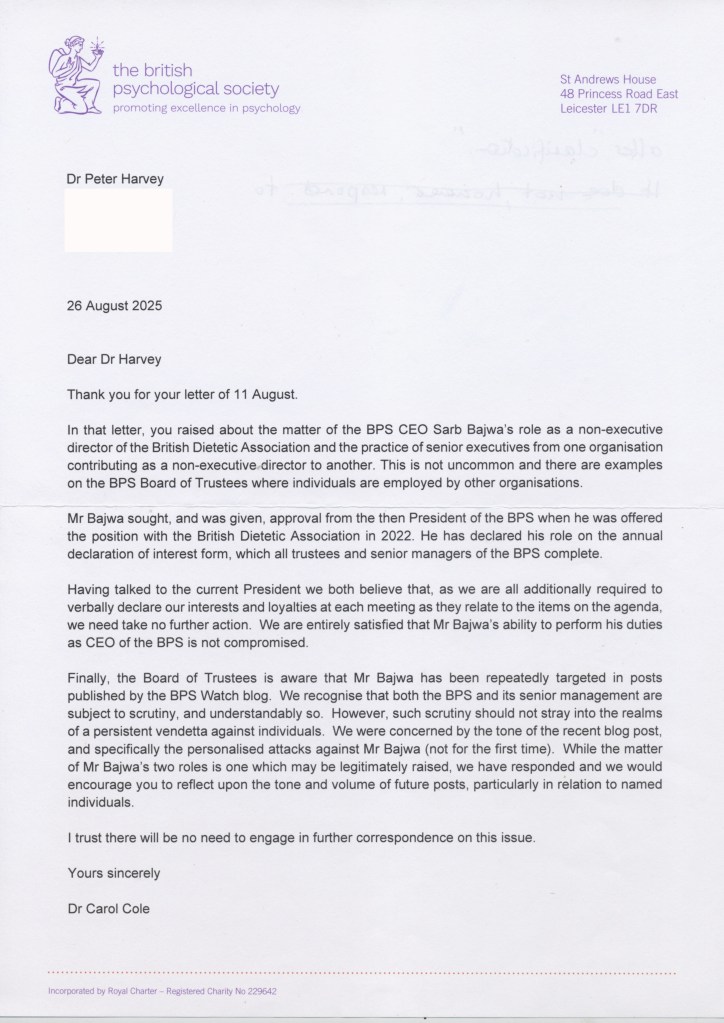
The curious case of Sarb Bajwa and the British Dietetic Association – BPS response.

We sent a copy of our recent blog post regarding the CEO, Sarb Bajwa, to the President and Chair of the Board of Trustees for comment. Dr Carol Cole, Chair of the Board responded and her reply is shown, in full and unedited (except for the redaction of my home address), below and is published with her permission. Note that this correspondence was originally by old-fashioned letter as, at the time of initial contact, the BPS did not have a way of contacting either the Chair or the President except by the CEO’s email; this is now no longer the case and both officers have individual email addresses at the BPS. In separate correspondence she also referred us to a statement by the BPS concerning Mr Bajwa’s return to work after his suspension and we are happy to post the link here.

Board of Trustees, Governance

Opacity and inertia at the BPS

This letter was sent to the Chair of the Board of Trustees, the President, the CEO and the Chair of the Practice Board (via email) at 0700 on Thursday 18 September, having been drafted the day before. By 0930 on Thursday 18 September the Minutes of the Board of Trustees meeting held in May 2025 appeared on the BPS website. As an aside, it is surprising that the Board hadn’t met since December 2024, a gap of 4 months. For comparison purposes the Board met eight times in 2021, nine times in 2022, five times in 2023 and five times in 2024. The minutes of the Practice Board (as of 0950 on Thursday 18 September) remain unpublished.

Dear Chair,

I write to you repeating concerns expressed since the inception of BPSWatch.com,  which was formed 5 years ago by three people who between them had more than 150 years continuous membership, track records of holding significant office within the Society and lifetime careers as practitioners. We have repeatedly during that period raised failures of openness transparency and accountability as well as restriction of debate around contentious issues.

We have had to contact the Society on a number of occasions to point out that minutes are not posted in a timely fashion for key boards. 

Importantly, there are no minutes of the Board of Trustees meetings for the whole of 2025 and it is now September. Have any meetings actually taken place? If so, why is it not seen as important to post records of the deliberations and decisions?

There are no minutes for the Practice Board since those for March 3rd, a gap of six months. Information on the of this Board should be a key focus for practitioner psychologists as they should inform us about matters discussed relating to the interface with public policy, public institutions, media and the wider public. The workings of the Practice Board should enable practitioner members to understand and contribute to the thinking, discussion and practice development of applied professional psychology in the UK. Many current and important policy issues clearly have psychology and psychologists at their heart. The almost information-free Practice Board Minutes of 3rd March do nothing to assist, let alone engage, practitioners in matters directly impinging upon their work. Taking the very high profile matter of post-Cass development of NHS services, the minutes merely state “Children and Young People Gender Group: The first meeting has taken place, and a discussion paper is in development”. Apparently nothing further is forthcoming since 6 months ago. Given that the Chair of the Practice Board and the President know from direct contact with concerned psychologists how much anxiety and energy was invested by senior practitioners in ensuring that post-Cass there would be credible input to future services, this parlous situation is wholly unacceptable. A further question, in the absence of any information whatsoever, concerns the ongoing dislocation of the BPS and the content of its Gender Guidelines from current review and policy discussion of adult gender services in England and Wales. We know that the ACP UK have been actively involved.

We received an assurance from the Chair of the Practice Board that given the gaps between meetings and the ratification of minutes there would be helpful updates of relevant policy development. These have not materialised.

Nor, as far as we are aware have there been helpful updates on any regular basis from the CEO, something we were led to expect when he was appointed. There is no open discussion of the BPS’s challenges and problems.

The Annual Report made available for the AGM was entirely unhelpful. It consisted of embarrassingly hearty self-congratulatory PR and little else beyond accounts which tell us we are now paying four senior staff over £100k per year, 2 of whom receive over £140k. There is declining membership reported, now significantly below 60k and many reports to us of poor Customer Relations Management. However, your restructuring saw the conspicuous disappearance of a Director level head of Membership and Professional Standards. You intend to sell off the Leicester Office base. This all sounds to members like declining health of the organisation, yet we are given no idea whatsoever what possibly questionable business plans have been running the Society from behind the scenes, and whether a radical change of course is desperately needed. From our position it seems that the focus is most definitely NOT on the professional career section of psychologists and a there is widely reported hostile reluctance to engage with senior experienced professional psychologists unless they toe particular ideological lines. This of course is a well known symptom of managerialism’s efforts to contain and suppress senior members who may challenge. BPS members are paying a lot for an unsatisfactory level of support and general performance. When we have challenged this, as we are entitled to do, this is deemed to be attacking staff personally rather than critiquing performance and outcomes. 

The BPS only exists because of members’ subscriptions. Paid and elected officers are accountable to that membership. Depriving that membership of information concerning matters of policy and decision making can  be deemed misgovernance and goes against Charity Commission requirements. 

Pat Harvey 

on behalf of BPSWatch.com

Board of Trustees, Governance

The curious case of Sarb Bajwa and the British Dietetic Association

David Pilgrim posts….

Sarb Bajwa remains the CEO of the British Psychological Society. In the view of many, he has been a lame duck ‘leader’ since his suspension in the wake of the fraud perpetrated by his personal assistant. The appointment of that assistant was surely his responsibility. She had 17 previous convictions relating to fraud. Over an 18-month period there were more than 900 authorised fraudulent transactions on their Society credit cards amounting to more than £70,000 (see here). Bajwa’s year-long suspension resulted in eventual reinstatement, but questions were raised about failures on the BPS side of the timeliness, process and probity of their investigation of his conduct.  

Astonishingly, not content to retain his full-time salary, and with his legitimacy hanging by a thread, the BPS CEO decided to branch out and offer his personal wisdom to another organization, becoming a Director of the British Dietetic Association (BDA) in 2022. This is the only body in the UK representing the whole of the dietetic workforce and it also functions as a trade union (see here).  

Whether the BDA were told of his suspension is one of many loose ends to query about Bajwa’s flirtation with ‘moonlighting’. We do not know if this unreported soft shoe shuffle was done with the complicity of the BPS Board; maybe they were allowing him a face-saving exit to pastures new. Who knows? We can only speculate because we can only do that, given that the BPS has an unfailing habit of not disclosing matters of importance to ordinary members of the Society. Members were not told about the fraud at the time, nor of his suspension, nor of the quick exit, minus punishment and whilst still presumably suspended, of the Chief Finance Officer to a post at, ironically, the National Lottery Community Fund. 

Now members have not been told, except by @psychsocwatch on “X”, that the Leicester BPS HQ office is now up for sale. For those new to the news, you may want to read that sentence again, but it is true. The BPS has run a deficit for many years and drawn down Society assets in the millions. There were many financial irregularities over the last two decades and five changes of Finance Director in about as many years. The membership has kept been totally in the dark about this dire financial position of the Society.

What purported to be a “business plan” discounted holding onto senior practitioner membership and their interests in favour of grasping at recruitment of early career graduates and their accreditation. That tactic is not turning out to be a cash cow. Rumblings about accreditation within higher education are seeing senior academics question what they actually get from the BPS, other than a tiresome bureaucracy constraining their freedom. Income streams, which sustain the highly paid Bajwa, his mysterious deputy and his Senior Management Team are clearly wobbling. The financial viability of the BPS is now highly uncertain. An Al Capone type outcome might be emerging. It is not the self-serving mendacity of the leaders, we have documented at length, that may be their downfall but mundane financial matters. However, for them it is not about owed tax but empty coffers.

Under Bajwa’s stewardship, a cabal has continued to run the BPS incorporating for a while the CV-improving applicants for Board membership. This has included cycle after cycle in the past ten years of Presidential candidates. A significant proportion of them have removed themselves before completing their three-year term. One was reportedly physically removed from the premises, one was expelled from membership and another left for personal reasons. One president, David Murphy, resigned as Vice President after the reputed breakdown of his relationship with Bajwa. Given the failure of accurate reporting by Jon Sutton, the supine editor of The Psychologist, of the true reasons for his resignation, Murphy was moved to publish his full letter of explanation on “X” (see here). The first appointed independent chair of the Board of Trustees, David Crundwell resigned without explanation after being in post for a mere 15 months (see here)

Who, other than BPSWatch has reported this shambolic picture of disaffected departures and financial meltdown? The Board have carried on regardless, with boat rocking not being permitted and the duty of transparency on behalf of ordinary members going absent without leave. Only those in the know are allowed to continue to be in the know. The antics of Bajwa have only been possible because of these other complicit actors. 

Given all of the above, what role has Bajwa been exploring on the Board of the BDA and how does he depict his claim to grand managerial authority? His statement here on the BDA website conceals his role in the BPS completely:

I am a senior manager and leader and spent the early part of my career living and working in Southern Africa for an international aid organisation. Over the last 15 years I have been working for a number of global professional membership and learned societies in a variety of regulated sectors, including: legal services; financial services, the engineering industry and health and social care. I am used to working in a changing national and international political landscape and have led these organisations through a variety of challenges. I understand the importance and value of professional bodies both for their members and the wider public good and believe that they have an invaluable role to play particularly in terms of building and sharing expertise and knowledge. I have been responsible for strategic planning; operational delivery; change management; managing campaigns and lobbying; public policy development; events and marketing; external relations and stakeholder management; customer service; financial and budgetary management I enjoy leading and driving change, being externally focused and forward facing and I have consistently delivered growth in the organisations for which I have worked. I am excited and looking forward to being part of the BDA family and contributing to our success.

This statement is, of course, not big on humility but, to be fair, we are all now used to the shameless self-promotion in the new professional class of managers. Bajwa is no more or less guilty of this sort of bullshit which we have come to expect from most of them.  But it is not what he says here that is the problem but what he does not say. We need to move into what philosophers call an ‘omissive critique’ in a wider exercise of critical deconstruction. Here I pick out some of his key claims.

Claim 1 I have been responsible for ….change management… Would that be the £6 million wasted of the members money, with no proven outcome?

Claim 2 I have been responsible for external relations and stakeholder management…. This has included becoming an expert on mental health, even getting co-authorship in an article in The Lancet, despite no clinical or research credentials in the field. As for ‘stakeholder management’, does that include the skill of keeping everyone in the dark, including his own workforce, about selling off their place of work? 

Claim 3 …..financial and budgetary management. Laugh or cry at this point? Would that be him signing off the fraudulent claims of his subsequently imprisoned PA? Would that be overseeing the demise of the Society’s financial viability, with the needed redundancies and property sell-offs first in London and then in Leicester?

Claim 4 I have consistently delivered growth in the organisations for which I have worked. Another laugh or cry moment and a reprise of the previous point.

Claim 5 I am excited and looking forward to being part of the BDA family and contributing to our success.  Well, if the BDA family was to be his new refuge, presumably he would be making decisions about living in two homes and allocating time to each.

Can a full time CEO of one organization be a director in another?

The answer to this question in a British context is ‘yes’, if it is within the law. The challenge of credibility Bajwa has here (along with the complicit actors in his ‘two families’) is not legal but ethical and it revolves around the matter of trust in principle and his personal trustworthiness in practice. This broad point contains with it the following considerations.

First, did the BPS Board approve of Bajwa’s move to a ‘new family’? Again, we do not know, but Board minutes from the time may provide that answer, unless -conveniently – the relevant content is redacted, which is a hallmark of BPS information control to the outside world. If it was approved, redacted or not, then it is not clear what benefits would accrue exactly in Leicester. Surely energy and time would be lost. Synergies might accrue but they should be proved, not assumed.

Second, are the activities of the two organisations separate enough to ensure no conflicts of interest? Neither Bajwa nor his complicit actors at the head of each organisation can reassure any sceptical onlooker. The latter first needs to discover the fact of his two-family living arrangement about the ‘challenge’ (as managers like to describe excruciatingly awkward questions) his dual role poses. Again, we may be the only source of that disclosure – it certainly has not been announced by anyone in the BPS to our knowledge.  An obvious query considering that fact relates to the professional work of dieticians and health psychologists. There may be boundary disputes between them and conflicting emphases in their client work. 

Third, there is the matter of time commitment and this links to the point about assumed synergy. If the latter cannot be proven, then why would a full-time CEO in one place be encouraged to take on the burden of a directorship in another? If Bajwa is receiving payment for his role, this is one consideration, but even if the role is pro bono there is still an opportunity cost. Bear in mind that the fraud and the financial meltdown have created an organisation in serious trouble. That being the case, surely any CEO worth his or her salt should devote 100% of their time and effort to mitigating the impact of an imminent organisational implosion. This is a crisis for the workforce in relation to their job security and a crisis for the BPS members if they unwisely still rely on the Society as a stable base for their discipline. Both staff and members are now in jeopardy, so this is not the time to fiddle while Rome burns. However, this is the BPS and the expected norms of probity and caution in publicly responsible bodies do not apply within the culture of its cabal.

Fourth, in that context, can Bajwa discharge his fiduciary duties with proper integrity to both the BPS and the BDA? This is an open question, but it needs to be asked for all those interested in credibility of both organisations. For example, the loyalty to each is strained by the conflicts of interest noted above.

Fifth, can confidentiality be sustained and kept separate when two roles are carried out simultaneously?  Scenarios may arise when the confidential interests of one organisation might interfere with the other one. 

Even a person with a proven track record of ethical integrity would struggle with these tensions. In the case of Bajwa, his integrity has been tarnished by the fraud and his Houdini-like escape from its consequences. This is not a good look for him or either of the two “families” that he currently shares. Sadly, it is what we have come to expect on this blog from those running the BPS. Few CEOs in the third sector have the dubious distinction of having a whole book published about the dysfunction of the regime over which they continued to preside (see here ).

There is a depressing symmetry between a failed organisation and its failed managers. The former may have emerged anyway, given changes in the economic viability of siloed uni-disciplinary authority; a norm in the last century, which has fragmented in this one. Better managers might stave off the inevitable, whereas poor ones expedite the decline and fall. Bajwa and his cabal confirm this conclusion and leave us with one last query. Do those at the top of the BDA (or its’ ordinary members) have any idea at all about what has happened in the BPS? For Bajwa to have had the gall to make the statement he did on their website reflects his character and maybe their naivety about welcoming him into their family. 

"The Psychologist", Gender, Governance, Identity Politics

The BPS : failed and still failing – and failed again.

You may have read our open letter [see here] to Professor Tony Lavender, Chair of the Practice Board of the British Psychological Society. We have had a number of responses to the letter supporting our view. This week (2 September) we received this response from Professor Lavender. Below it is our reply (sent today 3 September).

Dear Pat, Peter, and David

I am writing in response to your recent open letter, ‘The BPS and Gender: Failed and still failing.’

I understand that over recent years, you have raised these issues on many occasions and have received numerous in-depth answers which explain the BPS position, and which fully respond to your concerns. This has included responding to complaints, open letters, and concerns about specific members raised under our member code of conduct. The BPS has taken your concerns seriously and has addressed them with a considerable amount of care and attention as well as significant organisational resources. Because of this, it seems unnecessary to repeat information which has been communicated to you on multiple occasions previously, much of which is also publicly available.

Our Guidelines for psychologists working with gender, sexuality and relationship diversity are broad guidelines which set out general principles for psychologists and those working in associated fields. The guidelines clearly state they are not for the specific clinical treatment or assessment of gender dysphoria or incongruence. The society has stressed on multiple occasions that the guidelines do not relate to children and young people under the age of eighteen. So, while we note your concerns in the context of the Cass Review, we cannot agree that it is valid to project them onto guidance which is designed for adults. However, we do agree that there is a need for increased clinical guidance for professionals working with children and young people in the complex area of gender dysphoria. We have already indicated to NHS England our strong desire to join a consortium of relevant professional bodies to identify gaps in professional training and develop training materials to upskill the workforce. You will also know that the BPS recently created a Children and Young People and Gender task and finish group to look at the critical issues relating to children and young people and gender. This work is currently underway. 

In relation to the Cass Review, we cannot accept your view that the BPS is somehow ‘anti-Cass.’ Our response, as stated by Dr Roman Raczka, to the final report of the Cass Review commended Dr Cass for her ‘thorough and sensitive review into an area that is highly complex and controversial to many.’ He went on to state that, ‘Dr Cass and her team have produced a thought-provoking, detailed, and wide-ranging list of recommendations, which will have implications for all professionals working with gender-questioning children and young people. It will take time to carefully review and respond to the whole report, but I am sure that psychology, as a profession, will reflect and learn lessons from the review, its findings, and recommendations.’ This analysis of the final report and the resulting implication for psychology is currently underway. To support the cross-organisational group of members collaborating on our response, we reached out to the wider BPS membership to submit their evidence-based contributions. It does not appear that you took the opportunity to input into this important work. 

I note your concerns that any perception that the BPS had adopted an ‘anti-Cass’ position could endanger the organisation’s important relationship with NHS England. I am pleased to be able to reassure you that the BPS continue to have a positive relationship with NHS England. NHS England did recently approach the BPS to provide a statement relating to theirannouncement on the expansion of services for children and young people. On this occasion we politely declined as our consultation work with members was ongoing. NHSE readily understood and referred to our initial response to the final Cass report as “supportive.” 

The BPS recognises that the society may adopt policy positions that some of our members disagree with, but these policy positions are arrived at by assessing the evidence base, accessing the relevant expertise of our members as well as providing opportunities for our wider membership to feed their evidenced-based reflections through our consultation processes. While the BPS acknowledges that you remain dissatisfied with the society’s views on gender, with a membership of more than 65,000 passionate people, it is not expected that all our members will hold a single, unified view on any issue. Diversity of thought and opinion is a welcome hallmark and an inherent strength of both our profession and of our organisation.

Kind Regards

Tony Lavender.

This is our reply:

3 September 2024

Dear Tony

Thank you for your response of 2 September to our open letter of 14 August.

We find it difficult to believe that you wrote this reply although you have signed off on it. Accordingly, what follows is not directed at you personally.

Does no-one at the BPS recognise the very serious reputational mess that the BPS finds itself in on this matter? Apparently not. The tone of the response is arrogant, defensive and patronising to senior long-term members who have spent many hours over the years contributing to the Society, latterly to attempt to orient it to a better and more responsive and responsible course. The response is so inappropriate and, in a number of ways dishonest, that it requires point-by-point dissection and this follows below in the order offered by your response.

Your opening paragraph states:

I understand that over recent years, you have raised these issues on many occasions and have received numerous in-depth answers which explain the BPS position, and which fully respond to your concerns. This has included responding to complaints, open letters, and concerns about specific members raised under our member code of conduct. The BPS has taken your concerns seriously and has addressed them with a considerable amount of care and attention as well as significant organisational resources. Because of this, it seems unnecessary to repeat information which has been communicated to you on multiple occasions previously, much of which is also publicly available.

You imply that the BPS has been more than helpful, bending over backwards providing us with plentiful information in an open and transparent manner. That does not square with our experience. Only recently there was the example of the highly irresponsible actions of the editor of The Psychologist (supported by the Chair of the Editorial Board) in posting and retaining a link online to the Singapore-based Gender GP, a supplier of puberty blockers, despite being shown specific warnings from the NHS and the clear position taken by Cass concerning puberty blockers. That link remained online for several months after the representations had been made and rebuffed, and it was only taken down – without acknowledgement to us – after a judge had issues a warning about Gender GP in the High Court. We made a formal complaint about the rude and inappropriate response made by the two men. This was rejected out of hand. No acknowledgement, no reflection, no learning, no apology. The Chair of the Sexualities Section has repeatedly criticised Cass and insulted psychologists he deems supporters of Cass/Gender Critical and has cast disparaging and unprofessional aspersions on social media on LinkedIn. The BPS argued that it should be dealt with by the HCPC and their decision was that this did not reach their threshold for investigation as a fitness to practice issue. On then requesting that the BPS formally investigate (under the BPS’s own Member Conduct Rules and Social Media Guidelines) it refused to act (or may have done but the Complaints Process does not allow complainants any meaningful feedback). Issues of confidentiality regarding complaints aside, some years ago there was an undertaking to publish anonymised data about the types of complaints that were being received, investigated and their outcomes. This appears not to have been done, and it is our view that beyond fitness to practice responsibilities taken by the HCPC there are member Conduct Rules, Code of Ethics and Conduct, Social Media Guidelines and rules for members undertaking official duties for the BPS which should be in force but about which there is no feedback given in terms of application. The BPS is not a learning organisation in itself or for its members.

Your comment about information being publicly available mystifies us. One of our enduring complaints is the lack of information for members. It is our group, as well as others on social media, who have been the source of much information that should have come from the BPS.

It is galling and insulting to be admonished in the second paragraph with 

The guidelines clearly state they are not for the specific clinical treatment or assessment of gender dysphoria or incongruence. The society has stressed on multiple occasions that the guidelines do not relate to children and young people under the age of eighteen. So, while we note your concerns in the context of the Cass Review, we cannot agree that it is valid to project them onto guidance which is designed for adults”.

We need to remind you that it was as a result of a lengthy complaint by one of us (which required considerable persistence) that it was finally made clear two years after publication of the 2019 Guidelines that the Guidelines were for adults/over 18s. On 9 April 2021 the Director of Membership and Professional Development wrote to confirm to us that

“…we have offered to put a statement on the front of our guidelines, on our website and all points/places where the guidelines are referenced to confirm that the BPS guidelines for psychologists working with gender, sexuality and relationship diversity are rot adults. We will implement this urgently.”

The belatedly “adults only” badging would not have happened had it not been for this hard-fought complaint and the rebadging did not remove ambiguities in the content of the guidelines that had implications for a philosophy of practice for young people. 

The concerns of the Cass Review on children’s gender services subsequently raised wide ranging issues of 

  • service philosophy; 
  • exploratory versus affirmative psychological practice;
  • diagnostic overshadowing;
  • the needs of detransitioners.

All of these critical matters are largely downplayed, disregarded or ignored in the revised 2024 adult guidelines. You cannot surely think that at age 18, the radical paradigm shifts proposed by Cass suddenly do not apply? 

The 2024 edition of the Guidelines is a document entirely discontinuous with, and dislocated from, the services which will be developed from Cass, and you actually confirm that with your ridiculous phrase “…we cannot agree that it is valid to project them onto guidance which is designed for adults“. Please do not think it is remotely permissible to bandy the word “project” about in this fashion with clinical psychologists and please endeavour to reflect how utterly patronising and inept these two paragraphs are.

Regarding your third paragraph – is the BPS anti-Cass? The balance of evidence so far is certainly that it has not been interested in, or has been defensive about, the highly relevant recent history of disquiet about the psychologist-led GIDS service that finally led to the Cass Review. This can be evidenced in detail by scrutinising what the BPS has said and done on its website and in The Psychologist, latterly and most blatantly in relation to the revision of the adult Guidelines which we emphatically argue above should show some continuity and consonance with the Cass paradigm shift. The Guidelines patently do not. We would direct you to the following: https://www.bps.org.uk/news/bps-response-new-nhs-england-regional-model-gender-identity-services-children-and-young-people.This is an alarming response following proposals from Cass that GIDS should close. It focussed away from the service philosophy and inadequate psychological practice issues then emerging, and on to waiting time problems. It placed its concern with the current GIDS psychologists rather than showing any curiosity that possibly damaging practices might have been going on there in psychology-led services for children and young people: 

We are aware that some BPS members will work across the Tavistock Clinic and that this news might be unsettling and upsetting for them. We would encourage any members who are affected by this to seek support from their Union or by contacting the BPS where we will work, as their professional body, to support them accordingly.

A response (https://www.bps.org.uk/psychologist/time-honest-reflection-not-defence) from senior members/practitioners to this BPS reaction stated :

These constitute serious criticisms of a flagship psychology-led service, resulting in its closure to protect patient safety. In this context, the statement issued by the BPS is profoundly inadequate. It offers no acknowledgement of the severity and range of these problems, or of the harm done to some children and young people. There is no reflection on mistakes made or lessons to be learnt. Defence, not reflection, has been a theme throughout the story of GIDS. Many clinicians, parents and patients have raised repeated concerns about the practice model. Ex-patients have discussed feeling rushed into body-altering interventions which some have come to regret. Criticism has grown louder recently, following a 2018 internal report, a judicial review in 2020, damages awarded to the Trust safeguarding lead and an ‘inadequate’ CQC report in 2021, plus increasing media coverage. Concerns that GIDS was operating outside usual clinical practice were first raised, however, in 2004. Critics have consistently been labelled bigots or transphobes and ostracised.

Key people at the BPS remain openly hostile to Cass. The Chair of the Sexualities Section has stated publicly that he will be part of a group criticising her Review and its evidence base. The BPS appointed two new members to the working group for the revised Guidelines who were implacably trans-activist and anti-Cass. They are employed in private service provision, Gender Plus, who will get their clientele (including some children) from those who wish to by-pass service strictures in the new NHS provisions. The BPS as a body have been constipated in producing any fully worked out response to Cass. Roman’s response is far from that – it is just a place holder. This is a marked deficit in timeliness and enthusiasm, critical or otherwise, given that psychologists have such a central role to play – no signs of BPS reflection or audit of what went wrong. What has he or anyone else done to action his comment ‘I am sure that psychology, as a profession, will reflect and learn lessons from the review, its findings, and recommendations.’  Not happening and no proposals to make it happen. This response demonstrates that very clearly.

You refer to our failure to contribute to the project identifying the implications of the Cass Review for psychology (https://www.bps.org.uk/news/members-encouraged-contribute-cass-review-project ). Have you considered how that was phrased by the BPS Comms Team? Fill in an online form and “Members are reminded that contributions should be evidence-based”. So, individual members are supposed only to send in opinions which are evidence-based. When part of the problem in previous services was poor evidence, when Cass has extensively, and over a long period reviewed evidence, what is an individual psychologist going to do to produce a contribution which is evidence-based?  This was going to discourage more people than just ourselves from thinking there was much point. Maybe, given our experiences, that was deliberate.

In noting in our letter to you that adult gender services were now also to be reviewed, we have stressed above the discontinuity of paradigm between remodelled children’s services and the stale narrow re-statement in 2024 of a BPS position that had been extant from 5 years before in the 2019 Guidelines. Can you believe that these guidelines will say anything whatsoever in terms of their content to impress policy makers that the BPS can assist them? The BPS is stuck in its activist capture demonstrated with evidence in our letter.  The appointment of Moon and Zitz to a team led by Richards was doubling down on existing massive bias in the ideology of the authors. Your last paragraph 

The BPS recognises that the society may adopt policy positions that some of our members disagree with, but these policy positions are arrived at by assessing the evidence base, accessing the relevant expertise of our members as well as providing opportunities for our wider membership to feed their evidenced-based reflections through our consultation processes. While the BPS acknowledges that you remain dissatisfied with the society’s views on gender, with a membership of more than 65,000 passionate people, it is not expected that all our members will hold a single, unified view on any issue. Diversity of thought and opinion is a welcome hallmark and an inherent strength of both our profession and of our organisation.

is patently ridiculous and insults our intelligence. Everything in this last paragraph is untrue. To use common parlance, the whole reply is gaslighting. How could a small writing group of six who shared clear common affiliations with trans activism such as WPATH and BAGIS and working for Gender Plus represent a breadth of viewpoint? Why choose an additional psychologist such as one still aligned with GIDS instead of someone from the thirty-five experienced psychologists who had left that regime? Why had two of the previous authors taken the decisive decision to have their names removed from the 2019 document? Despite seismic shifts in the context of gender services between 2019 and 2024, the BPS made decisions which showed no reflection of that and reinforced its capture by trans activists, a narrowing of dogmatic prescription rather than more nuanced, diverse and inclusive perspectives. It is beyond irony that you trumpet diversity of thought and opinion in your defence of an entirely exclusive and inflexibly rigid document. The Society has dug a deep hole for itself, and it keeps on digging. Your Comms-Speak response confirms this: “65000 passionate members” is taking that rhetoric to its silly apogee.

Withdraw the guidelines now. 

Yours sincerely,

Pat Harvey, David Pilgrim, Peter Harvey,

BPS members, Clinical Psychologists.

BPSWatch.com, @psychsocwatchuk

Gender, Governance, Identity Politics

Trans capture in the BPS in its social and historical context

David Pilgrim

Introduction

I argue below that the concerted pressure from transgender activists within the British Psychological Society (BPS) has a particular social and historical context. Their claims emerged from a complex mixture of factors at the turn of the 20th century. That picture included philosophical idealism from Nietzsche via Foucault, New Social Movements in the wake of black civil rights protests in the USA, changes in biomedical ambitions for a technological fix for human distress, the abandonment of redistributive forms of politics to create social justice in favour of the politics of recognition, the shift from second wave to third wave feminism with its celebration of Queer Theory, as well as the direct and indirect financing of the transgender movement. On the latter count, the gender clinic industry is a source of drug company profits (from the use of puberty blockers and cross-sex hormones). In addition, there key billionaire contributions to support transgender activism via charitable foundations (https://4thwavenow.com/2018/05/25/the-open-society-foundations-the-transgender-movement/).

I will return to these synergistic ideological and economic mechanisms below but will start with their practical outcome in recent times in the BPS. By going to and fro between these local and recent events on the one hand, and their social and historical context on the other, I hope to understand why this particular ‘culture war’ about gender has often generated more heat than light. That trend can be seen in purported scholarly organisations like the BPS and in the NHS, where advocates of ‘gender medicine’ have become impaired in their reasoning and their honesty about both evidence and ethics.

The BPS has painted itself into a corner on gender

Since the final Cass Review was published, there has been a stubborn resistance from transgender activists in the UK. Those we listed in our letter to Professor Tony Lavender, Chair of the BPS Practice Board [on this blog August 15th] reflect that push back inside the BPS, from those capturing its policy stance on the contested notion of ‘gender’. We might add others, such as Dr Rob Agnew (Chair of the BPS Psychology of Sexualities Section – see below) and Dr Adam Jowett (Chair of the BPS EDI Board and BPS Trustee). The first, a clinical psychologist, on X described the release of the Cass Review as a ‘…bad day for trans youth…’.

The second, an academic psychologist, provided research to the previous government, which despite its foreboding rhetoric and poor methodology, failed to offer a shred of evidence that conversion therapy for gay or transgender people existed in Britain within mainstream mental healthcare. 

The misleading elision of aversion therapy for gay men in the past and exploratory conversations with children today, is absurd (Pilgrim, 2023a). Despite this, that line of reasoning has continued in the BPS since 2018 with Igi Moon at the helm, spearheading the ‘Coalition Against Conversion Therapy’, using the Society’s resources and its administrative base to lobby government. Take this boast from the Coalition:

Dr Igi/Lyndsey Moon, who is chair of the Coalition and British Psychological Society lead said:

‘This is a clear sign that the Government has at long last listened to LGBT individuals and national organisations who have tirelessly campaigned for change. We, along with our Coalition partners, have repeatedly called for an end to the practice of Conversion Therapy and will work with the Government to ensure it delivers on its promise.  The Coalition will fully engage with the forthcoming consultation on the best way to implement an end to this practice.’” (https://www.cosrt.org.uk/tag/coalition-against-conversion-therapy/).

Today, trans capture is not unique to the BPS, but the difference is that most other relevant organisations are now adapting to the realpolitik of a post-Cass world and are managing to contain the excesses of their activist members. Within medicine, controversially, the BMA is out of sync with that trend and so it has become newsworthy for the storm that this has created in its own membership (Feinmann, 2024). Hundreds of BMA members are now resigning in protest at trans capture in their trade union and professional body (see https://archive.ph/uRNLH and https://archive.ph/VINHO).

Agnew and Jowett, along with the activist authors of the  Guidelines for Psychologists Working with Gender, Sexuality and Relationship Diversity (https://explore.bps.org.uk/content/report-guideline/bpsrep.2024.rep129b). (first issued in 2019 and modified in 2024), as well as the collusive support of the editor of The Psychologist, have now painted the BPS into a corner. Because the matter of gender has not been explored fully and properly within the whole membership containing, like civil society more widely, distinctly differing viewpoints, one, and only one, policy, theoretical and ideological position on sex and gender has been left standing. For now, the white, pink and blue flag flutters imperiously above the Leicester HQ. 

This poses a problem for the BPS and is an irritating embarrassment to any ordinary member holding a view non-compliant with transgender activist dictates. If that conclusion is in doubt about policy capture, at the time of writing the BPS has just offered the world an ‘unconference’ [sic] to explore ‘perinatal psychology’ ( https://www.bps.org.uk/event/reflections-equality-diversity-and-inclusion-perinatal-psychology-systemic-vitality-or). Although factually only women can have babies and breastfeed naturally, the BPS now endorses the neologisms of ‘birthing parents’ and ‘chest-feeders’.

I now turn back to the wider context to understand how we have arrived at this strange scenario, whereby a putative scholarly organisation has been reduced to a platform for partisan rhetoric.

The wider context: hegemony and mission creep

The word ‘hegemony’ connotes the dominant role of one viewpoint in a specific cultural setting. It has a dynamic implication, because nothing lasts in human affairs. There is a power struggle and there are winners and losers over time and place. In Western democracies we are living in a time when the dominance of gender ideology has been embedded since the 1990s. However, it is now fracturing. The word ‘gender’ appeared as an alternative to both ‘women’ (‘women’s studies’ became ‘gender studies’ in the academy) and sex, as in the highly risky use of ‘gender’, not ‘sex’, in medical records (Dahlen,2021). This was reflected in the ascendency of Queer Theory, third wave feminism and the politics of recognition, at the height of postmodernism in the 1990s (Butler, 1995; Rubin, 1992; Califia, 1995; Taylor, 1994).  

In the clinical domain, what started in the 1960s as a compassionate acceptance of adult transsexuals, who at that time were mainly men wanting to be women in physical appearance and social presentation (Benjamin, 1966), soon moved into areas of practice that provoked critical opposition for a range of reasons. Those critics, for daring to speak out, were to be dubbed ‘transphobic’ or ‘anti-trans’. This article will probably meet the same dismissal. 

Thus, the right to disagree, in the academy, the clinic or wider civil society was to be quashed at every opportunity by transgender activists. This casts doubt upon the confident cultural dominance of transgenderism. For hegemony to be true to form it needs to acquire a stable matter-of-fact consensus view without coercion; it is a form of soft, not hard, power. That is a defining feature of hegemony: it relies on credible language not on brute force. Thus, transgender activists have not enjoyed that taken-for-granted consensus, as they have had to face opposition from unimpressed and unpersuaded critics. In response, these critics have been personally disparaged, threatened and harassed.

Mission creep in the clinic and the invention of cis bigotry

Under the transgender umbrella it soon became evident that the male to female (MtF) transsexual group contained at times a version of extended fetishism or autogynephilia (Blanchard, 2005). These male cross-dressers were sexually aroused by acting like women and surrounding themselves intimately with natal women. The latter were to be dubbed, patronisingly by transgender activists, as ‘cis women’ raising a logical conundrum. If a transwoman was now declared with total certainty to be a woman, then why was a natal women called something else (i.e., a ‘cis woman’ and not just plainly a ‘woman’)? One answer, which the anti-realist postmodernists found unacceptable, was that women have XX chromosomes and men have XY chromosomes. Postmodern framings ignored facts and instead preferred unending fictions. Another answer was the hierarchy of victimhood created by the logic of identity politics (transwomen were deemed to be more oppressed than cis women).

To say that a woman is an adult human female (a dictionary definition) was then rendered as a form of hate speech by the guardians of identity politics and, at times, this even triggered police involvement. However, a man has never had a baby and never will. The ‘unconference’ noted above will not change that reality. A woman will never die of prostate cancer. A man in a dress demanding to be called ‘she’ is still a man (Greer, 1999). Indeed, for gender re-assignment to mean anything plausibly, it must manipulate a healthy male body to look like a female one or vice versa. This generated another conundrum but this time about social norms. Despite norm-busting claims of celebrating gender diversity, what used to be called a ‘sex change’ has, by and large, hormonally and surgically generated very conservative and caricatured stereotypes of appearance. 

A legacy of these linguistic gymnastics has been the emergence of a ‘woman with a penis’ and even a ‘trans lesbian’, defying the logical and historical agreement that lesbians are females sexually attracted to other females. Old-fashioned common-sense realists (i.e. most ordinary citizens remembering their school biology lessons) were thrown into confusion with all of this postmodernist word play. Wrong footed, unenlightened ‘cis’ social actors were to become bigots for ‘misgendering’ a man in a dress or ‘dead naming’ a person they had known for years as male or female, who has now opted to self-identify as a member of the opposite sex. Just as the victimhood of being transgender was guaranteed, then so too were the inevitable moral failings of untutored ‘cis’ people, with oppressive ‘cis women’ being especially suspect. ‘Black face’ causes understandable offence but ‘woman face’ is supposedly now a symbol of human progress and tolerance (cf. Tuvel, 2017).

Depicting or speaking about something as real is not necessarily the same thing as it being real (technically this is called an ‘epistemic fallacy’). We can recognise a drawing of a unicorn, but unicorns do not exist. People may lie about themselves or be deluded. The recognition of self-statements by others is a negotiation not an enforced outcome on tramlines, a point those defending the ethics of recognition note (Honneth, 1995). But according to gender ideology, insinuated now in the official BPS policy position, if a boy says he is a girl, then he is a girl. Accordingly, ontological realism with its principle of limits was discounted by Queer Theory underpinning BPS policy. Instead, it favoured unendingly elastic epistemological relativism (cf. Henry, 1950). A philosophical realist insists that an adult person with XY chromosomes is a man. By contrast, a philosophical idealist claims that they can be a woman if they say they are. One of them is wrong. 

The principle of limits first discussed by the philosopher and psychologist C.D. Broad in the early 20th century was defended later by second wave feminists (Broad, 1949). For example, Oakley (1972) accepted that gender expression was socially negotiated over time and place, but she held on firmly to biological reality and the immutability of sex. However, within twenty years, the third wave went much further, rendering the material reality of the natural world irrelevant. Talk, and talk about talk, now became all important, in the hurry towards the promised land of radical social constructivism. Sex as a biological fact was old hat and a likely source of hate speech. 

This switching of priorities in social science, bizarrely later to be adopted by some who should have known better in the natural sciences, with their authority predicated on versions of philosophical realism, conflated ontology and epistemology. Now ‘everything was socially constructed’, a view reinforced by the growth of postmodern psychology in the academy.  In the clinic, it led to GIDS, with its preference for children being ‘assigned’ a sex at birth, as if it were an arbitrary opinion. 

That scorned decision-making from people offering their commonsense observations about a baby boy or girl, must now be trumped by the absolute life-long certainty of self-identification. This must not be gainsaid by anyone, including psychologists. ‘Trans children’, even before they went to school, would signal with certainty that they had been ‘born in the wrong body’, and adults must accept that judgment credulously. 

However, a ‘non-binary’ claim within the transgender panoply created another conundrum and contradiction: if we are all born with a life-long fixed ‘gender identity’, then how can it change from day to day or hour to hour in some, but not all, of us? If our gender identity is like a permanent inborn soul, then how come that for some of us it keeps slipping and sliding away? The mystique of ‘having’ a gender is mysterious indeed and these are serious theological and psychological questions about souls or selves. Ultimately how do we understand personhood? (See Smith (2010) for a critical realist take on that big question.) 

The impact of gender ideology in the BPS

The Guidelines issued by the BPS on gender in 2019 and revised this year reflect this wider context of an ideology which has been imposed on children by adults. Children did not invent gender ideology. However, their views have been shaped by it en masse, encouraged by virtue signalling policy makers in health and education and online social contagion. In truth, ‘trans children’ do not reflect a suddenly recognised aspect of ontology. After all, where were they all 30 years ago?  Instead, in the wake of Queer Theory they were invented by some adults on an ideological mission and nameable activists in the BPS and other organisations reflect that scheming and earnest missionary activity (Moore and Brunskell-Evans, 2019).

Diagnostic overshadowing, revealed in the Cass Review, became evident and was reflected in Agnew’s simplistic view that there is a single reductive category of ‘trans youth’. According to him and the discredited GIDS leadership, we need look no further than self-identification and a moral obligation to affirm the self-statements of gender questioning children. What this insistence closed off was the evidence that the GIDS waiting list contained distressed children who were depressed, anxious, survivors of abuse, might have marked autistic features or had come from a family context of parental homophobia (Barnes, 2023). Psychologists led that now discredited biomedical project and the BPS backed it to the hilt; recent events suggest that it does not intend to abandon that position.

Whilst affirmation superficially signals patient-centredness, it is the very opposite. Diagnostic overshadowing and the reification of ‘trans children’ diverts clinicians from a standard obligation to offer biographically unique formulations. Why were these young people being treated in a different way to any other clinical presentation? Also why were psychologists leading the charge for biomedical interventionism, when that reactionary and bio-reductionist role had been left previously to biological psychiatrists, with their ‘great and desperate cures’ which always focused on the body, rather than biographical uniqueness?

The answer to these questions lay in mission creep from the Benjamin regime, with its focus on adult transsexuals in the 1960s, to children in the 1990s. Once activists made that daring shift it would inevitably be provocative and so it was the case. The psychology leadership at GIDS adopted uncritically that mission creep, modelled in the Netherlands on a small and highly selected sample of children and ‘rolled it out’ in the NHS, as a full-blown service philosophy (Biggs, 2023). Worse than that, a study looking at outcomes failed to demonstrate the clinical effectiveness of an affirmation model in the UK – that bad news for transgender ideologues was actively suppressed for many years (Butler et al, 2022). This obfuscation only came to light because of a freedom of information request (Biggs, 2019). That evasion of the truth from those committed to expanding ‘gender medicine’ in the NHS was confirmed by the unwillingness of managers of adult gender clinics to release follow up data about the outcomes for transgender patients during the Cass Review (https://www.theguardian.com/society/2024/apr/10/adult-transgender-clinics-in-england-face-inquiry-into-patient-care.)

If affirmation is so worthy and the outcomes are so good, then why is evidence about them being cynically suppressed by those promoting and managing ‘gender medicine’? The answer is that ideology has been more important than evidence for those defending its expansion. A summary of this challenge for transactivists about evidence is offered here in Feinmann (op.cit.):

At the heart of the dispute is a series of systematic reviews that rigorously examined the robustness of practice and guidelines underpinning the care of young people with gender dysphoria, in particular influential guidelines by the World Professional Association for Transgender Health (WPATH). A total of seven papers by the York University systematic review group were published in the Archives of Disease in Childhood in April. The papers found that the evidence on the use of puberty blockers and hormones in young people with gender related distress was “wholly inadequate, making it impossible to gauge their effectiveness or their effects on mental and physical health.” Nick Brown, editor of the Archives of Diseases in Childhood, told The BMJ, “A common thread in the review findings was the breathtaking dearth of quality evidence to guide care in this vulnerable group of young people.”.

This need to suppress or evade inconvenient truths, along with the iatrogenic risk that all ‘trans youth’ are exposed to by an affirmation model (Jorgensen, 2023), has culminated in a crisis for transgender hegemony in clinical contexts. It is now breaking down, as the Royal College of Psychiatrists, the Royal College of General Practitioners, the Academy of Medical Colleges, the Association of Clinical Psychologists and the Pharmaceutical Society have now all backed the Cass Review and pulled back from previous degrees of trans capture. This is true also of the incoming Secretary of State for Health who has continued the ban on puberty blockers. That new emerging consensus is clearly leaving the BPS out in the cold in policy making.

The paradox of identity politics writ large in the BPS

The weak governance at the top of the BPS, alongside its largely passive and acquiescent membership have, in recent years, created an open goal for transgender activists. Igi Moon coopting the BPS administration for the wild goose chase of purging the land of conversion therapy (i.e. having routine therapeutic explorations) has been par for the course. So too with Christina Richards, a co-author of the WPATH ‘standards of care’, who had free reign to dominate the BPS Guidelines group. This counselling psychologist left being non-directive at the consulting room door and told us that there was to be no debate and that all identities have equal value. However, on pragmatic grounds Richards modified the ‘Kink’ and ‘Slut’ strictures from the 2019, when the document was revised in 2024. 

The Sexualities Section of the BPS has now become obsessed by transgender rights, mirroring the reason, in wider British society, why the LGB Alliance found it necessary to split away from Stonewall. Those leaving in protest emphasised that in their own histories they might have been shepherded by adults into a biomedical pathway. The BPS Lesbian and Gay Section formed in 1998 initially made only a passing mention of transgenderism (https://www.bps.org.uk/member-networks/psychology-sexualities-section). Today it is called the “Psychology of Sexualities Section”. But, as a sign of how times have changed in the shifting self-righteous world of identity politics it includes the following commitments:

“...developing non-heterosexist and gender-inclusive forms of research, theory and clinical practice in British psychology...”

and

…taking a broadly affirmative approach towards sexualities, including transgressive sexualities, while also strongly condemning those which are coercive…

This legitimises the title of the controversial Guidelines, which we have critiqued and complained about on this blog. 

Maybe the gains of homosexual rights, now largely won in formal legal terms in Western liberal democracies, have created the space for a new raison d’etre for both Stonewall and trans captured organisations like the BPS. This focuses on reifying trans identities and appealing to a sense of injustice about a new form of victimhood. The latter seemingly entails the ‘human right’ of existentially confused children to have access to an iatrogenic pathway of hormones and surgical mutilation on demand, being cruelly denied to them by Cass and her supporters.  Accordingly, Rob Agnew the Chair of the newly named Section in a forlorn response on X to the release of the Cass Review said this:

Bad news for our trans youth this morning, but let’s be honest, we knew it was coming. In 2021/22 I reviewed the WPATH guidelines for the General Medical Council for a fitness to practice lawsuit in trans youth healthcare provision. The conclusions and the consequences of Cass are out of step with better quality, more comprehensive reviews, and out of step with approaches in other countries. So over the coming days I, and many other clinicians, will be having a look at the final Cass Review in detail and trying to answer the question ‘Why was Cass unable to find the research needed to provide trans youth with vital medical approaches that other countries found?‘.

Maybe Cass was trying to go beyond the selective approach to evidence preferred by the activist-driven WPATH (see later). Maybe Agnew might indeed ‘look’, but he would find nothing of value to him in the evidence available, unless it is to be approached with a highly biased selective attention. 

All this indignant rhetoric from Agnew reflects a paradox of identity politics as both a libertarian and authoritarian form of adventurism. On the one hand, the politics of recognition seem to invite tolerance and an unending plurality of perspectives. On the other hand, those same politics enforce very strict rules of expression. Its leaders and guardians, in no uncertain terms, tell us what must be spoken and proscribe what must not. 

Second wave feminists, scientific realists and some religious groups have chosen to speak out against this dogma and denial of debate from their particular gender critical perspective, Consequently, they have been vilified and hounded by the gender thought police. Some have lost their jobs. Some had death and rape threats. Some were cancelled on university campuses. All were cast as bigots; the term ‘TERF’, and the recurrent online invitation to kill one, was largely limited to women. A recurrent problem for the logic of identity politics is that special pleading for one social group often might necessitate hostility to another. For example, in the case of transgenderism there is recurring misogyny and a contempt for lesbians (the real ones not the fictional ones).

The ‘no debate’ campaign was clear to see, as freedom of expression in general, and academic freedom in particular, were restricted in ways previously seen only in Nazi Germany and Stalinist Russia. Whether authoritarian control is imposed by the Party or by identity politics from the cyber-mob, the right to speak out freely and disagree with one another is suppressed (cf. Nossel, 2020). But without disagreement there can be no progress about either knowledge production or deliberative democracy (Mercier and Sperber, 2021; von Heiseler, 2020). 

This wider process of suppressed debate has infected the BPS, with consequences for a discipline already theoretically and methodologically contested.  Psychology is at the cusp of social and natural science, and unsure whether to celebrate or reject its older pretensions to be an experimental science guided by statistical precision. It starts in artificially controlled closed systems, like the psychology experiment, or conclusions from spreadsheets of correlations, but then claims authority in the fluxing situated complexity of everyday life (all human systems are open systems). It gets methodologically confused (or sometimes pre-emptively arrogant) about that challenge. Epistemological pluralism and contestation have thus been inevitable. Understandably we are now used to the collective noun for psychologists being a ‘disagreement’. 

Transgender capture has now entered that contested space with its favoured radical social constructivism. It is part of the ‘broad church’ depiction from the Society’s apparatchiks. In relation to gender, that broad church now seems to have been taken over by a cult, or at least a group of socially connected activists, using the manipulative tactics of entryism. In our letter to Tony Lavender, we pointedly named these people. They were joined for a while by others working in gender clinics attempting to extend prescribing rights to psychologists. This had puberty blockers and hormones in their fixed sights. That particular putsch from the trans activists in 2019 failed but it was a close call.

Strictly this network has been ‘cultish’ rather than a cult, as it lacks a defined charismatic leader. Also, the underpinning history of transgender activism has been complex as I noted in the introduction and so the singular ‘cult thesis’ is reductive.  Nonetheless, it makes sense that some gender critics use the term ‘cult’, given the mixture of dogmatism and messianic fervour that characterises the transgender movement for now. The parents of gender questioning children understandably do at times report that they have lost them to a cult.  

Dogmatism and rigidity of thought are well explored by cognitive psychologists. We can reason in quickly needed binaries to ward off risk or spot a friend or foe. As we mature, we also learn cautious reflection to generate situated wisdom (phronesis) and tentative understandings about our inner and outer worlds (Dutton, 2020; Kahneman, 2011). What identity politics have done, reinforced by rapid online digital decisions, is to encourage a fixation in a simplistic toddler mode of thinking, or what previously psychoanalysts called ‘splitting’. Black and white, goodies and baddies, you are either for or against us, ingroup good, outgroup bad, ‘like’/’dislike’ etc. Mature grown-ups show epistemic humility, nuanced reflection and context specific moral reasoning, toddlers do not (Neiman, 2021). The activists capturing the BPS (and the BMA-see below) are like very clever toddlers getting their own way, when they can. 

The point here is that such antics are ripe for psychological understanding, rather than passive and unthinking compliance. It was that compliance, which the transgender activists, who were writing the ‘Guidelines’, were expecting from a dutiful membership. Collusively, the Professional Affairs Board and the Society’s ‘Director of Knowledge and Insight’ [sic] signed them off with unreflective enthusiasm in the same year that the final Cass Review was published. This may be a decision that they are already regretting.

The unlikely bedfellows of the BPS and the BMA

Post-Cass, the transgender activists are not going down without a fight in Britain. Ex-GIDS staff are forming alliances with cooperative medical prescribers to set up new services and keep the old spirit alive in the private sector. The ban on puberty blockers has now made their enthusiasm for the old regime precarious in practice, though workarounds will be tested out and promiscuous prescribers may try their luck again in the court of the GMC. 

Within organisations they are also offering a rearguard action to discredit Cass. Two stand-out examples are the BMA and the BPS, which are bucking the trend of consensus building about implementing her Review (Abassi, 2024; McCartney, 2024). Apart from their tactics of entryism to achieve short term goals, transgender activists are now playing catch up about evidence and accordingly they are in a bind. The reason for the catch up is that evidence has never really been their strong suit. Who needs evidence when the truth about gender identity is taken as a given? The BMA, at risk of losing much of their membership, have announced that they will review the Cass Review in the next few months, a decision flowing from the capture of the BMA council by a handful of transgender activists. Watch that space, when selected papers are cobbled together.  

A shared rhetoric of justification of both psychology and medicine is that they are evidence based. However, this poses a problem for transgender activists. Privately they know that there is still no strong evidence that biomedical affirmative care is either effective or safe. In the case of paediatric transition, this immediately becomes a child protection issue. We have regularly made this point to BPS leaders, and they have regularly ignored us. The Guidelines they have endorsed totally fail to properly consider either empirical evidence in the round, or sound ethical cautions about child protection.

The metaphysical chasm revealed by trans capture

Notwithstanding the antics of activists in the BMA or the BPS when capturing the policy machinery, there is an irrefutable deep metaphysical chasm between gender ideology and its critics. It is not only that the former conflates ontology and epistemology whereas the latter separate them. It is also about a fundamental difference of viewpoint about ethics flowing from that gap. Transgender entryism in the two organizations genuinely brings with it the belief that there is one, and only one, valid ethical framework, which I deal with below. They are so certain on a priori grounds that the unending recognition of the self-statements of any individual, adult or child, must be respected that the consequences of that policy are ignored. 

In line with that moral certainty, which is foundational to identity politics, they take their eye off the ball about evidence.  Alternatively, they suppress inconvenient findings as I noted above and only deal with it as a post hoc rearguard action. In the latter, two features are evident. First, menacingly they attack their opponents, ad hominem style. Second, they assert that their own selective version of evidence is superior by dent of professional expertise or being experts by experience. 

On the first count, Hilary Cass was disparaged for being ‘cis and het’. The degree of vilification she experienced warranted advice from the police that she should not travel on public transport. An immediate response in the journal, which is the quasi-academic outlet for WPATH, has a self-evident title making this point (Horton, 2024). 

On the second count, WPATH now has a major credibility problem when it tries to defend its empiricist credibility, given that it is activist driven. The argument that being expert in a field offers an immediate authoritative position is as flawed in ‘gender medicine’, as in any other branch. However, the activist-with-an-agenda component amplifies that tendency. Those with a vested interest in the field, whether as practitioners or ideologues, raise immediate and unique doubts about their plausibility (Choudry et al 2002). 

Insider lobbyists use their expertise as a claim to legitimacy, but sceptical outsiders argue the very reverse. In the case of WPATH the creation of their own dedicated journal outlet (the International Journal of Transgender Health) guarantees a reliable noticeboard for its aims, while pretending to offer academic impartiality. This has been mirrored in the use of The Psychologist by activists in the BPS. The problem for both WPATH and the BPS is twofold.  Evidence rarely supports their cause, despite their claim to the contrary, and the ethics of recognition are not the only game town, a cue for the next and final section. If the BPS leadership insists on blindly taking its policy lead from WPATH, then it is now entering a particularly sinister phase of collusion.

WPATH, castration and the ethics of recognition

WPATH is the international (though US-dominated) home for transgender activists and those clinicians who have built their careers within ‘gender medicine’. To say the least, this is rather grandiose posturing, given that there is no genuine international consensus on gender medicine. Its worth in principle is doubted by many and those supporting it have no confident agreement on evidence-based and safe practice. 

Unsurprisingly, a core aim of WPATH is to encourage policy makers to expand the availability of ‘gender medicine’, emphasising grounds of equitable access to all transgender people (a capacious group now). In our letter to the BPS leaders, pointing up this enmeshment and expansionist aspiration, we noted that a key figure has been Christina Richards who wrote a section for the eighth edition of the ‘Standards of Care’ issued by WPATH (Coleman et al 2022; WPATH, 2024). Thus, Richards is both a dominant activist within the BPS and a key UK representative on the international scene. Note that two other members of the writing group producing the ‘Guidelines’ in 2024 (Igi Moon and Alex Penny Lenihan) were also WPATH members. This was a triple guarantee that the BPS Guidelines would be WPATH compliant.

The expansionist aim of WPATH is predicated on a plausible ethical claim, aligned with the politics of recognition. The latter emerged in the wake of the American civil rights movement about equal citizenship. It shifted the matter of social justice away from redistribution (a structural focus) to that of personal recognition alone (a post-structural focus) (Fraser, 1999). A consequence of this shift has been that those traditional concerns about inequalities, created by the real material forces of biology and economics, have been replaced in importance by policies of obligated recognition. This is why the ethics of recognition now can only be understood by making sense of the strengths and weaknesses of the politics of recognition or identity politics (Pilgrim, 2023b). 

Transgender activism is one variant of New Social Movements in civil society, expanding since the 1970s and commonplace in the EDI policies of organisations. In truth the ‘E’ has virtually disappeared because it came from an old, and now largely ignored, social movement rooted in the conflict between labour and capital in the workplace (Ben-Michaels, 2006). Recent events suggest that the transgender movement is now faltering because it is dogmatic about fictions but casual about facts, as well as being menacingly authoritarian. Accordingly, it is at odds with the rights of women to be left to their privacy and dignity and of children to grow up naturally without interference. 

Whilst the ethics of recognition are important, and any fair-minded person can reflect on their merits, they are not the only game in town (Häyry, 2009). The Cass Review reflected a different, and equally legitimate, ethical stance based on consequentialist and deontological arguments about the priority of a duty of care to do no harm (the principle of non-maleficence). If gender medicine is not provenly safe, then we need to hit the pause button. This is basically the case from Cass. Thus, the strength of her analysis was its focus on patient protection in general and of child patients in particular, whereas the strength of the transgender position was in its prioritisation of respect and recognition. However, the WPATH guidelines have now entered a low point of credibility in their hegemonic struggle against those like Cass and her legions of supporters. 

The WPATH position has been generated only by activists and gender clinic career professionals. The have no good faith interest in a fully balanced, evidence-based, justification for the very existence of gender medicine. Quite the opposite: it would be like turkeys voting for Christmas.  According to WPATH, gender medicine should be expanded simply because it is inherently a ‘good thing’. And why is it a good thing? Because WPATH and their local missionaries capturing the policy process say so. 

However, their own internal discussions in revelations about the ‘WPATH files’ have demonstrated that its leaders have known for a while that the findings of Cass were substantially correct (https://sex-matters.org/posts/updates/wpath-the-truth-about-gender-affirming-healthcare/). This leaked internal discussion from the WPATH leaders shows that they know full well that major biomedical interventions can be iatrogenic (what a surprise) and that it is impossible for children to give informed consent. The consent is not informed by evidence of efficacy and safety and the capacity to consent is impaired by dint of cognitive immaturity. Despite this indisputable scenario, the most recent version of the WPATH ‘Standards of Care’ now recommends no lower age limits on biomedical transition (except for genital surgery on girls).

Moreover, apart from hiding that damning discussion from public scrutiny (as with the evasions about evidence in the UK I noted earlier) the other step taken in the new ‘Standards of Care’ issued by WPATH has included for the first time ‘eunuch identities’ (WPATH, 2024). This is what the relevant paragraph says:

Eunuchs and eunuch-identified people have existed for millennia. Some eunuchs or eunuch-identified people experience dysphoria about their genitalia and desire that their reproductive organs be surgically removed or rendered non-functional. Due to social stigma and perhaps a lack of previous medical access and information, some eunuchs or eunuch-identified people may attempt to do this by themselves or with people who are not sufficiently trained, often leading to unfortunate outcomes. One of the consistent priorities throughout the SOC-8 is to encourage and highlight the importance of individualized care for transgender and gender diverse people in lieu of one-size-fits-all health care models. This is as true for eunuchs or eunuch-identified people as for other people who identify as transgender or gender diverse. (https://www.wpath.org/media/cms/Documents/SOC%20v8/SOC-8%20FAQs%20-%20WEBSITE2.pdf)

This position from WPATH was fed by those in the Eunuch Archives (https://reduxx.info/top-trans-medical-association-collaborated-with-castration-child-abuse-fetishists/).  The Archives have been generated by men with castration fantasies, many of which include ones about castrating young boys. The link between WPATH and the Eunuch Archives has had a direct impact on the NHS. In Scotland advice from that link was uploaded to official guidance (now removed) (https://archive.ph/rEqzo).

This permeable discursive boundary between pornified child abuse and the WPATH guidelines for ‘gender medicine’ may be shocking to any newcomer to the strange world of gender politics. However, the eunuch question is being dealt with consistently by WPATH, within the broad rationale of both the politics and ethics of recognition. That ‘all identities are of equal value approach’ is germane to the BPS guidelines and is traceable to the politics of recognition and to the sexual libertarianism of Queer Theorists like Rubin and Califia (ibid). 

Contra to the realist’s principle of limits, the collective imagination of gender ideologues has no limits. If an identity (any identity) can be stated, then it must be respected, no question. The problem for the ethics of recognition is that some self-identified groups are offensive to others and for good reason. Paedophiles, incels and necrophiliacs can and do claim a worthy personal and group identity. Will they be next on the WPATH ‘good to go’ list? If they are not, then the WPATH leaders will need to reflect on and articulate ethical criteria other than recognition per se; the ethics of recognition are a one trick pony.  

Whilst any psychologist can read and reflect on the merits of Queer Theory or the ethics of recognition, they may then be found lacking for legitimate reasons. Criticisms should then be listened to respectfully and not shouted down. Why should the BPS membership slavishly adhere to the directives of a manipulative group of transgender activists? Their ‘Guidelines’, are little more than ‘thou shalt’ type propaganda. Why should those of us pointing out that high handed bossiness be silenced? How is that process of silencing consistent with the BPS claiming to be a scholarly society and a ‘membership organisation’? The Society seems to have now sacrificed the principle of academic freedom at the altar of identity politics and it is dancing to the tune of WPATH. 

A problem now for WPATH is that elective castration is deemed to be a matter of serious criminality, when sought and found in non-clinical settings. However, we are then expected, quite seriously, to accept that the same procedures are positively ethical and wholesome, when carried out in clinical settings. Compare the self-righteous defence of elective castration from WPATH above, with how the British courts dealt, in April 2024, with Marius Gustavson (https://www.bbc.co.uk/news/uk-england-london-68977469). He was given a 22-year prison sentence for heading up a ‘lucrative business’ in human castration and variants of BDSM, including electrocution. The sentencing judge described the perpetrator’s conduct as “gruesome and grisly” and “extremely dangerous”.  He deduced a combined motivation for the crimes of financial gain and sexual gratification. Defence lawyers suggested that Gustavson was offering a service to ‘put a smile on people’s faces’ of those suffering, like him, from ‘body integrity dysphoria’. That claim for recognition-based beneficence, from this non-clinical ‘eunuch maker’, is broadly the same as the ethical rationale from WPATH of reducing dysphoria. Any fair-minded reader would struggle to spot the difference between them. 

The claim from WPATH is that adverse outcomes would be minimised (but note not disappear) in clinical settings, but why castrate anyone in principle, ever? How exactly is mutilating a healthy body a life affirming activity? Going back to Kant, this has been a serious challenge for medical ethicists. Where is the longitudinal evidence that elective castration leads to long term mental health gain, rather than it being an extreme masochistic act, surrounded by short term sexual excitement at a no-turning-back existential moment? Why were WPATH content and enthusiastic to rely on the advice of the sinister paraphiliacs in the Eunuch Archives? The answer to these questions is that the ethics of recognition have now been offered as a credible alternative to both the deontological and consequentialist traditions. 

WPATH is now clearly pitched against Cass and a wide range of her supportive gender critics. We all can decide which side we are on or if we are ambivalent. We can reflect carefully on a serious healthcare and education policy matter. WPATH and the BPS want that reflection to cease as they already know the answer: gender medicine must expand and expand, as an exercise in ensured human betterment. Richards told us confidently, the ‘debate is shut’; but some of us disagree and for good evidential and ethical reasons. 

Squaring the circle about the ethics of castration (sordid and criminal or wholesome and beneficent?) may reveal yet another crack in the credibility of the advice of WPATH. In case the obvious needs stating, it is not only those seeking elective castration, discussed with relish in the Eunuch Archives and now in WPATH, who point up this ethical minefield. It is also within the now routinised world of MtF transitioning, or what used to be called a ‘sex change’. The latter is euphemised as ‘bottom’ surgery, which is the removal of the penis and testicles and the construction of a neovagina, with the serious iatrogenic risks this creates (Negenborn, et al., 2017). In the interests of personal recognition, non-medical ‘cutters’ and ‘eunuch makers’, often criminalised, operate just like the prestigious surgeons working in gender clinics. Both destroy healthy genitals, and both put physical health at risk, with no guarantee of mental health gain, case by case.

A complement of this grisly scenario is that healthy young females (usually destined if left alone to become lesbians) are having double mastectomies at the hands of qualified surgeons in pursuit of authentic selfhood. They do not send tissue for histopathological analysis (as would happen in routinely in cancer surgery) because they know full well that the breasts removed are perfectly healthy (cf. Hostiuc et al.,2022). It is little surprising then that the American Society of Plastic Surgeons has just announced that such surgery is unethical, though the litigious culture of the USA may have prompted that judgment (https://www.city-journal.org/article/a-consensus-no-longer).   

This is yet another sign that the hegemony of transgender activism, embodied in the work of WPATH is now breaking down. A further sign is that NHS England no longer uses the WPATH guidelines as its benchmark of good practice. Any resistance to Cass from the BPS or the BMA will put evidence firmly in the spotlight, which has not been the strongest card that transgender activists have played to date. The hegemonic power balance is shifting away from transgender activism at the very point that the BPS has opted to offer its full and unguarded support.

Conclusion

I have placed the trans captured position of the BPS in its social and historical context. The Society has been one international outlet for WPATH triumphalism. At times our local leaders have reciprocated by being international contributors. Activists like Richards have embodied that linkage and other members of the team imposing the Guidelines on the BPS membership were WPATH members. Its database of members is online for all to see and the few cases of UK representatives stand out for their activism in the BPS and their careers in NHS gender clinics and increasingly privatised care post-Cass.  

The BPS now finds itself in an isolated position by defending a pre-Cass position in a post-Cass world. The ACP-UK has a key seat at the table in the latter context of policy development, whereas the BPS has now lost that status. It remains captured by gender ideologues, who have recently enjoyed their salad days in the BPS and other organisations. However, those activists are now losing their grip on cultural dominance. Their lonely isolation may be reduced by the live links they have retained with WPATH and the energising struggle to win their battle over ‘conversion therapy’. In their turn, gender critics will point out that the real conversion therapy is to take a healthy young body and render it sterile and mutilated, with the goal of creating a semblance of the opposite sex, but with no guarantee of mental health gain from case to case. 

The exposure of doubts from lead activists in the leaked ‘WPATH files’, and the Association’s new-found cooperation with the sinister Eunuch Archives have exposed it for what it is, i.e., obsessed by personal recognition at all costs. It seems to be unconcerned with public safety or child protection. The UKCP have now pulled out of the campaign against conversion therapy, while BPS activists remain at its centre. That twin goal from activists, of turning conversations into conversion and defending the discredited GIDS regime, undermines the case from the BPS to be taken seriously today.

On this blog, the more we shine a light on the policy antics of the Society the more it is obvious that it remains a dysfunctional organisation, with little or no claim to public confidence because it has no credible governance. Its penchant for policy developments which are unrepresentative of its broad membership and a threat to public safety is particularly noteworthy and reckless. Allowing the cultish antics of transgender activists to have so much sway is typical of an organisation that has seriously lost its way. 

References

Abassi, K. (2024) The Cass review: an opportunity to unite behind evidence informed care in gender medicine. BMJ385:q837

Barnes, H. (2023) Time to think: The inside story of the collapse of the Tavistock’s Gender Service for Children Swift Press

Benjamin, H. (1966) The transsexual phenomenon New York: Julian Press.

Benn Michaels, W. (2006). The trouble with diversity: How we learned to love Identity and ignore inequality New York: Holt.

Biggs, M. (2023) The Dutch protocol for juvenile transsexuals: Origins and evidence, Journal of Sex & Marital Therapy,49: 4, 348-368.

Biggs, M. (2019) Britain’s experiment with puberty blockers’, Inventing transgender children and young people, (pp4-55) (eds. M. Moore & H. Brunskell-Evans) Cambridge Scholars Publishing,

Blanchard, R. (2005). Early history of the concept of autogynephiliaArchives of Sexual Behavior. 34, 4:439–446.

Broad, C. D. (1949). The relevance of psychical research to philosophy”.  Philosophy. 24, 91, 291-309.

Butler, J. (1999) Gender trouble: Feminism and the subversion of identity.  New York: Routledge

Butler, G., Adu-Gyamfi, K., Clarkson, K., El Khairi. R, Kleczewski, S., Roberts, A., Sega,l T.Y., Yogamanoharan, K., Alvi, S., Amin, N., Carruthers, P., Dover, S., Eastman, J., Mushtaq, T., Masic, U. and Carmichael, P. (2022). Discharge outcome analysis of 1089 transgender young people referred to paediatric endocrine clinics in England 2008–2021. Archives of Disease in Childhood. doi:10.1136/archdischild-2022-324302.

Califia, P. (1995) Public sex: The culture of radical sex. New York: Clies

Choudry, N.K., Stelfox, H.T. and Detsky, A.S. (2002) Relationships between authors of clinical practice guidelines and the pharmaceutical industry. Journal of the American Medical Association 287:612–7.

Coleman, E., Radix A.E., Bouman, W.P., Brown, G.R., de Vries, A., Deutsch, M.B., et al. (2022) Standards of Care for the health of transgender and gender diverse people, Version 8. International Journal of Transgender Health. 23:sup1, S1-S259  

Dahlen, S. (2021) Dual uncertainties: On equipoise, sex differences and chirality in clinical research The New Bioethics. 27, 3, 219-229.

Dutton, K. (2020) Black and white thinking: The burden of a binary brain in a complex world. London: Bantam.

Fraser, N. (1999). Social justice in an age of identity politics: Redistribution, recognition and participation. In Ray, L. & Sayer, A. (eds) Culture and economy after the cultural turn (pp25-52) New York: Sage.

Feinmann, J, (2024) Puberty blockers: BMA calls for lifting of ban on prescribing to children. BMJ386:q1722

Greer, G. (1999) The whole woman London: Penguin.

Häyry, M. (2009) Presidential address: The ethics of recognition, responsibility, and respect. Bioethics.23(9):483-5.

Henry, J. (1950) The principle of limits with special reference to the social sciences. Philosophy of Science 17, 3, 247-253.

Honneth, A. (1995) The struggle for recognition: The moral grammar of social conflicts Bristol: Polity Press.

Horton, C. (2024) The Cass Review: Cis-supremacy in the UK’s approach to healthcare for trans children. International Journal of Transgender Health (online March)

Hostiuc S., Isailă, O.M., Rusu, M.C. & Negoi, I. (2022) Ethical challenges regarding cosmetic surgery in patients with body dysmorphic disorder. Healthcare (Basel). 10(7):1345.

Jorgensen, S. C. J. (2023). Iatrogenic harm in gender medicine. Journal of Sex & Marital Therapy49(8), 939–944.

Kahneman, D, (2011) Thinking fast and slow New York: Macmillan.

Moore, M. and Brunskell-Evans, H.(eds) (2019) Inventing transgender children and young people, Cambridge: Scholars Publishing.

Mercier, H. and Sperber, D. (2011) Why do humans reason? Arguments for an argumentative theory. Behavioral and Brain Sciences, 34, 2, 57-74.

Negenborn, V. L., van der Sluis, W. B., Meijerink, W. J. H. J., and Bouman, M-B. (2017). Lethal necrotizing cellulitis caused by ESBL-producing E. coli after laparoscopic intestinal vaginoplasty. Journal of Pediatric and Adolescent Gynecology30, e19–e21.

Neiman, S. (2011) Moral clarity: A guide for grown-up idealists London: Vintage

Nossel, S. (2020) Dare to speak: Defending free speech for all New York: HarperCollins.

Oakley, A. (1972) Sex, gender and society Aldershot: Arena

Pilgrim, D. (2023a). British mental healthcare responses to adult homosexuality and gender non-conforming children at the turn of the twenty-first century. History of Psychiatry, 34(4):434-450.

Pilgrim, D. (2023b) Identity politics: Where did it all go wrong? Oxford: Phoenix.

Rubin, G. (1992) Thinking sex: Notes for a radical theory of the politics of sexuality. In C.S. Vance (ed) Pleasure and danger: Exploring female sexuality (pp, 267-319).  London: Pandora.

Smith, C. (2010) What is a person? Chicago: Chicago University Press.

Taylor, C. (1994) The politics of recognition. In A. Gutmann (Ed.), Multiculturalism (pp. 25–74). Princeton: Princeton University Press.Tuvel, R. (2017). In defense of transracialism Hypatia: A Journal of Feminist Philosophy. 32 (2): 263–278von Heiseler T.N. (2020) The social origin of the concept of truth – how statements are built on disagreements. Frontiers in Psychology Apr 28;11:733

WPATH (2024) Standards of Care (version 8) https://www.wpath.org/soc8

"The Psychologist", Gender, Governance, Identity Politics

The BPS and Gender: Failed and Still Failing

The following open letter was sent on Wednesday 14 August 2024.

Professor Tony Lavender, Chair of the Practice Board of The British Psychological Society

Dear Tony.

We write this open letter to you as Chair of the Practice Board, under whose scrutiny and authority the updated Guidelines for Psychologists Working with Gender, Sexuality and Relationship Diversity were released in June 2024 (https://explore.bps.org.uk/content/report-guideline/bpsrep.2024.rep129b). You and your Board members, as well as the President (copied in), bear a collective responsibility for the claims we make about the gross inadequacies of the document that we elaborate below. One of us (Pat Harvey) was involved in direct discussions with you and the then President-Elect prior to that document’s publication. You were made fully aware of serious concerns about the positioning of the British Psychological Society on the controversial matter of gender prior to release  by senior clinical psychologists, some with extensive experience in this area of work.

In the light of those continuing concerns, and in the context of recent relevant events, we are appalled by what you have now ratified as the official and definitive BPS position on Gender. We believe that the content of the document and the gross ideological bias of the authors will bring the BPS into further disrepute. Moreover,  it will isolate the Society from the wider community of professional bodies and their practitioners, who are now engaging in an active debate about gender services, led by the NHSE.

The letter by Dr Hilary Cass written in May 2024, but released on 7 August, sets out a catalogue of serious failings in the adult Gender Identity Services in which psychologists have been centrally involved (https://www.england.nhs.uk/wp-content/uploads/2024/08/PRN01451-letter-from-dr-cass-to-john-stewart-james-palmer-may-2024.pdf). The following from Cass will suffice to illustrate:

Clinicians who spoke to me felt that, in common with the population that is presenting to children and young people’s services, the majority of patient presentations were extremely complex, with a mix of trauma, abuse, mental health diagnoses, past forensic history, ASD and ADHD, and therefore this limited assessment was inadequate. These other clinical issues were not addressed or taken into account in decisions to prescribe masculinising or feminising hormones.

The revised BPS Guidelines downplay any notion of the common presence of  serious  mental health problems in gender confused individuals, be they adults or children.  Instead, they encourage an essentialist view of gender identity as a coherent psychological phenomenon. This ‘stick of rock’ approach to personal identity reifies transgender patients as if they are all psychologically identical, which is crass and implausible (an approach called ‘diagnostic overshadowing’). The latter then deflects needed clinical attention from the very diverse biographical contexts of gender confused presentations. As a result, common and variegated mental health problems, along with disavowed same sex attraction often underlying the gender confusion are ignored. Indeed, the gender ideology that permeates the Guidelines actively assumes that, in the main, the only distress that transgender patients experience is socially created by minority stress. 

The empirical evidence does not support this thesis. Transgender presentations often arise from biographical contexts of trauma and are attended by a range of anxiety and depressive symptoms, with some patients having marked autistic tendencies. In the case of children, the homophobia of parents is at times relevant. In some adult cases, the presentation reflects extended fetishism (‘autogynephilia’) or masochistic castration fantasies (see later). Contrast our points here about complexity with the reductionist certainty of the Guidelines

“…marginalisation due to a GSRD identity or practice. This marginalisation can cause distress leading to mental health problems…” .

This emphasis in the Introduction (Page 4) continues throughout the brief document, locating and thereby reducing the diverse psychological distress presenting to practitioners: 

“…It is the marginalisation and repression that causes the difficulties, rather than the identities and practices themselves”.

Whilst, paradoxically, the BPS promotes the notion that working with gender identity requires highly specialised practitioners, diverse gender identities are normalised

…”diverse gender identities are a normal part of human diversity…”

and non-problematic

“…Any exploration of a client’s identity or practice will be on the understanding that GSRD identities and practices are as legitimate an outcome as any other…”.

This is patently untrue and irresponsible: it is an ideological assertion not a conclusion derived from a balanced consideration of psychological complexity in open systems. The “understanding” that is here being required of a practitioner is a judgemental ideological position. If adopted by the practitioner in each and every case it may actively encourage clients to enter a biomedical pathway of hormones and surgeries which involve serious iatrogenic risks. 

The Guidelines promote the unwise adherence to an approach that culminates in distressed detransitioners and those who come to regret the biomedical approach encouraged by practitioners in the past. Detransitioners report that they were insufficiently assessed or challenged by clinicians and encouraged instead to believe that a trans identity will be a legitimate and beneficial outcome. 

As Cass noted in her review, there is no evidence that ‘gender medicine’ is either safe or that it achieves its claimed goals of psychological wellbeing. Accordingly, two major medical ethics criteria are breached : first, ensure beneficence and second, ensure that no harm is done to patients (non-maleficence).  Your support of these Guidelines makes the BPS explicitly culpable in supporting an unethical approach to clinical care.

Dr Cass’s letter (note, about adult services in this case)  contains the following: 

“Adverse outcomes • Clinicians informed me that suicides of patients on treatment were not formally discussed in Morbidity and Mortality meetings, with no clear strategy for determining whether there were lessons to be learnt for future cases. • I heard that detransitioners tended to move between clinics, often not returning to their clinic of origin, and there was no system for informing the originating clinic about them. In one clinic regret was treated as a new episode of dysphoria.”

The Cass Final Report (https://cass.independent-review.uk/home/publications/final-report/) has a section on Detransition and makes recommendation (No. 25) about service provision, which is to be followed by NHS England. The authors of the revised Guidelines and the BPS Practice Board should have been well aware of the publicity over the past few years regarding transition regret. The Cass report with the section on “Detransition” was released in April 2024. The BPS Guidelines, released in June 2024, nowhere contain the words, “detransition”, “detransitioners,” or “regret”.

It is our contention that these Guidelines, ratified by the Board which you chair, represent an active barrier to much needed change in philosophy and practice for psychologists working in re-formed Gender Services in the immediate future. Ironically the release of the Guidelines was accompanied by this, in effect, pseudo acknowledgement of the challenging situation since the previous heavily criticised Guidelines had been written 2019: Debra Malpass, BPS director of knowledge and insight [sic] said: 

“We appreciate this is a sensitive, complex and sometimes controversial area. The BPS has worked to produce guidelines that are balanced, accurate and based on principles that derived from both the literature and best practice agreement of experts in the field.” ( https://www.bps.org.uk/news/updated-guidelines-psychologists-working-gender-sexuality-and-relationship-diversity-published)

You informed us that this was to be a revision rather than a rewrite. This was clearly a strategic mistake given the seismic conflicts in the field of gender services that had unfolded since 2019.  In the context of these high profile controversies about children, including a Judicial Review which addressed consent, one of us made a formal complaint which saw the BPS add a retrospective note that the Guidelines had only been intended to apply to over 18s. This had not been evident to practitioners in the first two years after publication!

Owing to its revision status, you told us that the same authors had to be used. Again, given the dramatic changes in the wider context since the 2019 publication, this was clearly a mistake. Furthermore, of the original six authors, two had demanded that their names be removed post-publication. We can reasonably suppose that those dissenters  were unhappy to be associated with the document and that they had not signed off on its final form. This would indicate clear maladministration by those in the BPS responsible for ensuring due process. When the 2024 revision came out, it was evident that two new individuals had been added to the working group to bring the number back up to six. As ever with the British Psychological Society, the process for making those appointments was entirely opaque. The new appointees galvanised and amplified an already rigid and biased approach in the previous Guidelines. In order to understand the wider context of our criticism, some background is needed to explain their personal ideological alliances. The particular and named transgender activists who wrote these Guidelines endorse the wider position of international activist organisations. Indeed, some such as the Chair, Christina Richards, were actively involved in writing those international guidelines for the World Professional Association for Transgender Health (WPATH). As psychologists they are narrowly committed to Queer Theory/radical social constructivism. This position is only one of many espoused by BPS members in their theory and practice and hence the author group is clearly unrepresentative. Here we list the organisations and ideology in which the activist authors of the Guidelines are embedded:

WPATH.  Key to the global controversy regarding gender is the organisation World Professional Association for Transgender Health who produce “Standards of Care”, now on their eighth version (Soc 8). In the last year WPATH has been riven by scandal concerning its suppression of evidence, leaks of its revelatory internal discussions of its pursuit of specific agendas and by its introduction of the sinister Eunuch Gender (see https://environmentalprogress.org/big-news/wpath-files and https://www.theguardian.com/commentisfree/2024/mar/09/disturbing-leaks-from-us-gender-group-wpath-ring-alarm-bells-in-nhs). Despite this, the response of a BPS staffer to a critical comment made on the draft of 2024 was this:

These guidelines align with scientific literature and this is listed in the references section. For example, the largest ever meta analysis undertaken by the World Professional Association for Transgender Health. 

While the Department of Health said NHS England ‘moved away from WPATH guidelines more than five years ago’ the WPATH Soc8 is given as a key reference in the 2024 document by the BPS.

BAGIS. The British Association of Gender Identity Specialists is the UK home for many trans ideologue practitioners who are often also members of WPATH. Prominent members include practitioners at the existing 6 adult clinics which withheld information about outcomes from the Cass Review, notably Walter Bouman, who has heavily criticised Dr Hilary Cass, questioning her expertise and commenting in that context that there is “…a fine line between naivety, narcissism and psychopathy…”.

Both WPATH and BAGIS have members who strongly espouse variants of Queer Theory (QT) which seeks to support, via discourse analysis, any rejection of what is seen as ‘normal’ sexual conduct and gender expression. This is explicitly on the basis of’ liberation’ and ‘individual authenticity’. At times this libertarianism extends to an ‘anything goes’ stance. The latter legitimises lowering or eliminating the age of consent for sexual activity, castration, bestiality, ‘age-play’ and other fetishes or paraphilias. The latter context means that transgender activists reject the common fetishistic underpinning of autogynephilia in male to female transexuals. Moreover, as well as this extreme relativism, Queer Theory by dint of its radical social constructivism, is anti-realist and so it dismisses a biopsychosocial consideration of material reality (both biological and social), to which most clinical psychologists are committed. 

The BPS has demonstrated an extreme reluctance to acknowledge the need for psychological debate about all of these contentious matters, and has, instead, simply bowed to activist demands and preferences. This has meant that child safeguarding has been eschewed and instead the normalisation of gender education has ignored it as a version of grooming. Neither social contagion nor the role of the internet have been discussed. None of these troublesome issues that practitioners may regularly encounter in services is addressed in the Guidelines or allowed to be explored in The Psychologist. Even more basic discussions about the likely diverse aetiologies of trans identification of such different groups as teenage girls and middle-aged men are suppressed.

PRIVATE CLINICS, GENDER PLUS. These have emerged as privatised alternatives to proper holistic mental health care for children in the NHS. They circumvent objections to the drive that has come from activists to affirm and encourage paediatric transition. This is far more than avoiding waiting lists but is about an ideology of their service philosophy. Since GIDS was shut down and puberty blockers banned in the NHS these private arrangements have taken on a particular political salience. When these private clinics generate iatrogenic harm in some patients (as they will), it will be the NHS that will have to deal with the consequences. This picture is already apparent in relation to those seeking detransition after a biomedical regime has significantly affected their health . Likewise, the diagnostic overshadowing of these clinics means that they do not consider the wider mental health needs of their clients on a long-term basis. Nor do they provide an environment in which long term follow up data can or will be collected to address the deficits in research and evidence base. Gender Plus is a recent arrival on the scene. Its ethos and attitude can be quickly understood from this article from its director, Aiden Kelly, a clinical psychologist, reminding us that as with the GIDS debacle, services are still being led by psychologistshttps://www.theguardian.com/commentisfree/article/2024/jul/19/transgender-children-ban-puberty-blockers-wes-streeting?CMP=Share_iOSApp_Other  . This article was reposted – with evident approval – by Dr Rob Agnew, Chair of BPS Section on Gender, Sexuality and Relationship Diversity https://www.linkedin.com/feed/update/urn:li:activity:7220099032344375298/ another vociferous trans activist in a key BPS position.

Given the context of all the above, the constitution of the named author group for the new Guidelines, starting with the retained Chair, warrants particular critical scrutiny viz:

Professor Christina Richards (chair) (2019, 2024) is a transwoman reported to have an intimidating and domineering style by previous insider observers. Richards lost two disaffected authors post-publication of the 2019 Guidelines. The 2024 revision may be seen to have lost some of Richards’  previous directive and declamatory style “…psychologists should…”. In the 2019 publication, in a mere eleven full pages that comprise the body of text, that phrase was used fifteen times out of twenty-seven headings and an additional forty-two times beneath the headings. In the new version, the infamous ‘Slut’ reference is amended and ‘Kink’ is omitted from  favoured BDSM allusions but the 2024 version is still, in essence, the same deplorable document.  Richards has twice been an inappropriate choice of Chair for the previous Guidelines being a proponent of Queer Theory, a self-styled expert author on BDSM and Kink, ‘furries’ and ‘age-play’. Richards is a WPATH chapter author and a BAGIS council member (https://bagis.co.uk/council/christina-richards/). Richards’ credibility as a psychologist with respect for research and open-mindedness was profoundly undermined with a presentation at Lincoln University in which Richards claimed forcefully in relation to outcomes of trans surgery that the debate “…is shut: there is not a debate about this anymore…” (see https://youtube.com/clip/UgkxRGiT6y5ouSa6T9Nes0om-J6HWo7otLDx?si=oIRaEuIZ2ER659rw). Further evidence of an unprofessional biased attitude can be taken from a quote from Richards regarding a specialist gender job advertisement in The Psychologist – “The details of Gender Diversity can be learned, but an open and inquiring mind cannot. Bigots and exploitative theoreticians need not apply!” .(https://www.bps.org.uk/psychologist/featured-job-highly-specialist-clinical-or-counselling-psychologist). The contempt that Richards holds for both routine empirical science, academic freedom (no debate should surely ever be ‘shut’) and alternative theorisations about gender in psychology other than Queer Theory are very evident.

The other authors are:

Martin Milton  (2019, 2024) was Professor of Counselling Psychology at Regents University, and is a consistent defender of transgender demands in the field of psychological therapy.

Penny Lenihan (2019, 2024) was Richards’ supervisor and is a member of WPATH. Lenihan’s website confirms being a ‘BPS and HM Government Registered Gender Diversity Specialist”. The notion of being a ‘specialist’ in this contested clinical domain is taken for granted without explanation or justification. 

Stuart Gibson (2019, 2024). Nothing of note publicly in relation to transgender activism. His main background is in relation to psychological aspects of HIV and AIDS, and this reflects a legitimate input to the guidance about gay men. As a representative of the LGB rather than LGBTQ+ community he is somewhat of an outlier, but nevertheless he presumably supported and signed off the document we criticise.

The following were newly appointed for the 2024 Guidelines:

Claudia Zitz (2024) BAGIS member, Queer Theory, Gender Plus. Worked at the now discredited GIDS and along with some others in that group is attempting to replicate that pre-Cass clinical model.

Igi Moon (2024) WPATH member, Queer Theory proponent, Gender Plus team member. Moon has been the vocal leader of the MOU on ‘conversion therapy’ campaign and used the BPS administrative system and resources to advance its aims.

Considering how unfit for purpose the 2019 Guidelines produced by the first four authors above were, it was inconceivable that a fresh approach or greater balance would be applied to the Guidelines revision by adding to the reduced group the trans activist hard-liners Zitz and  Moon.  The 2024 Guidelines form a policy ostensibly for the use of, and compliance with, the whole membership. Its authorship as represented above clearly renders the following statement accompanying publication absurd:

The principles they are based upon are derived from both the literature and best practice agreement of experts in the field and may also be applied to other disciplines, such as counselling, psychotherapy, psychiatry, medicine, nursing and social work.

The expansionist ambitions of this statement beggars belief in a post-Cass context.

The BPS has embarrassed itself and undermined its public standing by issuing this flawed and highly biased set of Guidelines and demonstrated that as a professional body it is unfit for purpose. The BPS has now further isolated itself from a rapidly moving context of debate and changing practice by adhering to an extremist pre-Cass set of policy expectations.  The Cass review now has the full confidence of the Secretary of State for Health as well as the Association of Clinical Psychologists, the Royal College of General Practitioners, the Royal College of Psychiatrists, the Academy of  Medical Royal Colleges and the British Pharmaceutical Society. In addition, the UKCP has withdrawn its support for the Memorandum of Understanding on Conversion Therapy.  Notably only the BMA, which has also been captured by transgender activists, is swimming alongside the BPS against this broader policy trend. 

Moreover, in that new context, the BPS refuses to encourage and allow the exploration of competing ideas about psychological practice in the area. It fails to reflect upon any lessons learned from the psychologist-led failed GIDS services. Adult NHS Gender Services are now in the spotlight as unfit for purpose. These 2024 Guidelines contain absolutely nothing of relevance to the changes that have to come. This is shameful.

The BPS publication, The Psychologist, has also demonstrated organisational capture. In recent years the editor has repeatedly censored contributions from dissenting voices. He commissioned a trans activist non-member to write (with active help from the staff) an ill-judged article which he published immediately after a Judicial Review. We know the details of this from an irritable exchange with the editor on the matter https://www.bps.org.uk/psychologist/blow-rights-transgender-children). This article, as they say, has aged very badly.  Worse, the editor, a person we have found peculiarly tetchy and thin skinned about any challenge, chose to leave a reference link for the infamous Singapore-based Gender GP online for several months despite protest and evidence of warnings from the NHS.  This was seriously irresponsible.  

We believe that you, the Practice Board and the BPS are failing the membership, practitioners and the public. Meanwhile the ACP-UK’s statement (below) is the one that has appeared on the official NHSE notice of future developments alongside those from Secretary of State Wes Streeting, Hilary Cass, the Chair of the Academy of Medical Royal Colleges and other key players centrally involved (https://www.england.nhs.uk/2024/08/nhs-to-roll-out-six-new-specialist-gender-centres-for-children-and-young-people/)

Professor Mike Wang, Chair of the Association of Clinical Psychologists, said: “The Association of Clinical Psychologists UK welcomes the publication of the Cass Review implementation plan. We have been involved in the development of the implementation plan at every level and we are pleased that NHS England and the Academy of Medical Royal Colleges is relying on senior clinical psychologists to deliver training and to lead the new service hubs. We continue to support the recommendations of the Cass Review and welcome NHS England’s vigorous implementation project”.

We are making the case to you that you and your colleagues, through neglect or active collusion with this ongoing capture, have ensured that the Society has no right to expect a seat at the table of future UK discussions on service delivery and on development of its evidence base. This is a task that psychology practitioners will have to pursue individually or via the ACP-UK or other more widely representative bodies. 

We request your immediate active attention and intervention and a withdrawal of the 2024 Guidelines.

Yours sincerely

Pat Harvey, David Pilgrim, Peter Harvey,

BPS members, Clinical Psychologists.

BPSWatch.com, @psychsocwatchuk


"The Psychologist", Charity Commission, Expulsion of President-Elect, Financial issues, Governance

The BPS in court – again

Yet again the BPS is spending your money – despite its financial difficulties – on expensive barristers and KCs. This is taken from a press release published today (22 July): 

The Employment Appeal Tribunal will this week (24 and 25 July) hear a landmark whistleblowing claim that could ensure protections to over 900,000 charity trustees who might need to blow the whistle on corporate governance failures within the charities they oversee.  

The claim is being brought by Dr Nigel MacLennan against the British Psychological Society (BPS) in a legal case that could extend the same protections that workers and employees enjoy under whistleblowing legislation to the many thousands of trustees, school and NHS governors, and other volunteers who play a vital role in upholding proper corporate governance standards and ethical conduct within the organisations they have duties to serve and protect.  

Dr MacLennan was a Trustee and President-Elect for the BPS at the time of his expulsion in May 2021. Following his appointment, he uncovered serious concerns of corporate governance failings within the BPS, including potentially illegal practices, which he reported to the Charity Commission.  

The Charity Commission made the first of four regulatory interventions into the BPS within 11 days of Dr Nigel MacLennan taking office, based on his evidence. Despite this, Dr Maclennan was expelled and dismissed from office by the BPS, causing profound damage to his reputation and career, and significantly impacting his mental health.  

Dr MacLennan took his claim to an employment tribunal which found that he was not protected by whistleblower legislation and he was not a worker of the BPS. 

In bringing this appeal, Dr MacLennan and his legal team will argue that he entered into a contract with the BPS and was fulfilling his legal obligations in blowing the whistle, and should therefore be protected. They will also argue that Dr MacLennan and other trustees are protected from reprisals for blowing the whistle under Articles 10 and 14 of the European Convention on Human Rights (ECHR). 

The significance of this case has been underscored by the Judge of the Employment Appeal Tribunal, who, in allowing the appeal, made an order that the Government be invited to intervene in this case because of its significant public interest implications

Just to be clear, this Appeal is to clarify an important legal principle rather than an appeal against Dr MacLennan’s expulsion by the BPS. Should the Appeal be upheld then it will allow him to take to BPS to court to contest his (in our view, unjust) expulsion (for more on this see previous blog posts Part 1, Part 2 and Part 3).

What may be news to you is the first sentence of the fourth paragraph. How many of you knew that the Charity Commission (CC) made four interventions? This is truly astonishing. It’s even more astonishing that the CC did not take any further action. However, why I raise this matter here is the fact that, as far as I am aware, this information has not been made public before. In its usual tight-lipped secretive manner [see here] the BPS has kept schtum and not any of of this has been shared with the members  – the people on whom the SMT relies for their high salaries. I cannot imagine that the CC recommended that their intervention and the subsequent actions (if any) should be kept quiet. I would hope that the CC would have encouraged (if not made it mandatory) for the BPS to keep the membership fully informed. But no – a total comms blackout. We don’t expect anything from The Psychologist, of course, which seems to take perverse pride in not reporting on Society matters of critical importance to the membership.

We will keep you updated (although the judgement of this appeal is unlikely to appear immediately) on any other previously unknown information which comes out.

Peter Harvey

Blog Administrator

Board of Trustees, Gender, Governance, Memory and the Law Group

Zombie CEOs and zombie organizations

David Pilgrim posts….

Recently a group of BPS members have set up a petition to remove Sarb Bajwa. In typical high handed fashion (or was it just panic over the Society’s dwindling finances?) he  proposed shutting down valued qualifications without consultation. This is par for the course. From the start of his reign at the top he has held the membership in contempt. When we at BPSWatch.com began our campaign in 2020 to expose the corruption and dysfunction in the BPS, his opening gambit was to go the Board of Trustees and ask them what he should do with members who kept pestering him with complaints. This was a pointed reference to our multiple letters, asking legitimate questions, which were being blocked and ignored. We were threatened with legal action and told that we were breaching the Society’s dignity at work policy. It was clear that disaffection in the ranks of ordinary members was seen as an irritation and threat to managerial interests and not an opportunity for dialogue, quality improvement or organizational learning. And as events were to prove, and over 80 posts on BPSWatch later, the BPS was certainly in need of both of these. 

Bajwa’s position has been nothing but consistent: in his view members are an impediment to unbridled managerial discretion and power. An example of this irrational authority was of his co-authoring a paper in Lancet Psychiatry about mental health policy (Bajwa, Boyce and Burn, 2018). What was his intellectual authority for putting his name to the paper on behalf of the BPS? The answer is that he had none, but a few of the Society’s members, had they been consulted, could have shared their wisdom from years of research and practice. Then we had the £6 million Change Programme. Did he consult experts in the membership on organizational change? Were targets properly defined and communicated? Has that enormous spend subsequently been evaluated properly? Have members got a better service via a streamlined Customer Relations Management System? The answers are all ‘no’.  And then there are all the letters sent to him by members, including those multi-signed. What did he do? The answer is that simply ignored them. What did he do with follow up prompts? The answer is that he simply ignored them.

Bajwa is a very clever man but his talents have not been put to work in the interests of the membership. To be fair he has been busy. He had his column with its pearls of wisdom to write for the ever biddable Psychologist until that went silent after his largely covered-up suspension. He also had to work hard to save his skin during that period. His subsequently imprisoned PA, who stole more than £70k of members’ cash for a year and a half (“A Kid in a candy shop” was her hapless comment at sentencing) had been given the blessing for the phoney expense forms being signed off under Bajwa’s nose. He wasn’t keeping his eye on the Finance Director either, who was reassuring him that, following an earlier fraud, things had been tightened up. At this point, Bajwa needed, and he found, the skills of Houdini. Off went the similarly suspended FD, setting a trend of virtually an annual turnover in that role ever since. This pattern itself reveals the financial and managerial anomie of an organization that is lurching towards bankruptcy (in more ways than one). To this day the members of the BPS have been given no account of this period of corruption. It has been buried, like so many of the Society’s murky recent secrets, by mendacity from the top, the antics of Bajwa’s favourites, the Comms Directorate, and – unfortunately – indifference from below. 

When cornered, Bajwa always has another card to play: he asks to see the complainant for a chat. This act of noblesse oblige puts him in control. Does he apologize? The answer is probably ‘no’. Does he bullshit? The answer is probably ‘yes’. If the ‘come in for a personal chat’ gambit fails, another jape up his sleeve is to delegate the need to apologize to an underling. A good example here was in relation to the failure of the BPS to deal with the scandal surrounding the work of H.J. Eysenck (Pilgrim, 2023).

In December 2018 David Marks (then the editor of the British Journal of Health Psychology) sent a letter prompting Bajwa to do something about a matter that had been ignored by the BPS since the 1990s when the psychiatrist Antony Pelosi blew the whistle on Eysenck’s work. Bajwa, as is par for the course, ignored the letter. After his return from suspension (October 2021), he received a prompt from Marks. Three years [sic] had gone by. Bajwa still did not reply. However, presumably he nudged a subordinate with one of many Orwellian titles in the BPS (‘Head of Quality Assurance & Standards’) – Dr Rachel Scudamore – who replied to Marks thus:

“We accept that a failure to respond is discourteous and that it would leave you in a position of not knowing what action has been taken. I can only apologise on behalf of the Society for this error on our part.”

‘We’ presumably is a coded euphemism for ‘my rude and indifferent boss’; Scudamore herself had nothing to apologise for. Why did Bajwa not send the letter himself with a personal apology? After all, the original letter and prompt were not sent to Scudamore but to him. In light of his haughty contempt for members noted above, the answer is fairly obvious to any observer with an ounce of nous.

To be fair, Bajwa has only got away with this brass-neck management style because of complicity. He returned after almost a year off on his full and substantial salary, a weak smile on his face standing next to the woman the Board had used sleight of hand to install as President when the whole Presidential team of 3 disappeared in three months whilst he was “gardening”. The Board of Trustees could have sacked him on the spot given his parlous performance but they did not. There are reasons for that which are not best described as his “blamelessness” and may be more to do with his holding their dodgy processes over the BPS. The BPS members, alerted to it by numerous reports from us in BPSWatch, could have risen up en masse and demanded his resignation but they did not. Maybe they are still getting the organization and managers they deserve. Either way the BPS is not a membership-led or membership-responsive organization and it is still being run by a morally bankrupt group of leaders. The survival this CEO reflects the history and continuation of a group of appointed and elected Trustees, who clearly have not understood the scandalous state of affairs they have both created and continue to defend. Or if they do understand they have not cared. The caveat here is the fates of elected Presidents along the way, so many resigning before their full term in the team was complete. A hitherto BPS stalwart (and past-President) David Murphy noted that, in 2022, only one of the recent past 6 presidents completed their full three-year term. He resigned as Vice President when he could no longer go along with the Board’s corporate position and issued a shocking disclosure letter citing his misgivings about governance on his X(Twitter) page, having suffered bland misrepresentations in The Psychologist . Now, however, the sudden resignation of the first ever independent Chair of the Board of Trustees might prove a watershed. We do not know the real reasons why he resigned – yet.

The Board at the time did not take responsibility for stopping the fraud or holding those responsible for it to account or for keeping the membership informed about its sources and aftermath. They also went on to support the kangaroo court expulsion of a whistleblowing elected President, with a casual contempt for natural justice. That is a saga which continues at present in legal jurisdictions.

Of great importance is the fact that poor governance has enabled policies which fail the criteria of the BPS mission and are at odds with child protection. 

The first is the extant and unrevised policy on gender, which is clearly out of sync with the Cass recommendations. The statement issued by the BPS in response to the Cass interim report is nothing short of lamentable. The second is the extant and unrevised policy on memory and the law (see here and previous posts), which limits relevant psychological evidence to false positives in cases of those accused of historical child sexual abuse. This leaves survivors of abuse silenced by their deletion from what is considered to be legitimate psychological research. Both these topic areas, gender and memory, are central to conceptual, research and practice dimensions of psychology. 

The CEO, Sarb Bajwa, and those who were responsible for the above picture of organizational dysfunction and its policies that fundamentally undermine child safeguarding, ought to be ashamed of themselves. The evidence to date is that the required shame will not be forthcoming. 

Bajwa, S. Boyce, N. and Burn, W. (2018) Researching, practising and debating mental health care. Lancet Psychiatry 5, 12, p954

Pilgrim, D. (2023). Verdicts on Hans Eysenck and the fluxing context of British psychology. History of the Human Sciences36(3-4), 83-104.