Board of Trustees, Expulsion of President-Elect, Governance

The End of Membership Democracy in the BPS?

The campaign in the self-serving bunker at the centre of the BPS continues unabated. Its main character, which we have documented in our posts in the past few months, includes a number of strands. Some reflect the tactics of evasion and secrecy. They include complaints being ignored, as well as concerns (that are not complaints) being turned into complaints and sent into a rabbit hole.  The complicit non-reporting of the crisis in ‘the magazine of the British Psychological Society’ has been a trusted management mechanism to keep members in the dark. Dictates have been sent out by ‘Trustees’ to Senate members to demand their silence in a comical pantomime of control freakery.

Other tactics have involved clear projection: a bullying and high-handed culture of management has accused its critics of being the bullies. The power asymmetry here between the parties is ignored but that acknowledgment would require a capacity for honest reflectiveness. Journalists just doing their job in a democracy have been threatened with legal action. By any standards of common sense and fair judgement, this precarious regime of power has had a probity bypass. 

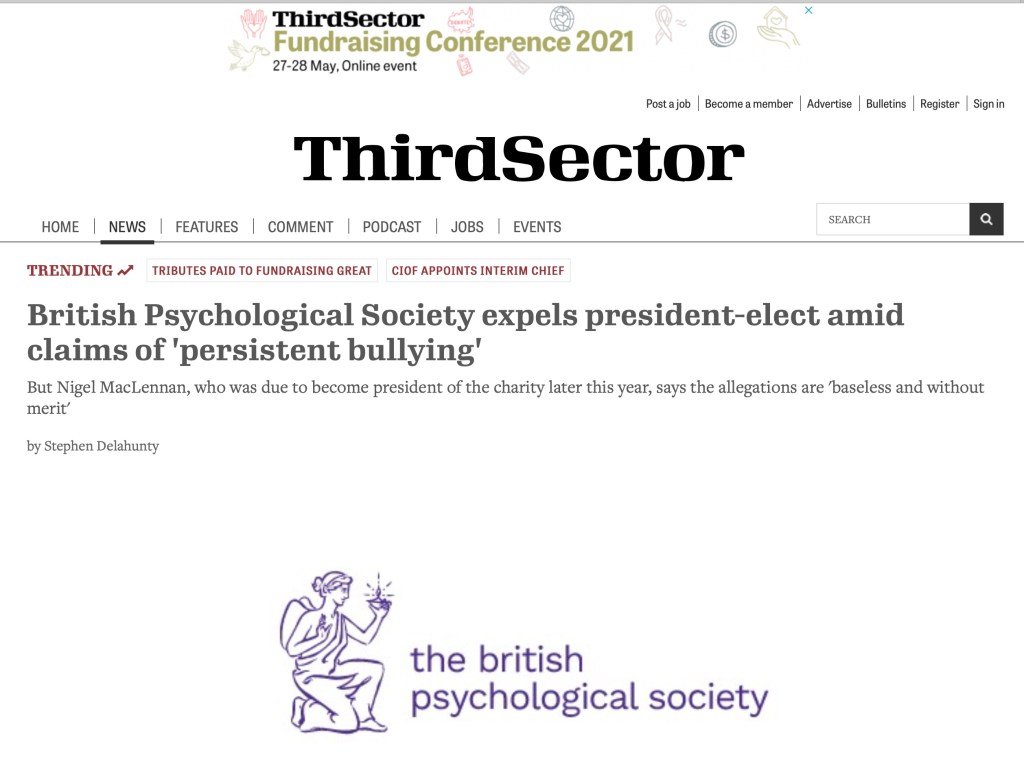
The most egregious example of this has been the ‘investigation’ and subsequent expulsion of the President Elect. His sin was to be open from the beginning about reforming the governance arrangements in an organisation which, for years, had flouted the normal expectations of charity law and good practice guidelines offered by the Charity Commission.

What price membership democracy?

The literal price of being in the BPS is known to its membership. For now, some of those fees are maintaining the high salary of a CEO who is still ‘out of the office’, so remains unable to fulfil his duties. Those in the bunker have told us nothing, so members are left to speculate. 

In the few days that have elapsed since the expulsion of the President Elect was announced (in a scripted account – crafted by whom?), matters have deteriorated further. The unprecedented video from the ‘Interim Chair’ of the Board of Trustees was a callous public disparagement of the President Elect. Speaking from an office and role that, under Statute 20 of the Society, she still has no right to hold, her personalised career-threatening attack upon him remains on Youtube for the world to see.

This scandal now has worsened.  A rapid election is to be held to replace the summarily deposed President-Elect before his appeal has even been heard. From well before he took office there were overt intentions to obstruct him wherever possible. We believe that there is evidence to support this that will be made public. Like the ‘investigation’ of the allegations against him this is a travesty. History will judge those responsible for deposing him, so this faux process of justice will peter out to its discreditable conclusion.

In case members are getting too excited about choosing someone new and untainted by what has gone before, they need to be prepared for a disappointment. This is the score. Only candidates from the current Board of Trustees or Senate members will be permitted to stand. This is the very group under whose ‘oversight’ the Charity Commission has become involved on an ongoing basis. There is an active police investigation into an alleged major fraud (watch this space next month). The self-same group from which the Vice-President resigned,  citing issues about “…governance oversight, escalating expenditure and lack of openness and transparency…”, which he communicated to the Charity Commission.  Former President, Professor Peter Kinderman, informs us that several years ago “…When I was President, I was routinely excluded from key decisions, was threatened with legal action over ‘fraud’ (I was completely exonerated, of course) and forced to resign (as Vice-President) for advocating for what is now effectively BPS policy…” .

What sort of real choice are members now given?   

The candidate will be drawn from a pool of complicit individuals. They assume that everything in the garden is rosy and the much-vaunted £6 million Change Programme will supercharge the BPS, when the membership to date have been shown no substantive evidence to support this wishful thinking. 

Meanwhile, for now, any vestige of membership democracy has been placed on indefinite hold. We can only hope that needed legal proceedings, active media interest and decisive action from the Charity Commission will, between them, resolve this sinister and shameful demise of the public face of psychology in the UK once and for all. 

BPSWatch – Editorial Collective

'False Memory Syndrome', Memory and the Law Group

On memories of abuse….

The BBC website, the Daily Telegraph and the Daily Mail are all reporting on the trial of an alleged sexual abuser, the widow of a former High Court judge. All quote the following statement by the prosecuting QC

“He tried to bury away the memories and not to think about them”.

As is her right, we have no doubt every effort will be put into her defence, perhaps even involving the British False Memory Society.

How will any witnesses for the prosecution or the barristers involved be able to rely on a balanced, empirically based set of guidelines to argue against any claims that the accuser’s memories may be ‘recovered or false’? The short answer is that they won’t because ‘The BPS’, in its wisdom, has given up on any pretence to take this matter with the seriousness that it deserves by abandoning the revision of its Memory and The Law guidelines (see here).

We can only hope that the court is able to hear from a balanced and fully informed range of expert witnesses. It is shameful than none of the psychologists who may be in that position will be able to call on the backing and support of their professional society.

The BPSWatch Editorial Collective

Governance

The BPS is unfit for purpose

This was originally sent as a comment to our post ‘The Crisis deepens…’ We felt that it was important enough to stand on its own as a separate post.

TheBPSWatch Editorial Collective.

I am Professor David Marks, membership number 3829, a Chartered Member with FBPsS, currently a member of the Division of Health Psychology, previously a member of other groups and networks. I joined the BPS as a student in 1963. After completing a BSc and PhD I worked in universities in the UK and overseas carrying out teaching administration and research. I have practiced as a psychologist and worked as a consultant to multiple organisations within the NHS, industry and voluntary sectors. I served as Head of Department at two large Psychology Departments, firstly at Middlesex University, where I worked from 1986 to 2000, and then at City, University of London from 2000 to 2010. I founded two scholarly journals and, for 26 years, have served as Editor-in-Chief of the Journal of Health Psychology

Based on my research publications, I was appointed to a BPS Fellowship in 1984. In the early 1990s, I was elected chair of the BPS Health Psychology Section, which was taken into Special Group status and subsequently to a Division. I was actively involved in the BPS accreditation of the first MSc awards in health psychology and the first Stage 2/doctoral training provision in the UK. I sat on various BPS boards and represented the BPS on international bodies. Over many years multiple elected and unelected BPS officers were well known to me and I counted many as personal friends. 

It with sadness and regret that I believe that I must state my concerns about the Society, its organization, working practices and public outputs. 

I am writing this comment in support of the recent blog postings on ‘BPSWatch’. I do not know and have never met any of the three authors. However I have read their postings and find myself in total agreement with the points they have been making. Rather than resign from the Society, which has crossed my mind on numerous occasions, I had always hoped that change could come from within. Now, seeing the total chaos that reigns, and the complete lack of transparency, accountability and honesty with members, I am strongly doubtful.

I can summarise my current thoughts on the BPS in four sentences: 

1) The BPS is grossly failing the public good, its members, and the discipline of Psychology.
2) The current problems of the BPS cannot and will not be solved by tinkering with the system, as has been tried unsuccessfully on a frequent basis over several decades.
3) Only root-and-branch restructuring would be able to make the necessary changes to achieve the objects of its charter.
4) Sadly, I do not believe the BPS has the wherewithal to achieve the necessary structural reorganization that is called for.

The BPS website (https://www.bps.org.uk/about-us/who-we-are) states:
“The British Psychological Society is a registered charity responsible for the development, promotion and application of psychology for the public good.
Through our Royal Charter we are charged with overseeing psychology and psychologists in the UK, and we are governed by a number of democratically-elected boards and committees.”

My nearly 60-year long association with the BPS indicates to me that the BPS is woefully unfit for purpose. The BPS fails to meet its obligations as a registered charity. This fact is evidenced by the Society’s:

Ineffective governance
Lack of accountability
Lack of transparency
Institutional racism
Improper complaints procedures
Willful neglect of fraud and/or malpractice

In due course, unless I resign first, I will address each point on this and/or my own blog site at: https://davidfmarks.com/

David F Marks
5 May 2021

Board of Trustees, Financial issues, Governance

Twenty Tough Questions for ‘the BPS’

Questions are coming thick and fast from colleagues new to the story of the crisis in the BPS. Of course, they are new to it because, amongst other things, the Board of Trustees (BoT) and Senior Management Team (SMT) have been secretive about the facts. In the past year nothing has appeared in The Psychologist (relevant note: ‘the magazine of the British Psychological Society’) to give the slightest hint of any organisational problems. The CEO’s monthly homilies petered out with no editorial explanation. The President, who has recently resigned, made absolutely no mention of the troubled state of the organisation in her final ‘reports’.

This blog and an increasing number of reputable journalists are now bringing into public gaze the extent of organisational dysfunction in the Society. We have been trying our best to do what the BPS has palpably failed to do in relation to transparency. However, we are not private detectives or forensic accountants and nor do we have the investigatory powers of the Charity Commission. The latter is hovering nearby, but to date it has not fully disclosed its intentions in relation to its ongoing ‘engagement’ with the BoT. Given the very large file of complaints against the Society, we are left wondering what will be the tipping point for them to announce a Statutory Inquiry.

The 20 questions that require answers

Here we raise some questions crossing our minds and those put to us by perplexed colleagues. Ipso facto, we cannot answer them definitively but we can pose them in good faith on behalf of the membership.

  1. Why is the CEO still in post and being paid (from membership fees) but ‘not in his office’?

2. The Finance Director left the Society abruptly just before Christmas last – what were the circumstances surrounding that departure?

3. Was the expelled President Elect genuinely allowed to conduct his duties and was he given access to information appropriate for that task?

4. Was there a deliberate strategy on the part of the BoT and SMT to marginalise and disempower him, given his election pledges to rectify governance problems in the Society?

5. Was there a large fraud conducted in the Society that is still being investigated by the police? 

6. What recruitment checks were conducted on the person who was alleged to have committed the fraud?

7. Who appointed this person?

8. Was the arson attack on the Leicester office during this period of turmoil (unreported to the membership) linked in any way to the alleged fraud investigation?

9. Did the BPS report the arson to the Charity Commission, as it is supposed to do under their guidance?

10. Why did the SMT refuse to give the BoT access to critical information, about the £6 million ‘change programme’?

11. What oversight was the BoT providing of the SMT and how was the effectiveness or otherwise of that oversight assessed? 

12. Did the BoT consider that its culture of information restriction, which we have experienced directly ourselves, reasonable for a membership organisation professing a value of openness and transparency?

13. Why did the BoT make public the alleged grounds for the expulsion of the President Elect in advance of his appeal?

14. How can the President Elect have a fair appeal, when it appears to have been already prejudiced?

15. In light of answers to the above questions, has the President Elect been subjected to a ‘kangaroo court’ or ‘show trial’?

16. Was there a planned and wilful campaign to remove the President Elect by the BoT and SMT, as both a radical reformer and a whistle blower, as soon as he was elected?

17. Have journalists making legitimate enquiries, about all of the above matters, been threatened with legal action by the BPS?   

18. Had the Vice-President, who resigned citing concerns about finance and governance, already ensured that those concerns were reported fully to the Charity Commission?

19. The ACAS definition of bullying is this: “Offensive, intimidating, malicious or insulting behaviour, involving an abuse or misuse of power through means intended to undermine, humiliate, denigrate or injure the recipient.”  Accordingly, does the action of broadcasting a video denouncing the President Elect constitute bullying by the BPS? 

20. Finally, does the BoT now knowingly have a policy to ward off legitimate questions from members about governance matters, by alleging that the questioning, in of itself, constitutes bullying and harassment of BPS staff? 

The final question is rhetorical; as victims of this tactic we can vouch that the answer is in the affirmative. Some of the questions on the list relate to criminal matters and others to aspects of due diligence and common decency. Ordinary members not only pose them now on reasonable grounds, but they deserve reasonable answers. The BoT have warded off the inconvenient truth surrounding the questions, using a mixture of silence, glib evasions, bureaucratic obfuscation and legal threats. 

Is this how we expect a properly functioning learned organisation to operate, with its rhetorical adherence to the principle of openness and transparency? We ask readers to please send us any other questions that come to mind, which we might have missed from the above list. If we cannot answer them we can at least share them.

We will be posting some more detailed analyses of these questions over the course of the next couple of weeks.

The BPSWatch Editorial Collective

Expulsion of President-Elect

A statement from Dr Nigel MacLennan

Following his expulsion from the BPS and hence his removal from the position of President-Elect, Dr MacLennan has issued the following statement:

“I stood for election to address the problems that were of concern to
members. Once elected I sought to exercise my responsibilities, which I took
to be, broadly speaking, the quality of management and governance systems. I
was unable to obtain the necessary information, which I believe I had the
right to, and accordingly sought advice from the Charity Commission. What
has happened to me, I do not think, relieves me of my duty to fulfil my
original mandate, which was to address the issues in the interests of
members. At all times I believe my actions to have been appropriate.”

Expulsion of President-Elect

Expulsion of the President-Elect

Press release from BPSWatch.com

The expulsion of the President Elect, Professor Nigel MacLennan

We believe that the British Psychological Society has acted in a manner that reflects extremely badly on the profession and discipline of psychology. In its handling of the alleged bullying by the most senior elected representative of the membership it has shown itself to be heavy-handed, seemingly vindictive and acting contrary to any principles of natural justice.

Whatever the merits or demerits of the allegations against Professor MacLennan, he deserves a fair hearing, free of bias and partiality, open and transparent whilst respecting the privacy of all parties. Any punishment or sanction should reflect the severity of any proven and demonstrable misdemeanours. We have reason to believe that both the process by which the BPS reached its decision and the way this decision was promulgated were flawed and that the punishment was disproportionate. Moreover, the grounds for expulsion were made public in advance of Professor MacLennan’s right to appeal the decision.

The BPS has a confused, confusing and inadequate complaints procedure, a fact acknowledged by the Acting CEO’s statement that the whole of the complaints process requires a root and branch review. The Acting Chair of the Board of Trustees has publicly acknowledged that the governance of the Society is in need of a major update. The Vice President resigned citing problems with governance as one reason for this. The Charity Commission is currently involved in an ongoing regulatory compliance case with the Society, partly due to the sheer number of complaints by members. There is currently a police investigation into alleged fraud. How can we have any trust in a process that is overseen by an organisation with such serious problems?

The decision was made public by means of an email to all members, which was accompanied by a video by the Acting Chair of the Board of Trustees. This did not simply inform the membership (and wider public) of the decision but details about the alleged grounds for his guilt. This is in stark contradistinction to the Society’s complete lack of information about the fact of the suspension of our Chief Executive many months ago, about which the membership has been dependent on rumour, speculation and some press coverage.

It is important to note that Professor MacLennan has a 21-day window in which to launch an appeal. Apart from the fact that there is no-one in senior elected or senior management positions to hear such an appeal, the tone and style of the letter and video make it clear that such an appeal would stand little chance of success.

Expulsion from the BPS is the most serious of sanctions, especially for an elected officer (and in this case, the only remaining senior elected officer as both the current President and Vice President have resigned). This was not the only option available and, indeed, has been rarely invoked in our experience. According to the BPS, expulsion was warranted because the tone and frequency of his communications demonstrated a lack of respect towards staff and trustees. We believe that this was an inhumane, unjust and inappropriate punishment. 

We urge the BPS to act in a manner which is expected and appropriate for a learned professional society and immediately commission a senior lawyer, completely independent, conversant with employment law to review the process by which the decision to expel Professor MacLennan was made and to make the outcome of that investigation – in its entirety – available to the membership.

Dr Peter Harvey, former Chair of the Division of Clinical Psychology, British Psychological Society;

Pat Harvey, former Chair of the Division of Clinical Psychology, British Psychological Society;

Dr David Pilgrim, former Chair of the History and Philosophy Section, British Psychological Society  

Editorial Collective, BPSWatch.com

Expulsion of President-Elect

Your starter for 10….

In the far-off days when I was a student, a common exam question used to start with the words ”Compare and contrast…” and there followed any two things – they could be theories, concepts, approaches – you get the picture. I want you to to put yourself in a similar situation now and you have to compose answers to the questions below on the Ethics and Professional Standards paper. 

There follow four scenarios, all real, and all documented. Your task is to identify in what ways these cases are similar and in what way they are different (apologies to David Wechsler). As you are answering this online you are allowed to access some information provided by the examiner as hyperlinks. There is no time limit. No additional marks will be added for comments such as “You must be joking.” or “You cannot be serious.”.

Scenario 1.

A senior and widely respected professor of clinical psychology at a UK university specialised in the treatment of young women with anorexia nervosa on which his reputation was based. He was a Fellow of the BPS. His therapeutic interest turned into the sexual abuse of at least four of his clients. A BPS Disciplinary Panel found him guilty of gross professional misconduct. After resigning his UK academic post he was believed to be teaching at an overseas university.

His punishment was him giving an undertaking not to practise again. 

He was not expelled and he remained both a member and a Fellow of the BPS.

Scenario 2.

A clinical psychologist and member of the BPS in practice in Wrexham specialised in sex therapy. As part of this therapy (initially free on the NHS) he began to see a female client as a private patient and charged her £35 per session which consisted of him having sex with her, usually in a car park. He had also discussed other clients with this person as well as shredding her medical records. He was found guilty of professional misconduct in that he acted in manner likely to be detrimental to the client.

His punishment was suspension of his membership for three years and would only be allowed to rejoin the BPS if he continued to undergo professional training.

Scenario 3.

A selection of studies by a highly respected and influential psychologist and Honorary Fellow with an extensive research record was reviewed by a truly independent panel of his academic institution. They concluded that the published results of these studies were unsafe and all editors of journals in which these papers appeared should be informed of this. This particular case has been well known to the BPS for at least two years.

His punishment is still awaited.

Scenario 4.

A Chartered Psychologist and Fellow of the BPS stood for election as President and was duly elected by the membership. His manifesto was clear about the need for reform of the governance and management of the BPS. Following a small number of complaints about his persistence and attitude by a handful of staff, the BPS invoked its Member Conduct Rules and found him guilty of “persistent bullying”.  All this information was not only sent to members by email, it was accompanied a by a YouTube video. It was also given prominence of the BPS website. This despite that fact that there there is a 21-day appeal period which, should it be successful, will repudiate the allegations.

His punishment was immediate expulsion.

Please now answer the following questions:

  1. Draft a letter to the victims in Scenarios 1 and 2 explaining and justifying why more serious steps were not taken to protect others and to expel the psychologists in question.
  2. Why is sexually abusing your clients seen as a less serious matter than alleged bullying?
  3. Why is research misconduct seen as less serious matter than alleged bullying?
  4. Why do we have to wait for a proper statement from the BPS on high profile research misconduct for two years, whilst allegations of bullying can be made, investigated and dealt with in under 12 months?
  5. In Scenario 2 devise a three-year CPD programme teaching practitioners that sleeping with your clients and requiring them to pay for sex is wrong. Please also describe what outcome measures you would use to assess progress.
  6. The BPS has admitted that the complaints procedure and member conduct rules and procedures are in need of a root and branch review. Prepare a Press Release explaining how that statement squares with the statements made in the letter sent out to members in Scenario 4.
  7. The BPS Complaints FAQs includes the following statement ‘…The Society does not have a function to investigate complaints against its members…”.  In the light of this admission. write a letter for members explaining how the process described in Scenario 4 can be justified.

You may wish to consult the following references:

Scenario 1

https://www.theguardian.com/uk/1999/jun/13/theobserver.uknews1

Scenario 2

http://news.bbc.co.uk/1/hi/wales/4350712.stm

Letter to The Psychologist (page 79) from Peter Harvey February 2006 (available on The Psychologist Archive. [https://thepsychologist.s3.eu-west-2.amazonaws.com/articles/pdfs/0206lets.pdf?X-Amz-Algorithm=AWS4-HMAC-SHA256&X-Amz-Credential=AKIA3JJOMCSRX35UA6UU%2F20210507%2Feu-west-2%2Fs3%2Faws4_request&X-Amz-Date=20210507T123834Z&X-Amz-SignedHeaders=Host&X-Amz-Expires=10&X-Amz-Signature=990b08b403a97ae7560cd425990b650a16493077bccb1ad378e76173c5066c50]

Scenario 3

https://journals.sagepub.com/doi/abs/10.1177/1359105318820931

https://thepsychologist.bps.org.uk/volume-32/september-2019/role-auditing-hans-eysenck

https://journals.sagepub.com/doi/10.1177/1359105318822045

Scenario 4

https://www.bps.org.uk/news-and-policy/important-news-british-psychological-society

https://www.thirdsector.co.uk/british-psychological-society-expels-president-elect-amid-claims-persistent-bullying/governance/article/1714936

https://www.thetimes.co.uk/article/psychological-society-president-ousted-for-alleged-bullying-pfwdx8cm6?shareToken=35bd3b82af0348459ff4adffd99ebd8e

https://www.bps.org.uk/news-and-policy/member-conduct-rules

https://www.bps.org.uk/sites/www.bps.org.uk/files/Page%20-%20Files/Complaints%20FAQs.pdf

For more general background reading you are recommended to see

Pilgrim, D. & Guinan, P. (1999) From mitigation to culpability: rethinking the evidence about therapist sexual  abuse. The European Journal of Psychotherapy, Counselling & Health 2 (2), 153-168.

Once your incredulity has subsided you may begin.

Peter Harvey, Former Chief Examiner and Chair of the Board of Examiners for the BPS Qualification in Clinical Psychology.

Expulsion of President-Elect

The crisis deepens…

Many of you will have seen the announcement by the BPS telling you of the expulsion of the President-Elect, Dr Nigel MacLennan. This is an extremely serious matter. We have some reason to believe that the process by which this decision has been reached may be flawed. It is clearly highly damaging to him personally to have allegations about his behaviour made in public in advance of any appeal he might make. The question must also be asked about what efforts have been made to go to external mediation to attempt a resolution. Surely the Charity Commission would have been able to advise on this?

The Society is now in a situation where there are no senior elected members in any position of authority. The President and Vice President have resigned and the President-Elect removed. The CEO is “not in the office”, the CFO resigned late last year and there is no replacement listed on the BPS website – all the most senior positions in the Society are vacant. The Charity Commission is “engaged” with the BPS following a large number of complaints by members about serious concerns about governance and the behaviour of members of the Senior Management Team towards members.

Those of us who started this blog have had a long relationship with the BPS over the years as well as making significant contributions as elected officers. It is no exaggeration to say that we are thoroughly ashamed of the BPS at present. It is certainly not the organisation to which we once gave our time and energy. This is now the time for the membership to stand up and be counted. Members currently have no elected – and hence accountable – representation at senior level. The only people making decisions that affect your society, your discipline, your profession are unelected, unaccountable employees, the majority of whom have no background in psychology. 

Our organisation is in serious, perhaps terminal, decline. Will you join with us in trying to rescue it?

Peter Harvey

Blog Administrator

Board of Trustees, Gender, Governance

Sins of omission – more rhetoric of justification from the BPS Board of Trustees

From the Editors of BPSWatch…

The crisis of governance in the BPS has been rumbling on for the past year. Slowly journalistic interest appeared, with articles in Third Sector and the Daily Telegraph leaking to the public what the BPS Board or The Psychologist had failed to disclose to the membership. This invites us to reflect on what is not said as well as what is said, when considering organisational rhetoric to justify the status quo (philosophers interested in absence dub this an ‘omissive critique’.).  

For those of us who think a better future must start with an honest reflection on the present, then we cannot rely on the preferred account of reality declared by the BPS Board of Trustees (BoT). They are not the whole problem (that is systemic and cultural as we have noted in several of our postings) but they are the current living proof of that deeper and longer problematic picture.  In that context, we now turn to a brief omissive critique of an important Board statement.

The Board response to the recent article in the Daily Telegraph

On April 26th 2021, Hayley Dixon in the Daily Telegraph provided us with a rough but accurate sketch of the governance crisis and its consequences (see here). Here we provide in full the ‘official’ response offered from ’the BPS’ then next day (see here).

Responding to an article in the Daily Telegraph, Interim Chair of the Board of Trustees, Professor Carol McGuinness said:

For more than a century, the British Psychological Society has promoted the practice of psychology and advanced professional thinking on often complex and contentious issues. With more than 60,000 diverse members, debates on professional issues are often vigorous and there is sometimes heated disagreement between our members.

The past 18 months have been turbulent for the BPS as we go through a process of significant and much needed organisational transformation. During this period several working groups have considered very sensitive topics which have gone through an expert and democratic process.

Our guidelines for psychologists working with gender, sexuality and relationship diversity are not, in our view, at all contentious. They require our members not to discriminate against individuals and to treat them with respect. This includes the use of appropriate, inclusive language, which all patients and clients should be able to expect.

The guidelines relate to adults and young people and not to the treatment of children, and professionals understand the difference. Our guidance does not contain any reference to the prescribing of puberty blockers for children under the age of 16.

There is general debate across the health sector on the extension of limited prescribing rights for different professions, something that has brought benefits to patients through, for example, the work of nurse prescribers. There are strong views among our members about whether some psychologists should be granted prescribing rights, with vigorous positions presented by those both for and against this potential change.

However, our research to date on prescribing rights, following a two-year consultation process – that it could be useful in certain settings – is simply a contribution to the debate.

The debate on prescribing has no connection whatsoever to our guidance on gender, sexuality and relationship diversity. We have always been clear that the issue of prescribing rights will require further debate and indeed the BPS does not currently have a fixed position on this issue. We have repeatedly stated that we will continue to listen to and engage with our members on this important issue.

Ultimately, the BPS does not have the power to decide on this issue, as it is a process governed by Parliament following extensive public consultation. We are disappointed that the Daily Telegraph has chosen to repeat the views of a small minority of BPS members who are unwilling to accept the outcome of our consultations and policy positions.

As a board of trustees we have been open about the need for improvements across the society which is why we committed a significant amount of money to our ongoing three-year transformation programme. The BPS is not perfect, and there is always room for improvement in any organisation.

It is clear to us that stronger governance processes will be required in the future, and this work is well underway. We have kept the Charity Commission fully informed of developments throughout and continue to engage with them.”

An ommisive critique of the statement

The reader can draw their own immediate conclusions about the adequacy of this response. Here we only want to list what was not said in this statement.

1.  Professor McGuinness was voted into the interim Chair role of the BoT in the wake of the resignations of both the President and Vice President (see here and here – you may need to register (free) to access these articles). This reflected a wilful refusal of the Board to comply with Statute 20 of the Society: the chairing role should have been handed over immediately to the Chair Elect. Her authority in the Chair is at best dubious and at worst totally illegitimate. The naïve reader would be unaware of this legitimation challenge for the Board still today. 

2. The allusion to diverse views and heated debate does not mention that debate has been actively blocked, with articles censored (see here), review groups closed down and lobbying about policies ignored.

3.   The statement does not mention the routine use of threats of legal action against Society members and others such as accusing dissatisfied complainants of harassment in pursuit of their case.

4.   Many objections have been raised about the very lack of the democracy and full expertise drawn upon in policy formation in the Society. These have been ignored in relation to the prescribing debacle, the contentious gender document and the peremptory closure of the memory and law group.

5.   Describing the gender document as ‘not at all contentious’ fails to mention those objecting, on legitimate grounds, to it both before and after the legal change on December 1st 2020. However, the prefix ‘in our view’ is relevant because this reveals the self-interest in depicting reality in a particular manner. 

6.  The claim that there is no connection between the prescribing and the gender polices fails to mention the overlap of decision-makers in the two groups and the fact that a consideration of hormone prescription was part of the first of them.

7.   The BoT are ‘disappointed’ in the article from Hayley Dixon, but the statement does not mention that the BPS was unhelpful  and, we believe, invoked legal threats about its publication. We understand that other approaches from Third Sector encountered the same aggressive non-cooperation. Journalists encountering such resistance tend to suspect that a story is worth telling.

8.   The commitment proffered about the change programme in the BPS as an organisational solution assumes that it will work in the absence of honest reflection about the current crisis of both legitimacy and governance: the very point we keep repeating and illustrating on this blog.

9.   The claim that the BoT continues ‘to engage’ with the Charity Commission is the most important rhetorical query for us. To what degree has that engagement been necessary and why? Will they now make all the changes necessary to bring the Society into regulatory compliance? Does the BoT even admit that any changes need to be made? If so will the Trustees need to resign and a fresh start made under completely new governance arrangements?

These questions are all important, the response from Professor McGuinness offers us no clues at all. Surely the membership deserves a full and frank statement about all of these matters, if the alleged principle of openness and transparency is to be put into practice. 

The Editors, BPSWatch.