Expulsion of President-Elect

The crisis deepens…

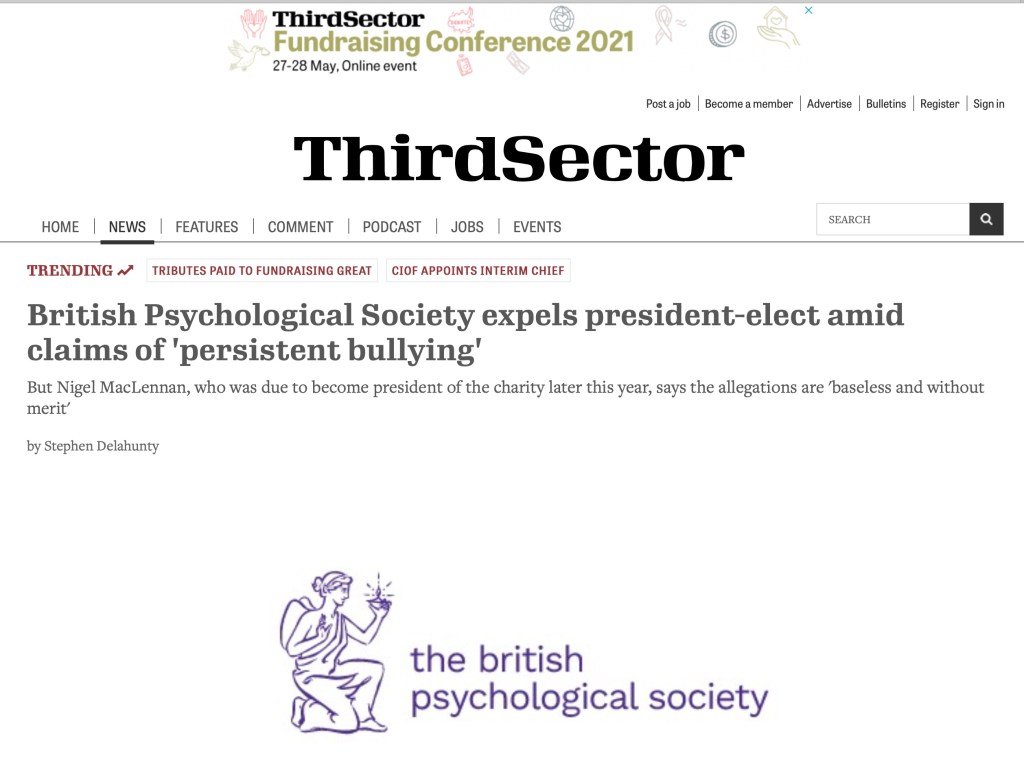
Many of you will have seen the announcement by the BPS telling you of the expulsion of the President-Elect, Dr Nigel MacLennan. This is an extremely serious matter. We have some reason to believe that the process by which this decision has been reached may be flawed. It is clearly highly damaging to him personally to have allegations about his behaviour made in public in advance of any appeal he might make. The question must also be asked about what efforts have been made to go to external mediation to attempt a resolution. Surely the Charity Commission would have been able to advise on this?

The Society is now in a situation where there are no senior elected members in any position of authority. The President and Vice President have resigned and the President-Elect removed. The CEO is “not in the office”, the CFO resigned late last year and there is no replacement listed on the BPS website – all the most senior positions in the Society are vacant. The Charity Commission is “engaged” with the BPS following a large number of complaints by members about serious concerns about governance and the behaviour of members of the Senior Management Team towards members.

Those of us who started this blog have had a long relationship with the BPS over the years as well as making significant contributions as elected officers. It is no exaggeration to say that we are thoroughly ashamed of the BPS at present. It is certainly not the organisation to which we once gave our time and energy. This is now the time for the membership to stand up and be counted. Members currently have no elected – and hence accountable – representation at senior level. The only people making decisions that affect your society, your discipline, your profession are unelected, unaccountable employees, the majority of whom have no background in psychology. 

Our organisation is in serious, perhaps terminal, decline. Will you join with us in trying to rescue it?

Peter Harvey

Blog Administrator

Board of Trustees, Gender, Governance

Sins of omission – more rhetoric of justification from the BPS Board of Trustees

From the Editors of BPSWatch…

The crisis of governance in the BPS has been rumbling on for the past year. Slowly journalistic interest appeared, with articles in Third Sector and the Daily Telegraph leaking to the public what the BPS Board or The Psychologist had failed to disclose to the membership. This invites us to reflect on what is not said as well as what is said, when considering organisational rhetoric to justify the status quo (philosophers interested in absence dub this an ‘omissive critique’.).  

For those of us who think a better future must start with an honest reflection on the present, then we cannot rely on the preferred account of reality declared by the BPS Board of Trustees (BoT). They are not the whole problem (that is systemic and cultural as we have noted in several of our postings) but they are the current living proof of that deeper and longer problematic picture.  In that context, we now turn to a brief omissive critique of an important Board statement.

The Board response to the recent article in the Daily Telegraph

On April 26th 2021, Hayley Dixon in the Daily Telegraph provided us with a rough but accurate sketch of the governance crisis and its consequences (see here). Here we provide in full the ‘official’ response offered from ’the BPS’ then next day (see here).

Responding to an article in the Daily Telegraph, Interim Chair of the Board of Trustees, Professor Carol McGuinness said:

For more than a century, the British Psychological Society has promoted the practice of psychology and advanced professional thinking on often complex and contentious issues. With more than 60,000 diverse members, debates on professional issues are often vigorous and there is sometimes heated disagreement between our members.

The past 18 months have been turbulent for the BPS as we go through a process of significant and much needed organisational transformation. During this period several working groups have considered very sensitive topics which have gone through an expert and democratic process.

Our guidelines for psychologists working with gender, sexuality and relationship diversity are not, in our view, at all contentious. They require our members not to discriminate against individuals and to treat them with respect. This includes the use of appropriate, inclusive language, which all patients and clients should be able to expect.

The guidelines relate to adults and young people and not to the treatment of children, and professionals understand the difference. Our guidance does not contain any reference to the prescribing of puberty blockers for children under the age of 16.

There is general debate across the health sector on the extension of limited prescribing rights for different professions, something that has brought benefits to patients through, for example, the work of nurse prescribers. There are strong views among our members about whether some psychologists should be granted prescribing rights, with vigorous positions presented by those both for and against this potential change.

However, our research to date on prescribing rights, following a two-year consultation process – that it could be useful in certain settings – is simply a contribution to the debate.

The debate on prescribing has no connection whatsoever to our guidance on gender, sexuality and relationship diversity. We have always been clear that the issue of prescribing rights will require further debate and indeed the BPS does not currently have a fixed position on this issue. We have repeatedly stated that we will continue to listen to and engage with our members on this important issue.

Ultimately, the BPS does not have the power to decide on this issue, as it is a process governed by Parliament following extensive public consultation. We are disappointed that the Daily Telegraph has chosen to repeat the views of a small minority of BPS members who are unwilling to accept the outcome of our consultations and policy positions.

As a board of trustees we have been open about the need for improvements across the society which is why we committed a significant amount of money to our ongoing three-year transformation programme. The BPS is not perfect, and there is always room for improvement in any organisation.

It is clear to us that stronger governance processes will be required in the future, and this work is well underway. We have kept the Charity Commission fully informed of developments throughout and continue to engage with them.”

An ommisive critique of the statement

The reader can draw their own immediate conclusions about the adequacy of this response. Here we only want to list what was not said in this statement.

1.  Professor McGuinness was voted into the interim Chair role of the BoT in the wake of the resignations of both the President and Vice President (see here and here – you may need to register (free) to access these articles). This reflected a wilful refusal of the Board to comply with Statute 20 of the Society: the chairing role should have been handed over immediately to the Chair Elect. Her authority in the Chair is at best dubious and at worst totally illegitimate. The naïve reader would be unaware of this legitimation challenge for the Board still today. 

2. The allusion to diverse views and heated debate does not mention that debate has been actively blocked, with articles censored (see here), review groups closed down and lobbying about policies ignored.

3.   The statement does not mention the routine use of threats of legal action against Society members and others such as accusing dissatisfied complainants of harassment in pursuit of their case.

4.   Many objections have been raised about the very lack of the democracy and full expertise drawn upon in policy formation in the Society. These have been ignored in relation to the prescribing debacle, the contentious gender document and the peremptory closure of the memory and law group.

5.   Describing the gender document as ‘not at all contentious’ fails to mention those objecting, on legitimate grounds, to it both before and after the legal change on December 1st 2020. However, the prefix ‘in our view’ is relevant because this reveals the self-interest in depicting reality in a particular manner. 

6.  The claim that there is no connection between the prescribing and the gender polices fails to mention the overlap of decision-makers in the two groups and the fact that a consideration of hormone prescription was part of the first of them.

7.   The BoT are ‘disappointed’ in the article from Hayley Dixon, but the statement does not mention that the BPS was unhelpful  and, we believe, invoked legal threats about its publication. We understand that other approaches from Third Sector encountered the same aggressive non-cooperation. Journalists encountering such resistance tend to suspect that a story is worth telling.

8.   The commitment proffered about the change programme in the BPS as an organisational solution assumes that it will work in the absence of honest reflection about the current crisis of both legitimacy and governance: the very point we keep repeating and illustrating on this blog.

9.   The claim that the BoT continues ‘to engage’ with the Charity Commission is the most important rhetorical query for us. To what degree has that engagement been necessary and why? Will they now make all the changes necessary to bring the Society into regulatory compliance? Does the BoT even admit that any changes need to be made? If so will the Trustees need to resign and a fresh start made under completely new governance arrangements?

These questions are all important, the response from Professor McGuinness offers us no clues at all. Surely the membership deserves a full and frank statement about all of these matters, if the alleged principle of openness and transparency is to be put into practice. 

The Editors, BPSWatch.

Board of Trustees, Governance

Is the BPS Board of ‘Trustees’ doomed to fail?

David Pilgrim posts….

Many of the postings (see, for example, here and here) on this blog have addressed the governance failings of the Board of ‘Trustees’. The latter is placed in quotation marks because, as we have argued previously, they do not offer independent scrutiny or oversight. The Senior Management Team (SMT) is salaried, and the other members are drawn from sub-systems of the Society with their particular interests. The very point of Trustees in relation to charities is that they should be impartial and independent. This is a circle that cannot be squared at present in the BPS. 

How has the Society got itself into this fix? It is partly a lack of insight from the current incumbents on the Board. All representations from us about this problem, as with other serious matters, have fallen on deaf ears. But this cultural norm of defensiveness and denial is not the whole explanation. If we go on to the BPS website, and we pull up the relevant documents related to the Royal Charter and Statutes and the Rules of the Society, then the answer is there in plain sight.

The Royal Charter only requires that there should be a Board of Trustees. This is a broad-brush requirement and it prescribes no operationalised detail. When we then go to the Rules, there is precious little on the Board – more is said about the Council of Representatives (now the Senate). However, what is said in the Statutes document does tells us who (by role) will constitute the Board (the Presidential triumvirate, chairs of the BPS sub-systems or other appointed delegates along with the Honorary Treasurer and Honorary General Secretary). Although in practice today the SMT members join the Board meetings, they are not mentioned in either the Statutes or the Rules: see below on this current silence in BPS documentation. Given the power and responsibility of the SMT, an observer may consider this curious, to say the least.

So there we have it. All the members of the Board are either salaried or appointed from the sub-systems of the Society. The Presidential triumvirate is elected by the membership. At the time of writing both the President and Deputy President have recently resigned and for reasons we cannot discover, the President Elect is not being permitted to chair the Board in their absence. This failure to appoint the President Elect as the acting Chair of the Board is explicitly contrary to the Statute 20 of the Society. For now the Board has no elected leadership, which simply aggravates the preexisting sham of its independence.  

Note that financial, career or reputational interests are embedded in all of these roles on the Board.  There are no independent people from outside the Society, especially ones that might have relevant skills in relation to finance or organisational efficiency and probity. This whole scenario is out of sync with both the spirit and detail of charity law. To a new pair of eyes, used to charity functioning, this beggars belief.

Silence about the Senior Management Team

The above describes, in large part, the arrangements that have emerged in the Society since the Royal Charter was granted in 1987. This created the inevitable conditions for conflicts of interest and a conservative culture of self-protection. Reflective critical oversight would destabilise that culture. It has been largely absent, because independence on the Board has also been absent. With the same names being recycled in the sub-systems (including as well the honorary roles of Treasurer and General Secretary), often for years on end, the description of an oligarchy is warranted. However, that problem was then joined by another.

Once the BPS was to be managed, not merely administered, the pre-existing tendency of weak governance was then amplified. I have discussed this point about the implications for organisations of the New Public Management Model in my previous posting and will not repeat the critical points again. What is relevant here is the contrast between the documents concerning the Rules, the Royal Charter and the Statutes of the BPS, and those which are available to us about the SMT. The BPS website lists who the people on the SMT are, as well as their titles. However, I cannot find any document that describes specifically how that salaried team relates functionally to other parts of the Society, or describes its powers in comparison to the sub-systems and the general membership. 

This dual problem of the old oligarchy interacting with the new SMT has implications for democracy. The frustrations we have encountered, when trying to fathom what is going on in the closed world of the Board of ‘Trustees’, are now added to by the lack of transparency available to members about the workings of the SMT and its self-defining power and control over processes in the Society. In a well-run charity, information about these matters should be available to all concerned, in a clear and transparent manner. 

Members and the public should know how the performance of managers would be evaluated and by whom. Board meetings would be about the SMT reporting to and being accountable to Trustees in a spirit of respectful critical scrutiny from the latter. They would not be ‘briefing’ meetings for the former. When the SMT was first set up in the BPS, for a while it did not even send in written reports to the Board; apparently that has now changed. As far as the Board is concerned, we still cannot work out (wagging-wise), which is the tail and which is the dog. 

Were the BPS to have publicly available and credible delegation and oversight frameworks, these would be codified and documented in a similar fashion to those I cite above about the Rules and the Statutes. I may have failed to spot these functional descriptions of the SMT and their accountability on the BPS website. Apologies to all readers if they are there and I have missed them. If this is the case, then maybe someone on the Board of ‘Trustees’ could get in touch with us with the relevant correction. If they are not there, then it is a matter of urgency for them to be produced and disclosed to members of the Society.

Conclusion

The culture of poor governance, which all of the postings on this blog have sought to illuminate, is traceable in part to a structural problem about the Society’s tradition of forming a Board of ‘Trustees’ narrowly from within its own ranks. The formally codified character of the Board of ‘Trustees’, in the documents I cited at the outset, puts this body on tramlines, with conflicts of interest and poor oversight being the inevitable outcome, as we now see. 

This means that when and if the BPS is reformed as a charity, in order to ensure the regulatory compliance currently missing, then this present statute describing the Board, which makes it a hostage to fortune, needs be scrapped. It should be replaced by one that prescribes a properly independent body and then current critics can remove the quotation marks from ‘Trustees’. There are plenty of well-run charities that are role models, and the Charity Commission itself will surely advise on this matter.

The role and powers of the SMT should be spelled out in cogent and trustworthy frameworks of delegation and oversight. The absence of these at present is a serious problem and it simply permits members of the SMT to exercise unchecked power in relation to a range of matters. These include centralized financial control, the interpretation of policy documents, media policy emphases, interference with academic activity and the control of information internally and in relation to those outside of the Board (including members of the Society, the press and the general public). These proposals would not fix all of the problems of organisational dysfunction in the BPS but they would be a very good start.

Board of Trustees, Charity Commission, Governance

Evasion as a management strategy

David Pilgrim posts….

At the time of writing, the Charity Commission is taking an active interest in the governance of the BPS. This is happening because it has received many complaints from BPS members about a range of topics, some of which we have reported on this blog. The Charity Commission is likely to find this process somewhat difficult. The complexities of the misgovernance that we have done our best to expose are one part of the challenge and the other is a culture of managerial evasiveness. 

At the time of writing, the Charity Commission is taking an active interest in the governance of the BPS. This is happening because it has received many complaints from BPS members about a range of topics, some of which we have reported on this blog. The Charity Commission is likely to find this process somewhat difficult. The complexities of the misgovernance that we have done our best to expose are one part of the challenge and the other is a culture of managerial evasiveness.

This always leads back, at some point, to the common malaise of governance failure. For all we know, things may be worse than we have uncovered, given our limited powers of investigation. What is clear though is that dark clouds are building slowly over the Board of Trustees, which at some point must be held responsible for the mess we are in. The Vice President may well have been wise to jump ship. Other Trustees have resigned, the Finance Director left after less than two years in post. Who would wish to seek election for President this year – will they want to shore up the old regime or face the task of managing a reckoning about misgovernance?

This not only reflects a current crisis but also a long-standing cultural norm, such as the lack of independence of the Trustees and their common conflicts of interest. Some is more recent and can be located in the culture of the New Public Management Model (NPM) that is common now in public bodies. As a charity the BPS is legally ambiguous in this regard; its responsibilities towards the public mean that it acts like a public body in much the same way as say the NHS. The long-term cultural inadequacies seem to have combined with the new management broom of the past couple of years as a tipping point to create manifest organisational dysfunction.

The NPM, augmented by new forms of digital governance (‘computer says “no”’), is commonly experienced by us all as citizens. Those working in higher education have suffered its consequences and enjoyed its advantages for a while now. This has been the case in the NHS for even longer. We have enough case studies now to know how and when it works well and when it does not. A particular problem in the case of the BPS is that the Senior Management Team (SMT) is dominated by individuals who are not psychologists and have no practical appreciation of academic cultural norms or the ethics of psychological practice. 

Accordingly, the BPS as a recent expression of this new managerialism, is a case of ‘could do very much better’. But that is our judgment and not those of those currently on the Board. From them, the message is very clear and repeated: ‘problem what problem?’. That is the guiding message or ‘party line’ we find when any matter is raised of concern with them. It is the reason this blog was established. It is the reason we contacted the Charity Commission with our dossier. It is the reason the latter now are taking action. It is also the reason why the Board at some point must be held to account for the mess we are in.

Dealing with those at the top of the BPS is like meeting a client for the first time in a therapy session who sees absolutely no point in being there because they have no problems in their life. That is, other than you, who, to their irritation, has other ideas. You are wasting their time. You have the problem not them. This is exactly how we are now experiencing the BPS and, empirically, their evasiveness takes on many forms. Whether Board members subjectively really believe that there is no fundamental problem in the way the Society is currently governed is unknown for now.

Malcontents and the faux system of complaints

Encountering the mysteries of the BPS complaints process for the first time is not for people of a nervous disposition or lack of determination. The current complaints procedure in the BPS is highly dysfunctional. Indeed, the Society itself acknowledges as much, when it has a stated commitment to ‘…undertaking a full root and branch review of the complaints process and the member code of conduct rules and procedures…” (email from SMT to Peter Harvey, 17 February 2021). However, to date there has been no sign that this intention will be put into practice.  A lack of trust in rhetorically-stated intentions is evidenced by the many examples that we have accumulated of the evasive tactics deployed by Board members, when challenged about any matter of concern (whether or not this is explicitly framed as a complaint). 

Sometimes complaints receive no reply at all, others are acknowledged but nothing further is heard, and yet others receive no more than a cryptic reference to a Society document, which fails to engage properly with the substance of the complaint. We have several email trails of this ‘no reply’ evasion and its variants. Sometimes when members express a concern about a problem, and they are requesting a needed respectful dialogue about it with a relevant responsible person in the BPS, the contact is converted into a complaint. We can evidence when this has happened on several occasions, even when the member is explicitly requesting that it is not a complaint.

Complaints might not be investigated, dismissed vacuously or merely viewed as an organisational irritant. A minute of the Board of Trustees Meeting of December 2020 states, “This year has seen a trend for the potential misuse (sic) of the complaints process, where it has been used to express a difference of opinion or dissatisfaction with a consultation outcome.”. The minute also states, “The volume of complaints is a strategic risk for the Society and was considered at the Risk Committee.”. 

Thus complaints are seen as a risk to the Society rather than matters to be addressed in their own right or as opportunities for organisational learning. Currently, the BPS is the opposite of what in the literature is called a ‘learning organization’. The minute reflects an explicit antagonism to the latter prospect. Complainants are merely malcontents to be batted away. This leaves us with an important sub-text: the BPS would work just fine if its members simply paid their subscriptions and remained silent or only offered praise not criticism.

When and if complaints are dealt with, it is common for the complaints team not to record who the investigating officer was or who within the BPS has provided a form of words being passed on by an administrative operative. The complaints team is at times being used inappropriately as a foil to evade managerial accountability. This is not fair on BPS employees operating below Board level, especially when they are being asked to investigate complaints against their own managers. 

We have not a single record of an occasion in which a member felt that the process and outcome of their complaint were satisfactory. To use a standard set by the Professional Standards Authority, the BPS complaints process currently is not characterised by ‘…sound decisions that are fair, transparent, consistent and explained clearly…’.

Cancellation as the ultimate evasion

Some members of the SMT at times refuse adamantly to discuss matters any more with those ordinary members who continue to be assertive about their concerns . Here are some very recent examples from March 2021.

I have been in communication with the BPS for the past year, at first with the CEO (not then ‘away from his office’). I have mainly complained about a lack of academic freedom, especially the creeping culture of censorship in the BPS. Recently I offered to follow up, on behalf of colleagues, the lack of a satisfactory response about the prescribing rights ‘consultation’. The Deputy CEO, Diane Ashby, replied by not addressing the content (about prescribing) but by using ad hominem logic.  She complained of my ‘…excessive level of correspondence…’ in recent times. Also, she complained that my mails were ‘…duplicates…’ because previous responses were not satisfactory. These responses according to Ms Ashby were ‘…fully answered…’. Of course, if that had been the case then I would have had no need to write again. She concluded that any more communication from her to me would be a waste of BPS resources and that she had instructed all staff not to reply to my mails. Given that this personal dismissal of me then completely side-stepped the content of the mail (the mystification about the consultation on extending prescribing rights to psychologists), this left us all none the wiser.

Accordingly, the evasion was picked up immediately by Pat Harvey. She too attempted to get a straight answer from Ms Ashby about the implausible account of the management of the prescribing rights consultation. Remember that over a hundred psychologists had written complaining about this matter, with zero response. A follow-up letter of concern about that situation was also then ignored. It was completely legitimate for us to continue to press for clarification. Pat Harvey’s request for clarification received no such clarification. Ms Ashby made it clear instead that she had nothing more to say on the prescribing matter to any member. This is hardly a shining example of the ‘openness and transparency’ boasted of rhetorically by the BPS Board.

A parallel process of blocking as the ultimate evasion of accountability was encountered by Peter Harvey when he tried to inquire about the continuing serious concerns about the peremptory closure of the memory and law group. A member of the SMT told him, after the commonly needed prompt, that his views were ‘…noted…’, and they would have to ‘…agree to disagree…’. Peter replied pointing out this was not a trivial difference of opinion but a grave matter implicating public protection. He received back a dismissal in style the same as above. The SMT member insisted that Peter’s concerns had been addressed and that the correspondence was now ‘…closed…’.

This cancellation scenario suggests a threadbare claim to be a learned organisation and certainly the antithesis of a learning organisation. The BPS now has a management culture which is rigid, defensive and high handed, closing down discussions that do not suit it and treating its members as irritants, obstructing a modernising ‘change programme’.  Change is certainly needed in the BPS. However, what we are arguing for and what is envisaged by these recently imported NPM advocates, with no wise appreciation of pure and applied psychology, are quite clearly different.

The rabbit hole of the complaints process

The focus from the SMT entailed in this blocking is on how unresolved concerns, followed up by needed multiple prompts from dissatisfied complainants, are simply an irritant and a tiresome opportunity cost. Accordingly, they are framed by the SMT as the complainants harassing BPS employees, rather than them being ongoing attempts, in good faith, to ensure accountability about unresolved concerns. The examples just given are the tip of the iceberg. Many colleagues have had similar experiences of being ignored or receiving responses full of blandishments that do not address the concern being raised. Many give up in confusion and some resign from the Society in despair. 

This mystification seems to be at its worst over the matter of whether the BPS does or does not investigate complaints against members alleged to have transgressed the code of conduct. The poor state of the complaints’ infrastructure in the BPS at present allows the SMT and other Board members to make arbitrary judgments about what or who is investigated. This has a slight Alice in Wonderland feel when an ordinary member (or a member of the public) tries to make a complaint. 

Some will simply not get off first base with this stock answer from the BPS websites FAQs, where we find this blunt admission: ‘…the Society does not have a function to investigate complaints against its members…’.  However, we do have some clear evidence that when the Board is minded, occasionally and selectively, it will investigate members. This is mystifying: does the BPS, or does it not, to use its own statement cited, ‘…have a function to investigate complaints….’?   And what criteria are being invoked, or interests at play, when this case is being investigated but another is ignored?

The arbitrariness at play here is striking and reveals a very particular symptom of the general problem of misgovernance. Either there is a complaints process that exists, with a properly resourced infrastructure of investigation and discipline or there is not. If it does exist, then why are all complaints not dealt with equally and thoroughly, with due process ensured? If it does not exist (as the FAQ citation claims), then why does the Board agree for some complaints to be investigated and not others? This means that it has arbitrary power, but it does not have credible authority (in its ethical sense).

Conclusion

Those of us producing BPSWatch.com hope that these grave shortcomings about members raising concerns in the Society, will be addressed thoroughly by the Charity Commission. We also hope that the upcoming assessment by the Professional Standards Authority (PSA) of the application by the BPS to have an accredited register, will take into serious consideration the governance chaos and the structural shortcomings evident. We have no information as to whether or not the BPS has admitted to its own internal difficulties when making the application. 

What is clear to us is that, for now at least, the cultural norms of the Society could not offer confidence to the public about its complaints policy, which is a complete mess. We will continue to make our views about the ongoing problems in the BPS clear to both the Charity Commission and the PSA.

Prescribing Rights

A challenge to the BPS on Prescribing Rights for psychologists.

Pat Harvey writes…

The BPS position on prescribing rights for psychologists is controversial and the Society has not carried out adequate consultation. The communication below has been sent to chairs of Divisions and Faculties, accompanied by the copy of a letter (below) signed by 102 psychologists last October


Letter to Chairs of Divisions and Faculties of the British Psychological Society 20 March 2021

Dear Colleague

I am contacting you in your capacity as an elected office holder of a Division or Faculty within the BPS. I write on behalf of a group of around 20 clinical psychologists who are seriously concerned about the recent BPS decision to recommend to NHS England that some psychologists should have prescribing rights. 

We understand that NHS England will not be taking further action on this matter until the COVID crisis has resolved. The problem that we wish to draw to your attention is that the Division of Clinical Psychology has made little or no attempt to survey its members in a thorough, fair and transparent manner.  We are concerned that you and your members may be unaware of the position that the BPS is now adopting on this crucial issue for our future professional roles. We see this interim period as now giving an important opportunity to conduct a full, accurate and impartial survey of all BPS members, especially those who belong to the Divisions and Faculties that are most likely to be affected. A poll of a small number of counselling psychologists was carried out, but as far as we know, no other Divisions or Faculties have formally consulted with their members. 

To give a brief history: A group of clinical psychologists and service users expressed their concerns about extending prescribing rights in Nov 2019 in an open letter to the BPS. It outlined the many problems with the BPS discussion paper which was used as the basis for further consultation by the BPS Task and Finish group on Prescribing Rights.

Here is further information:  https://www.madintheuk.com/2019/11/prescribing-rights-psychologists-cautious/

No response was ever received to the letter, although the authors were told that it had informed the subsequent discussions. The Task and Finish group on Prescribing Rights then proceeded, in our view on a flawed basis, to further discussion leading to its final conclusion, in which the BPS recommended to NHS England that developing a policy for prescribing rights for some psychologists should be pursued. Along the road to this point, a number of other very serious concerns about biased and misleading information, failure to consult, and extremely poor process, emerged. These were summarised in a letter with over 100 signatories (attached below minus signatures) sent to senior BPS staff on 6 October 2020. Despite chasing this up, the issues raised in this letter have never been directly addressed, and the recommendation went forward. 

In contrast, the ACP (the Association of Clinical Psychologists in the UK) carried out a survey of 439 people and found that the majority (58%) did not want prescribing rights for themselves and also had concerns about other CPs being able to prescribe. They found that 17% want to prescribe themselves, 16% were uncertain and 9% did not want to prescribe themselves but had no concern about other CPs prescribing. 

We have reason to suppose that there are other agendas are driving the current conclusions, but we hope you agree that the overriding priority is to have a fair and transparent discussion in which we can consider what will ultimately be best for clients and service users and for the unique contribution our professions can make.

Please let me know if you would like to discuss this further with one of the core group of 20 clinical psychologists who have been involved in trying to ensure fair process. If you wish to discuss the issue more generally Professor Peter Kinderman has agreed to be contacted via email on profpeterkinderman@gmail.com  If you receive any further feedback from members it would be helpful if you could let me know. 

Best wishes

Pat Harvey Consultant Clinical Psychologist, Psychology and Counselling Service Manager (retired) BPS No. 4810

Copy of email letter sent 6 October 2020 to Hazel McLaughlin, BPS President, copied to Sarb Bajwa, Kathryn Scott and Esther Cohen Tovee. Heading: ‘Urgent expression of concern about prescribing rights consultation process.’ Signed by 102 psychologists.

hazel.mclaughlin@bps.org.uk DCPUKChairDrEstherCohen-Tovee@ntw.nhs.uk Sarb.Bajwa@bps.org.uk Kathryn.Scott@bps.org.uk

Dear Hazel McLaughlin,

We write to express our grave concerns about the proposal to extend prescribing rights to some psychologists, and about the process through which the BPS view is being decided. This decision has the potential to produce major changes in how psychology and the BPS are seen by the general public and in the ways in which psychologists work with people referred to them, as well as how they work alongside other professionals. An open letter to the BPS outlined many other serious concerns, including the growing awareness of overprescription and withdrawal problems in antidepressants, and the overuse and misuse of psychiatric drugs in people with learning disabilities and older adults https://www.madintheuk.com/2019/11/prescribing-rights-psychologists-cautious/ . Equally complex issues are raised by the prospect of prescribing in other proposed settings, all of which deserve careful consideration in their own right.

All of this has serious, undiscussed implications for our core professional roles and independence. Particularly in mental health settings, there is a risk of jeopardising our specialist expertise and the psychological perspective that is so important and already under-represented, thus reducing rather than increasing service user choice. The requirement for prescribing psychologists to use diagnostic categories directly contradicts the DCP Position Statement on Classification (2013) which called for a move away from functional psychiatric diagnosis, and the DCP Good Practice Guidelines on Psychological Formulation (2011), which describe formulation as an alternative to, not an addition to, psychiatric diagnosis. The gravity of the implications in already highly controversial areas, and the strong opinions held on both sides of the argument, demands a thorough consultation process which is open and transparent, balanced and unbiased. It needs to be based on sound methods and evidence and to ensure that BPS members are fully informed about the issues and implications. None of this has happened. This at the very least risks reputational damage to the BPS.

We understand that the Prescribing Rights Task and Finish group is submitting a document to the Practice Board for a final recommendation this week. If the Practice Board agrees, as seems likely, then NHS England will be informed that psychologists want prescribing rights to be extended to some psychologists. Yet there has been no adequate consultation of members. On the contrary, the initial discussion document was mainly based on extremely small numbers and convenience samples from two conferences. The only professional group specifically consulted at this stage was counselling psychologists, in spite of the fact that clinical psychologists are likely to be seriously affected. This document also failed to inform members of many of the issues and evidence relevant to the prescribing rights proposal, as set out in responses to the consultation. What appears to have been the final stage of consultation consisted of a BPS online event which can only be described as a travesty. It was originally set up as a debate between two panels for and against the proposals, so that members could be presented with a wide range of views. Twenty-four hours beforehand, the ‘against’ panel found out that that the format had been changed, on spurious grounds, to a question-and-answer session with members of the task and finish group and one of their nominees (a psychologist prescriber from the US.) As a result, the ‘pro’ discussants outnumbered the ‘anti’ one by five to one.

It is essential that further discussion and consultation takes place, as happened with previous issues. For example, when the clinical supervisor role was first mooted, the DCP conducted a survey garnering 681 responses which were published before any decision was taken. In contrast, this consultation process has been grossly inadequate in the following ways:

  • Lack of adequate discussion across the BPS membership (and indeed psychologists who are not members of the BPS). An informal poll on the UK Clinical Psychology Facebook site resulted, a few hours later, in over 550 people saying they were unaware of the consultation.
  • An initial consultation document based on ‘how’ not ‘whether’ prescribing rights should be granted; was poorly evidenced; and failed to highlight many of the key issues. For example, the article cited to support the likelihood of psychologists of ‘de-prescribing’ (Linda & McGrath, 2017), actually found that on the “last full day of patient care” prescribing psychologists in the US had decreased medications in an average of 2.18 of cases but increased them in an average of 2.93 of cases. In addition, over the previous 12 months, 83% of the patients were given a prescription, only 16.33% were seen for therapy alone, and 29.3% were seen for medication alone (Linda & McGrath, 2017).
  • Failure so far to involve affected divisions, particularly the DCP, which represents the largest group of psychologists in the BPS.
  • Strong opposition from significant numbers of psychologists (as evidenced by the many unanswered concerns raised in the online discussion; the strong reservations expressed on the UK Clinical Psychology Facebook site; and the open letter to the BPS in 2019 https://www.madintheuk.com/2019/11/prescribing-rights-psychologists-cautious/).
  • Failure to involve service users adequately.
  • Lack of clarity about aspects of the proposals (such as the need for supervision by consultant psychiatrists or other medical specialists; the requirement to use a diagnostic framework).
  • Biased representation in the Task and Finish group, as acknowledged by chair of theProfessional Practice Board Alison Clarke in her article in The Psychologist https://thepsychologist.bps.org.uk/volume-33/march-2020/more-debate-prescribing-rights
  • Pressure on members of the Task and Finish group to agree to the proposals.
  • The decision not being taken at the appropriate level of the BPS, given the very major implications for our practice and our professional identity
  • Additional serious questions about the consultation process, including but not limited to:
  • –  the fact that most questions raised by the audience in the online BPS event were aboutconcerns, but only 3 out of 70 were responded to
  • –  the biased public BPS video on prescribing rights, in which only 5 seconds out of 3 and a halfminutes were devoted to possible disadvantages of the proposal
  • –  the marked failure to clarify the process by which the decision would be made – for example, the precise role that the debate, the email responses and the public consultation will play in the outcome.

We are aware that the Task and Finish Group believes it has already considered all the relevant issues. Clearly, not only has appropriate and serious attention to the many issues involved not been given, but also the process of discussion, consultation, dissemination of information to members and others, and decision making has been shockingly poor. We have been contacted by many colleagues, service users and others who are quite rightly deeply concerned. We fear an exodus of these psychologists from the BPS.

We look forward to a very prompt reply to this issue, given that a decision is due to be rushed through this week. We hope to hear that the process has been suspended so that genuine consultation and debate can take place. We will be pleased to provide any further information you may need. Please can you let us know that you have received this letter.

Reference

Linda, W. P., & McGrath, R. E. (2017). The current status of prescribing psychologists: Practice patterns and medical professional evaluations. Professional Psychology: Research and Practice48(1), 38-45.

Governance, Memory and the Law Group

Memory and the Law – a dereliction of duty – Part 3

Peter Harvey writes….

In response to my last email to the BPS (see here), I received the following reply:

Dear Peter,

We worked closely with the Memory Based Evidence Task and Finish Group to resolve the challenges they faced. However the standards of evidence for the report and the need for a convergence of evidence from experimental work and clinical practice, as defined within the Terms of Reference for the group, could not be met. 

One of the areas where there was a lack of consensus was the nature of the output.  Their proposal to produce a series of briefings on the same topic from differing perspectives would not be an appropriate way of providing guidance for legal professions.  This approach lends itself to a series of papers in a special issue of a journal. This is the approach that has been agreed by members of the group as a way forward. As mentioned previously, this allows for a definitive review of the different aspects of evidence-based memory and allows space to outline where there are controversies as well as clear consensus.

The appointment of Professor Martin Conway as Chair of the 2008 Guidelines was in line with society policies at that time. Professor Conway was not a member of the Memory Based Evidence Task and Finish Group.

Any concerns relating to the integrity or ethical conduct of members needs to be specified with evidence so that they can be reviewed under the BPS Member Code of Conduct.

In terms of the lifespan of guidance documents, there is already a formal, structured and timed review process in place. All guidance is reviewed at two years and five years post-publication. To make the distinction clear to members and visitors to the website about what is current and what is historical guidance, we will consider adding an archiving section with a statement on legacy documents on the redeveloped website. This will help make clear that they do not reflect the BPS’s current position. The 2008 Memory and the Law publication is no longer available on the BPS website.

Your point about spending time and energy reinventing the wheel is well made. There is a 2019 research briefing on improving witness testimony produced by the Parliamentary Office of Science and Technology. This document involved the College of Policing, the Home Office and the Ministry of Justice along with a host of other experts, including members of the Memory Based Evidence Task and Finish Group. Producing a very similar document would be a duplication of effort when a resource with significant input from psychologists is already available.

Debra Malpass, Director of Knowledge and Insight

I have written the following in reply:

Dear Dr Malpass,

Following on from your email of 26 February 2021, I have prepared a more detailed response as set out below.

1. We worked closely….

Who are ‘we’? This is important for two reasons. Firstly, in this specific instance the decision is a de facto change of BPS policy – from having a set of identified, validated and authoritative guidelines for both the profession and the wider public to having nothing. Surely this decision should have been made by the Trustees after consultation with the wider set of subsystems? You will recall that I raised the issue of who else was consulted in my previous correspondence – I have yet to have an answer. Secondly, a more general issue applies to a number of occasions when there have been statements published in The Psychologist in response to queries headed, for example,  ‘Society reply..…’ – an anonymous, unattributable statement that could have come from anyone, anywhere within the organisation. If we are to have an open, transparent system then there has to be accountability and responsibility or, at the very least, attribution.

2. …the Terms of Reference…could not be met…

What does ‘…consensus…’  mean? If you take it to mean total agreement on all major points then this is unlikely in a contested area. In much of psychology there will be differences of opinion and interpretation. Professional guidance should mean that such differences and controversies are set down fairly and openly.  Much of professional life is about managing conflict and difference and you are telling me, in all seriousness, that this group of highly competent people were not able to reach a position where differences and controversies could not be stated clearly. This really beggars belief. And did no-one suggest that it was possible that the constraints of the Terms of Reference (ToR) might be wrong in some way or other – too restrictive, too demanding of a ‘consensus’ for example? Why did this impasse not result in a constructive review and re-evaluation of the ToR and an engagement with the group as to a constructive way forward?

3.  …a series of papers…

You state

Their proposal to produce a series of briefings on the same topic from differing perspectives would not be an appropriate way of providing guidance for legal professions.

You then note that the agreed way forward was series of papers in a special issue of a journal (the shortcomings of which I have referred to previously). You then go on to say

..this allows for a definitive review of the different aspects of evidence-based memory and allows space to outline where there are controversies as well as clear consensus..

I may be missing something glaringly obvious here but what is actual difference between these two statements? As I noted previously, the status of an ad hoc collection papers in a learned journal has none of the authority of a proper set of guidelines from a professional body – especially if those guidelines are clear about where there is agreement and where there are disputes.

4. …concerns relating to the integrity or ethical conduct of members…

I do not see the relevance of this. I made it absolutely clear in my email that I was not impugning the integrity of Professor Conway  – a position I still hold to. My point, and I reiterate it, was to criticise the BPS for appointing, as Chair of the original group, an individual who was clearly aligned to a pressure group and who, as a consequence of that, could be accused of having a conflict of interest. The issue is the lack of insight and governance on the part of the BPS, not a comment on the ethics or behaviour of Professor Conway.

5. …the lifespan of guidance documents…

I do not have a problem with policy documents having a lifespan – my concern is that this information not easily available.  Do all BPS Documents have a clear statement as to when they will be reviewed? Do all BPS documents have clear statements that they have a limited shelf-life? Does the BPS inform the membership regularly when guidance has expired? At present you seem to expect that psychologists have the ability to remember the dates of issuance of a set of guidelines and five years later think “ Aha – these guidelines are now archived.”. Surely it is possible for the membership to be informed when guidance is no longer applicable – perhaps a brief paragraph in The Psychologist? This is not difficult and is arguably a duty of the BPS to ensure that its membership is keep fully up-to-date on key matters of policy.

6. …Memory and the Law publication is no longer available…

It’s all very well for the BPS to do this but, as I have stated before, this document is still available and is seen to be current. In addition to the examples I noted in previous correspondence you will see that it (and note that is the 2008 version, not the revised 2010 one) is listed by Professor Conway as a recent publication on the City University Centre for Law and Memory website – this suggests that he, too, may be unaware of the archiving policy. And, as you will see below, is still regard as suitable for referencing in the guidance that you recommend (see 7, below).

7. …POST briefing …improving witness testimony…

Are you now suggesting that this is a substitute for BPS guidelines? Is this now BPS Policy? This is a complex document, evidenced from a wide variety of sources both within psychology and the law and, as such, looks to be a useful summary (perhaps I should add that I would claim no specific expertise in this area and I will leave it to others to cast a more critical eye over it). But it raises many issues. Are you going to suggest to the BPS membership that this should be used by members in place of the now non-existent BPS Guidelines? If so, what due diligence has the BPS done on the document? You will note that amongst those interviewed was Professor Martin Conway – was he representing himself, the BPS or the British False Memory Society?  The same could be applied to any of those interviewed or involved in the review process. And, I note this with a certain irony, the 2008 BPS Guidelines are used in this document (Reference 11).

8. Concluding comments 

I would draw your attention to these recent letters to The Psychologist website – one from a member of the disbanded group (https://thepsychologist.bps.org.uk/comment/361#comment-361) and one from a practitioner (https://thepsychologist.bps.org.uk/comment/362#comment-362). The first undermines the narrative that all members of the group were happy with the decision to disband. We are being fed an ‘official’ version of events that is at variance with the experience of those who have been actively involved and committed. This is not good enough. The second emphasises the very real gap that now exists in the absence of proper guidelines and the risk to justice that this might entail. Again, this is not good enough.

I restate my position that the BPS is guilty of a shameful dereliction of its duty to its members and to the wider public. Implying that another organisation’s document would serve the same function as one under the Society’s banner smacks more of convenience and cowardice than a commitment to science and practice. The power and authority of guidelines comes from the fact that psychologists as a group have the most integrated, model-based, evidenced-based data on human memory of any. We have a duty and a responsibility to ensure that, whilst these data are incomplete, needing ongoing research and are open to debate (as with any controversial issue) they should be made available to benefit of all.  By not resolving this issue and shutting it down, the BPS is guilty of undermining any authority it may have had and of neglecting to face, with honesty and integrity, its duty to its members and the wider public.

Yours sincerely,
Peter Harvey (Member number 5187)

'False Memory Syndrome', Memory and the Law Group

The British False Memory Society – a personal story

A quarter of a century ago information about myself and my supposed false memory was given to the British False Memory Society (BFMS) without my consent. This information has been used to construct all sorts of theories about myself and my memory. It is very bizarre as it was all third-party information. There was nothing objectively true or false about it, no court cases, and no police involvement. It was simply disputed within family conversations. I do not understand how it is ethical for psychologists to affirm that my disputed memories are false without having further evidence.

This is the reality of the experience of someone whose life has been directly affected by the controversy surrounding the accuracy of memory – away from the laboratory, away from academic debate – this is what happens to real people in real life. The quote comes from a post sent to us following our coverage of the Memory and Law debacle. The full post is here and contains important and well-researched information about the British False Memory Society, members of its Scientific Advisory Board and the tactics used by the BFMS.

One of the areas that is of particular concern to us is the reference to the Centre for Memory and Law at City University. In the absence of formal, up-to-date, evidenced-based balanced guidance for practitioners and the courts, where will lawyers go? The Centre’s title says it all, and yet it is headed by someone whose links with the BFMS are well-known. Karl Sabbagh, who was convicted of grooming of a teenage girl in 2019, remained an adviser to the BFMS until 2021 who only acted when contacted by a journalist [see here] – how can we trust them?

We continue to urge the BPS to rescind their decision to abandon the work of the Law and Memory Group; to ensure that any future group is properly representative of all the views and controversies; and that any new group is set up to included the voices of those who have experienced the machinations of organisations such as the BFMS at first hand.

Posted by BPSWatch Admin

Important Addition information (16 April 2021)

In the original version of this post a reference was made to the BFMS Archive being held at City University. We have been informed by City University that it “.. does not hold personal data for which the British False Memory Society is a data controller.  Any enquiries about this should be directed to the BFMS. Any files for which BFMS is a data controller were securely transferred to the BFMS from City in December 2017.”.

Gender, Governance

How Did We Get Into This Mess?

David Pilgrim posts….

The recent description of the BPS as a ‘stultifying bureaucracy’, characterised by ‘administrative incompetence and deliberate procrastination’, seems to be completely fair comment. The evidence to confirm the conclusion, using a range of case studies, was sent in our dossier to the Charity Commission, which I summarised in the earlier posting The Mess We Are In. 

Do all charities descend into these cultural norms: are they all on the same tramlines of determination? Possibly the tendency is there in for all, but clearly some of them function better than others. Moreover, when the whistle is blown on problems such as those in the dossier, they do not all react in the same way. As in all open human systems, there is variability of outcome and so precise predictions are offered at our peril. So, we might ask, what is peculiar about the BPS? Its concrete singularity as a dysfunctional charity bears examination. 

A personal look back

My own starting point is a memory from long ago when I had just qualified as a clinical psychologist. I was at a conference and was chatting in the bar with Don Bannister about the BPS (a body I had recently joined but knew little about). For those who do not know the name, he was a leader in personal construct psychology, who never shied away from criticising his own discipline. Don was a smart and impish intellectual. 

This was in the late 1970s, and I vaguely saw the Society as probably a stuffy but benign organisation, whereas Don had already seen it for what it was. He was of the view that on paper the BPS was indeed a democratic membership organisation. However, in actual practice, this was not the case. The reason, he argued, was that only a self-selecting group of psychologists could be bothered with its bureaucratic intricacies (for their own personality or careerist reasons). They then got their feet under the table and would not budge for years on end. 

Today that picture still remains obvious and is why I describe the organisation not just as a ‘bureaucracy’ but also an ‘oligarchy’. I would re-frame the combination as this: it is an oligarchy that uses bureaucratic means to protect the status quo and ward off critical scrutiny. In Orwellian fashion it uses the rhetoric of democracy and transparency to do the very opposite of its claims. Our dossier offers extensive evidence for that conclusion. 

Another rhetorical point to note is that ‘recycled’ bureaucratic authority is not declared publicly in a state of shame about personally monopolising a democratic structure. Instead, these oligarchs see themselves clearly as serving the organisation and its membership; a point they make proudly on their CVs and personal websites.  (The bankrolling of some of them came to an end just a few years ago, but the status implications remain the same for those working for expenses only.) Of course, some people genuinely move in and on quickly, in a spirit of true democracy but many do not.

As confirmatory evidence that Don Bannister had got it about right, another but more recent memory comes to mind. In 2015, with John Hall and Graham Turpin I edited a book (sponsored by both the Division of Clinical Psychology and the History & Philosophy Section), Clinical Psychology in Britain: Historical Perspectives. It was launched at the DCP Conference and was discussed enthusiastically. 

Many of the contributors to the book, who were on the brink of launching the break away group the Association of Clinical Psychologists (ACP), came to the launch. However, out of disdain for the legitimacy of the DCP and the BPS they refused to pay the conference fee.  These aging rebels were of the understandable view that they had written their contributions pro bono so why pay? They pitched up anyway and, in a proud act of delinquency, they set up a table and offered their very own prepared laminated badges for those going into the room. The game was up; these were psychologists who themselves had played by the rules of the bureaucratic oligarchy for many years and could not take it anymore.

Cultural history

Here are some ideas about history to account for the above state of affairs. First, from the outset, the emerging autonomy of psychology in Britain tussled with the established disciplines in the academy of philosophy and medicine. Both, in their own way, tried to constrain its development or colonise its agenda. This created a scenario of assertiveness (and some might say arrogance) for the fledgling discipline of psychology in the early 20th century. The knowledge base of the discipline may have been contested but the self-confidence of all concerned, whatever their competing views, soon became evident. 

Second, until the second half of the 20th century academic psychologists in the Society dominated its leadership, placing those going off to professionalise their wares in applied settings in a secondary position. This led to a paradox of the latter legitimising psychology in public life externally but the Society itself being more dominated by academic leaders internally. A complaint then of applied psychologists was that they had less power than academics and their concerns were not taken as seriously. The BPS was established as a learned society primarily, with its unifying characteristic of being an academic discipline. Its professional applications, which eventually were expressed in its Divisional structure seen today, were self-confident but they also, of necessity, played second fiddle politically to the legacy of organisational history.  

The formation of the ACP was one eventual culmination of the contradictions of this legacy. I assume similar imagined futures for applied psychologists in the other Divisions are now abroad.  The tension was manifested by a trend over time for applied psychologists to put themselves forwards more for the role of President, though this did not quieten disaffection in Divisional ranks. Moreover, Presidents, whatever their background in the discipline, have tended to ensure cultural reproduction, rather than challenge fundamental organisational roles and norms. When challenge has occurred, it has been met with systemic resistance and personal animosity to the attempted new broom. The genuinely challenging President is a marked man or woman in the BPS.

A recent example of the continuing dominance of academic psychologists being in tension with the views of applied psychologists was the Memory and Law debacle. Collusion between academics on the Research Board ensured that experimentalists favouring the claims of the False Memory Society had taken precedence over the evidence from applied psychology of widespread child sexual abuse in Society. The rapid closure of the group meant that the latter cautions were not to be fully reviewed, with the public protection implications left free floating. As a relevant aside here, I attended the tense exploratory meeting to relaunch this now aborted group in 2018. I applied to be on the substantive group, in order to ensure a proper discussion of the scale and mental health consequences of child sexual abuse. My application to join the substantive group was rejected, despite the fact that I had just finished the book Child Sexual Abuse: Moral Panic or State of Denial? I was given no explanation by a senior manager, who was not a psychologist. She has now left and. I have been unable to ascertain who advised her to reject me and on what grounds. 

Third, the separation of the applied from academic wings culminated in the Society abandoning a unified investigatory and disciplinary system to ensure public protection. This then left the Society with no clear role, embarrassingly leaving the matter of ethical impropriety to regulatory bodies like the HCPC on the one hand or employers on the other. Justice for complainants remains then a hit and miss affair.  We are in the process of preparing a fuller post about this. If selective management attention is in doubt about this gap in the system, witness how the complaints process is applied assiduously in some cases, while others are just ignored. This is not just inefficiency (though it includes that). It is mainly about interest work that inflects what is investigated properly and what is treated in a tawdry fashion. For example, anyone seriously challenging the status quo about a flawed policy is simply ignored (emails are not answered) or the complaint peters out, with no serious discussion of learning from the process by those running the Society. If a training film was needed on how not to be a ‘learning organisation’, the BPS would be an excellent start. 

Fourth, in the past few years the more general shift in organisations to the New Public Management Model and its increasing reliance on digital governance (‘computer says “no”’) has been obvious in the Society. This brings with it the same problems witnessed first in the NHS and then in higher education, with a new management class emerging to control all others. Once this emerges, considerations about the power, status and salaries of this new management elite predominate in decision-making. A ponderous slow-moving bureaucracy then is ensured. Culturally now there is the added sense of being in a lesser amusing episode of The Thick of It, with the unending obsession of BPS leaders with control over both information and people. In this case, ipso facto, this has been at the expense of openness and transparency and a healthy version of membership democracy. Moreover, unlike in the NHS and higher education, where senior managers have often actually had some proper role in their organisations over many years, in the Third Sector we witness a form of managerialism, which can be readily disconnected from the content of the employing body.

Democracy and managerialism in tension

Why should senior managers in the BPS genuinely care about outcomes preferred by the membership, or ensure lay representation within management structures like the Board of Trustees? Like politicians, their short-term interest is mainly in their own domain of power and influence. Other communities of interest might undermine managerialism and so they are instrumentally ignored, or control sought over them. Unlike its ordinary members, managers have no long-term commitment to the Society. The departed employee who kept me out of the Memory and Law group was symptomatic of this here today, gone tomorrow, managerialist culture. Witness the history of the recently and suddenly departed Finance Director, who moved on to a completely different charity before Christmas. As usual, the membership had to find out about this fact; they were not informed.

The oligarchy I describe here and in previous postings then reflects that convergence of interest between a core group of elected or appointed psychologists hanging around in the Society, for years on end, with these career managers.  Thus the recycled authority of the same names (tipped off to me in the late 1970s by Don Bannister) no longer represents the single elite group in the Society. It is now jostling for position with the new senior managers, leaving ordinary members and the general public demoted in importance or out in the cold. 

For those who are prepared to enter the Machiavellian world of this new political amalgam, and work hard at that insinuation, there are certainly gains to be made. This has been evident in the capture of sub-systems by some activists from within identity politics. Witness their persistent and recurring role over the BPS policies on gender, prescribing rights and the Memorandum of Understanding about conversion therapy. In some cases, this has meant policy indolence in the face of legal circumstances. 

For example, the Judicial Review in December 2020 changed the law on biomedical paediatric gender transition. The BPS should have immediately reviewed its policies of relevance but has refused to do so, despite representations. Its magazine The Psychologist instead of reporting the Judicial Review as a game changing legal event and exploring its ethical implications for research and practice instead issued a single pre-prepared biased account, in defiance of the unanimous judicial ruling. Witness also how managers in the BPS have signally failed to rectify the implications of this policy capture in the public interest, with most members probably being unaware of the chicanery involved. This same point applies to those representing the biased interests of the False Memory Society, noted above, embedded in the Research Board over many years.

What Next?

Where is all this going? One scenario is more of the same. The Board of Trustees might continue with its ‘problem what problem?’ approach. It will just carry on protecting the incumbent interests of the oligarchy, with its wilful blindness to endemic poor governance. (An exception here was the resignation recently of the Deputy President, citing the latter as the main reason.) Another is that more and more members will leave in frustration and this might coalesce into new organisational formations, in addition to the ACP. If this is a large fracture, with applied psychology setting up shop elsewhere, then the BPS may need to re-name itself something like ‘The Society for Psychology Graduates’. A final scenario is that a root and branch reform of the Society will ensue, to at last ensure its proper governance, prompted by a combination of press interest and Charity Commission engagement and investigation.

Watch this space.

Governance

“…Stultifying bureaucracy, administrative incompetence and deliberate procrastination…”

The headline quote about the BPS comes from a senior and experienced clinical psychologist – and it sums up pithily our concerns about the Society and how it fails its members. Although not the author of that statement, Sarajane Aris, who is a former Director of Policy of the DCP, has been a Head of a clinical psychology service in the NHS and is a former Associate of the Care Quality Commission has experienced similar frustrations with the BPS. She has felt it necessary, but with considerable reluctance, to write to the Charity Commission with her concerns, in order to effect some change.  With her permission, we summarise the main points of her letter below. 

1. Lack of timely Professional Guidance for practitioners. 

When the commissioning of NHS clinical psychology services was transferred from Primary Care Trusts to new Commissioning bodies, clinical psychologists needed timely and informed advice as how to approach these unfamiliar organisations and demonstrate the value of clinical psychology. A group of committee members on the Division of Clinical Psychology Leadership and Management (L&M) Faculty prepared this guidance in 2009, in readiness to be used by the new groups. This included important information as to how they could show the effectiveness of the delivery of clinical psychology services and save commissioners money at various points on a variety of care pathways. It was crucial that this guidance was available to service heads and directors in advance of the formal take over of responsibilities by the commissioners in 2010. This took on an additional significance given the loss of senior posts in the profession at that time. This guidance was not published by the BPS until 2015. Thus an important document was not available in time for our profession due to delays created by the numerous BPS committees and other internal processes before sign off. Five senior and experienced psychologists worked hard – and at no cost to the BPS – to produce a document in time to have impact, and yet it took 5 years to go through the BPS before formal publication. Too late to be of any real use. 

2. Mentoring. 

The DCP had set up a mentoring website in 2016 through the L & M Faculty, following on from a successful pilot scheme. Unwillingness on the part of the BPS management and administration to take on the running of the website meant that the scheme faltered. It is now in its third iteration because of failures by the BPS to take on responsibility for it. This has resulted in significant delays and extra work – again given freely by committed volunteer members of the BPS. Contrast this to the Royal College of Psychiatrists, whose scheme has been up and running since 2015. 

3. The Universal Declaration. 

The Universal Declaration of Ethical Principles for Psychologists is one of the seven Declarations of the International Union of Psychological Sciences (of which the BPS is a National Member). It was referred to the L & M Faculty for review in 2015. This group suggested that Principle 2 be amended to include the concept of compassion. A great deal of work and effort by various people went into making the case for such a change which was supported by the then President. Clearly, such a change could only be put forward by the BPS itself. At this stage, it was sent to various committees and sub-committees within the Society and its sub-systems. The result of this toing and froing between the various groups was that the inclusion of compassion wasn’t something the BPS could support and no further action would be taken. Sarajane notes 

I spent considerable time and effort attempting to move this forwards. I tried to pursue it throughout 2016 with emails, only to hear nothing. To be honest, at that point I gave up, as I had turned my attention to another project for the DCP. 

4. DCP Policy Director role. 

In working in this role,

I was often cut across by the BPS Policy Director with no attempt at collaboration, consultation or aligned working. This created unnecessary delays, confusion and lack of clarity leading to ineffective outcomes...

The above catalogue of organisational failure should give us all cause for concern. There are clearly serious issues in the system which result in, not simply failure and frustration on the part of hard-working volunteer members of the BPS, but also in lack of support and guidance for those working in practice. Sarajane puts it well in the penultimate paragraph of her letter to the Charity Commission. She notes that she has given 

..12 years of significant input and services to the DCP/BPS, in order to make a real difference and positive impact for our profession… 

but this has had 

…little positive and impactful outcome. The BPS itself, through their processes and procedures, have prevented significant work from succeeding and impacting. I might go as far as saying hindering impactful change. In my view this has serious implications, and indicates we have a failing professional body… 

which is not acting as 

…an effective professional body and being an authentic and transparent learned Society. 

This is a sorry judgement from a senior and highly committed psychologist who, after exploring all options available to her within the BPS, felt the need to raise her concerns with the Charity Commission. Just what will it take for the BPS to realise that, as an organisation, it is failing both its members and the public?